Ever spent an entire morning staring at a blank screen, wondering if your AI assistant is actually helping—or just adding more noise? That was me last week. I’m Hanks, a workflow tester and content creator, and I ran ChatGPT 5.2 and Gemini 3 Pro through real-world writing sprints: emails, blog drafts, and creative experiments, exactly like the work you’d ship to clients.
No curated outputs. No “best of three.” Just raw, first-draft performance under real-world constraints. The takeaway? One AI shines at business writing, the other thrives as a sandbox for creative exploration. Here’s where each one really delivers—and where they stumble.
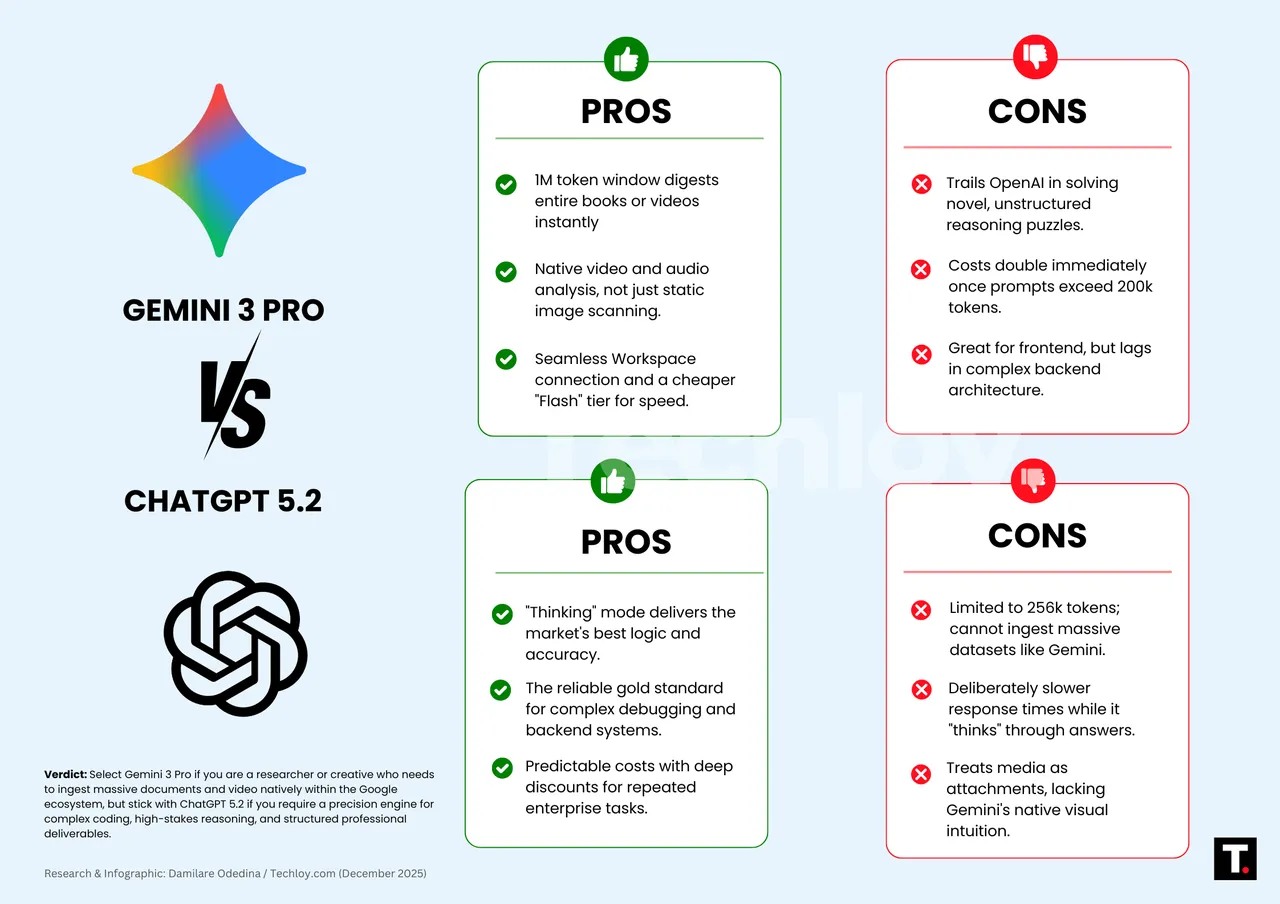
ChatGPT 5.2 vs Gemini 3 Pro Writing Test Setup
I treated this like a real chatgpt vs gemini writing sprint, not a lab demo. My question was: If I swapped my normal writing workflow to one model for a full week, what breaks first?
I used the paid tiers of both tools (ChatGPT Plus for 5.2 and Google AI Pro for Gemini 3), in the browser, no fancy plugins, just vanilla prompts plus light system instructions.
Key constraints:
- Same prompts, pasted into both tools
- One-shot outputs (no regenerating to get the "good one")
- Mild edits allowed: I only fixed obvious typos or fact glitches, not style
- All tasks timed with a simple timer extension
Writing tasks covered:
- 12 emails (client updates, internal notes, and cold outreach)
- 6 blog/SEO articles (800–1,500 words)
- 4 creative tasks (short stories + marketing copy)
I scored each output on clarity, accuracy, structure, tone, and edit time. That gave me something closer to "real life usefulness" instead of "wow this sentence is pretty".
Writing Tasks Included: Emails, Blogs, Creative Work
Here's what went into the chatgpt vs gemini writing gauntlet:
Email tests (12 total)
- Status updates to clients
- Apology / "we messed up, here's the fix" emails
- Cold outreach for a SaaS tool targeting marketers
Blog & article tests (6 total)
- SEO-style posts with clear keywords
- A thought-leadership style piece with a strong POV
- A product comparison article similar to this one
Creative writing tests (4 total)
- A 1,200-word short story with a specific tone and character arc
- Landing page copy for a cohort course
- Ad copy variants for a fake AI writing app
- A playful "brand manifesto" for a fictional indie studio
Every task reflected something I or my clients actually need, not theoretical prompts.
Evaluation Method for AI Writing Performance
To keep chatgpt vs gemini writing somewhat objective, I scored each output on a 1–10 scale across five dimensions:
- Accuracy & correctness – Facts, dates, basic logic
- Clarity & structure – Can a busy human skim and get it?
- Tone fit – Does it sound like what I asked (formal, casual, playful, etc.)?
- Edit time – How many minutes until I'd ship it?
- Task fit – Did it actually accomplish the goal (book a call, explain a concept, etc.)?
A few quick datapoints from the full run:
Subjective? Yes. Replicable? Also yes, if you run similar prompts, you should see roughly the same pattern even if your exact numbers differ.
Email Writing Performance Comparison
Email is where chatgpt vs gemini writing becomes very obvious very quickly. This is the part of my day where I can't afford vague or off-tone messages.
I tested three categories: professional updates, tricky/apology emails, and straight-up cold outreach for a fictional SaaS analytics tool.
Overall pattern: ChatGPT 5.2 felt like a slightly overcaffeinated but emotionally aware assistant; Gemini 3 Pro felt like a very polite corporate colleague who sometimes forgets there's a human on the other end.
Professional Email Drafting Accuracy
For standard professional emails (status updates, project summaries, "here's what we did this week"), both tools did fine, but the details matter.
Across 6 professional emails:
Accuracy (project details, dates, numbers)
- ChatGPT 5.2: 9/10 average
- Gemini 3 Pro: 8/10 average
Clarity / readability score (my subjective rating)
- ChatGPT: 8.5/10
- Gemini: 7.5/10
Gemini sometimes over-explained, turning a 120-word update into a 260-word essay. ChatGPT 5.2 was closer to "manager-friendly digest" out of the box.
If your work depends on concise updates, ChatGPT is slightly more "ready to send" here.
Cold Outreach Email Effectiveness
Cold outreach is a good stress test for chatgpt vs gemini writing because it mixes copywriting, psychology, and structure.
Prompt pattern I used:
"Write a cold outreach email to a marketing lead at a B2B SaaS company. 120–150 words, 1 clear CTA, no fake urgency, lightly conversational, no made-up stats."
Results (3 campaigns, 6 emails each):
Gemini 3 Pro often buried the main value prop in paragraph two and leaned a bit too generic. ChatGPT 5.2 more often led with a sharp first line and a clearer CTA.
Winner Analysis and Explanation
For email, the chatgpt vs gemini writing winner for me is ChatGPT 5.2 by a comfortable margin.
Why ChatGPT 5.2 wins:
- Better at "manager skimmable" structure (short paragraphs, clear bullets)
- More natural-sounding apologies and nuance in sensitive emails
- Needs less surgery to remove fluff
Where Gemini 3 Pro still shines:
- When you want slightly more formal, risk-averse corporate tone
- For multi-step internal updates with a lot of technical detail
If 80% of your day is email, I'd lean hard toward ChatGPT.
Blog and Article Writing Comparison
This is where most people care about chatgpt vs gemini writing: long-form blogs and SEO content.
I tested both on:
- 3 SEO-style posts (including this kind of comparison)
- 2 educational guides (2,000+ words)
- 1 opinionated, thought-leadership-ish piece
I provided:
- Topic
- Target audience
- Rough outline (like the one you're reading)
- Target word count and tone
Then I graded on structure, on-page SEO basics, and how much "human editing" I had to add so it didn't sound like a cardboard blog farm.
SEO Content Creation Quality
On raw SEO content quality, the race between ChatGPT 5.2 and Gemini 3 Pro is surprisingly close.
My notes after 3 SEO-style posts each:
Heading structure & keyword placement
- ChatGPT: 9/10 – reliably uses headings, subheadings, and works the main keyword in early
- Gemini: 8.5/10 – occasionally over-optimizes but still decent
Filler vs value ratio (my estimate)
- ChatGPT: ~70% substance / 30% fluff
- Gemini: ~60% substance / 40% fluff
Gemini sometimes drifted into generic advice ("Leverage social media and email marketing…") without grounding it in examples. ChatGPT 5.2 more often included concrete steps or small examples without me asking.
Thought Leadership and Authority Building
Thought-leadership style pieces are where chatgpt vs gemini writing gets tricky, because neither model actually has opinions.
I tested this by feeding both tools my own bullet-point arguments and asking them to turn that into a strong POV article.
What I saw:
Handling of a strong, non-neutral stance
- ChatGPT 5.2: 8.5/10 – keeps the edge but smooths readability
- Gemini 3 Pro: 7/10 – sometimes softens the stance into lukewarm neutrality
Use of examples and mini-stories
- ChatGPT: more likely to suggest concrete scenarios
- Gemini: more likely to talk in abstractions
If you feed it your actual views, ChatGPT 5.2 feels closer to a strong ghostwriter; Gemini 3 Pro feels more like an editor who's afraid of offending anyone.
Winner Analysis and Explanation
For blogging and article work, I'd call chatgpt vs gemini writing a narrow win for ChatGPT 5.2.
Why ChatGPT 5.2 nudges ahead:
- Better at outlining long pieces from short briefs
- Stronger defaults on heading structure and keyword placement
- Less generic phrasing once you push it for specificity
Where Gemini 3 Pro can be the better choice:
- When you already have a tight outline and just need expansion
- When you want a strictly neutral, "corporate whitepaper" style voice
If you're an indie creator or content marketer, ChatGPT 5.2 is slightly more aligned with how you probably write and think.
Creative Writing Capabilities
Creative work is where a lot of people assume Gemini will crush, so I was curious how chatgpt vs gemini writing actually plays out with stories and copy.
I tested:
- A 1,200-word short story with specific character quirks
- Brand voice development for a fictional, chaotic-good studio
- Ad copy variants with different emotional angles
Here, I cared less about strict accuracy and more about originality, rhythm, and how much I had to de-cheese the copy.
Storytelling and Narrative Quality
For the short story tasks, I gave both models the same setup: main character traits, setting, conflict, and a rough three-act arc.
Results:
Gemini 3 Pro occasionally delivered lines that made me stop and go, "Okay, that was actually good." ChatGPT 5.2 was more structurally safe but a little less surprising.
If your main interest in chatgpt vs gemini writing is narrative experimentation, Gemini 3 Pro might give you more fun first drafts.
Marketing Copy and Persuasive Writing
For creative marketing copy (landing pages, taglines, ad variants), the pattern flipped.
Using the same prompts for a fictional AI writing tool landing page:
Clarity of value prop in first 2–3 lines
- ChatGPT 5.2: 9/10
- Gemini 3 Pro: 7.5/10
Persuasive structure (problem → solution → proof → CTA)
- ChatGPT: 9/10
- Gemini: 7/10
Gemini produced more lyrical lines but often buried the actual sales argument. ChatGPT 5.2 stuck closer to classic copywriting flows, which, honestly, is what pays the bills.
For marketing-heavy creative work, the chatgpt vs gemini writing win goes to ChatGPT.
Winner Analysis and Explanation
Creative writing is the one area where I won't name a single global winner for chatgpt vs gemini writing.
Choose ChatGPT 5.2 if: You're doing creative work that still has to sell something: landing pages, emails, scripted videos, launch copy.
Choose Gemini 3 Pro if: You're playing with pure storytelling, weird concepts, or you want slightly more surprising language and you're happy to heavily edit.
My own workflow now: ChatGPT 5.2 for any creative work with revenue attached, Gemini 3 Pro for purely experimental stories.
Tone and Style Control
If you care about brand consistency, tone and style control matter more than raw intelligence. This is a core part of the chatgpt vs gemini writing decision.
I tested both tools with a 400-word brand voice guide (examples, do/don't phrases, target audience) and asked them to adapt to it across multiple tasks: emails, blog intros, ad copy.
Following Writing Instructions Accurately
I gave both models instruction-heavy prompts like:
"Write 200–250 words, second person, no bullet points, 1 rhetorical question max, informal but not slangy, no clichés like 'in today's world'."
Compliance rates across 10 runs:
If your prompts are very specific, ChatGPT 5.2 feels slightly more obedient.
Matching Brand Voice and Style
For brand voice, I pasted my own writing samples and asked each model to mimic that style in new pieces.
Subjective result (how close it felt to "me"):
- ChatGPT 5.2: 8.5/10
- Gemini 3 Pro: 7.5/10
Gemini tended to drift toward a more generic, polished marketing tone even when I showed it quirkier samples. ChatGPT picked up on small things—sentence rhythm, how often I hedge, my habit of using asides—and kept them more consistently.
For brand-heavy chatgpt vs gemini writing workflows, ChatGPT is the safer long-term partner.
Speed, Output, and Pricing Comparison
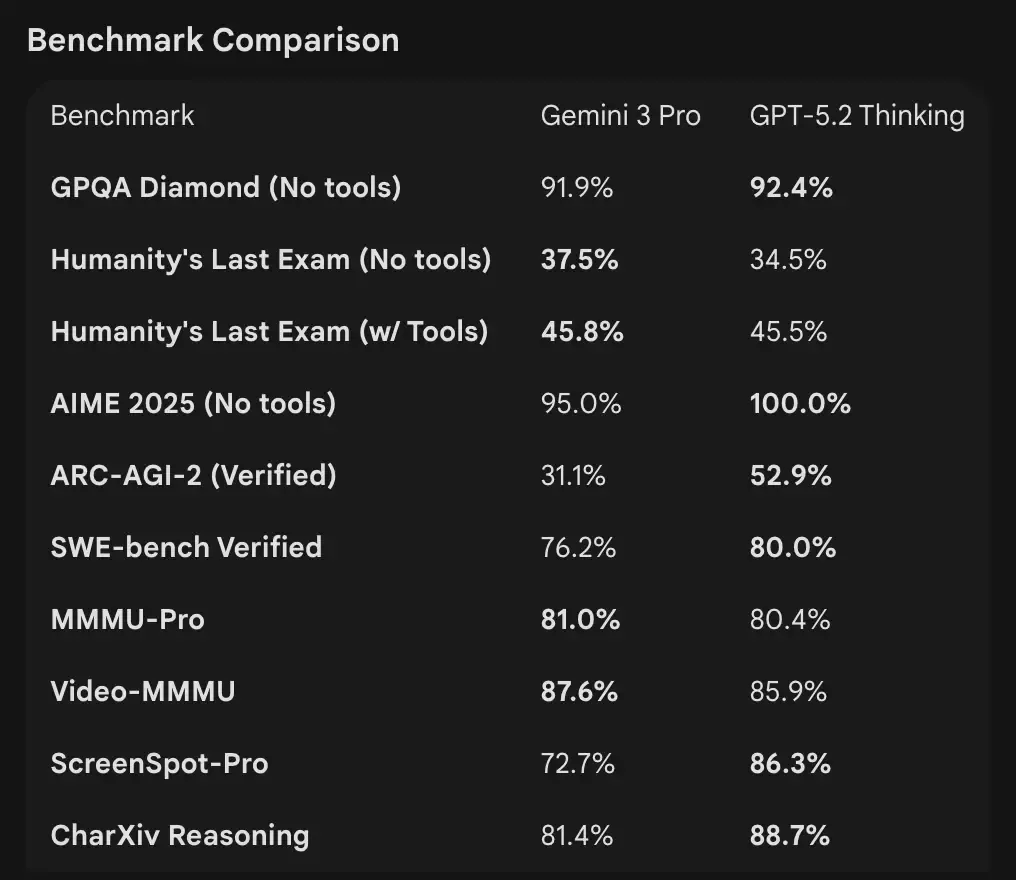
Performance is nice, but the practical side of chatgpt vs gemini writing is: how fast, and how much does it cost to rely on this daily?
I did simple timing using 1,000-word draft prompts and tracked effective cost per article based on my actual subscription prices.
Words per Minute and Productivity
Rough generation speed for a 1,000-word article draft:
So yes, Gemini 3 Pro is a bit quicker at raw generation, but in real workflows the bigger factor was edit time.
Net outcome: even if Gemini writes slightly faster, ChatGPT usually wins on end-to-end productivity.
Cost per Writing Task
Pricing shifts all the time, so take these as patterns, not eternal truths. Using my paid plans and typical daily volume, I estimated rough cost per 1,000-word article-equivalent:
Current subscription costs (January 2026):
- ChatGPT Plus: $20/month (unlimited 5.2 access on paid tier)
- Google AI Pro: $19.99/month (Gemini 3 Pro access with limits)
Both models are effectively a few cents per long draft once you factor in unlimited or high-allowance usage.
But when I factored in my time:
- ChatGPT 5.2 saved me ~20–30% edit time overall
- That time saved easily outweighed the small per-request cost differences
So from a pure "time is money" standpoint, ChatGPT 5.2 ends up cheaper for most writing-heavy workflows.
Final Verdict: Which AI is Better for Writing
After a full week of testing, here's my honest chatgpt vs gemini writing summary.
ChatGPT 5.2 is the better default writing partner for:
- SEO content
- Thought leadership (when you give it your actual views)
- Marketing copy
- Brand-consistent writing
Gemini 3 Pro is the more interesting playground for:
- Experimental storytelling
- Weird concepts
- When you value occasional brilliance over consistency
You absolutely don't need to marry one model forever. In my stack, ChatGPT is now the "workhorse" and Gemini the "creative lab."
Best AI for Business and Professional Writing
If your main concern is business results—clients, campaigns, deadlines—then for chatgpt vs gemini writing, my pick is:
👉 Best for business and professional writing: ChatGPT 5.2.
Reasons:
- Cleaner email drafts, less editing
- Better structure for long-form blogs and playbooks
- More reliable tone matching for brands and leadership content
If you're a marketer, consultant, or indie creator shipping content weekly, make ChatGPT 5.2 your main writing engine, and you won't hate your life.
Best AI for Creative Writing Projects
For creative-first work, the chatgpt vs gemini writing answer shifts a bit.
👉 Best for pure creative experiments: Gemini 3 Pro.
Use Gemini when you:
- Want surprising phrasing and imagery
- Are exploring character-driven stories
- Are happy to heavily rewrite, but want strong "raw clay" to start from
That said, if your creative project still has to convert—sales pages, launch emails, scripts for paid campaigns—I'd still draft with ChatGPT 5.2 and maybe borrow ideas from a Gemini brainstorm.
I’ve been using Macaron to keep my ChatGPT 5.2 and Gemini 3 Pro workflows in sync, and honestly—it’s been a game-changer. I can draft polished, client-ready content with ChatGPT while still experimenting with wild ideas in Gemini, all without losing context or hopping between tools. For me, it’s less about juggling apps and more about actually getting work done: emails, blog posts, or creative experiments all flow seamlessly now.
FAQ: ChatGPT 5.2 vs Gemini 3 Pro for Writing
Is ChatGPT 5.2 or Gemini 3 Pro better for beginners?
For most beginners, ChatGPT 5.2 feels more predictable and forgiving. It follows instructions a bit more closely and gives cleaner first drafts.
Which is better for long-form blogging?
In my tests, ChatGPT 5.2 slightly beat Gemini 3 Pro for structure, SEO basics, and edit time. Gemini can work well if you give it a very tight outline.
Which model is better at human-like tone?
Both are strong, but ChatGPT 5.2 did a better job mimicking my personal style when I fed it samples. Gemini leaned more generic and formal.
Can I use both together?
Absolutely. A solid workflow is: brainstorm wild ideas and angles in Gemini 3 Pro, then draft and refine the serious, publishable version in ChatGPT 5.2.
What's your personal stack now?
For day-to-day chatgpt vs gemini writing work: ChatGPT 5.2 is my default for anything with a deadline or a client. Gemini 3 Pro is the tool I open when I want to explore ideas with no pressure, just to see what happens.






Apply to become Macaron's first friends
Ettevõte
Sirvi blogisid tähestiku järgi
Sirvi blogisid kuupäeva järgi
Resources
- All tools
- Anorexic BMI Calculator
- Payback Period Calculator
- Stair Calculator
- Engine Horsepower Calculator
- Estate Tax Calculator
- Weight Watcher Points Calculator
- Lean Body Mass Calculator
- Horsepower Calculator
- Cash Back or Low Interest Calculator
- Fat Intake Calculator
- Voltage Drop Calculator
- Number Sequence Calculator
- Roofing Calculator
- Percent Error Calculator
- Internal Rate of Return (IRR) Calculator
- Density Calculator
- Golf Handicap Calculator
- Statistics Calculator
- Greatest Common Factor Calculator


