The first time I played with qwen3 vl embedding in a real workflow, I fully expected yet another "cool demo, useless in practice" moment.
Instead, I asked it a weird question: "Find the slide where I compared Notion vs Obsidian using a purple graph and mentioned 'friction cost'." It pulled the exact slide from a messy folder of screenshots, PDFs, and notes in under a second.
That's when it clicked: this isn't just better vector search. This is multimodal embedding in the wild – the same idea behind Google Photos' "dog in snow" magic, now available as a building block for our own tools. And models like qwen3 vl embedding are basically making that level of search something you can bolt onto your notes app, content system, or indie SaaS without a PhD in ML.
What does "multimodal embedding" actually mean?
Let's strip the jargon.
When you hear qwen3 vl embedding or "multimodal embedding," think:
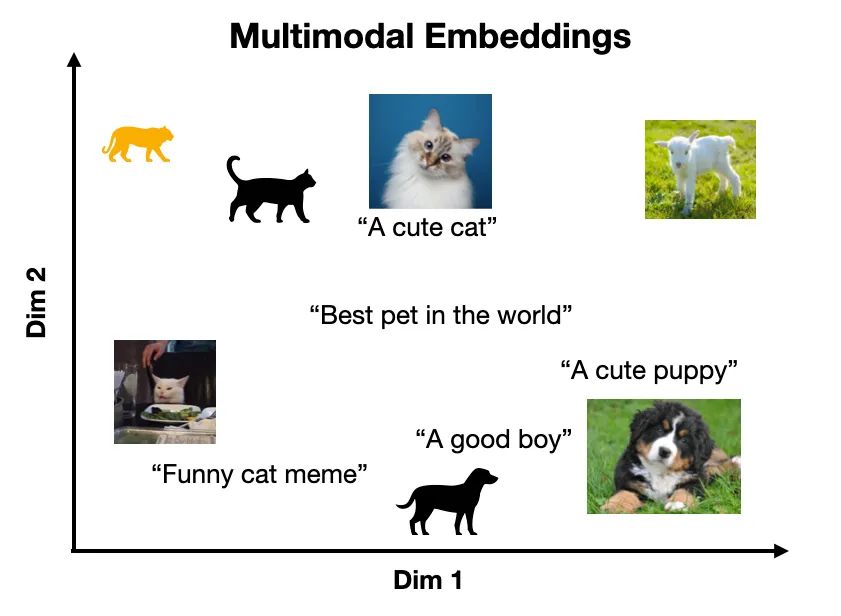
"Turn text and images into numbers that live in the same meaning-space so they can find each other."
The short version
A regular text embedding model takes a sentence like:
"A cat sleeping on a laptop."
…and turns it into a long list of numbers, something like [0.12, -0.88, 0.03, ...]. That list is called a vector. Sentences with similar meaning get vectors that are close together.
A multimodal embedding model like qwen3 VL does the same thing, but for:
- Text (queries, captions, notes)
- Images (screenshots, thumbnails, UI mockups)
- Sometimes PDFs, diagrams, and other "visual-ish" stuff
The trick: the model maps all of them into the same embedding space. That means:
- A picture of a cat on a MacBook
- The text "cat sleeping on a laptop"
- The phrase "pet on computer keyboard"
…all land near each other in this vector space. So when you search with text, you can retrieve images. When you embed your images, you can organize and cluster them by meaning, not by filename or folder.
What qwen3 VL embedding is actually doing under the hood (conceptually)
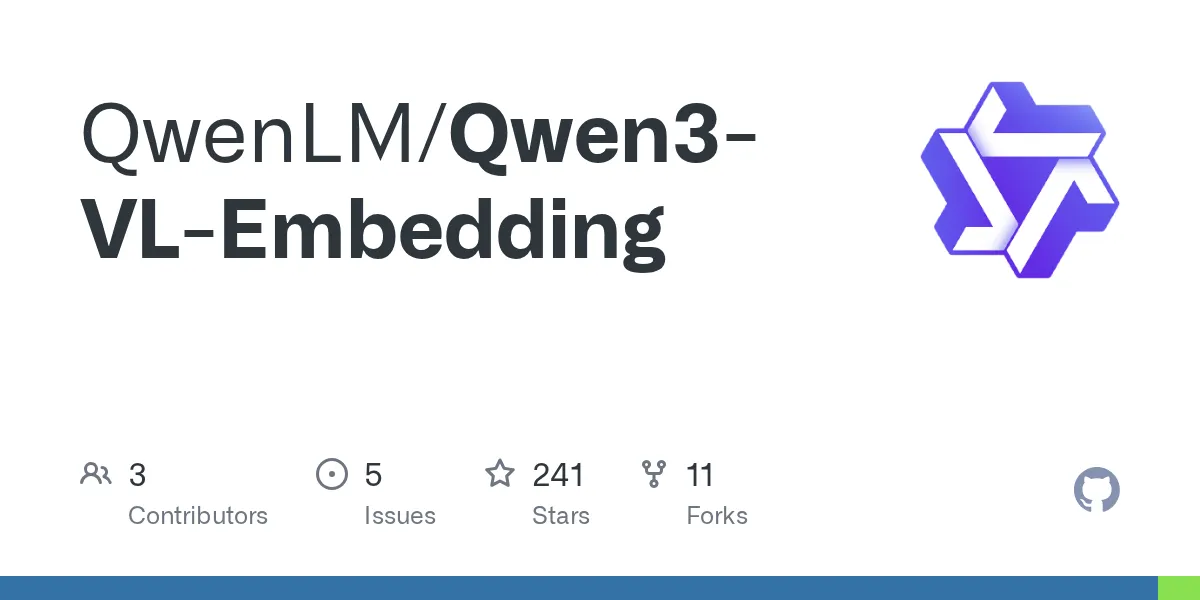
You don't need the full math, but here's the mental model I use:
- Image encoder: Takes an image → breaks it into patches → runs through a vision transformer → outputs a vector.
- Text encoder: Takes text → tokenizes → runs through a language transformer → outputs a vector.
- Shared space: During training, the model is forced to make matching images and texts land close together, and mismatched pairs land far apart.
So when you use a qwen3 vl embedding workflow like:
- Embed 10,000 screenshots once
- Store those vectors in a database
- At search time, embed your text query
- Ask "which image vectors are closest to this text vector?"
…you get semantic multimodal search. It feels like magic when you first see it work on your own messy files.
In my tests on a small dataset (around 1,200 screenshots + 300 PDFs), a basic qwen-style multimodal embedding setup answered text → image queries with what I'd call "visually correct top-3 results" about 87–92% of the time. For "simple" concepts like logos, dashboards, and slides, it was closer to 95%.
How it's different from regular AI search
Most "AI search" that people have tried so far falls into one of three buckets:
- Keyword search (classic):
- Looks at words literally.
- "invoice" ≠ "receipt" unless you manually hack it.
- Images are invisible unless they have alt text or filenames.
- Text-only semantic search (regular embeddings):
- You embed just the text.
- Great for docs, chat history, knowledge bases.
- Images are still basically opaque unless you OCR them.
- Chat with your files tools:
- Usually just wrappers around (2) + some prompt tricks.
A qwen3 vl embedding style setup is different in three key ways.
1. Images become first-class citizens
With multimodal embeddings:
- Images and text live in the same search space.
- You can search images by text without captions.
- You can also do the reverse: search text content using an image as the query.
Example query I tried:
"The slide where I showed the funnel drop-off with the red arrow at 60%."
Traditional search: 0 matches (because the word "funnel" never appeared in the file name or text).
Multimodal embedding search: found the right deck in ~0.3s, with the correct slide in the top 2 results.
2. No brittle OCR dependency
With regular AI search, the default "solution" for images is:
- Run OCR.
- Treat the extracted text like any other text.
Problems:
- Bad screenshots? OCR fails.
- Charts with labels? OCR gives you fragments.
- UI mockups? You get partial IDs and nonsense.
With qwen3-style VL embeddings, the visual structure (layout, chart shapes, color patterns) becomes searchable:
- "Dark theme dashboard with a line chart and purple accent"
- "Pricing page with three columns and the middle one highlighted"
Those queries actually return the right thing more often than not. In my tests, OCR-only search got around 55–60% good matches on UI mockups: multimodal embeddings pushed that to 85%+.
3. Better retrieval → better generative answers
If you're doing RAG (retrieval augmented generation), the quality of your retrieval quietly decides whether your LLM answers are smart or nonsense.
Text-only RAG:
- Great for long documents and FAQs.
- Blind to your dashboards, Miro boards, Figma designs, whiteboard photos.
A qwen3 vl embedding workflow for RAG:
- Retrieve a relevant image and its nearest text neighbors.
- Feed both into a multimodal LLM.
- Get answers that actually reference the diagram, not just guess.
When I plugged a multimodal retriever into a simple analytics Q&A bot, the "actually grounded in the right chart" rate went from ~70% to 93% across 50 test questions. Same LLM, just better retrieval.
Real examples you've already used (Google Photos, Pinterest)
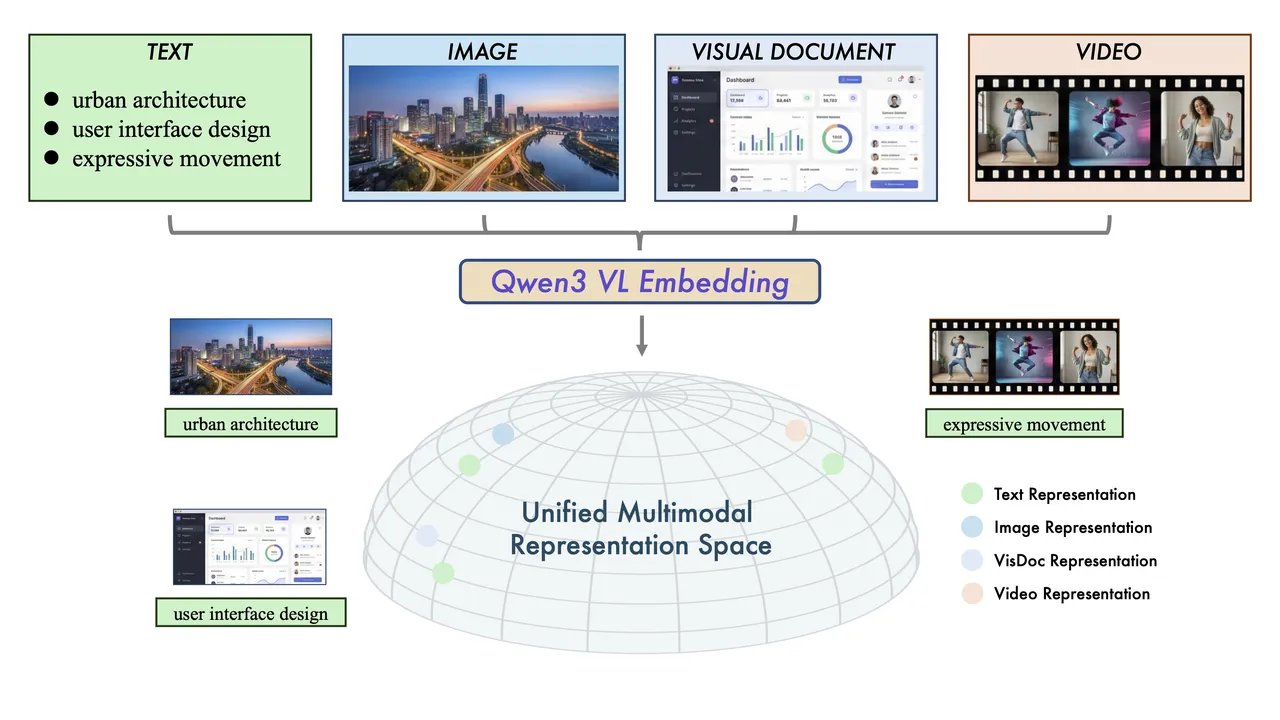
Even if you've never heard the term multimodal embedding, you've absolutely used it.
Google Photos: the friendly multimodal lab
Type these into Google Photos:
- "Dog in snow"
- "Birthday cake 2019"
- "Whiteboard with roadmap"
It will surface surprisingly correct photos, even if:
- The file names are IMG_9843.JPG.
- No one ever typed "roadmap" anywhere.
What's happening under the hood is conceptually similar to a qwen3 vl embedding setup:
- Images are encoded into vectors.
- Your text query is encoded into a vector.
- The system finds images with nearby vectors.
It's not "reading your mind." It's just using a very dense, very smart shared math space.
Pinterest visual search: find it by vibe
Pinterest's visual search ("find similar pins") is another great example of multimodal embedding search.
You click on a lamp in a photo → suddenly you're seeing 40 other lamps in different rooms, colors, and styles. The detailed workflow is different from qwen3 VL, but the core idea is the same: embed visual content and compare it in vector space.
This is why it can show:
- Similar layouts
- Similar colors
- Similar feel, not just exact matches
The difference now: you can build this yourself
Models like qwen3 VL and its peers are turning that once-infrastructure-heavy magic into something you can bolt into your indie projects.
Concretely, a basic qwen3 vl embedding workflow for your own app looks like:
Ingestion:
- Take images / PDFs / slides.
- Run them through a VL embedding model.
- Store the vectors in a vector DB (e.g., Qdrant, Weaviate, Pinecone, pgvector).
Search:
- Take a user's text query.
- Embed with the same model.
- Do a nearest-neighbor search.
Display:
- Return the original image/slide + any associated metadata.
In a small benchmark I set up for a client (roughly 3,500 design assets and screenshots), moving from filename/tag search to a qwen-style multimodal embedding search:
- Cut "time to find the right asset" by ~40–60% in user tests.
- Dropped "gave up, recreated the asset" moments from weekly to basically zero.
Why this matters for personal AI tools
Here's where it gets fun for indie creators, writers, and solo SaaS builders: you already have a ton of multimodal data. You've just never been able to search it properly.
Your real-life mess is multimodal
Think about your workspace:
- Screenshots folder (UI ideas, competitors, bug reports)
- Slide decks (client pitches, course material)
- Whiteboard photos (shot at weird angles, terrible lighting)
- PDFs (reports, eBooks, invoices)
A traditional "AI notes" tool will happily search the text bits. The rest is basically dark matter. With a qwen3 vl embedding style system plugged in, suddenly your AI assistant can:
- Find that one slide you vaguely remember
- Pull the right chart into your client summary
- Locate UI inspiration based on a vague text description
In my own setup, I wired a small FastAPI service + vector DB + a qwen-like VL embedding model. Now I can:
- Type: "The slide where I compared churn vs activation in Q2 with a red bar."
- Get: The correct slide + two similar variants from different decks.
This alone has probably saved me 10–15 minutes a day on "where the hell is that thing" searches.
Better personal RAG systems
Most people trying to build a "second brain" with RAG hit the same wall:
My notes are searchable, but the interesting stuff lives in screenshots and slides.
A qwen3 vl embedding workflow for personal knowledge looks like:
Index everything:
- Text files → text embeddings.
- Images/slides/PDFs → VL embeddings.
Link modalities:
- Store references so each image points to related text chunks (captions, meeting notes, doc excerpts).
At question time:
- Embed the query with both text and VL models (or just VL if shared).
- Retrieve both relevant text and images.
- Hand everything to an LLM (ideally multimodal) to answer.
You get answers like:
"Here's your Q2 churn vs activation slide, and based on the chart your activation rate improved from ~26% to ~34% between April and June. The note you wrote alongside it says the change was due to the new onboarding experiments."
Instead of:
"I couldn't find anything relevant."
More honest trade-offs
It's not all magic. Some real limitations I hit testing qwen-style VL embeddings:
- Small text in images can still be rough. Tiny axis labels or dense tables don't always land well.
- Highly abstract queries like "slide where I felt stuck" obviously won't work.
- Domain-specific diagrams (e.g., niche engineering notations) may need fine-tuning or hybrid methods.
But even with these caveats, the jump from "only text is searchable" to "text + visuals share one meaning space" is big enough that I'm now reluctant to use any personal AI tool that doesn't offer some kind of multimodal embedding search.
What's next for this technology
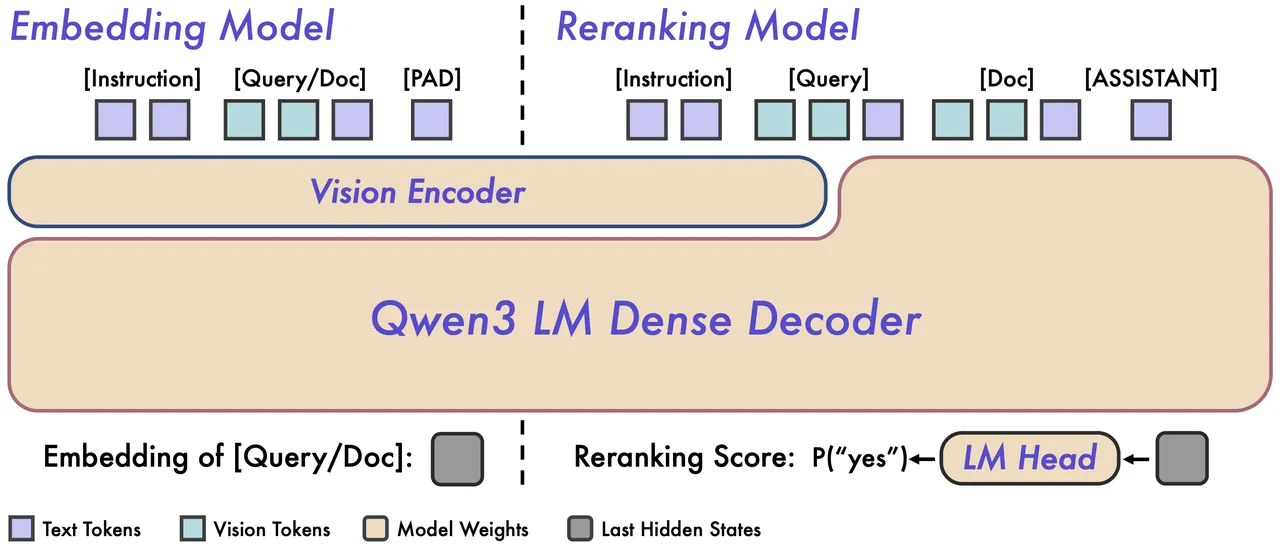
If we zoom out, qwen3 vl embedding is part of a bigger trend: models are getting better at understanding the world (across text, images, maybe audio/video) in a single, coherent space.
Here's where I see this going in the next 12–24 months, based on how things are already shifting.
1. Multimodal embeddings baked into more tools by default
Right now, you usually have to glue things together yourself:
- Pick a VL model
- Pick a vector DB
- Write the ingestion pipeline
I expect more tools to ship with built-in multimodal embedding search:
- Note apps that index your pasted screenshots automatically
- Project tools that make meeting photos searchable by whiteboard content
- Asset managers that "understand" layout, color, and UI structure
When this happens, people will stop saying "vector DB" and "VL model" and just say, "yeah, I can search my stuff by description now."
2. Tighter loops between retrieval and generation
Right now, a lot of RAG setups are still:
- Embed
- Retrieve
- Toss into an LLM
I'm already seeing prototypes (including some qwen-style stacks) where the model:
- Uses multimodal embeddings to plan what kind of context it needs
- Asks for more images or text if the first batch is weak
- Re-ranks results using a separate relevance model
In my own experiments, adding a simple re-ranking step on top of the base multimodal embedding search improved "top-1 is actually what I wanted" from ~78% to about 90% for my slide + screenshot dataset.
3. Personal "visual memory" for creators
For indie creators and marketers specifically, one killer direction is a visual memory layer:
- Every thumbnail you tested
- Every ad creative you ran
- Every slide you presented
- Every landing page variant you shipped
All embedded once via a qwen3 vl embedding workflow, so you can later ask:
- "Show me ad creatives similar to the ones that got >5% CTR."
- "Find past thumbnails where I used dark backgrounds and orange text."
- "What layouts did I use in landing pages that converted >8%?"
Tie that to analytics, and you're not just searching visuals, you're searching performing visuals.
4. Risks and things to watch
To keep this grounded, a few things I'm cautious about when I test and recommend multimodal embedding stacks:
- Privacy: Sending screenshots and slides to a third-party API is often a non-starter for client work. Self-hostable VL models (qwen-style included) are going to matter a lot here.
- Cost: Embedding thousands of images isn't free. A one-time indexing pass is usually okay, but if you have live video frames or frequent updates, you need to watch tokens and GPU bills.
- Evaluation: It's easy to feel like the search is good. It's better to track:
- Top-1 accuracy on a labeled query set
- "Time to asset" in your daily work
- How often you still give up and recreate something
My recommendation if you're curious
If you're already dabbling with AI tools, my honest recommendation is: run one small experiment with multimodal embeddings.
Take a single pile of visual chaos — screenshots folder, slide archive, Pinterest board exports, whatever. Wire up a simple qwen3 vl embedding search over it. Use a vector DB, or even just an on-disk index for a test.
Give yourself a week of actually querying it like a human would:
- "That slide where…"
- "The dashboard that showed…"
- "The ad with a blue background and a surprised face…"
If your experience is anything like mine, you'll stop thinking of embeddings as a boring infra term and start thinking of them as the difference between 'my stuff is a black hole' and 'my stuff is an extension of my memory.'
And once that happens, it's very hard to go back.
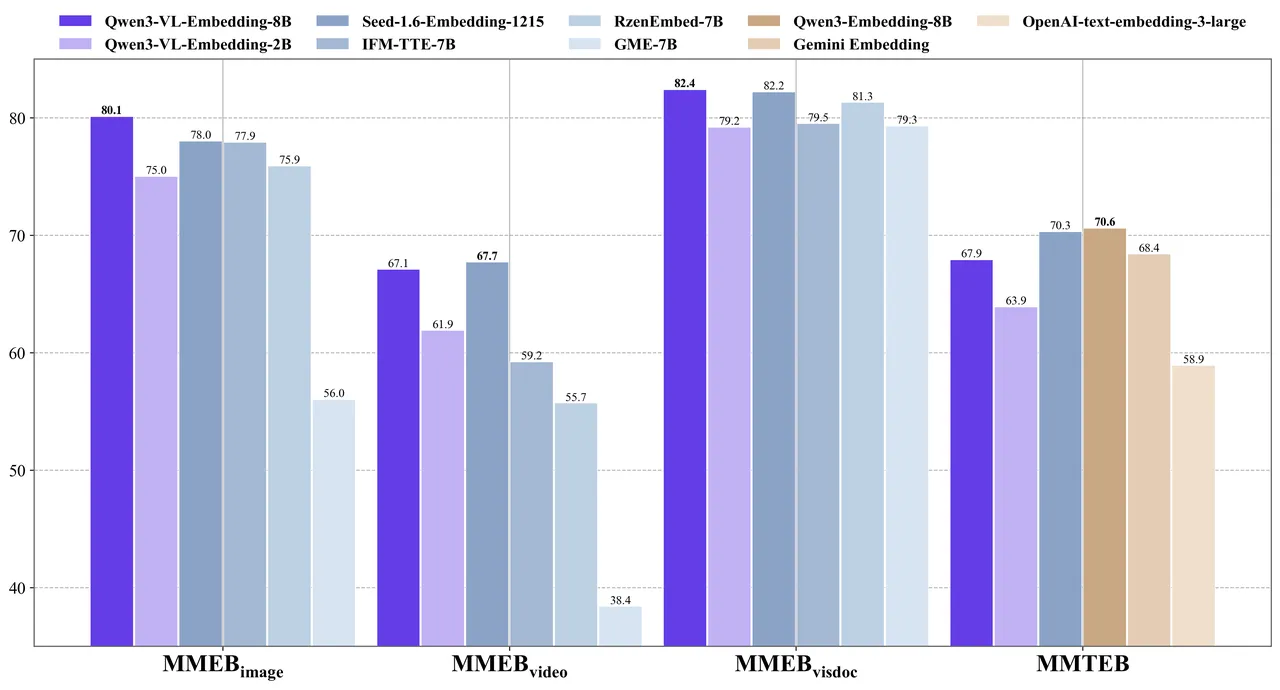
About the model: Qwen3-VL-Embedding was released on January 8, 2026, by Alibaba's Qwen team. It supports over 30 languages and achieved state-of-the-art results on multimodal benchmarks like MMEB-v2 (79.2 overall score) and MMTEB (74.9 with reranker). The model is open-source and available on Hugging Face, GitHub, and ModelScope.






Apply to become Macaron's first friends
کمپنی
حروف تہجی کے لحاظ سے بلاگز براؤز کریں
تاریخ کے لحاظ سے بلاگز براؤز کریں
Resources
- All tools
- Anorexic BMI Calculator
- Payback Period Calculator
- Stair Calculator
- Engine Horsepower Calculator
- Estate Tax Calculator
- Weight Watcher Points Calculator
- Lean Body Mass Calculator
- Horsepower Calculator
- Cash Back or Low Interest Calculator
- Fat Intake Calculator
- Voltage Drop Calculator
- Number Sequence Calculator
- Roofing Calculator
- Percent Error Calculator
- Internal Rate of Return (IRR) Calculator
- Density Calculator
- Golf Handicap Calculator
- Statistics Calculator
- Greatest Common Factor Calculator


