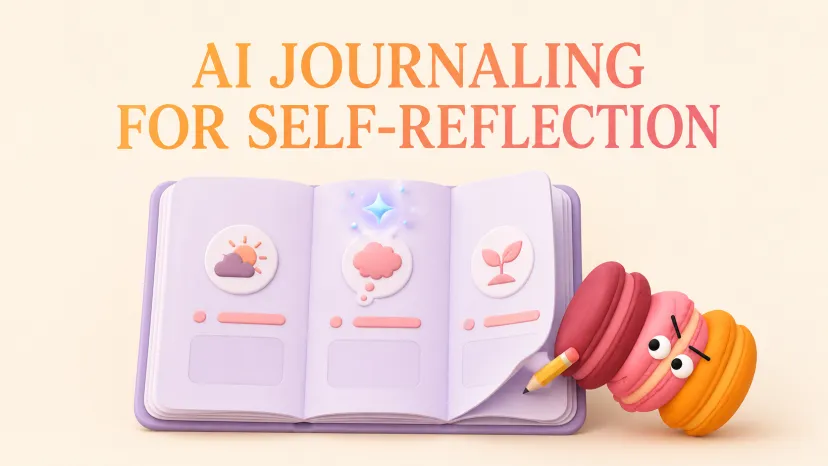
For about eleven days I kept opening the same blank journaling app at 9:47pm, typing two sentences, deleting one of them, and closing the tab. The streak counter said I was doing fine. I wasn't. I was performing journaling at an app that had no idea I'd already explained the same situation with my sister three nights in a row — and would happily let me explain it again on night four.
That's when I started actually testing what AI journaling could do, instead of treating it like a fancier notebook. My name's Maren, and most of what I write here comes out of running small experiments on my own week — keeping what survives past day fifteen, killing what doesn't. This one ran longer than most.
What AI journaling apps are actually useful for
The honest version: most of them are still glorified text boxes with a prompt generator bolted on. A few are something else.
Reflection, pattern tracking, prompts, and emotional clarity
The four things AI journaling apps can do that a Notes app can't — if they're built well — are these:
Surface patterns you can't see from inside the week. I had no idea I always wrote about work on Tuesday nights until something pointed it out.
Ask the second question. Not "how are you feeling" — that's the first question, and it's useless by week two. The second question is "you mentioned this same thing on the 8th, did anything change?"
Hold context across sessions. This is the one most apps fail. If I have to re-explain who Jordan is every time, I'm doing the app's job for it.
Translate vague feelings into named ones. James Pennebaker, who's spent decades on this in research showing expressive writing can improve physical and mental health, has been clear that the labeling matters more than the writing itself.
If an app does none of these four things, it's a Notes app with a subscription fee.
What to look for before choosing one
I've stopped reading feature lists. They all sound the same. What I look at now is much shorter.
Privacy first. Where do my entries live? If the answer is "our servers, indefinitely, used for training" — close the tab. Look for the privacy policy in plain English, not a 4,000-word legal scroll. Anthropic's own approach to data handling is a useful reference point if you want to see what readable looks like.
Memory that's editable, not just present. Memory is the difference between a journal and a chat app, but a memory you can't see or edit is a liability. I want to know what it thinks it knows about me, and I want to delete the wrong parts.
Export. If I can't take my entries with me as plain text or markdown, it isn't my journal — it's their database with my feelings in it.
Tone control. Some apps default to a therapist voice. Some default to a coach voice. Some default to a relentlessly cheerful assistant. None of these are neutral. Pick one whose default doesn't make you want to lie to it.
Safety routing. This one matters. A serious app should know when to stop being an app. If the topic shifts toward crisis, it should route you toward something like the 988 Suicide & Crisis Lifeline instead of generating a coping affirmation.
Where AI journaling helps most
I tested the same setup across four contexts. Two worked, two didn't.
Relationships, decisions, routines, and mood patterns
Worked well: relationships and decisions. When I'd write about a conversation with a friend that left me uneasy, having something reflect back "last month you described a similar pattern with the same person" was genuinely useful. I wouldn't have caught it. The Positive Affect Journaling study published in JMIR found that focused journaling was linked to lower mental distress and improved resilience — which lines up with what I noticed.
Worked well: routine and mood tracking. Two weeks in, I could see that my "I'm fine" entries clustered on the days I'd skipped lunch. Nothing dramatic. Just useful.
Didn't work: anything resembling crisis. I tested this once, deliberately, with a journal entry about a hard week. The response was warm and well-intentioned and entirely the wrong tool for the moment. AI journaling is a reflection aid. It is not a person.
Didn't work: high-stakes life decisions. I wrote about a job decision for four days. The app helpfully surfaced both sides. I already knew both sides. What I needed was someone to push back on my reasoning — which is what a therapist or a real friend does. The app can't.
What AI journaling should not do
This is where I get specific, because the line matters.
Therapy claims, crisis support, or making decisions for you
If an app calls itself "AI therapy," I uninstall it. There's a real difference between reflection support and therapy, and apps that blur it are doing harm. The Mayo Clinic's stress management guidance lists journaling as one tool among many — not a replacement for professional care.
Same with crisis. An AI journal that tries to handle suicidal ideation is dangerous, not helpful. The honest version of safety is a clear handoff, not a longer reply.
And on decisions — the app should help you see your own thinking more clearly. It should not tell you what to do. Anything pitching itself as "AI life coach that decides for you" is selling something I don't want to buy.
How Macaron-style personal AI fits this use case
Here's where it gets specific for me. The reason I kept coming back to a personal AI setup, rather than a standalone journaling app, was the memory.
Memory, gentle prompts, and personalized mini-tools
Most journaling apps reset every session. A personal AI that actually remembers — what I'm working on, who shows up in my entries, what I said last Sunday — does the one thing that makes journaling feel less like talking to a wall. The gentle prompt difference is small but real: instead of "how was your day?" every night, it's "you mentioned a deadline on the 14th — did that land?"
The other thing that surprised me was being able to spin up small tools for specific reflection patterns. A weekly review template that pulled forward the loose threads. A mood note format I actually use. Not features I read about — things I built in a sentence because the friction was low enough.
I'm not going to oversell it. Three weeks in, what's still running is the memory and the prompts. What I stopped using was the structured templates — they felt too much like homework. Worth knowing before you set anything up.
FAQ
Are AI journaling apps the same as therapy?
No, and any app implying otherwise is misrepresenting itself. Pennebaker's foundational 1997 review in Psychological Science established that expressive writing has measurable mental health effects — but the average effect size across over 100 studies is modest, and the research is on writing as an adjunct, not a replacement for clinical care.
How private are my journal entries?
It depends entirely on the app. Read the privacy policy section on data retention, training use, and third-party sharing before you write anything personal. If the policy isn't readable in five minutes, that itself is a signal. Export options matter — if you can't leave with your data, you don't own it.
Can AI journaling help me notice emotional patterns?
This is the strongest use case. Pattern recognition across entries is the one thing AI does meaningfully better than a paper journal, particularly for mood, recurring topics, and writing time-of-day correlations. A PMC review on journaling efficacy noted positive associations with anxiety and depression management, especially when journaling was consistent and reflective rather than purely venting.
What should I look for in an AI journaling app?
Editable memory, plain-text export, a privacy policy you can actually read, tone you don't hate, and clear safety routing for crisis content. If you can find all five, you've narrowed the field by about 80 percent.
When should I speak with a licensed professional instead?
If your entries keep returning to the same distress without movement, if you're noticing symptoms that are affecting sleep or daily functioning, or if any thoughts of self-harm come up — those are signals for a real person, not an app. The 988 Lifeline is available by call or text in the US, and a primary care provider can help you find ongoing support.
I'm planning to keep this setup running another month and see whether the pattern-tracking holds up past the novelty curve. That's usually where these things quietly fall apart — week six, not week two. I'll check back in.
I’m Maren, a 27-year-old content strategist and perpetual self-experimenter. I test AI tools and micro-habits in real daily life, noting what breaks, what sticks, and what actually saves time. My approach isn’t about features—it’s about friction, adjustments, and honest results. I share insights from experiments that survive a real week, helping others see what works without the fluff.