I answered 93 questions, got a four-letter result, and felt absolutely nothing. Desire for tools that produce useful signal rather than empty labels applies when looking for effective ways to use Qwen 3.5 in real workflows.
That was my third time taking a traditional MBTI-style quiz. Same format, same forced binary choices, same creeping suspicion that I was just picking whatever made me sound more interesting. The results varied slightly each time. I couldn't tell if that meant I'd changed, or if the test had never actually caught anything real to begin with.
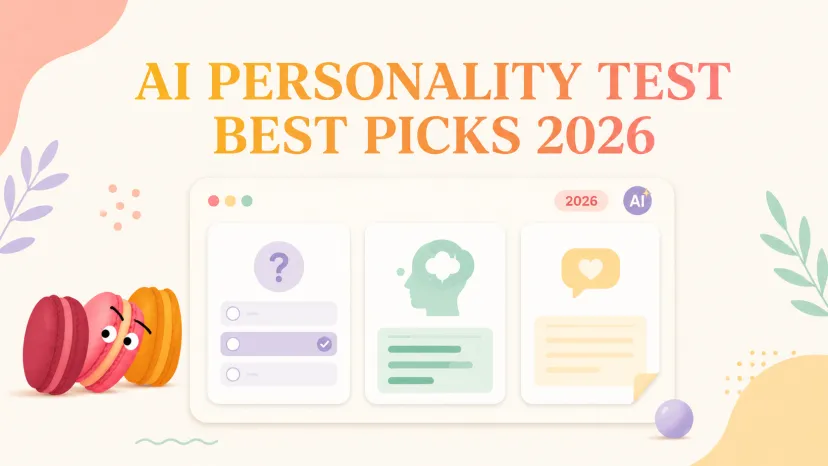
Like many others, I, Maren, went looking for something different. I spent a few weeks testing every AI-powered personality tool I could find — the ones that actually use machine learning, not just a fancy UI slapped over the same old questionnaire. Here's what I found, and more importantly, what you should watch for before you trust any of them.
How AI Personality Tests Work
Traditional personality tests hand you a list of statements. You rate yourself. The system tallies your score and sorts you into a bucket. The whole process rests entirely on your ability to accurately self-report — which is a significant assumption, especially when you're answering things like "I enjoy being the center of attention" in a context where the answer feels loaded either way.
AI personality tools work differently at the architecture level. Most of them analyze language rather than checkboxes. They use natural language processing to examine word choice, sentence patterns, and emotional tone across your open-ended responses. Some go further — PsychAdapter, a model fine-tuned on 850,000 Facebook posts, correctly matched personality traits with an impressive 94.5% accuracy, and GPT-4 was able to classify 76% of MBTI types by analyzing just 50 tweets.
The better tools aren't just running a smarter quiz. They're doing something closer to linguistic forensics.
What's Different From Traditional Tests
The most obvious difference is input type. Traditional tests constrain your answers. AI tools — the good ones — don't. Unlike other tests, some AI personality tools use advanced text analytics that don't rely on predefined answers, letting users respond to open-ended questions with no boundaries, making it harder to game the result and arguably closer to how personality actually expresses itself.
The second difference is adaptability. AI can help translate and localize assessments to avoid idiomatic expressions and culturally specific norms that might disadvantage certain groups — and can detect when variations in responses are due to cultural context rather than actual personality differences. Traditional tests built on Western samples don't do this. They just apply the same scoring model to everyone.
The third difference is speed. AI can interpret thousands of data points in seconds, reducing the time required while maintaining — and in some cases improving — scoring consistency compared to manual methods.
Best AI Personality Tools in 2026
I tested these myself. I'm not listing anything I didn't actually use.
Listen Labs Personality Test — This one surprised me. It runs a conversational AI interview rather than a questionnaire. The AI asks follow-up questions based on what you say, which means the session feels less like filling out a form and more like talking through your thinking with someone who's paying close attention. The resulting report is genuinely specific. It identified patterns I recognized immediately. Free to try.
Apt AI — Built on MBTI, Big Five, and Enneagram simultaneously. Apt's machine learning algorithms analyze various aspects of your personality and identify patterns that single-framework tests might miss, giving you results across multiple established models rather than forcing you into one system. Takes about ten minutes. Most useful if you want cross-framework comparison in one sitting.
Personality Reveal — Uses Symanto's psycholinguistic API to analyze personality from written text. You answer three open-ended questions with no word limit and no preset options. The AI reads what you wrote, not how you scored yourself. Interesting methodology, and the results shift if your mood or framing shifts — which the tool actually flags as a feature rather than a bug.
Humanality — More relationship-focused than the others. It maps your personality specifically toward how you interact with people you care about, which makes it more actionable for anyone using this for communication or compatibility work rather than pure self-knowledge.
Crystal Knows — Not purely an AI test, but worth including because it does something none of the others do: it predicts how to communicate with other people based on their personality, not just yours. Useful for work contexts. Has both free and paid tiers.
AI vs Traditional — Which Is More Accurate
Here's where I have to be honest about what the research actually says, because the headlines oversell both sides.
A 2026 analysis published in Frontiers in Computational Neuroscience found that while top-performing LLM-based systems report 75–85% accuracy at the dichotomy level, improvements over baselines are often modest, domain-dependent, and sensitive to dataset biases — including issues like polarized predictions and overconfidence.
The bigger problem is what the training data actually captures. Researchers found that AI models appeared to achieve higher MBTI accuracy on forum datasets — but explainability analysis revealed this was largely due to users explicitly mentioning their personality types in their posts. When those references were removed, performance dropped sharply, suggesting the models were learning to spot self-labeling rather than genuine psychological patterns.
So the honest answer is: AI personality tools are more flexible and often more engaging than traditional tests. They may catch things a checkbox-based questionnaire misses. But "more sophisticated" doesn't automatically mean "more accurate" — and the accuracy claims you'll see on most tool landing pages aren't backed by independent peer review.
What AI does genuinely better: reducing the social desirability bias that warps self-report answers, adapting to cultural context, and generating more granular, personalized output. What traditional tests still do better: transparency about methodology, peer-reviewed validity data, and test-retest reliability that's actually published.
Limitations of AI Personality Testing
I want to lay these out plainly, because I'd be doing you a disservice if I didn't.
The self-report problem doesn't disappear. Even open-ended AI tools are still analyzing what you choose to write. If you're having a bad day, or performing a version of yourself, the output reflects that version — not some stable psychological substrate.
Training data carries bias. Many of the datasets used to train personality AI overrepresent certain populations — college students, English-speaking forum users, people already interested in personality typing — which means the models are learning patterns tied to specific demographics, not universal markers of personality.
Privacy is a real question. Most of these tools collect your written responses, sometimes your behavioral data, and in some cases link it to a profile. Before you type anything substantive into an AI personality tool, read the privacy policy. Understand what's stored, what's sold, and what's used to train future models. The tool that gave me the most interesting results was also the one with the least transparent data policy — and that's a tradeoff worth thinking about.
Results can feel accurate without being accurate. This is the Barnum effect: personality descriptions are often written broadly enough that almost anyone recognizes themselves in them. Accurate personality tests combine psychology with validated behavioral models — and the distinction between a test that measures something real and one that just feels real is not always visible to the person taking it.
None of this means you shouldn't use these tools. It means use them as a starting point for reflection, not as a verdict.
FAQ
Are AI personality tests accurate?
More nuanced than a yes or no. Top-performing AI systems report 75–85% accuracy at the MBTI dichotomy level, but performance varies significantly by dataset, domain, and whether the model is detecting genuine linguistic personality signals or simply picking up on self-referential labels in the training data. For self-discovery purposes, they're useful. As clinical or hiring tools, the validation standards aren't there yet.
Is there a free AI personality test?
Several. Listen Labs, Personality Reveal, and Humanality all offer free versions. In 2026, personality assessments are used by 89% of Fortune 500 companies, and the proliferation of free tools reflects how broadly accessible this space has become — though free doesn't always mean validated, and the gap between flashy and rigorous can be significant. I'd suggest trying two or three and comparing where they agree.
Can AI replace MBTI?
Not in the way the question implies. MBTI has decades of organizational infrastructure behind it — certified practitioners, licensed instruments, established norms. AI tools don't have that. What they do have is a different approach to input. AI uses natural language processing to examine word choice, sentence patterns, and emotional tone — while the MBTI remains popular, AI-driven tools often rely on the Big Five because it's more grounded in research and proven more reliable for continuous trait measurement. Think of them as different tools for different questions, not a direct replacement.
What data do AI personality tests collect?
It depends entirely on the tool, and this is where I'd urge genuine caution. At minimum, most collect your written responses. Some collect behavioral data, session timing, and device information. Some are explicit that your responses are used to train future models. A few sell aggregated data to third parties. Always read the privacy policy before entering anything personal, especially on free tools where the product is often the data you generate.
Which AI personality test should I start with?
If you want conversational depth: Listen Labs. If you want cross-framework comparison in one session: Apt AI. If you want something focused on how you show up in relationships specifically: Humanality. And if you want a tool that helps you understand other people's communication styles — not just your own — Crystal's personality framework is the most practically useful thing I found for real-world application.
The most honest thing I can tell you after all this testing: the tool matters less than what you do with the output.
Every result I got — across six different platforms — pointed at the same two or three patterns. The format changed. The framing changed. The underlying signal stayed the same. That's probably the most accurate finding of all: you already know most of this about yourself. A good AI personality test just gives you language for it.
If you want to go deeper on how those patterns affect your relationships specifically, the MBTI compatibility work I've been doing here on Macaron connects directly to everything these tools surface. Same patterns, different lens.
I’m Maren, a 27-year-old content strategist and perpetual self-experimenter. I test AI tools and micro-habits in real daily life, noting what breaks, what sticks, and what actually saves time. My approach isn’t about features—it’s about friction, adjustments, and honest results. I share insights from experiments that survive a real week, helping others see what works without the fluff.