Cheap Healthy Foods to Keep Buying
Cheap Healthy Foods to Keep Buying
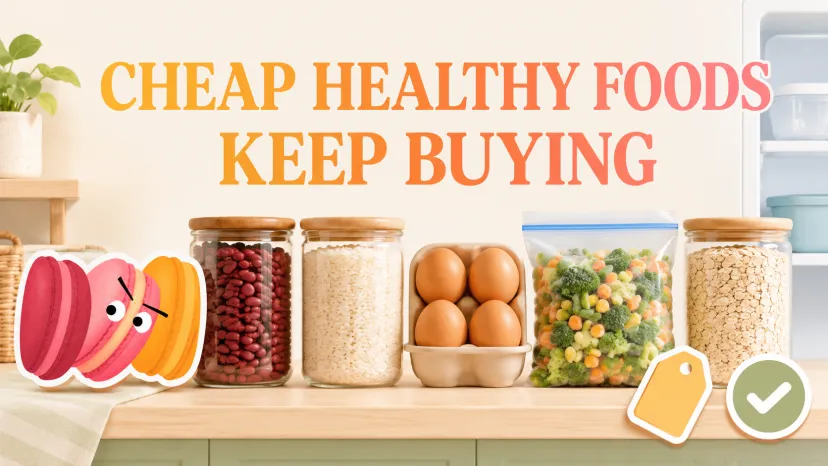

For about a year I had a "cheap healthy foods" list saved on my phone. Lentils, oats, frozen spinach, eggs, brown rice, cabbage. I bought them dutifully every two weeks. Then I'd open the fridge on day nine and find the cabbage halved, the spinach untouched, the lentils still in their bag. The list was correct. My life around it wasn't.
That gap — between what's cheap and healthy on paper, and what actually gets eaten — is what changed how I shop. I'm Maren, and I write about the small frictions that decide whether a habit holds or quietly falls apart. Cheap healthy foods are a habit problem dressed up as a grocery problem. The cheapest food in your cart is the one you throw out, no matter what its protein-per-dollar ratio is.
So this isn't a ranking. It's a working list of foods I've kept buying for over six months because they survive a real week — including the Wednesdays where I order takeout and the Sundays where I never cook the thing I planned to cook.
What makes a food both cheap and useful
Flexibility, shelf life, and enough real-life value

A food earns a permanent slot in my cart when it does three things at once. It stays good long enough to forgive a chaotic week. It works in more than one type of meal without needing a recipe. And it gives me something my body actually notices — protein that holds me until afternoon, fiber that keeps things steady, or a vegetable I'll eat without bargaining with myself.
That third part is where most "cheap healthy food" lists fall apart. Sardines are nutrient-dense and cost almost nothing. I won't eat them. Kale costs more than spinach and wilts faster. Cheap doesn't help if the food sits there silently judging me until trash day.
The 2025–2030 Dietary Guidelines for Americans make a similar point in their own polite federal way — the foods worth building a diet around are nutrient-dense whole foods you'll actually eat across a lifetime, not foods that win on paper and lose on Wednesday.
Cheap healthy foods by category
Proteins, carbs, produce, snacks, and freezer basics
I think in five buckets now, not one big list. Here's what's currently surviving in my kitchen:
Proteins that don't stress me out

- Eggs. A dozen is still one of the cheapest complete-protein purchases per gram, and Harvard's review on eggs and heart-healthy eating put to bed most of the cholesterol panic I grew up with. I keep two cartons — one is always running out.
- Dried or canned beans and lentils. Harvard's legumes and pulses page calls them "an inexpensive source of protein, vitamins, complex carbohydrates, and fiber" — which is the closest a nutrition page gets to what I'd call a unicorn food. I keep canned chickpeas and black beans for fast nights, dried lentils for slow ones.
- Greek yogurt, plain, large tub. Per-serving cost drops roughly in half versus single cups, and it doubles as breakfast, dip, and sauce base.
Carbs that earn their shelf space

- Rolled oats. Mayo Clinic's piece on healthy oatmeal calls them "nutritious, inexpensive and versatile" — and after eating them four mornings a week for two years, that line about beta-glucan supporting cholesterol and gut health holds up to my own bloodwork.
- Brown rice or whole-grain pasta. The "complete package" of nutrients in whole grains — bran, germ, endosperm — survives in cheap forms. I don't need the artisanal version.
- Potatoes and sweet potatoes. Cheap, filling, and they keep for weeks if you don't refrigerate them.
Produce that survives the week

- Cabbage. Lasts longer than any other green vegetable in my fridge. Slaw, stir-fry, soup, taco filling.
- Carrots, onions, garlic. The aromatic base of nearly everything I cook. Long shelf life, low cost, no waste.
- Bananas and apples. Cheap, portable, no prep.
Snacks that aren't a trap
- Peanut butter (look at the ingredient list — peanuts, maybe salt).
- Popcorn kernels. A bag costs almost nothing and lasts months. Cheaper and lower-sodium than microwave packets.
Freezer basics — this is where most lists undersell
I'll get to why frozen earned its own section.
How to build meals from lower-cost staples
Mix-and-match meals, pantry anchors, and repeatable combinations
Here's the pattern that broke my "I bought ingredients but didn't make anything" cycle: stop planning meals, start planning anchors. I keep one cooked grain, one cooked protein, and one defrostable vegetable available at any time. Whatever I assemble from those three is dinner.
A pot of lentils on Sunday becomes lentil soup Monday, lentil tacos Tuesday, and a sad-but-fine lentil bowl Thursday when I get home at 8:30. The lentils didn't change. My energy did. The anchor absorbed the chaos.
The combinations that keep showing up:

- Eggs + frozen spinach + leftover rice = a 6-minute fried rice bowl.
- Canned chickpeas + cabbage + peanut butter sauce = an actual lunch in 10 minutes.
- Oats + plain yogurt + frozen berries = breakfast for four mornings in one mason jar.
None of this is a recipe. It's just three things in a bowl that taste like food. That's the bar.
Common mistakes
Buying cheap foods you never use, and mistaking cheap for joyless
The two failure modes I've personally lived through:
Buying for the version of me that doesn't exist. That bunch of kale I bought because Sunday Maren was going to make a kale salad. Wednesday Maren ordered Thai. The kale died in the drawer. Now I buy frozen spinach instead — same nutrients, no guilt timeline.
Treating cheap as a personality. A pantry of dried beans, brown rice, cabbage, and canned tomatoes is nutritionally complete. It's also miserable by Thursday if there's no salt, no spice, no something that makes you actually want to eat. I keep one good olive oil, one chili crisp, and one block of decent cheese. They cost more per ounce than anything else in my kitchen and they're what makes the cheap stuff edible long-term.
Cheap foods vs eating healthy on a budget
Ingredient strategy vs full routine strategy
These are two different problems. Cheap healthy foods is a shopping-list question — what to put in your cart. Eating healthy on a budget is a system question — how to actually stay fed without overspending across a month, including the days you don't cook.
This article answers the first one. The second one is bigger — it includes meal repetition, leftover strategy, eating out math, what you stock for tired nights, and how often you're allowed to give up and order pizza without blowing the week. Knowing which question you're trying to solve saves a lot of frustration with lists like this one.
Limits and trade-offs
I'd be lying if I said this approach scales infinitely. A few honest notes.
The CDC has tracked for years that only about 1 in 10 American adults eats the recommended fruits and vegetables daily, and "cost and access" is a major reason. Cheap healthy foods can narrow that gap, but they don't close it for people in food deserts, on very restrictive diets, or feeding kids with strong food preferences.
Frozen vegetables get dismissed too easily. The National Kidney Foundation's review on fresh, frozen, or canned vegetables found that frozen and fresh produce are "basically nutritionally equivalent" — and frozen often wins for nutrient retention because it's flash-frozen at peak ripeness. For the price, my freezer does more nutritional work than my crisper drawer.
And cheap is not always the goal. Sometimes the more expensive ingredient — the one you'll actually finish — is the cheaper purchase by week's end.
FAQ
Q1: Is this list good for families, or just for single people/small households?
This list works well for 1–3 people and scales easily. Eggs, beans, cabbage, oats, and frozen vegetables are all high-value “bulk” foods. Simply double the batch when you cook (e.g., make a big pot of lentils or brown rice on Sunday) and you can feed more people without extra effort. For picky kids, turn cabbage into stir-fries, taco fillings, or dumpling stuffing and use peanut butter or a bit of cheese to boost acceptance.
Q2: Won’t I get bored eating the same foods all the time?
You will get bored if you don’t vary the flavors. The key is seasoning and combinations, not the base ingredients. Keep one good olive oil, chili crisp, or a block of decent cheese on hand. The same pot of lentils can become curry soup on Monday, lentil tacos on Tuesday, and a quick stir-fry on Thursday. Rotating spices and sauces makes the meals feel completely different.
Q3: Are frozen vegetables really as nutritious as fresh ones?
Yes. Multiple reviews, including those from the National Kidney Foundation, show that frozen vegetables are nutritionally comparable to fresh — and often better because they’re flash-frozen at peak ripeness, locking in more vitamins. For busy people or anyone who wastes fresh produce, frozen spinach, berries, and mixed vegetables are excellent, zero-waste choices.
Q4: How much money can this approach actually save per month?
It depends on your location and previous habits, but most people save 30–50% compared to random grocery shopping plus frequent takeout. The real savings come from dramatically reducing waste (food waste often accounts for 20–30% of a typical grocery budget). It’s not about buying the absolute cheapest item — it’s about buying things you’ll actually finish.
Q5: Can I still use this list if I have special dietary needs (vegan, gluten-free, diabetic, etc.)?
Yes, in most cases. Vegans can drop eggs and Greek yogurt and add more beans, tofu, or nuts. Gluten-free eaters can swap regular oats for certified gluten-free oats or quinoa and use brown rice or sweet potatoes instead of whole-wheat pasta. For blood sugar control, prioritize lentils, chickpeas, Greek yogurt, and cabbage (low glycemic) while moderating rice and potatoes. The core principle stays the same: choose foods that last, are flexible, and that you’ll actually eat.
Previous posts:








Apply to become Macaron's first friends
Read & discover
AI Personal Assistant
Free calculators


