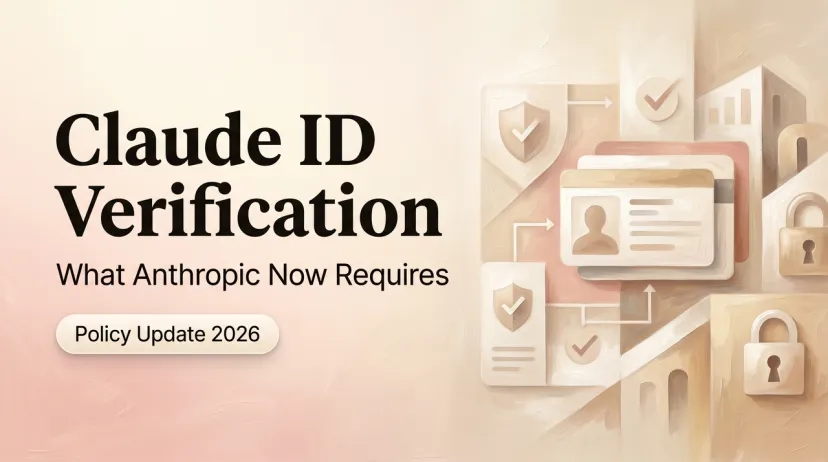
Claude ID Verification: What Anthropic Now Requires
Claude ID Verification: What Anthropic Now Requires
A friend texted me last week: "Claude just asked for my passport. Is this real?" It was. She'd opened the app, hit a flow she'd used a dozen times, and landed on an identity verification screen asking for a government ID and a live selfie. Careful attention to how a platform actually behaves is useful when applying practical Qwen 3.5 best practices instead of assuming defaults will work. She wasn't sure if she'd tripped something, upgraded something, or if this was just the new normal.
Anna here. If you're trying to figure out whether the prompt you saw was legitimate, what's actually being collected, and how this affects your account — here's what's publicly known, and what Anthropic hasn't said yet.
What Claude's new ID verification actually is
What changed on April 14, 2026
On April 14, 2026, Anthropic quietly published a help center article titled "Identity verification on Claude." That page is the canonical source for everything that follows. The headline: Anthropic is now asking certain Claude users to confirm their identity with a government-issued photo ID, and in some cases a live selfie, before they can keep using certain capabilities.
The policy isn't universal. Anthropic describes it as a rollout "for a few use cases," meaning most people won't see the prompt. But if you do, it isn't a phishing attempt — it's a real workflow, and skipping it means losing access to whatever you were trying to do.
Persona Identities as the third-party provider
Anthropic didn't build this system in-house. The actual ID check is run by Persona Identities, a San Francisco–based identity verification company that also powers KYC flows for platforms like Reddit, Discord, and OpenAI. Persona handles the document scan, the selfie liveness check, and the encrypted handoff. Anthropic's role is to decide who gets asked, and to receive the verification result — not the raw images.
This distinction matters more than it sounds. We'll come back to it in the data section.
Who gets asked to verify
The "few use cases" trigger conditions
Anthropic hasn't published an exhaustive list of what triggers a verification prompt. The help center article says only that you "might see a verification prompt when accessing certain capabilities, as part of our routine platform integrity checks, or other safety and compliance measures."
From the ban-reasons section of the same page, plus reporting by The New Stack, the checks seem to target four broad groups: users flagged for repeated Usage Policy violations, accounts created from unsupported regions, Terms of Service violations, and suspected under-18 usage. Some users have also reported being asked to verify when signing up for the Max subscription tier, though Anthropic hasn't officially confirmed which plans are affected.
What Anthropic has and hasn't disclosed
The "few use cases" phrasing is doing a lot of work. What's clearly stated: verification is not required for every user, and it isn't being positioned as a blanket signup step. What isn't stated: exactly which features trigger it, what internal signals mark an account for review, or whether the scope will expand over time. If you're trying to predict whether you'll be asked, there's no public answer. You either see the prompt or you don't.
What documents Claude accepts
Passport, driver's license, national ID — physical only
The accepted list is short and strict:
A passport
A driver's license or state/provincial ID card
A national identity card
The ID has to be issued by a government, legible, undamaged, and include a photo of you. You also need to have the physical document in hand during verification — not a scan stored in your phone's camera roll.
Why photocopies and student IDs don't work
Anthropic explicitly rejects a surprisingly broad set of things that feel like they should count: photocopies, screenshots, scans, photos of photos, digital or mobile IDs (including mobile driver's licenses), student IDs, employee badges, library cards, bank cards, and temporary paper IDs. If you're traveling without your physical passport, you may genuinely not be able to verify, and there's no alternative path published.
How the selfie + ID flow works in practice
The flow takes under five minutes, per Anthropic's estimate. You're asked to photograph your ID (front and usually back), then take a live selfie — not a saved photo — with your phone camera or webcam. Persona's system runs a liveness check to confirm the selfie matches the ID photo and isn't a still image or deepfake.
Where the data is stored (Persona vs Anthropic)
This is the part most people skim past. Anthropic draws a line: your ID and selfie are collected and held by Persona, not on Anthropic's systems. Anthropic describes itself as the "data controller" — it sets the rules — while Persona is the processor that actually handles the images.
In plain terms: the images of your passport and face sit on Persona's infrastructure. Anthropic can pull up verification records when needed (for example, to review an appeal) but, per the help page, it doesn't copy or store the raw images itself.
Retention, training, and sharing disclosures
Three things Anthropic states clearly in its privacy policy and the help article:
Your identity data is not used to train Claude models. This is written out explicitly on the help page.
Anthropic collects only what's needed to verify identity — not extra profile data.
Your verification data is not shared with third parties for marketing or advertising, and is only disclosed outside Anthropic and Persona when legally required.
Persona itself is contractually limited to using the data for verification and fraud prevention, and all data is encrypted in transit and at rest.
What this doesn't cover
API access currently unaffected
If you use Claude through the API rather than the consumer app or web interface, this rollout doesn't appear to apply to you. The help center article is scoped to the Claude product experience. API access is governed by a separate organization-verification process that's been in place longer and targets developers, not end users.
What Anthropic has NOT disclosed
Worth underlining, because it affects how much you can actually evaluate the policy.
The retention period is not disclosed. The help page says Persona must "delete it in line with the retention limits we've set" — but those limits aren't published anywhere public.
The complete list of trigger conditions is not published. "Certain capabilities" and "a few use cases" are deliberately vague.
Subscription-tier specifics are not confirmed. User reports suggest Max signup may trigger verification, but Anthropic hasn't said so on the record.
Cross-border data handling details are thin. Users outside the US, especially in regions with strict data residency laws, don't have a public answer on where their verification data physically resides.
None of these gaps are unusual for a rollout this new. But if you're deciding whether to submit a passport image to a third-party vendor, knowing how long it'll be held is the kind of thing you'd want in writing.
FAQ
Is Claude ID verification mandatory for everyone?
No — not as of April 2026. Anthropic has only confirmed it's being rolled out for "a few use cases." Most users will likely never see the prompt. If you do, completing verification is required to access the feature that triggered it; declining means losing access to that feature, not your whole account.
Does Anthropic store my passport photo?
Anthropic's position is no — not directly. The raw images live on Persona's infrastructure. Anthropic can access the verification record through Persona's platform when needed (for appeals, for example) but doesn't copy the images into its own systems.
Is my data used to train Claude models?
No. This is one of the clearest statements on the help page: "We are not using your identity data to train our models." Verification data is scoped to confirming identity and meeting legal and safety obligations.
What happens if verification fails?
You get multiple attempts within the flow, so a blurry photo or bad lighting is usually fixable. If you've used up your attempts, Anthropic directs you to its identity verification help form. Common causes are expired IDs, damaged documents, or trying the selfie in poor lighting — as Decrypt detailed in its coverage of the initial rollout.
If the prompt shows up in your account, it's legitimate, the process is short, and the data handling is laid out in writing. What's still missing is the retention window and the full map of what triggers the check. Those are reasonable questions to keep asking — and ones worth watching as the policy evolves.
Hi, I'm Anna, an AI exploration blogger!
After three years in the workforce, I caught the AI wave—it transformed my job and daily life. While it brought endless convenience, it also kept me constantly learning. As someone who loves exploring and sharing, I use AI to streamline tasks and projects: I tap into it to organize routines, test surprises, or deal with mishaps. If you're riding this wave too, join me in exploring and discovering more fun!