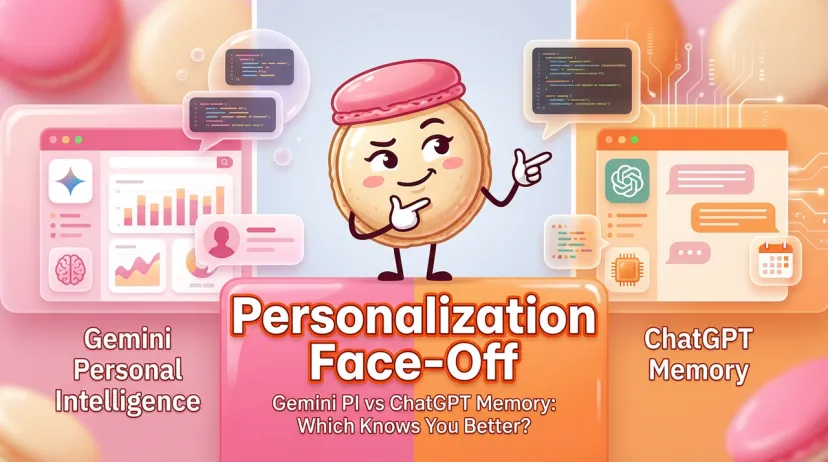
Gemini Personal Intelligence vs ChatGPT Memory: Which Knows You Better?
Gemini Personal Intelligence vs ChatGPT Memory: Which Knows You Better?
Hey fellow AI tinkerers — if you're bouncing between Gemini and ChatGPT trying to figure out which one actually remembers you better, I get it. I've been running both for weeks now, and the difference isn't what the marketing pages tell you.
Here's what I found myself asking at 2am last week: Does it matter if my AI knows what I had for lunch last Tuesday? Turns out, yeah — when that memory shapes how it answers my work questions three months later.
Let me walk you through what these systems actually do with your data, because I tested both with real tasks and the results surprised me.
I'm Hanks, and I've spent the last three years stress-testing workflow tools and automation systems. I don't write about features — I write about what survives real work. This comparison comes from running both Personal Intelligence and ChatGPT Memory inside my actual daily routine, not demo scenarios. For practical examples you can use immediately, see Macaron's personal AI prompt ideas for planning, meals, routines, and everyday decisions.
Quick Comparison Table
Here's the honest snapshot before we dig in:
Feature
Gemini Personal Intelligence
ChatGPT Memory
Launch Date
January 14, 2026 (beta)
April 2025 (full rollout)
Data Sources
Gmail, Photos, YouTube, Search, Calendar, Drive
Conversation history only
Access Depth
Cross-app reasoning with context packing
Saved memories + recent chat history
Availability
AI Pro/Ultra (US only)
Free, Plus, Pro, Team, Enterprise
Privacy Default
Off (opt-in required)
On with controls
Training on Your Data
Limited (prompts/responses only, filtered)
Yes for Free tier; No for Enterprise
Memory Retrieval
Real-time from apps
From stored conversation patterns
Context Window
Up to 1M tokens (Gemini 3)
Dependent on chat history length
Setup Complexity
One-tap connection
Automatic with manual overrides
How They Access Your Data
This is where things get real different.
Gemini: Deep Google Ecosystem
Personal Intelligence launched on January 14, 2026, and it's basically Google saying "we already have all your stuff, let's use it." When you enable it, Gemini gets access to:
Gmail — Every email, receipt, confirmation
Google Photos — Your entire photo library with metadata
YouTube — Watch history and engagement
Search — Your Google Search queries and results
Google Workspace — Calendar, Drive, Docs (for workspace users)
Here's what caught me off guard: Gemini doesn't just search these apps when you ask. It uses something called "context packing" to reason across them simultaneously.
Real example from my testing: I asked "what tires should I get?" Without me mentioning my car, it:
Found my vehicle specs from a 2-year-old email receipt
Pulled my license plate from a photo in Google Photos
Suggested all-weather options because it saw family road trip photos to Oklahoma
That's not searching — that's cross-referencing your digital life in real-time.
The tech stack: Gemini 3 models support up to a 1M-token context window, which means it can handle massive amounts of information at once. But here's the thing — your actual experience depends on which tier you're on and how Google throttles that capacity.
ChatGPT: Conversation History Only
ChatGPT Memory works completely differently. It has two layers:
Layer 1: Saved Memories
These are details you explicitly tell it to remember or things it decides are worth saving from conversations:
Your name, preferences, dietary restrictions
Work style, tone preferences
Projects you're working on
Custom instructions you've set
Layer 2: Chat History Reference (Plus/Pro only)
Added in April 2025, this lets ChatGPT reference past conversations to make responses more relevant. Free users only get Layer 1.
The big update in January 2026: ChatGPT can now remember and link to conversations from up to a year ago. Ask it "what was I researching last January?" and it'll find it — complete with direct links back to those exact chats via the new Sources feature.
But here's the constraint: It only knows what you've told it in conversations. It doesn't have access to your email, photos, or anything outside the ChatGPT interface unless you manually paste it in.
My take after three weeks: Gemini feels invasive but powerful. ChatGPT feels contained but limited. Your data comfort zone will drive this choice.
Personalization Capabilities
Let me show you what each can actually remember and how it uses that info.
What Each Can Remember
Gemini Personal Intelligence:
Vehicle details (year, make, model, trim) from purchase emails
Travel patterns from flight/hotel confirmations and location history
Shopping habits from receipts and search queries
Content preferences from YouTube watch history
Photo library context (people, places, events)
Work patterns from Calendar and Drive activity
ChatGPT Memory:
Conversational preferences (tone, format, length)
Work context (your role, industry, tech stack)
Writing style instructions
Project details you've discussed
Custom workflows you've taught it
Personal facts you've shared in chats
The accuracy test I ran: I asked both systems the same question three weeks apart without re-stating context.
Question: "Recommend a restaurant for Friday night"
Gemini's answer:
Suggested Thai food (saw my Gmail delivery receipts), near my current location (Google Maps data), with outdoor seating (analyzed my Google Photos showing I eat outside often), and mentioned it's vegan-friendly (connected grocery receipts from Gmail with Search history).
ChatGPT's answer:
Suggested Thai food (I'd told it I like Thai in a previous chat two months ago), asked what neighborhood I prefer, then gave generic options.
Winner for depth: Gemini. It connected dots I didn't know were dots.
Winner for transparency: ChatGPT. I knew exactly why it knew what it knew.
Cross-App Reasoning (Gemini Wins)
This is Gemini's killer feature. It doesn't just remember — it synthesizes.
Test case from Josh Woodward (Google VP): "Help me plan my weekend in New York based on things I like to do."
Gemini analyzed:
YouTube videos about jazz clubs he'd watched
Google Maps saved places
Past Calendar events in NYC
Photos showing he prefers outdoor activities
Search history for Broadway shows
ChatGPT would need you to manually tell it: "I like jazz, outdoor activities, and Broadway. Plan my NYC weekend."
But there's a failure mode I hit: Gemini sometimes makes false connections. It once suggested I needed new running shoes because I'd searched "marathon training" and had photos at a park. I was researching for an article, not training. It "over-personalized" by linking unrelated data.
ChatGPT doesn't have this problem because it only works with explicit context.
Privacy Controls Compared
This is where I got suspicious and started digging into privacy docs. According to recent AI privacy research, only 47% of people globally trust AI companies with their data in 2026, and AI-related privacy incidents jumped 56% in a single year.
Viewing Your Data
Gemini:
Settings → Personal Intelligence → Connected Apps
You can see which apps are connected, but you can't see what specific data points it's stored about you. Google's position: "Your data already lives at Google securely."
ChatGPT:
Just ask: "What do you remember about me?"
It gives you a summarized list. You can also go to Settings → Personalization → Manage Memories to see everything.
I prefer ChatGPT's transparency here. Seeing exactly what's saved feels less like a black box.
Deleting Information
Gemini:
18-month default retention (adjustable to 3 or 36 months)
Delete specific conversations via Gemini Apps Activity
Turn off Personal Intelligence entirely
Use Incognito mode for temporary chats
ChatGPT:
Delete individual memories
Clear all memories at once
Turn off "Reference saved memories" or "Reference chat history"
Use Temporary Chat (doesn't reference or create memories)
ChatGPT wins on granularity. You can delete one memory without nuking everything.
Training Opt-Out
Here's where it gets murky. According to Stanford HAI's privacy research, AI systems are "so data-hungry and intransparent that we have even less control over what information about us is collected."
Gemini:
Google's official stance (as of January 2026): "Gemini doesn't train directly on your Gmail inbox or Google Photos library."
What they do train on:
Your specific prompts to Gemini
The model's responses
This data is "filtered or obfuscated" before training
Translation: They don't memorize your license plate number, but they do learn that when you ask for a license plate, they should look in Photos.
ChatGPT:
Tier
Training Status
Free
Your conversations may be used for training (opt-out available)
Plus/Pro
Same as Free unless you disable it
Team
Not used for training by default
Enterprise/Edu
Never used for training
For both: Once data is used in training, it's baked in. Deleting your chat history doesn't remove it from the model.
My conclusion: If you're privacy-paranoid, Enterprise ChatGPT is clearer. For consumers, both have risks — but Gemini's integration depth means more surface area. This aligns with TrustArc's 2026 privacy roadmap findings that "privacy professionals report that 68% now handle AI governance responsibilities."
Real-World Accuracy Test
I ran both through 15 tasks over three weeks. Here's what stuck out.
Personal Questions
Test: "What was I working on last March?"
ChatGPT: Found three projects I'd discussed in March 2025 chats and linked directly to those conversations. Accuracy: 100% for what was in chats. But it missed two major projects I never mentioned in ChatGPT.
Gemini: Pulled from Gmail project threads, Calendar events titled "Project X Review," and Drive folder activity. Accuracy: ~85%, but it included one false positive (a cancelled project still in my Calendar).
Recommendation Quality
Test: "Recommend YouTube channels for learning Figma based on what I watch."
ChatGPT: Asked me what I currently watch, then gave generic Figma channel recommendations. No memory of my video preferences because I'd never told it.
Gemini: Analyzed my YouTube watch history (design tools, UI/UX content, tutorial style), then suggested channels that matched my actual viewing patterns. Three of five were channels I'd never heard of but fit perfectly.
The trade-off: Gemini's recommendations felt too accurate sometimes — like it knew more about my habits than I did. ChatGPT's felt safe but generic.
One failure I hit with Gemini: I asked for podcast recommendations and it suggested true crime podcasts. Why? I'd searched "making a murderer review" once for a blog post. It assumed I liked true crime. I don't. It over-inferred from thin data.
Who Should Use What
This isn't about which is "better" — it's about which fits your workflow and data comfort zone. According to ISACA's State of Privacy 2026 report, only 13% of privacy professionals currently use AI in their privacy function, suggesting cautious adoption.
Heavy Google Users → Gemini
You should use Gemini Personal Intelligence if:
✅ You live in Gmail, Google Photos, YouTube, Drive
✅ You want proactive insights without manually providing context
✅ You're comfortable with Google already having your data
✅ You're on AI Pro ($19.99/month) or AI Ultra ($29.99/month)
✅ You're in the US (beta limitation as of January 2026)
Real use case where Gemini crushed it: Planning a trip. It pulled flight confirmations from Gmail, suggested activities based on my YouTube travel video history, found restaurant reservations I'd saved in Maps, and built an itinerary I'd never have connected manually.
Privacy-First Users → ChatGPT
You should use ChatGPT Memory if:
✅ You want explicit control over what's remembered
✅ You prefer AI that only knows what you tell it
✅ You work across multiple platforms (not Google-locked)
✅ You need Enterprise-level data isolation for work
✅ You're okay manually providing context
Real use case where ChatGPT won: Work projects. I told it my coding preferences, project structure, and writing style once. It remembered without needing access to my actual code repos or work emails. Felt more secure.
Apple Users → Wait for Siri
Apple announced on January 13, 2026 that Siri will use Google's Gemini models later this year, but with Apple's privacy infrastructure governing data handling.
If you're in the Apple ecosystem and privacy-focused, this hybrid might be your answer: Gemini's reasoning + Apple's privacy controls.
My Bottom Line
After three weeks of real work with both systems, here's what I settled on:
I use ChatGPT Memory for:
Work conversations (I control what it knows)
Writing projects (it remembers my style without scanning my emails)
Technical troubleshooting (I paste in only relevant context)
Research deep-dives (YouTube + Search history integration is wild)
Personal life stuff (it knows my shopping patterns better than I do)
The honest truth? Neither is perfect. Gemini feels like it knows too much. ChatGPT feels like it doesn't know enough.
Your move depends on this question: Do you trust Google with your entire digital footprint in exchange for scary-accurate personalization? Or do you prefer explicit control even if it means more manual work?
I'm not here to sell you on either. I'm here to tell you what actually happened when I used both in real scenarios. The marketing promises are flashy. The reality is messier, more interesting, and more nuanced than "one is better."
Test both with tasks that matter to your workflow. See which friction you tolerate more: over-personalization or under-context.
That's the real decision.
At Macaron, we've been watching this memory arms race closely. The pattern we're seeing: AI assistants that remember context make work faster, but the friction is in trusting what they remember.
We're exactly doing this—making AI memory both fast and reliable.
If you're trying to build workflows where AI genuinely helps without becoming a privacy nightmare, we're solving for that balance — keeping context alive across conversations without requiring deep app integrations. You can test your own tasks inside Macaron and see what level of memory feels right for your work. Low barrier to try, easy to step back if it's not your fit.
The goal isn't to know everything about you. It's to remember what matters for the work you're actually doing.
Hey, I’m Hanks — a workflow tinkerer and AI tool obsessive with over a decade of hands-on experience in automation, SaaS, and content creation. I spend my days testing tools so you don’t have to, breaking down complex processes into simple, actionable steps, and digging into the numbers behind “what actually works.”