Last Tuesday I spent twenty minutes watching my entire feed turn into a personality type showcase — and this time it wasn't MBTI. It was SBTI. I didn't plan to go down that rabbit hole. I was supposed to be finishing a brief.
The quiz exploded across platforms after hitting 40 million searches in a single day. A Bilibili creator built it as a casual project, the server crashed under the traffic, and mirror sites appeared in four languages almost immediately. One person made this. No dev team. No launch strategy.
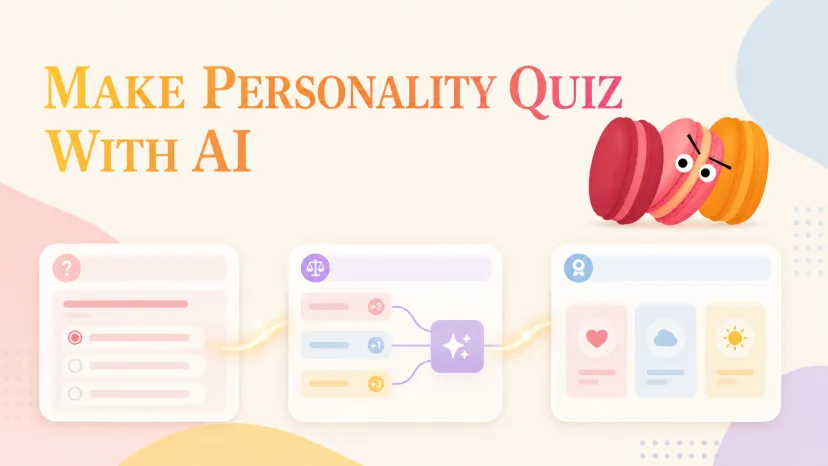
That detail stuck with me longer than expected. Because the format itself — answer some questions, get a shareable label, post it — isn't new. What changed is that AI now makes the build part accessible to anyone. I wanted to find out exactly how accessible. So I spent the better part of a week testing it.
Here's what I actually learned.
Why Make Your Own Personality Quiz
The real mechanism isn't virality. It's that personality quizzes generate a shareable output for every single person who takes them. Each result card is a piece of organic distribution. SBTI had no built-in sharing function — its spread was entirely driven by users voluntarily reposting their results. The quiz created the sharing behavior. The creator didn't have to.
Personality quizzes can reach 80% participation rates and 90% completion rates — numbers that outperform most static content formats by a wide margin. That's the format doing the work. Worth understanding before you build one.
What You Need Before You Start
Two decisions most tutorials skip entirely.
First: what is this quiz actually for? Entertainment, lead capture, community building, self-discovery — the answer changes everything. Question style, result logic, how the result screen works. SBTI is pure entertainment with no email capture, no sharing button, nothing. It worked because the results were funny enough to screenshot on their own. Different goal, completely different design.
Second: who specifically takes it? Not "everyone." A specific person, in a specific mood, with a specific reason to share. MBTI-related social media discussions grew 55% year-on-year in 2024, with Gen Z driving most of that growth through platforms that reward content inviting direct participation. Know which slice of that audience you're building for.
Once those two answers exist, the technical part is genuinely the easy part.
Define Your Types First
Most people start with questions. Wrong order.
Start with your result types. If you don't know what outcomes you're building toward, your questions won't connect to anything meaningful. Three to five distinct types is the practical range — fewer and the quiz feels rigged, more and the distribution gets messy.
For each type, write: a name specific enough to be memorable, a 2-3 sentence description that feels accurate without being flattering, and one detail that's slightly uncomfortable to read. That discomfort is what makes people screenshot it.
SBTI maps responses across 15 dimensions grouped into five broader categories, producing one of 27 four-letter types, each paired with a short, irreverent description. You don't need that complexity. But you do need the result logic locked before you write a single question.
Write Your Questions
Once types are defined, write questions that genuinely distribute people across all outcomes. The failure mode: questions where the "correct" answer is obvious. People optimize for the type they want, and the result means nothing.
Aim for 8-12 questions. Fewer and the result feels unearned. More and you lose people mid-quiz. Scenario-based questions with three options — where each option feels defensible — work better than rating scales. Not "are you logical or emotional?" but something where both answers reveal something real without either reading as clearly better.
SBTI includes 31 questions with simple A/B/C choices drawn from daily life scenarios — short enough that most people finish in minutes. The speed matters. Every question that makes someone pause too long is a dropout risk.
AI Tools That Can Help
Three I actually tested — verified working as of April 2026.
Opinion Stage — Describe your quiz goal, and the AI generates questions, answer options, and result logic. The free plan covers quiz creation, AI generation, and lead capture without a credit card. Result pages are clean enough to screenshot. Conditional logic works without configuring anything complicated. This is where I'd start.
Youform — Built specifically for personality quizzes rather than general forms. Describe your quiz idea and it generates questions and personality types together. The interface is minimal in a way that makes iteration faster than most builders.
ChatGPT or Claude (for the writing layer) — Not quiz platforms, but useful for what builders don't do well: writing result descriptions that sound like a person wrote them, checking whether your scoring logic distributes people evenly, generating question variations without an obvious "right" answer. I used Claude to pressure-test a quiz I built last month — gave it my scoring logic, asked it to simulate twenty different user profiles, and it caught two questions where every possible answer led to the same type.
Step-by-Step: Build a Quiz with AI
The actual sequence, not theory.
Step 1: Write your result types first. Name them. Write the descriptions. Make each one specific enough that reading it produces a slight wince of recognition.
Step 2: Feed those types to Opinion Stage or Youform. Describe your three types and your topic. Let the AI generate a first draft of questions. Expect about 60% to be usable.
Step 3: Pressure-test the question set. Take the quiz yourself twice, answering differently each time. If every path leads to the same result, your questions aren't doing the work. Ask an AI to simulate different answer combinations and track the distribution.
Step 4: Rewrite the result descriptions. AI-generated copy tends to be generic. Result descriptions need behavioral specifics — not "you value independence" but "you usually figure out the directions before you ask anyone."
Step 5: Test with five real people. Not for opinions. Watch where they pause, where they re-read, where they seem frustrated. Fix those moments before publishing.
Tips to Make It Shareable
The result screen is the product. Everything before it is invisible once someone hits their outcome. That page — the title, the description, the image — is what gets shared. Spend more time on it than feels necessary.
Make the result feel accurate enough to be slightly embarrassing. SBTI works in part because of the Barnum Effect — people tend to believe specific-seeming statements that describe them with enough precision that they feel personally identified. The difference between a result that gets shared and one that doesn't is usually one sentence that's too accurate to ignore.
Give each type a name that works as a social label. If the name is too long to say in conversation, simplify it. "I'm a Quiet Disaster" travels. "I tested as 'Highly Cautious Decision-Maker'" does not.
Common Mistakes to Avoid
Building questions before types. Still the most common error. Questions without a destination produce results that feel random.
Too many result types. More than six means you need more questions to distribute people meaningfully. Most audiences don't have patience for 20+ questions.
Generic result copy. "You're creative and independent" describes 40% of all people. Results need behavioral specifics.
No mobile testing. Most people take and share quizzes on their phone. A result page that doesn't display cleanly in an iPhone screenshot kills the share loop before it starts.
FAQ
Can AI generate personality quiz questions?
Yes — reasonably well when given clear parameters. The more specific you are about result types and audience, the better the output. Where AI consistently falls short is result descriptions. Those need a rewrite pass. Use AI to get to a working draft fast; spend your time on the copy.
Do I need coding skills to make a quiz?
No. Tools like Opinion Stage, Youform, and involve.me are drag-and-drop builders with AI generation built in. You can get from idea to published quiz in an afternoon without touching code.
How do I make my quiz go viral?
Planning for virality usually produces the wrong quiz. What actually drives sharing is a result that feels accurate enough to be worth proving to someone else, in a format that's easy to send. Research shows 46% of users feel better after sharing personality results on social media. That emotional payoff is the mechanism. Make the result feel worth sharing, and the sharing tends to follow.
How many questions should I include?
8-12 is the practical range. Under 8 and the result feels unearned. Over 15 and you start losing people before they finish. SBTI used 31 questions with simple A/B/C choices — short enough to finish in minutes. Question count matters less than how fast each question moves.
How do I distribute results evenly across types?
Run the quiz yourself with different answer combinations and track where each path leads. Then ask an AI to simulate 15-20 different response sets and check what percentage ends up in each type. If more than half of paths lead to one outcome, adjust the answer-to-type mapping — that's faster than rewriting the questions.
The creator of SBTI described it as a casual project that started as an attempt to nudge a friend toward quitting drinking. It crashed a server.
That's not a formula. But it does suggest the ceiling is higher than most people build toward.
Start with the types. Let AI handle the first draft. Fix the result copy. Test on five people. Publish.
Day three will tell you if it fits your audience. That's all I'd ask.
I’m Maren, a 27-year-old content strategist and perpetual self-experimenter. I test AI tools and micro-habits in real daily life, noting what breaks, what sticks, and what actually saves time. My approach isn’t about features—it’s about friction, adjustments, and honest results. I share insights from experiments that survive a real week, helping others see what works without the fluff.