Perchance AI Story Generator Review: Best Uses and Real Limits
Perchance AI Story Generator Review: Best Uses and Real Limits
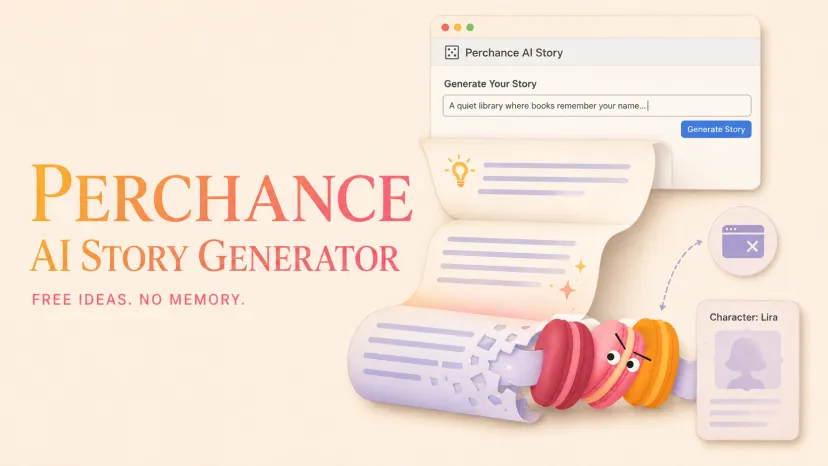

I keep three or four idea generators open in tabs because I write content full-time, and most "blank page" days aren't actually blank — they're frozen. I'm Maren, and I'm three chapters into a side project I keep abandoning for assignments like this one. The tab I keep coming back to runs the Perchance AI story generator: type a prompt, hit generate, read what comes out. No login. No saved profile. No daily cap. That's the whole pitch, and for a ten-minute warmup it's most of what I need. For a complete story rather than a one-off prompt, read Heroes Entwined, Macaron's free Iron Man and Spider-Man fan fiction.
Quick version, if that's all you came for: the Perchance AI story generator is a free, browser-based tool that turns a prompt into prose, paragraph by paragraph, with no account required. It's strong for ideation and warmups. It falls apart on anything longer than about a page, because it doesn't remember your story between sessions. Below is where it earns its place in my tabs, where it breaks, and what I switched to once the breaking got annoying enough to matter.
Disclosure: I write for Macaron, which makes two of the tools I compare here. I've tried to be straight about what Perchance does better — free, zero-friction, no account — and where I switched and why.

What the Perchance AI Story Generator Is
Here's the short version: it's a free, browser-based AI story generator built on top of Perchance, a community platform for randomized text generators. You type a prompt — a setup, a character, a vibe — and it returns a story, paragraph by paragraph, with an option to nudge what happens next. No account, no daily limit, no paywall. That part is unusual enough to mention twice.
One accuracy note, because it matters when you go looking: the genuine tool lives on Perchance's own domain, not on the lookalike sites that rank around it. If you want the real thing, it's Perchance's free story tool — the community platform that hosts it, not a third-party clone wrapping the same idea behind ads.
Random Generation, Prompts, and Story Formats
The site hosts dozens of forks. There's an AI story outline generator for plotting only, an enhanced build with local text-to-speech and rough story tracking, a stripped-down "Burg's Take" that's less flowery, plus genre-specific spins — bedtime stories, fanfic, even an AI Dungeon-style RPG mode. Each one tweaks the underlying behavior. Some lean shorter, some lean longer, some read aloud.
The core stays the same: prompt in, generated prose out, repeat. Because Perchance started life as a randomization tool, you can also throw a wildly underspecified prompt at it and let the random-generator machinery fill the gaps. That's a feature, not a bug, if you treat it as a slot machine for ideas rather than a drafting environment.

What the Perchance AI Story Generator Is Good For
I treat it as a warmup tool, not a drafting tool. That's the framing that's saved me the most time. Once I stopped expecting it to write things and started using it to break loose, it got useful fast.
Use Cases That Actually Hold Up
These are the jobs I keep handing it, roughly in order of how often:
- Beating blank-page freeze. When I can't write the first sentence, I let it write a bad one. Reacting is easier than starting.
- Character collisions. Pair two unlikely archetypes, watch what dialogue surfaces. Sometimes a real person walks out of the noise.
- Scene seeds. When I know the emotional beat but not the situation, I prompt the setup and harvest one usable image.
- Genre stretching. Fantasy and noir aren't my native registers, so I run them as a ten-minute exercise to find the vocabulary.
- Plot and outline ideation. The outline fork is better than the prose fork for this — give it a premise, get beats you can argue with.
- Low-stakes formats. Bedtime stories for a kid, a throwaway fanfic, a text-adventure to kill twenty minutes. These don't need to survive past the session, which is exactly Perchance's sweet spot.
That genre-stretching habit connects to something in Purdue's notes on fiction writing basics — that craft happens in the gap between intention and language, and the only way to close it is reps. The generator gives me reps without the cost of a blank page. The output mostly isn't keepable. The reps are.
There's a freewriting parallel here too. The old argument from the freewriting crowd is that pre-planning every sentence kills fluency. The generator does something similar, except the friction it removes is the first sentence — the one I always overthink into oblivion.

How to Get Better Results
Most of my early outputs were bland. The fix wasn't "better prompts" in the abstract — that advice is useless. It was adding constraints.
Prompt Structure, Genre, Tone, and Constraints
The shape that works for me:
[Setting] + [Character with one specific tension] + [Genre/tone marker] + [One thing that must happen]
The "one thing that must happen" is the part most people skip, and it's the part that does the work. Without it, the model drifts toward generic resolution — everyone reconciles, the storm passes, the end. With it, you get a scene that has a spine.
This isn't a quirk of Perchance. It's a creativity finding. Work collected in research on creative constraints, archived on PubMed Central, points to constraint as the thing that forces meaningful recombination instead of safe recombination. Limits are what stop a model — or a person — from reaching for the nearest cliché. Same principle whether you're prompting an AI or staring at a notebook.
Tone, in my experience, lives in two or three concrete words — not adjectives like "dark" but markers like "rain-soaked, untrusting, slightly bored." The model latches onto specificity and ignores mood-words. Give it texture, not vibes.
Where the Perchance AI Story Generator Falls Short
Now the part most reviews skip. The free, no-sign-up thing is real, and it's also the source of every limitation worth knowing about.
Continuity, Memory, and Long Projects
After about 800–1000 words, the generator starts losing the thread. Characters who were tense in paragraph two will be sharing a meal in paragraph six with no transition. It doesn't carry stakes. It carries vibes.
[SCREENSHOT: Perchance output, paragraph 5–6 of a tension-driven two-character prompt, with the line where tone breaks highlighted]
It also has no memory between sessions. Close the tab, lose the world. For a quick exercise that's fine — that's the deal you signed up for. For anything I want to develop over more than one sitting, it isn't. That's the friction I kept running into: the gap between "this gave me something" and "this remembers what it gave me last time."
I tested that gap directly instead of just describing it. Same prompt — a wary detective, a widow he doesn't trust — run through Macaron's one-sentence story app instead of Perchance. The first session held the tension past word 900, which Perchance never managed across four tries. The part that mattered more: I closed it, came back two days later, asked it to continue, and it picked the detective's suspicion back up without me re-explaining who the widow was.
[SCREENSHOT: Macaron story app, second session opened a day or more later, showing it reference a character detail from session one]
It's not flawless. Getting that memory to work means creating an account — one extra step Perchance never asks for. Fine if you're committing to a project; mildly annoying if you're just curious. And if the project runs long enough to need chapter-level continuity rather than just session-to-session memory, that's specifically what the Macaron novel app is built around: character sheets and plot threads it checks against instead of guessing fresh each time. If you want to see what fully developed output looks like, Macaron keeps a shelf of AI-generated novels you can read through.
For literary terminology and structure work, by the way, Purdue's literary terms reference is more useful than any AI output — it gives you the vocabulary to evaluate what the generator produced, which is a different and more durable skill than prompting.

Perchance Alternatives: Which Tool for Which Job
"What's a good Perchance alternative" is the wrong question until you answer a prior one: what are you actually trying to make? A throwaway scene and a 90,000-word manuscript are not the same task, and no single tool wins both. Here's how the main options sort out, based on what I've used and what holds up across reviews.
A few honest cuts through that table. If you want zero friction and don't care about persistence, nothing beats Perchance — that's not a consolation prize, it's a real category win. If you want the most literary raw prose, that's NovelAI's lane, and you'll pay for it. If you're writing an actual book with an outline and a cast you need to keep straight, Sudowrite or a memory-first tool earns its keep; a free generator will quietly contradict itself by chapter three.
The gap I personally kept hitting wasn't prose quality or price. It was memory. A purpose-built tool for ongoing creative work, like Macaron's story app, solves a different problem than Perchance does — it remembers the project so you don't re-explain it every session. Worth knowing which problem you're trying to solve before you pick.
FAQ
Is the Perchance AI story generator actually free?
Yes. No account, no usage cap that I've hit, no paywall. It's free in the way a public park is free — open to everyone, no ownership, no guarantees about who else is using it or what state you'll find it in.
Does it save my stories?
No. There's no native save tied to a profile. Copy what you want before you close the tab. I've lost things this way more than once, which is half the reason this review exists.
Can I use the output commercially?
Treat it as raw material, not finished work. Under the Copyright Office's AI guidance, purely AI-generated text — output produced from a prompt alone — generally isn't protected by copyright, because prompts by themselves aren't considered enough human authorship. What can be protected is the part you genuinely write: your selection, arrangement, and rewriting. So if you're publishing, rewrite the output in your own voice. That's not just legal hygiene; it's also the only way to make AI prose sound like anything.
Does the Perchance AI story generator remember my story?
No, and this is its single biggest limitation. It has no cross-session memory and starts drifting within a single session after roughly 800–1000 words. If "an AI story generator that remembers" is what you're searching for, you want a memory-first tool — that's the specific gap Macaron's story app was built to close.
How does it compare to ChatGPT for stories?
ChatGPT is more controllable; Perchance is faster for low-stakes ideation. I use both, for different jobs — ChatGPT when I know what I want, Perchance when I don't and need something to react to.
Is there a Perchance alternative that actually remembers my story?
Yes — that's exactly what the Macaron story app is built for, with the novel app extending it to chapter-length projects. Neither replaces Perchance for a ten-minute warmup; they solve the session-to-session memory problem Perchance was never designed to handle.
Will it write a whole novel?
It can generate a lot of words. Whether those words hold up as a novel is a separate question — and over full-length work the continuity issues compound until the story argues with itself. For long-form, you want structure and memory, not raw generation volume.
If you want a co-writer that remembers your project across sessions, Perchance isn't it — that's what sent me to Macaron's story app for the side project I mentioned, and to the novel app once it got long enough to need chapter-level continuity. You can run my exact test yourself: take a two-character, tension-driven prompt, push it past 900 words, then close it and come back the next day. Free tier, one sentence to start, and you'll know within ten minutes which problem you actually have. Perchance still wins the warmup. The rest of the project needs something that remembers.
It worked for me as a warmup against blank-page freeze and a way to stress-test a premise in ten minutes. That's the lane I'd keep it in.
Previous posts:






Apply to become Macaron's first friends
Read & discover
AI Personal Assistant
Free calculators


