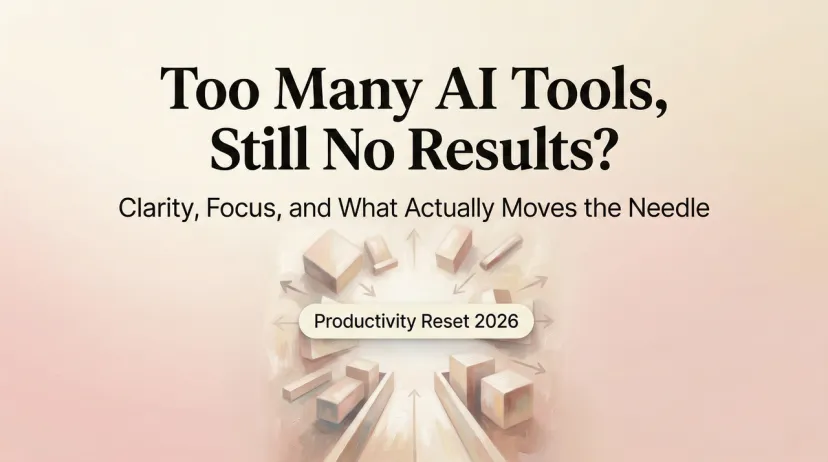
Hey, guys. I'm Anna. I didn't set out to collect AI tools. They just… piled up.
One day last month I opened my laptop to write a simple email and realized I had:
A browser tab with a general AI assistant
A separate one "just for writing"
A notes app with an AI add‑on
A little chatbot in my task manager
All of them supposedly helping me write, remember, and plan. In reality, I was doing something much less glamorous: trying to remember which AI knew the latest version of my plans.
That was the moment I felt it: not a productivity crisis, just a low‑grade mental hum. Too many AI tools, not enough sense of what was actually happening.
Over the last few weeks, I've been paying attention to this, not from the angle of "optimize everything," but from a quieter question: what would it look like if the AI parts of my day felt coordinated instead of noisy? This is what I noticed.
The Real Problem Isn’t the Tools
I don't think the core issue is that there are too many AI tools in the world. It's that most of them behave like enthusiastic interns who've never met each other.
On their own, each one is fine. Helpful, even. Together, they create this subtle fog where you're not totally sure where your ideas live or what's up to date.
Missing coordination layer
The phrase that kept coming to mind while I was switching between apps was: "Where is the adult in the room?" Not in a dramatic way, just in a "who's actually in charge of the plan?" way.
I'd draft a project outline in one AI, then later brainstorm details in another, because that's the tab I happened to have open. A week later, I could barely tell which version was the "real" one.
Technically, nothing was broken. Each tool did what it promised:
The writing assistant helped with tone
The planning bot generated steps
The notes add‑on pulled out summaries
But there was no coordination layer, nothing that knew:
What I'm currently working on
Which version of a plan is the latest one
How today's little change (a new idea, a canceled meeting) should ripple through the rest
Instead, all the "smart" parts lived in their own little boxes. I was the coordination layer, stitching everything together in my head.
Not a disaster. Just mildly exhausting.
Accumulation vs orchestration
At some point I realized I wasn't designing an AI setup. I was just accumulating tools.
Accumulation looks like this:
"Oh, this one is great for email, I'll just add it."
"This other one is supposed to be better at planning, I'll open that too."
"This notes app has AI now, I'll turn it on."
Individually, each decision is reasonable. Together, they create a situation where you're:
Re-explaining the same context to different assistants
Rebuilding the same prompts in slightly different ways
Trusting none of them fully, because the truth is scattered
Orchestration is different. It's less about which tools you have and more about how they work together around one idea: your actual life.
In practice, for me, orchestration started as one simple question:
"Where does my brain expect to find the source of truth for this?"
Is it one document? One chat thread? One app? One daily note?
When that answer is fuzzy, too many AI tools feel like noise. When the answer is clear, even if you still technically use a few tools, things calm down. You stop auditioning apps and start building a single, steady workflow.
And that's when I began noticing some clear warning signs that my setup, as it was, simply wasn't working.
Three Signs Your AI Setup Is Broken
Once I started paying closer attention, I could see exactly where the friction was coming from. None of these signs felt dramatic on their own, but together they made my "helpful" setup feel heavier than doing things manually.
Prompting instead of orchestrating
The first sign: I was spending more time prompting than actually moving things forward.
Every tool had its favorite way of being asked:
One wanted long, detailed instructions
Another responded better to short, direct requests
A third worked best if I referenced previous chats
So every time I switched tools, I had to mentally reload: "Right, this is the one that needs a lot of context. This is the one that forgets things quickly."
I caught myself doing this little dance one afternoon while trying to plan a small personal project. Instead of one calm conversation, I was:
Drafting ideas in one AI
Cleaning up the wording in another
Copying it all into my notes app "for safekeeping"
By the end, the plan was done, but I felt like a project manager for software, not a person planning something for myself.
That's when it clicked: I wasn't using AI to orchestrate the work. I was manually orchestrating multiple AIs, which is very different.
A healthy setup, I'm realizing, feels more like one ongoing conversation that can shift topics, not five separate chats that all need custom instructions.
Inconsistent outputs
The second sign showed up when I tried to reuse things.
I'd ask one assistant to help outline a recurring weekly routine, something simple like a planning ritual. The result was nice. Then the next week, in a different tool, I asked for a small update to that routine.
Same goal. Same person (me). Completely different style:
Different level of detail
Different structure
Different assumptions about what I cared about
Was any of it "wrong"? Not really. But the inconsistency made it harder to build trust. I couldn't relax into a pattern because there wasn't one. I was constantly evaluating: "Is this good? Is this better than last time? Do I need to rewrite this again?"
The third sign was the most annoying: when something didn't work, I often couldn't tell where it had gone wrong.
A small example: I asked one assistant to help me rewrite a message based on a draft that lived in another app. I copied it over, the AI did its thing, and the result looked… off.
Was the problem:
The way I'd originally written the draft?
The instructions I gave this particular assistant?
A mismatch between what this tool is good at and what I was asking?
Hard to say. And because the work was scattered, I couldn't quickly scan one clear "timeline" of what I'd asked and what had changed.
When your setup is fragmented, failure is fuzzy. You can't easily:
Retrace your steps
Reuse what did work
Adjust your approach in one central place
Instead, you patch things manually and hope the next attempt lands better.
That fuzziness is a quiet tax on attention — exactly the kind of issue taming agent sprawl aims to solve.
The Fix — One Workflow, Not Ten Tools
When I say "fix," I don't mean I discovered the perfect all‑in‑one platform and ascended to productivity heaven. I didn't. I still use a couple of different tools.
What changed was simpler: I picked one primary workflow and quietly demoted everything else.
Here's what that looked like in practice.
First, I chose a single place to be the home base for my brain. For me, that's one notes app with AI built in. For you, it might be:
One main AI chat you always return to
A daily note in a doc that you keep open
A simple text file where you paste important outputs
The key isn't the brand. It's the rule I gave myself:
"If it matters beyond today, it lives here."
Ideas, drafts, routines, little checklists, no matter which AI helped generate them, they all get parked in the same place.
Then I started treating other tools as specialists, not additional homes:
If I use a separate AI to clean up writing, the result still goes back into the home base
If I brainstorm in a different tool because it's handy on mobile, the best bits get pasted into the main thread or note
It's not automated or fancy. It's just consistent. And that alone reduced a surprising amount of mental noise.
A few things shifted once I did this:
I stopped rewriting prompts over and over, I could scroll up, reuse, and adjust
I saw patterns in what I actually ask for, which made it easier to refine
I trusted the history more, because it wasn't scattered across five apps
I don't have a universal answer yet. I'm still watching what happens as the pile of tools shrinks and the single workflow gets clearer. But so far, the air feels a little lighter — especially when we embrace AI's big payoff in coordination as a path forward.
If juggling multiple AI tools is starting to feel heavier than helpful, you’re not alone. We built Macaron to give you one place to generate and run your AI workflows, so your plans don’t live scattered across five tabs.
See how it works → https://macaron.im/
Hi, I'm Anna, an AI exploration blogger!
After three years in the workforce, I caught the AI wave—it transformed my job and daily life. While it brought endless convenience, it also kept me constantly learning. As someone who loves exploring and sharing, I use AI to streamline tasks and projects: I tap into it to organize routines, test surprises, or deal with mishaps. If you're riding this wave too, join me in exploring and discovering more fun!