Three weeks ago I sent my SBTI result to the team Slack as a joke. By the end of the day, seven people had taken it. By end of week, someone had printed their result and taped it to their monitor.
I'm Maren. I track what sticks in daily digital habits — and personality tests are usually in the "doesn't survive" column. I've taken dozens. Most get filed under "interesting for ninety seconds." But 2026 has been different. A specific cluster of viral personality tests has spread fast and — here's the part worth noting — kept showing up in conversations weeks later. That's my threshold: not the initial wave, but whether it holds.
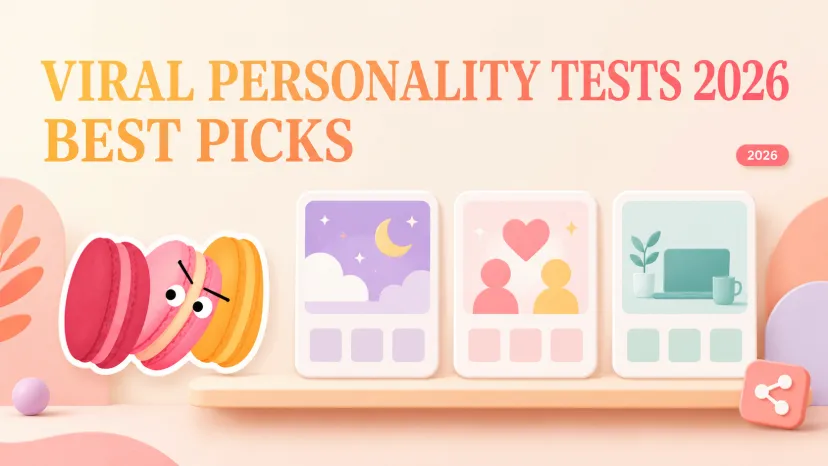
This is a roundup of what's actually trending, why each one blew up, and an honest look at what any of them are actually telling you.
Why Personality Tests Keep Going Viral
The virality isn't random. Research into social media sharing shows that personality test discussions have surged, with Gen Z driving growth on TikTok and Instagram — and 46% of users report feeling better after sharing personality results online.
That "feel better" part is doing a lot of work. It's not that the tests are more accurate. The format has gotten better at triggering the exact feeling that makes people share things.
According to researchers at UNSW Sydney, people are drawn to personality tests partly because of the desire for self-actualization — understanding one's potential — and partly because of the need for belonging, which is reinforced when we discover our "type" and find others who share it.
The tests that go viral nail this in under two minutes.
SBTI — The Self-Roast Quiz
What It Is
SBTI presents users with roughly 30 questions scored across 15 dimensions grouped into five categories: self-awareness, emotion, attitude, action drive, and social style. Results map to one of 27 distinct four-letter personality types, each paired with a short, irreverent description.
Instead of abstract traits like "extroversion" and "introversion," SBTI types describe relatable behaviors: the burnout-prone worker (MALO), the friend who always pays (ATM-er), the person who controls everything (CTRL).
I got OJBK — "The Whatever." Read the description. Couldn't argue with it. Free at sbti-test.net.
Why It Blew Up
On April 9 alone, searches for "sbti" on WeChat Index hit 40.85 million, while related discussions reportedly surpassed 20 million across social platforms.
The genius of SBTI is that it's designed to be a little embarrassing. Getting DEAD or MALO as your type is funny — but uncomfortably specific. That discomfort is what makes people screenshot and post.
SBTI doesn't try to tell users who they are in any stable psychological sense. It works more like a snapshot of how they feel they are functioning at a given moment — people repost results less as formal self-assessments than as quick, recognizable jokes about their current state.
It's not pretending to be deep. That honesty is exactly what makes it land.
Other Viral Tests Trending in 2026
The Open Psychometrics Character Test
The Open Psychometrics Stranger Things test went viral following the show's finale. It has 36 questions where each presents two contrasting personality traits on a slider — options include "outlaw or sheriff" and "charming or awkward."
What separates this from a typical fan quiz: the project has recruited more than 3 million volunteers to rate fictional characters on descriptive adjectives, which are aggregated to create profiles that users can be matched to.
I got Hopper both times I ran it. Choosing to believe that's a compliment. Free at openpsychometrics.org.
The "What Aesthetic Am I" Quiz
Quietly recirculating all year, driven by TikTok's "core" obsession. Rather than just looking at favorite colors, this test analyzes personality, ideal environment, stress response, and cultural touchstones to place users within aesthetic archetypes from Cottagecore to Dark Academia — framing aesthetics as "the new horoscopes."
Available at welovetest.net. Takes about four minutes. Results are surprisingly specific for something that asks about your ideal Saturday.
The Big Five / OCEAN (Quietly Reliable)
Not viral in the screenshot sense. But it keeps appearing as the test people recommend after the novelty of the others wears off. The Big Five is one of the most scientifically validated personality frameworks in modern psychology, measuring Openness, Conscientiousness, Extraversion, Agreeableness, and Neuroticism — best suited for career planning, self-awareness, and communication improvement.
Psychology Today hosts a free version. It won't give you a funny label. But three weeks later, you'll still remember what it said.
What Makes a Personality Test Go Viral
Shareability. The result has to function as a standalone unit — one screenshot, no explanation needed. SBTI nails this. Research on viral content shows that sharing probability increases when content reduces processing effort while maximizing information value, and when it confirms existing identity narratives.
Identity signaling. People aren't just sharing results — they're using results to signal something about who they are. Psychologists have found that people prefer feedback that confirms their identity, and that posting results online leads to an even greater sense of successfully attaining an identity goal. Getting MALO and sharing it is a way of saying "I see myself clearly, and I can laugh about it."
Low effort, high reward. The tests that go viral take under three minutes, require no signup, and deliver something that feels specific. Here's the part that surprised me: the effort-to-payoff ratio matters more than accuracy. SBTI has zero scientific basis and says so openly. It still went viral. The psychological payoff doesn't require the test to be technically accurate — it requires the result to feel plausible.
Are Any of These Tests Accurate?
Depends what you mean by accurate.
SBTI? No — and it admits it. The Stranger Things test from Open Psychometrics is crowd-sourced personality matching, which is interesting but not clinical. Researchers at Swinburne University caution that even more established frameworks like MBTI show poor "test-retest reliability" — meaning you can get different results taking the same test twice within a short period.
That said, accuracy isn't why most people take these. The UNSW research is clear: people take them to pursue identity goals and feel belonging. Knowing that going in makes the whole experience more honest.
Still thinking about whether "The Whatever" is an accurate description of my decision-making process. I'll check back in.
FAQ
What personality test is trending right now in 2026?
SBTI is the biggest trend of 2026 so far, going viral across TikTok and social media globally in April. The Stranger Things character test from Open Psychometrics also saw a major resurgence following the show's finale.
Are viral personality tests reliable?
Generally no — not in the clinical sense. Tests like SBTI are explicitly for entertainment. The Big Five (OCEAN) is the most scientifically validated widely available option. For anything beyond self-reflection, a licensed psychologist is a better resource.
Why do personality tests keep going viral on TikTok?
The format matches the platform. Results that work as standalone screenshots — especially meme-style ones like SBTI — are built for TikTok. "Which type did you get?" is one of the most reliable comment-bait questions on the internet.
What's the difference between SBTI and MBTI?
MBTI is a decades-old framework based on Carl Jung's personality theory, used in professional and educational contexts. SBTI is a satirical parody that replaces MBTI's personality types with internet slang and workplace archetypes — and makes no claim to scientific validity. One is meant to help you understand yourself. The other is meant to make you laugh at yourself. Both are currently living rent-free in group chats everywhere.
I’m Maren, a 27-year-old content strategist and perpetual self-experimenter. I test AI tools and micro-habits in real daily life, noting what breaks, what sticks, and what actually saves time. My approach isn’t about features—it’s about friction, adjustments, and honest results. I share insights from experiments that survive a real week, helping others see what works without the fluff.