What an AI Diet Plan for Weight Loss Can Realistically Do
How to Build an AI Weight Loss Diet Plan
What a Realistic AI-Generated Weight Loss Plan Looks Like
Where AI Weight Loss Plans Consistently Go Wrong
When to Talk to a Professional
Start With Structure, Adjust With Reality
FAQ
Related Reading
AI Diet Plan for Weight Loss: What Works and What Doesn't
AI Diet Plan for Weight Loss: What Works and What Doesn't
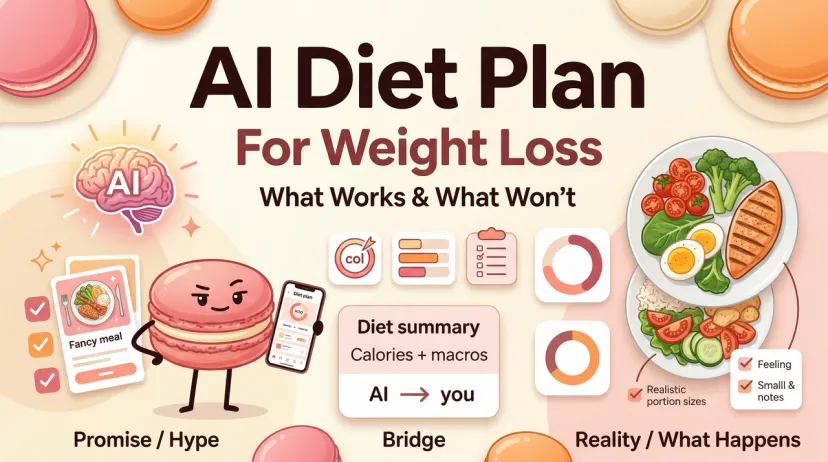
Tried an AI-generated meal plan for weight loss, followed it for six days, lost nothing, and couldn't figure out if the plan was wrong or you were. That loop is more common than most people admit — and the problem is usually not effort. It's that AI weight loss plans are starting frameworks, not personalized prescriptions, and most people use them without knowing where the edges are.
This guide is honest about what AI can actually do here, how to set up a plan that's genuinely safe to follow, and what to watch for when the output needs editing before you start.
This article is a general dietary reference. If you have a medical condition, take medications that affect metabolism, or have a history of disordered eating, work with a registered dietitian or physician before making significant dietary changes.
What an AI Diet Plan for Weight Loss Can Realistically Do
Fast Structure Based on Your Goals
The practical value of an AI-generated weight loss plan is speed and structure. You describe your situation — height, weight, activity level, food preferences, restrictions — and within a minute you have a week of meals with approximate calorie counts, a grocery list, and a macro breakdown. That starting structure, done manually, takes most people two to three hours.
For someone who's never meal planned before, that starting point is genuinely useful. It's easier to edit a plan than to create one from nothing.
Calorie and Macro Targeting
A capable AI will estimate your TDEE (total daily energy expenditure) from your stats and apply a calorie deficit to produce a weight loss target. It can also distribute macros across meals — typically keeping protein high, which is the most evidence-supported dietary lever for preserving muscle during weight loss.
This is where AI is most reliable: applying established frameworks (calorie deficit math, protein-to-bodyweight ratios, meal distribution) to your stated inputs. These aren't guesses — they're documented approaches the models have been trained on.
What It Genuinely Cannot Do
The list is real and worth knowing before you start:
It doesn't know your actual metabolic rate. TDEE calculators use validated equations, but individual variation at the same height, weight, and activity level can be 200–400 kcal in either direction. The number it gives you is an estimate. Your body's actual response is the real data.
It has no access to your medical history. Conditions like hypothyroidism, PCOS, insulin resistance, or medications including steroids, antidepressants, and antipsychotics can significantly affect caloric needs and fat loss rate. An AI can't account for these without you explicitly flagging them — and even then, it can't recommend the clinical adjustments a dietitian would make.
It can't tell when the plan isn't working for your body specifically. If you're losing faster than expected, slower than expected, losing energy, losing muscle, or developing symptoms, the plan needs to adjust. That requires human judgment applied to real-world data over time.
How to Build an AI Weight Loss Diet Plan
Step 1 — Set a Safe Calorie Deficit (Not Extreme)
A deficit of 300–500 kcal below your maintenance level produces roughly 0.5–1 lb of fat loss per week. This range is supported by research as sustainable and protective of muscle mass when protein intake is adequate.
Deficits above 750 kcal per day are where risks increase: greater muscle loss, hormonal disruption, difficulty sustaining the deficit long-term, and metabolic adaptation that makes the next phase harder. They can be medically appropriate in specific contexts, but not as a default starting point.
When prompting an AI, state the deficit explicitly rather than asking it to "make me lose weight fast." Something like: "Create a 1,600-calorie meal plan for weight loss. I'm a 5'6" woman, lightly active, current weight 160 lbs. I want to lose weight gradually, about 0.5–1 lb per week." This constrains the output toward a reasonable deficit rather than leaving it to guess.
If you're unsure what your maintenance calories are, the NIH Body Weight Planner uses validated research models to calculate personalized estimates based on age, sex, height, weight, and activity.
Step 2 — Define Food Preferences and Restrictions
The more specific your inputs, the more practical the output. Vague prompts produce generic plans. Specific ones produce something you can actually follow.
Include: foods you genuinely won't eat (not foods you think you should avoid), dietary restrictions or allergies, cooking time constraints, how many meals per day you want, and any preferences like high protein or low processed food. Also worth flagging: whether you eat out regularly, since a plan built entirely around home cooking fails the first time you have lunch at your desk.
Step 3 — Generate and Review the Plan
Once you have the output, review it before committing to it. Check:
Does the daily calorie total match what you asked for?
Is protein distributed across meals (roughly 25–40g per meal, not all in one place)?
Are the meals things you'd actually eat and can actually make?
Does the grocery list reflect what's in the plan?
Treat the first output as a draft. Edit meals that won't work in practice, swap proteins you don't like, and redistribute calories toward meals where you're typically hungrier. A plan you'll follow imperfectly is more useful than a plan you'll follow perfectly for three days and then abandon.
Step 4 — Adjust Based on How You Feel in Week 1
The plan is a starting hypothesis. Your body's response is the data.
After one week: if you're losing more than 1.5 lbs and feeling noticeably fatigued or weak, the deficit is likely too aggressive — add 100–200 kcal, mostly from protein or complex carbs. If you're not losing at all and adherence has been solid, reduce by 100–200 kcal or increase activity slightly. If hunger is unmanageable, look at protein distribution and fiber intake before cutting further.
Okay, I'll admit it — most people adjust too early or not at all. One week is the minimum data window for any real signal. Water retention, cycle effects, and daily variation mean day-to-day weight means almost nothing. Week-over-week trend is what counts.
What a Realistic AI-Generated Weight Loss Plan Looks Like
Sample Week Structure
A reasonable output for a moderately active adult aiming for 0.5–1 lb/week loss might look like this structural template. Actual calorie counts depend on your specific target.
Daily framework (1,500 kcal example):
Breakfast: ~350 kcal, 30g+ protein (eggs, Greek yogurt, cottage cheese)
Lunch: ~450 kcal, 35–40g protein (chicken, fish, legumes over salad or grain base)
At least 2 different protein sources per day (not chicken every meal every day)
Vegetables at lunch and dinner consistently — this is where fiber and volume come from
One planned "flexible" dinner that accommodates eating out or leftovers, rather than pretending your week will be identical to the plan
How to Read and Edit the Output
When an AI plan doesn't feel right, the fix is usually one of three things:
Protein is stacked into dinner. Common in auto-generated plans. If breakfast is 12g protein and dinner is 60g, hunger will be high all day and you'll fight cravings by 4 PM. Redistribute protein earlier.
Meals are technically correct but joyless. Plain grilled chicken, plain rice, plain steamed broccoli — every day. This is the fastest path to giving up. Swap one or two meals for options with the same macros but more flavor. The AI will tell you if you ask: "Replace Tuesday's lunch with something with similar macros that has more flavor."
The plan ignores your actual week. Auto-generated plans treat every day identically. Your week isn't identical. Flag the nights you won't cook and get simpler or leftover-based options for those slots.
Where AI Weight Loss Plans Consistently Go Wrong
Aggressive Deficit Targets
Without explicit constraints, some AI outputs default to 1,200 calories — the lowest threshold commonly cited in older diet literature. For most adults, this is too low to sustain protein targets, maintain energy for daily function, and avoid metabolic adaptation. It's also the level at which muscle loss accelerates without very high protein and resistance training.
If an output comes back below 1,400 kcal (for women) or 1,600 kcal (for most men) without you asking for it, that's worth questioning before you follow it. Push back explicitly: "That seems too low — can you revise to 1,600 kcal with the same macro targets?"
Ignoring Protein for Satiety
Hunger is the most common reason people abandon weight loss plans, and protein is the most effective dietary tool for managing it. A plan that hits the calorie target but sits at 80g protein when the goal is 140g will leave you hungry every afternoon. Not because you have no willpower — because the plan isn't built to support satiety.
Check the protein number before anything else. If it's below 0.7g per lb of bodyweight, the plan needs revision regardless of how the calories look.
Generic Meals That Don't Survive Real Life
This is the one that's hardest to see on paper but most visible by Thursday. A plan built around ingredients you don't particularly like, cooking methods that take 45 minutes when you have 20, or meals that require full grocery trips mid-week doesn't fail because you're undisciplined. It fails because it wasn't built for your actual life.
The fix: before starting, read through the whole week and flag anything you realistically won't do. Replace it. An AI will let you substitute without complaint — take advantage of that.
When to Talk to a Professional
Medical Conditions That Make AI Plans Risky
AI-generated weight loss plans are not appropriate as a primary approach — without medical supervision — for people managing:
Type 1 or Type 2 diabetes (caloric restriction and carbohydrate distribution directly affect blood glucose and medication dosing)
Thyroid disorders (metabolic rate is directly affected; standard TDEE equations may not apply)
PCOS or other hormonal conditions affecting insulin sensitivity
Kidney disease (protein targets used in weight loss plans may be contraindicated)
History of disordered eating (structured calorie-based plans can be triggering and counterproductive)
Current use of medications known to affect weight or metabolism
This isn't a comprehensive list. If you're unsure whether your situation warrants professional guidance, that uncertainty itself is a reason to ask.
What a Dietitian Adds That AI Can't
A registered dietitian brings clinical assessment, access to your medical history and bloodwork, and the ability to adjust recommendations based on your body's actual response over time. They also provide accountability and troubleshooting that a static AI plan can't.
The Academy of Nutrition and Dietetics maintains a tool to find credentialed dietitians by location and specialization. Many now offer telehealth sessions, which makes access significantly easier than it used to be.
An AI plan is a useful starting structure. A dietitian is the professional that structure gets calibrated through. For straightforward, healthy adults without medical complications, the AI plan is a reasonable starting point. For anyone with complicating factors, it's an adjunct, not a replacement.
Start With Structure, Adjust With Reality
The hardest part of weight loss isn't the first week — it's the adjustment when week two doesn't go the way week one did. At Macaron, we built our AI to plan around your calorie and protein targets and remember what you've already eaten this week, so daily decisions don't require recalculating from scratch. Try it free and plan this week before the week starts.
FAQ
How many calories should my AI weight loss plan target? A deficit of 300–500 kcal below your estimated maintenance (TDEE) is the most commonly recommended starting range for sustainable fat loss. Use the NIH Body Weight Planner to estimate your maintenance, then subtract from there. Avoid plans that take you below 1,400 kcal (women) or 1,600 kcal (most men) without medical supervision.
Can ChatGPT or Claude make a weight loss meal plan? Yes, and they do it reasonably well when given specific inputs. State your calorie target, macro preferences, restrictions, and cooking constraints explicitly. Review the output before following it — check protein totals, check that meals are realistic, and adjust anything that won't survive contact with your actual week.
How fast should I expect to lose weight following an AI plan? 0.5–1 lb per week is the most sustainable range for fat loss while preserving muscle. Faster rates are possible at higher deficits but come with greater muscle loss and are harder to sustain. If you're not losing after two consistent weeks, the estimate may be off — reduce by 100–150 kcal and reassess. If you're losing more than 1.5 lbs per week consistently, add calories back.
Is an AI diet plan safe to follow without a dietitian? For healthy adults without medical conditions, a well-structured AI plan within a reasonable calorie range is a reasonable starting point. It's not a substitute for professional guidance for anyone with a medical condition affecting metabolism or nutrition, a history of disordered eating, or medications that affect weight. When in doubt, consult a professional before starting.
What should I do if I'm always hungry on the plan? Check protein first — it's the primary satiety driver at a given calorie level. If protein is under 0.7g per lb of bodyweight, redistribute the meal composition before cutting anywhere else. Also check fiber: vegetables, legumes, and whole grains at lunch and dinner add significant volume without significant calories. If hunger persists after addressing both, the deficit may be too aggressive — add 150–200 kcal from protein or complex carbs.
Related Reading
AI Diet Plan — how to create any AI-generated diet plan, not just for weight loss
All information in this article is for general educational purposes. It is not a substitute for professional medical or dietary advice. Consult a registered dietitian or physician before making significant dietary changes, especially if you have a medical condition.
Hey — I'm Jamie. I try the things that promise to make everyday life easier, then write honestly about what actually stuck. Not in a perfect week — in a normal one, where the plan fell apart by Thursday and you're figuring it out as you go. I've been that person. I write for that person.