AI Journal App: What to Look for and What's Worth It
AI Journal App: What to Look for and What's Worth It

What would actually make you want to open a journal every day — not out of discipline, but because you genuinely wanted to?
I've been thinking about this one for a while. Because the apps that are supposed to make journaling easier often add friction in a different direction: prompts you don't connect with, AI responses that feel generic, interfaces that prioritize aesthetics over actually getting you to write something real.
AI journal apps have gotten genuinely interesting in the last year. Not because AI makes journaling easier, exactly — but because the right features can make you want to come back. Here's what's worth paying attention to, what's mostly noise, and which apps I'd actually point someone toward.
What an AI Journal App Does Differently
A regular journal app gives you a blank page. That's it. Which is fine if you already know what you want to say and have the motivation to say it.
An AI journal app — when it works — does something subtler. It meets you where you are instead of waiting for you to show up ready. That might look like a prompt when you open it at 10pm looking a little lost, or a weekly pattern it noticed that you hadn't consciously clocked yourself.
The difference isn't the AI part. It's whether the app is paying attention over time, or just sitting there waiting.
According to APA's Speaking of Psychology research on expressive writing, structured reflection — even brief, regular entries — has measurable effects on stress and wellbeing. The question is whether AI features help or hinder that process. In my experience, they mostly help, with a few notable exceptions covered below.

Features Worth Having
Mood Tracking

Not the emoji kind. The emoji kind is satisfying for exactly one week and then becomes a chore.
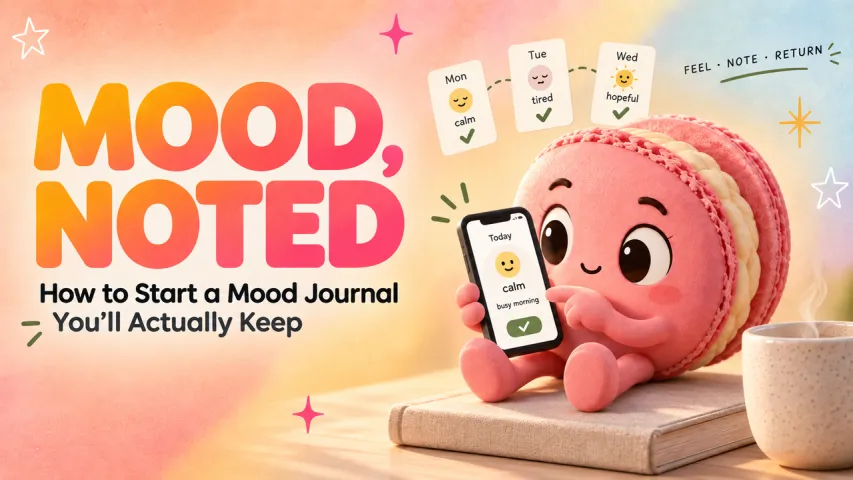
Mood tracking that's worth having does two things: it's fast enough that you actually do it (one tap, fifteen seconds max), and it connects to your entries over time so you can see patterns you'd miss in the moment. The best implementations I've seen let you add a note after the mood log — optional, never nagged — so context lives alongside the data.
What you want to watch for is whether the mood data stays siloed or actually feeds into the AI's responses. A good ai journal app will notice "you've logged low energy four Tuesday mornings in a row" and say something useful about it. A mediocre one just shows you a bar chart and calls it a day.
AI Prompts and Reflection
This is the feature that separates genuinely useful from gimmicky.
Prompts that work are specific to your situation, not generic. "What are you grateful for?" is a journaling prompt your grandmother could write. A prompt based on what you wrote last week — "You mentioned feeling stuck with your project — has anything shifted since then?" — is actually useful.
The Greater Good Science Center at UC Berkeley on journaling and meaning-making has documented how reflective writing works best when it involves processing and meaning-making, not just venting. Good AI prompts push in that direction. Bad ones just ask you to describe your day.
One thing I'd look for: does the app let you dismiss or skip a prompt without friction? Apps that guilt-trip you for not engaging with a prompt have fundamentally misunderstood what journaling is for.
Pattern Recognition

This is the feature I was most skeptical about and ended up finding most useful.
When an app tells you "you write longer entries on Sunday evenings, usually after social situations" — that's not a trick. That's the kind of thing a therapist might surface after months of sessions, handed to you quietly after a few weeks of entries.
Pattern recognition in an ai journaling app works best when it's surfaced gently, not aggressively. A weekly summary you can read or skip. A nudge that says "this week looked a lot like the one before you wrote about feeling burned out" — not an intervention, just a mirror.
The limit here is obvious: patterns are only as useful as the data going in. If you journal inconsistently (which most people do), the patterns will be thin. The best apps account for this and don't oversell the insight.
Features That Are Mostly Gimmicks
Let me save you some time.
AI-generated summaries of your own entries. You wrote the entry. You don't need a summary of it. This feature exists because it's technically impressive, not because it's useful.
"Ask your journal" chatbot interfaces. The idea is you can query your past entries like a database. In practice: you already know what you wrote. If you wanted to find something specific, search works fine. The conversational interface adds friction, not value.
Elaborate streak tracking. I've lost more journaling habits to streak anxiety than I have to actual disinterest. A missed day becomes a reason to abandon the whole thing. The best apps I've used have either removed streaks entirely or made them so low-stakes they're basically decorative.
AI-generated "insights" based on two entries. Some apps start showing you your "patterns" after three days. That's not a pattern. That's just your Monday.
Apps Worth Trying
Macaron
Macaron is worth calling out specifically because it does something most ai diary apps don't: it actually remembers you across sessions.

Most journaling apps treat each entry as a standalone object. Macaron's Deep Memory system builds a persistent understanding of who you are, what you've been through, what matters to you. So when you open it after a rough week and don't quite know what to say, it's not starting from zero. It already knows about the project you mentioned three weeks ago, the habit you were trying to build, the trip you were half-planning.
That's a different kind of tool. Less archive, more ongoing relationship.
The Mini-App generation feature is also genuinely useful for journaling adjacent tasks — habit trackers, mood logs, reflection templates — created in one sentence without setup. Worth trying if you've ever gotten halfway through configuring a habit tracker and then just... closed the tab.
One thing I'd flag: because Macaron builds this deep memory, the privacy question matters more here than with most apps. Check the data policy before you start sharing anything sensitive. (More on this in the privacy section below.)
Day One
Day One is the most polished journaling app on iOS, and its AI features are conservative in a way I actually respect. It uses AI for things like transcribing audio entries and suggesting prompts — it doesn't try to analyze your personality from four entries. The interface is beautiful, the sync is reliable, and if you want something that gets out of your way, it's still the benchmark.
The limitation is that it doesn't do the remember you over time thing. Each entry is its own object. Which is fine if that's what you want from a journal.

Reflect
Reflect sits somewhere between a note-taking app and a journal — it works well for people who think in connected ideas rather than dated entries. The AI features are modest but well-implemented: it can help you find connections between notes, suggest related entries, and generate prompts based on what you've been writing about.
It's not for everyone. If you want the structure of a dated journal, Reflect's freeform approach feels chaotic. But if your journaling practice already looks more like thinking out loud than diary entries, it fits well.
Privacy: What Happens to Your Journal Entries
This section matters more than it probably seems.
Journal entries are some of the most sensitive data you can generate. Not in a dramatic way — just in the sense that you write things in a journal that you wouldn't say out loud, and that data living somewhere you don't control is a different situation than a grocery list in a cloud app.
A few things to check before committing to any ai journal app:
Where is the data stored? On-device only, or synced to servers? If synced, is it encrypted in transit and at rest? End-to-end encryption (where only you hold the key) is meaningfully different from server-side encryption. Most apps use the latter, which is fine for most people but worth understanding.
Is your data used to train models? Some apps use your content to improve their AI. Others explicitly opt you out by default. The difference is in the privacy policy, usually in small print. Look for language like "your content will not be used to train" — or its absence.
Can you export and delete your data? This is a basic data hygiene thing. Any app worth trusting should let you export your entire journal in a readable format, and delete your account with complete data removal. If an app makes this hard to find or do, that's a signal.

Before you hand over that kind of data, it's worth reading EFF's guide to evaluating apps for privacy. The core question it frames: does the company's policy assert it cannot access your data, or only that it won't? That's a meaningful difference — and one most privacy policies bury.
For apps that build memory over time (Macaron included), this question is more important, not less. The value of persistent memory comes from depth of data. So does the risk.
Who AI Journaling Apps Suit
An honest answer: not everyone.
AI journaling apps work well for people who want to journal but find the blank page hard to start from, who journal sporadically and want help building a more consistent practice, and who are comfortable with a bit of structure (prompts, mood logs) rather than pure free-form writing.
They work less well for people who already have a strong journaling practice and find any friction annoying, who are deeply private and uncomfortable with any data leaving their device, or who want journaling to be entirely analog and screens-off.
If you're in the second group, the Center for Journal Therapy has good resources on more traditional, structure-free approaches that don't involve any AI at all.

FAQ
Is There a Good Free AI Journal App?
Yes, with caveats. Most free tiers are limited in ways that affect the AI features specifically — you might get prompts, but not the pattern recognition, or you get a prompt or two per day and then hit a wall. Day One has a usable free version. Macaron has a free tier worth trying before committing. The honest answer is that the features that make an ai journal app actually useful — persistent memory, deep pattern recognition — are usually behind a paywall, because they're computationally more expensive to run.
Are AI Journal Apps Private?
It depends on the app and how you define private. No app that syncs to a server is truly private in an absolute sense. Most reputable apps use standard encryption and don't sell your data. Apps with end-to-end encryption (where even they can't read your entries) are a smaller category. If privacy is a primary concern, look explicitly for E2E encryption or an on-device-only option.
Do I Need AI Features in a Journal App?
No. A lot of people journal perfectly well in Notes or a physical notebook. AI features add value when they help you actually use the journal — through prompts when you're stuck, or surfacing patterns you wouldn't notice yourself. If you already journal consistently and value the blank page, AI features might just add noise. Try a free tier before deciding AI belongs in your practice.
The apps in this space are better than they were a year ago. The features have gotten more thoughtful, the privacy conversations are more honest, and the best ones are starting to feel less like productivity tools and more like something you actually want to open.
That's a harder thing to build than it sounds. Worth trying if you've been looking for something that finally gets the point.
Recommended Reads
AI Fitness Coach: What It Is and Whether It Works











Apply to become Macaron's first friends
Read & discover
AI Personal Assistant
Free calculators


