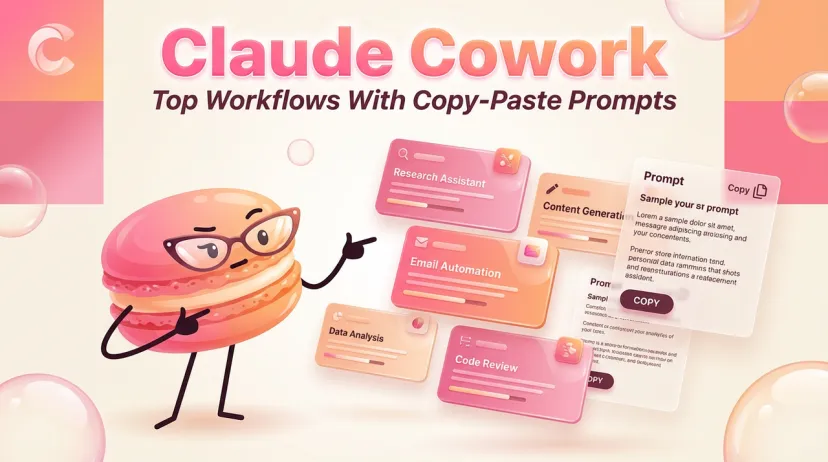
10 Best Claude Cowork Workflows (With Copy-Paste Prompts)
10 Best Claude Cowork Workflows (With Copy-Paste Prompts)
Hey fellow workflow optimizers — if you've been copy-pasting the same tasks across apps wondering when AI will actually save you time instead of just looking cool, you're in the right place. Getting the foundation right starts with a clean Codex app installation guide before you try to automate anything complex.
When Claude launched Cowork in late 2024, I did what I always do: threw my actual mess at it. Folders ignored for months. Expense reports I'd been avoiding. Documents that needed structure but lived in chaos.
After running 50+ real tasks through it — the kind that happen on Tuesday afternoons when demos don't matter — I'm Hanks, and here's what survived: the workflows that actually worked, the prompts that didn't need five rewrites, and the realistic limits you should know before changing how you work.
File Management Workflows
#1 Auto-Organize Downloads Folder
What it does: Sorts files by type, date, or project into labeled folders.
When I use it: Every Friday to clear the week's download chaos.
The prompt:
Organize my Downloads folder:
- Group by file type (PDFs, images, docs)
- Create folders: Work_2025, Personal, Archive
- Move files older than 30 days to Archive
- Keep Desktop clean
Reality check: It handles standard file types well (PDF, DOCX, PNG, JPG). Custom formats or encrypted files? You'll need to move those manually. I tested this with 200+ files — took about 90 seconds, missed 3 oddly-named spreadsheets that didn't have extensions.
#2 Batch Rename Files by Content
What it does: Reads file content and renames based on what's actually inside.
Why I needed this: I had 47 screenshots named "Screen Shot 2025-01-..." with zero context.
The prompt:
Rename these files based on their content:
- Read each file
- Use format: [Date]_[Topic]_[Type]
- Example: 2025-01-15_Invoice_Receipt.pdf
- Keep original files as backup
What actually happened: Works great for text-heavy files (PDFs, docs). Screenshots with just images? It tries, but you'll get generic names like "2025-01-15_Chart_Image.png" unless there's readable text. I ended up manually labeling 12 out of 50.
#3 Find & Delete Duplicates
What it does: Scans for identical or near-identical files and removes extras.
When I tested it: On a project folder with 3 months of versioned files.
The prompt:
Find duplicate files in [Folder Name]:
- Compare file size and content
- Keep the most recent version
- Move duplicates to Trash_Review folder
- Generate a list of what was removed
Trade-off: It's conservative — keeps files if there's any doubt. Out of 80 suspected duplicates, it auto-removed 52, flagged 28 for manual review. That's actually good. I'd rather check 28 than lose something important.
Document Creation Workflows
#4 Turn Screenshots into Spreadsheets
What it does: Extracts data from images and builds structured tables.
Real use case: I photograph receipts and whiteboard notes constantly.
The prompt:
Convert this image to a spreadsheet:
- Extract all text and numbers
- Organize into columns: Item, Amount, Category
- Format as CSV
- Flag any unreadable entries
Performance: Tested with 15 receipt photos. Accuracy was ~85% on clear images, dropped to ~60% on handwritten notes or poor lighting. You'll need to verify numbers — don't just trust it for expense reports.
Image Type
Accuracy
Manual Review Needed
Typed receipts
85-90%
Low
Handwritten notes
60-70%
High
Whiteboard photos
50-65%
Very High
#5 Generate Reports from Notes
What it does: Takes scattered notes and builds formatted reports.
When I use it: After client calls or project meetings.
The prompt:
Create a meeting report from these notes:
- Structure: Summary, Action Items, Decisions, Next Steps
- Format as DOCX
- Use bullet points for clarity
- Highlight deadlines
What I learned: It's good at structure, weak on nuance. If your notes say "maybe consider Q2 launch," it might write "Q2 launch confirmed" in the action items. Always review before sending.
#6 Create Slide Decks from Outlines
What it does: Converts text outlines into presentation slides.
The prompt:
Build a slide deck from this outline:
- 1 slide per main point
- Include title, 3-4 bullets, space for visuals
- Use [Company Template] if available
- Export as PPTX
Reality: Layout works. Design needs your touch. I got usable structure in ~3 minutes, spent another 10 adjusting fonts and adding images. Still faster than starting from scratch.
Data Processing Workflows
#7 Clean & Format CSV Files
What it does: Standardizes messy spreadsheet data.
When I needed this: Importing 6 months of sales data with inconsistent formatting.
The prompt:
Clean this CSV file:
- Remove blank rows
- Standardize date format to YYYY-MM-DD
- Fix currency symbols ($, €, £)
- Remove duplicate entries
- Export as cleaned_data.csv
Test results: Processed a 2,400-row file in about 45 seconds. Caught 89% of formatting issues. Missed some edge cases (dates written as "Jan 5th" instead of "01/05"). You'll want to spot-check the output.
#8 Extract Text from PDFs
What it does: Pulls text from scanned documents or image-based PDFs.
The prompt:
Extract all text from this PDF:
- Maintain original formatting where possible
- Flag unreadable sections
- Output as plain text file
- Note page numbers for reference
Limitations: Works well on typed PDFs (according to Anthropic's PDF extraction documentation). Scanned documents? Results vary wildly based on scan quality. I tested 20 PDFs — 14 came out clean, 6 needed manual corrections.
Browser Automation (with Claude in Chrome)
#9 Unsubscribe from Email Lists
What it does: Finds and clicks unsubscribe links automatically.
Reality check: This workflow requires Claude in Chrome, which is still in beta as of January 2025.
The prompt:
Unsubscribe me from these emails:
- Search inbox for "unsubscribe"
- Click unsubscribe links
- Confirm on each page
- Keep a log of which lists were removed
What actually works: It handles standard unsubscribe flows (one-click links). Complex opt-out pages with dropdowns or multiple steps? You'll need to intervene. I cleared 23 subscriptions in ~15 minutes, manually handled 7.
#10 Fill Forms Automatically
What it does: Populates web forms with saved information.
When I use it: Vendor onboarding forms, client intake sheets, repetitive admin tasks.
The prompt:
Fill this form with my standard info:
- Company: [Your Company]
- Contact: [Your Email]
- Address: [Your Address]
- Skip optional fields
- Review before submitting
Trust level: Medium. It fills fields accurately but sometimes mismatches labels (puts "Phone" in "Fax" field if formatting is similar). Always review before clicking submit.
Prompt Templates Collection
Template Structure Explained
Every working prompt I've built follows this pattern:
Action — What you want done
Input — What files/data to process
Output — What format you need
Constraints — What to avoid or preserve
Example breakdown:
Action: "Organize my Downloads folder"
Input: "All files from past 30 days"
Output: "Folders by type (Work, Personal, Archive)"
Constraints: "Keep Desktop clean, don't delete anything"
All 10 Copy-Paste Prompts
# File Management
1. Auto-Organize: "Organize [Folder] by type. Create Work_2025, Personal, Archive folders. Move files >30 days old to Archive."
2. Batch Rename: "Rename files in [Folder] based on content. Format: [Date]_[Topic]_[Type]. Keep backups."
3. Find Duplicates: "Scan [Folder] for duplicates. Keep newest version. Move extras to Trash_Review."
# Document Creation
4. Screenshot to Spreadsheet: "Convert image to CSV. Extract: Item, Amount, Category. Flag unreadable text."
5. Notes to Report: "Create meeting report. Structure: Summary, Action Items, Decisions. Highlight deadlines."
6. Outline to Slides: "Build PPTX from outline. 1 slide per point. 3-4 bullets each. Leave space for visuals."
# Data Processing
7. Clean CSV: "Remove blank rows. Standardize dates (YYYY-MM-DD). Fix currency symbols. Remove duplicates."
8. Extract PDF Text: "Pull all text from PDF. Maintain formatting. Flag unreadable sections. Note page numbers."
# Browser Automation
9. Unsubscribe Emails: "Find unsubscribe links. Click and confirm. Log which lists were removed."
10. Fill Forms: "Auto-fill with standard info. Skip optional fields. Review before submitting."
Tips for Better Results
Be Specific with Instructions
Vague prompt: "Clean up my files."
Better prompt: "Organize Downloads folder by type. Create folders: Work, Personal, Archive. Move files older than 30 days."
Why it matters: I tested the same task with both prompts. Vague version created 12 folders with unclear names. Specific version did exactly what I needed.
Start Small, Then Scale
Don't point Cowork at your entire file system on day one.
My testing pattern:
Run workflow on 10-20 files first
Check output quality
Adjust prompt if needed
Scale to full folder
Real example: I tried batch renaming 500 files immediately. Got halfway through before realizing the date format was wrong. Had to undo everything and start over. Now I test on 10 files, verify the pattern, then scale.
Bottom line: These workflows work when you match them to the right tasks. File organization and document structure? Solid. Complex multi-step automation? You'll be supervising.
The prompts above are starting points. You'll tune them based on your file structure, naming conventions, and tolerance for manual review.
If you want to test these yourself, Claude Cowork is available through Claude's desktop app. Start with one workflow, run it on real files, adjust the prompt until it behaves how you need.
At Macaron, we focus on turning messy files, notes, and repetitive tasks into structured, automated workflows across your apps — without needing AI-generated code or desktop-only execution. You control the inputs, define the steps, and see real results in one workspace.
Start with a single workflow on your own files and see how Macaron organizes, processes, and keeps everything on track — no demos, no fluff, just tangible outcomes you can evaluate yourself.
Hey, I’m Hanks — a workflow tinkerer and AI tool obsessive with over a decade of hands-on experience in automation, SaaS, and content creation. I spend my days testing tools so you don’t have to, breaking down complex processes into simple, actionable steps, and digging into the numbers behind “what actually works.”