Haircut Styles: Choose Your Next Cut With Confidence
Haircut Styles: Choose Your Next Cut With Confidence

What do you want your next haircut to change on an ordinary morning?
Maybe you want less weight, a clearer shape, more movement, or a shorter routine. Those goals can point to different haircut styles, even when two reference images look similar.
This guide helps you turn a visual impulse into a usable decision. You will compare the main haircut types, consider how your hair behaves, estimate the upkeep, and prepare a salon brief that leaves room for professional judgment.
Start With the Change You Actually Want
Start by naming the difference you want to notice. “Something new” is hard to discuss, while “I want my ends to feel lighter without losing tie-back length” gives a stylist something concrete.
Separate the desired change from the haircut name. You may like a shag photo because of its movement, not because you want short crown layers. You may save a bob because of its clean outline, while the actual length matters less.
Length, shape, movement, and daily effort

Write one sentence for each of these four areas:
- Length: What must stay possible, such as tying it back or keeping hair off your neck?
- Shape: Where do you want a stronger outline, softer edges, or less visual weight?
- Movement: Do you want a cut that follows your natural pattern or one you plan to style?
- Daily effort: How much time, heat, product, and restyling feel realistic?
Rank the four answers. When two goals conflict, that ranking makes the tradeoff visible before the appointment.
Compare the Main Haircut Families
Haircut family names are starting points, not complete instructions. A bob can be blunt or layered. A pixie can sit close to the head or keep more length on top. The details create the result.
Although people often search for women's haircut styles, these families are design labels rather than gender rules. Anyone can use them to discuss length, weight, movement, and maintenance.
Pixie, bob, lob, layered, shag, and long cuts

No family is automatically easy or difficult. A short cut may take little daily styling but need frequent shape decisions. A long cut may grow out quietly while taking more time to wash and dry.
Fringe can change any of these families, but it deserves its own comparison. Here, treat fringe as one part of the whole cut: its starting point, width, shortest length, and relationship to the side pieces.
Match the Cut to Your Hair's Real Behavior
The most useful reference is your hair on a normal day. Notice what it does after washing, sleeping, moving, and meeting humidity. A salon finish shows one possible result, not the only way the cut will sit.
Bring observations rather than conclusions. “This section lifts when it dries” gives a stylist more room to assess than “My hair cannot have layers.”
Texture, density, growth patterns, and shrinkage
Texture describes the visible pattern, such as straight, wavy, curly, or coily. Density describes how much hair is present across an area. Strand thickness is another variable. These qualities can combine in many ways, so one label rarely predicts the full result.
Also note cowlicks, parting habits, uneven growth, and sections that expand or contract as they dry. If your hair has shrinkage, agree on the reference state: wet, stretched, styled, or fully dry. Your stylist can then explain how the planned length may settle.
This is where choosing a haircut becomes personal without becoming prescriptive. Hair behavior helps shape the technical conversation; it does not determine what you are allowed to wear.

Estimate Styling, Trim, and Grow-Out Commitments
Every cut has two routines: the version you leave the salon with and the version you maintain at home. Plan around the second one.
Describe your current routine honestly. Include how often you wash, whether you air-dry, which tools you already use, and what you skip on busy days. A cut that requires a new routine can still work, but the change should be deliberate.
Time, tools, appointments, and awkward stages
Ask the stylist to walk through four timelines:
- how to recreate the everyday shape at home
- when the cut will begin to lose its intended outline
- what the first grow-out stage is likely to change
- how to move toward another length later
Avoid relying on a universal trim schedule. Hair growth, cut geometry, styling preferences, and tolerance for a softer outline all affect timing. Ask for a range, then decide whether the cost and appointment rhythm fit your life.
Use References Without Expecting an Exact Copy
A reference image works best as a set of visual clues. The person, lighting, styling, extensions, color, camera angle, and editing can all influence what you think you are choosing.
Bring a small, focused group of images. For each one, mark what you like and what you do not want. Two useful references with notes often communicate more than a large unsorted folder.
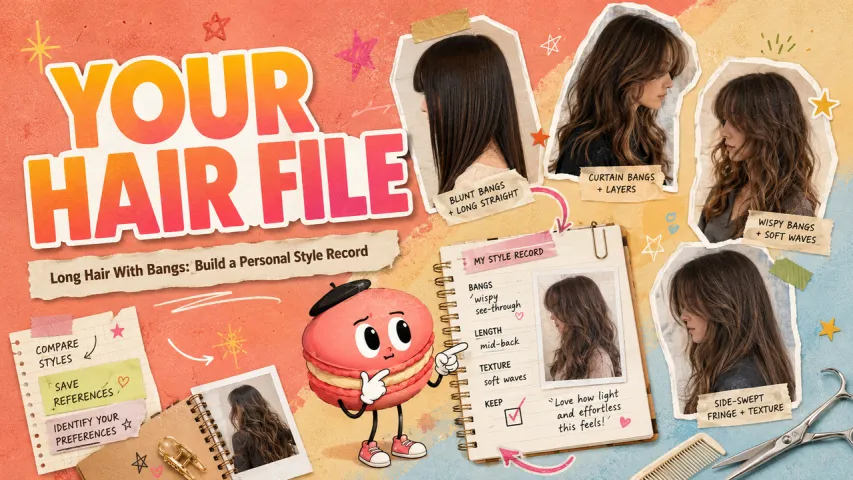
Read length, layers, fringe, and finish separately
Describe each image in four passes:
- Length: Where does the perimeter land relative to the jaw, shoulders, or back?
- Layers: Where do shorter sections begin, and how visible are they?
- Fringe: Is it blunt, separated, swept, or connected to face-framing pieces?
- Finish: Is the hair air-dried, curled, smoothed, diffused, or heavily styled?
Ask which parts can translate to your hair and routine. A reference is a conversation aid, not a promise of an exact copy.
Online photos also carry usage limits. The U.S. Copyright Office's photography guide explains that internet photographs can still be protected and that permission may be needed for reuse. Private saving, uploading to an app, showing a stylist, reposting, and publishing are different uses. Check the source license, platform terms, and rules that apply where you live before copying or sharing someone else's image. This is general information, not legal advice.
Build a Personal Haircut Decision Record
A decision record keeps one appointment from becoming a vague memory of what felt right or wrong. It can be a note, document, or table you control.
Past cuts, preferences, constraints, and follow-up notes
Use these fields:
If you choose to keep this record in Macaron, its current AI Personal Assistant page says Deep Memory is designed to remember preferences and context over time. Use it as a user-directed note and review layer. For visual exploration, Macaron's current Hair Renewal Magic Tool Playbook page describes portrait-based hairstyle previews. Treat those previews as reference material rather than a haircut record or salon-ready export.

Text notes may be enough. If you upload selfies or reference images, read the current Macaron Privacy Policy first. It says uploaded images may be processed and that necessary content may be sent to third-party AI providers. Macaron's current Terms of Service also require users to have the necessary rights for uploaded inputs. Avoid adding personal details that the haircut decision does not need.
Prepare a Salon Brief You Can Explain Clearly
Turn the record into a brief you can say aloud. Keep it short enough to discuss before the service begins.
Priorities, boundaries, and questions
Use this structure:
I want [main change] while keeping [important function or length]. My hair usually [relevant behavior], and I normally spend [realistic effort] styling it. I like [specific feature] in these references. I want to avoid [clear boundary]. What would you adjust, and how will this grow out?
Confirm the shared plan in plain language. Ask the stylist to show where the perimeter, shortest layer, and fringe will sit. If you do not understand a term, ask for a visual explanation before cutting begins.
This is also the right time to ask about price, appointment length, future trims, consultation options, and the salon's written correction policy. Service terms vary, so save the policy that applies to your appointment.
FAQ
Can virtual hairstyle apps export haircut records for salon visits?
Some can export or share visual results, but the format varies. Spacles currently says users can share a “Digital Blueprint” with a professional. The current TryOn Google Play listing describes save-and-share images. Neither creates a universal salon record standard. Check the app's export format, image quality, privacy terms, and current feature page before relying on it.
How should protective styles affect the timing of a haircut?
Ask the stylist which state they need to assess: in the protective style, immediately after takedown, fully detangled, stretched, or naturally settled. The sequence depends on the intended cut and service. Share the style history when booking, allow realistic takedown time, and avoid assuming one waiting period works for every technique or scalp condition.
What image permissions matter when saving celebrity haircut references?
The celebrity's presence does not make the photograph free to reuse. Check who owns the image, its source terms, and whether your planned use is private saving, app upload, salon sharing, or public reposting. Permission and legal exceptions vary by use and location. When uncertain, use a licensed source, the creator's approved sharing tools, or your own images.
Can a haircut consultation happen before booking the full service?
Yes, when the salon or independent stylist offers a consultation-only option. Ask whether it is virtual or in person and whether it has a fee. Also confirm whether that fee credits toward the cut and whether the same professional will perform the service. Save the answers from the salon's current booking information.
How do salon correction policies vary after an unsatisfactory cut?
Policies may set different contact windows, eligibility rules, responsible stylists, and remedies such as an adjustment or service credit. Save the policy in effect when you book. If there is a problem, contact the salon promptly with specific observations and photos. Ask what the policy covers before requesting a redo, refund, or work from another provider.
Conclusion
Choosing between haircut styles becomes easier when haircut ideas are tested against the life around the cut. Name the change you want, notice how your hair behaves, accept the maintenance you can support, and bring a record that makes the salon conversation easier.
Confidence does not require predicting the exact result. It comes from knowing your priorities, your boundaries, and the questions you still need a professional to answer.
Recommended Reads










Apply to become Macaron's first friends
Read & discover
AI Personal Assistant
Free calculators


