Intermittent Fasting Schedule: Every Protocol Explained
Intermittent Fasting Schedule: Every Protocol Explained

Hello, it's Anna here. I tried 16:8 for two weeks last fall. Made it to day eleven before I ate a granola bar at 10 AM and pretended it didn't count. That evening I looked at my fasting tracker app — the one with the little green circle that fills up as you fast — and thought, I don't even know why I picked 16:8. Was it because it's the best one, or just the one I saw first on Instagram?
If you've ever started an intermittent fasting schedule without really understanding what the different protocols do — or picked one just because a friend swore by it — this is the breakdown I wish I'd read before I began. Not the motivational version. The actual mechanics of each fasting window, what a real day looks like on each one, what breaks a fast (this gets more complicated than you'd think), and how to figure out which schedule doesn't fight your actual life.
No IF evangelism here. Just what I've learned from trying it, quitting it, trying it again, and reading way too many studies at midnight.
What Intermittent Fasting Actually Does (Beyond the Eating Window)
Most people think intermittent fasting is just "skip breakfast." That's like saying running is "moving your legs fast." Technically true, completely unhelpful.
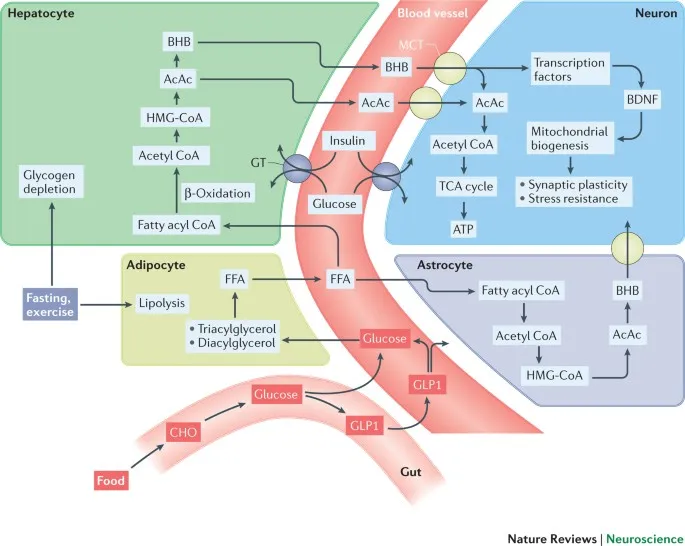
The real thing happening inside your body during a fast is a metabolic shift. And it doesn't kick in the moment you stop eating.
The Metabolic Shift After 12–14 Hours
When you eat, your body runs on glucose. That's its preferred fuel — easy to access, easy to burn. After your last meal, your body spends roughly 8–12 hours working through its glycogen stores (that's stored glucose, mostly in your liver and muscles).
Once those reserves get low, your body starts flipping to a different fuel source: fatty acids and ketone bodies. A 2025 review in Nature Metabolism describes this as "cyclic metabolic switching" — the back-and-forth between glucose-burning and fat-burning states. The researcher behind the theory, Mark Mattson at Johns Hopkins, argues that this cycling itself may drive many of the health effects people associate with fasting. Not just the calorie deficit. The switching.
This is why timing matters. A 10-hour eating window might not give your body enough fasting time to fully engage that switch. A 6-hour window almost certainly does. The protocols below are all variations on how long and how often you let that switch flip.
What the Evidence Actually Supports

I spent an embarrassing number of hours reading meta-analyses on this. Here's where the research is fairly solid as of early 2026:
Reasonably well-supported: Modest weight loss (comparable to standard calorie restriction), improved insulin sensitivity in people with metabolic issues, reduced fasting blood glucose, and lower triglycerides. A 2025 meta-analysis in Nutrition Journal looking at 15 randomized controlled trials found that IF consistently reduced body weight and improved several cardiometabolic markers in overweight adults.
Less settled: Whether the benefits come from the fasting itself or from the calorie reduction that usually comes with it. A January 2026 study published in Science Translational Medicine tested time-restricted eating in women with overweight while keeping calories constant — and found no metabolic benefit when calories didn't change. That's a significant finding. It suggests that for metabolic improvement, you probably need the calorie deficit too, not just the time restriction.
Not proven: That IF is superior to regular calorie restriction for weight loss. Most head-to-head comparisons show similar results. The advantage of IF, if there is one, is that some people find it easier to stick to. That's not nothing — adherence is everything with any eating approach — but it's a practical advantage, not a metabolic one.
What It Doesn't Do That People Claim
IF doesn't "reset your metabolism." It doesn't reliably extend human lifespan (the longevity data is mostly from animal models). It doesn't "detox" anything. And while autophagy gets mentioned constantly in IF circles, the evidence for meaningful autophagy activation during typical IF windows in humans is still thin. Most of that research comes from prolonged fasts in animals.
The Main Fasting Protocols — In Depth
Here's where most articles give you a table with hours and move on. I'm going to walk through what a real day actually looks like on each one, because that's what determines whether you'll stick with it.
16:8 — How a Real Day Looks
The basics: Fast for 16 hours, eat within an 8-hour window. Most popular IF schedule by a wide margin.
A realistic day: You finish dinner at 8 PM. You skip breakfast and have your first meal at noon. Your eating window runs from noon to 8 PM — lunch, a snack, dinner. That's it.
What it actually feels like: The first 3–4 days are rough if you're used to eating breakfast. You'll notice hunger around 9–10 AM. By the end of the first week, most people report that morning hunger fades significantly. Black coffee helps. A lot.
The honest truth: 16:8 is popular because it's the most livable — but "livable" depends on your schedule. If you work 7 AM to 3 PM, a noon-to-8 window means fasting through your entire workday. That's a different experience than someone who starts at 10. It also doesn't work great for early morning exercisers who need fuel, or parents whose mornings revolve around family breakfast.
18:6 — Who It Suits vs 16:8
Fast 18 hours, eat within 6. Two fewer hours means two meals instead of two-plus-snack. Window might be 1 PM to 7 PM.
Makes sense if 16:8 already feels easy and you want to push deeper into the metabolic switching zone. Doesn't make sense if 16:8 is already a stretch — and squeezing adequate nutrition into 6 hours requires deliberate planning. Undereating in a narrow window is one of the most common IF mistakes.
5:2 — How the Two Low-Calorie Days Work
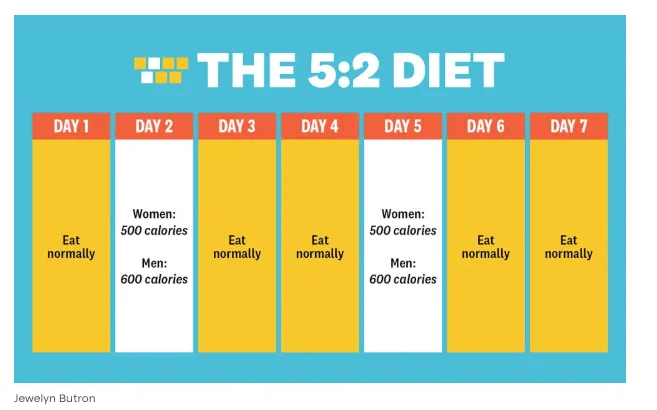
The basics: Eat normally five days a week. On two non-consecutive days, eat roughly 500–600 calories total.
What a fasting day looks like: You might have a 250-calorie lunch (think a large salad with chicken) and a 300-calorie dinner (soup, vegetables, a small piece of fish). Or one 500-calorie meal. The structure is flexible, but total intake stays under 600.
What surprised me: 5:2 is a completely different experience from daily time-restricted eating. You never deal with daily hunger adjustment. Five days a week, you eat normally — no watching the clock, no skipping breakfast. The two restricted days are harder in isolation, but they're only two days. Some people find this psychologically easier than daily restriction.
The evidence note: The 5:2 approach has been studied by researcher Michelle Harvie and colleagues at the University of Manchester. Their work suggests comparable weight loss to daily calorie restriction, with some evidence of better insulin sensitivity improvement — though results vary across studies.
Who it works for: People who hate daily restrictions or have unpredictable social schedules. Plan the two low days around quieter days.
The catch: Those low-calorie days feel miserable without a plan. Going in blind usually ends in crackers at 3 PM and starvation by 7. And some people compensate by overeating on normal days, which wipes out the deficit.
OMAD — The Extreme End and Its Risks
The basics: One Meal A Day. All your calories in a single meal, then fast for roughly 23 hours.
I'll be direct: OMAD is hard to do well. Getting adequate nutrition in one sitting is a real challenge — you'd need 1,200 to 2,500 calories depending on your size and activity. According to the Johns Hopkins intermittent fasting overview, extended fasting can produce metabolic benefits, but practically, most OMAD practitioners end up in unintentional severe calorie deficits. Over time: tanked energy, hormonal disruption, muscle loss.
It tends to work better as a short-term tool than a permanent lifestyle. I tried it for five days. By day three, my one meal had turned into a 90-minute eating marathon. That's not a healthy relationship with food. I stopped.
12:12 — The Beginner Entry Point
The basics: Fast for 12 hours, eat within 12 hours. This is barely a "fast" by IF community standards — but it's where most beginners should start, and it's where research suggests the metabolic switch begins to engage.
What it looks like: Dinner at 7 PM, breakfast at 7 AM. That's it. For many people, this is close to what they already do — minus the late-night snacking.
Why it matters: 12:12 builds the habit of having a defined eating window without the stress of hunger management. It also eliminates nighttime eating, which alone has been associated with weight gain and poor metabolic outcomes in multiple studies.
The underrated move: If you currently eat from 7 AM to 11 PM (which a lot of people do when you count the after-dinner snacks and the glass of wine at 10), going to 12:12 is a bigger shift than it sounds.
How to Choose Your Protocol
Based on Your Daily Schedule
This matters more than any metabolic argument. An IF protocol you can't maintain is worthless.
表格 还在加载中,请等待加载完成后再尝试复制
Based on Your Goal
Fat loss: Any protocol works, provided you're in a calorie deficit during the eating window. IF doesn't override thermodynamics. 16:8 and 5:2 have the most supportive evidence.
Maintenance: 12:12 or 14:10 keeps eating structured without extreme restriction.
Muscle preservation or gain: Be careful with longer fasting windows. Protein timing matters here — you need sufficient protein (more on this below), and cramming it into one or two meals is less effective for muscle protein synthesis than spreading it across three.
Based on Your Relationship With Food
If you have a history of binge eating, restrictive eating, or any eating disorder — read the "Who Should Not Do IF" section below first. Even without a clinical history, pay attention: if IF makes you obsess over the clock, feel anxious about "breaking your fast," or swing between restriction and overeating — that's a signal. The protocol isn't working for you.
What Actually Breaks a Fast
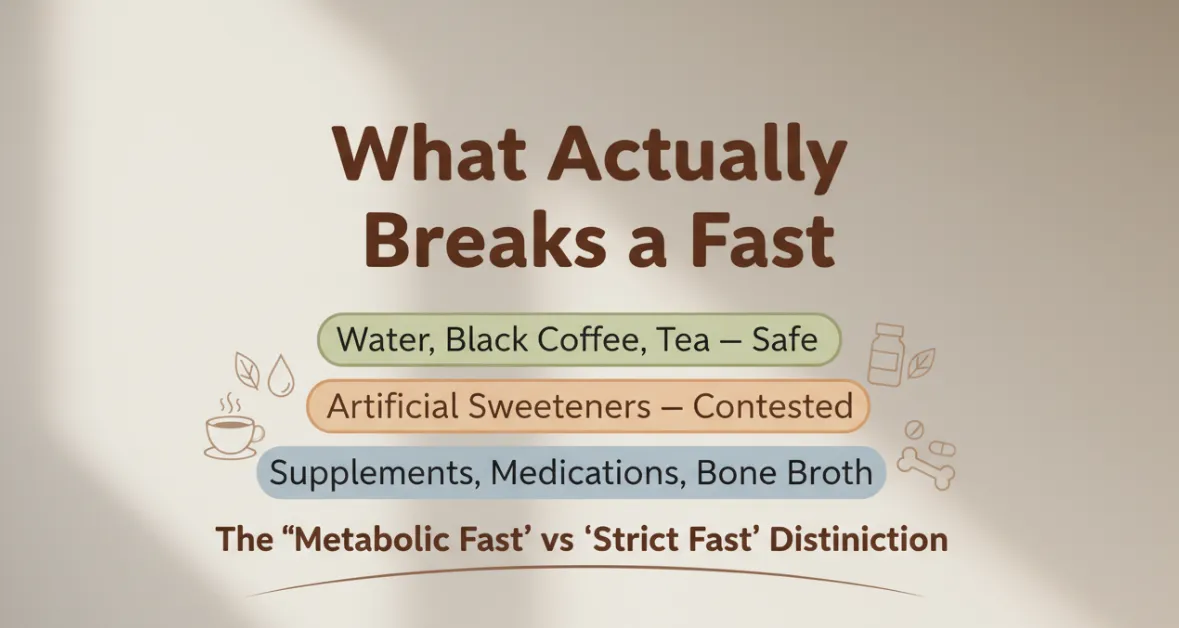
This is the most-searched IF sub-question, and the answers online are all over the place. Let me try to sort through it clearly.
Water, Black Coffee, Tea — Safe
Plain water, sparkling water, black coffee, and unsweetened tea do not break a fast by any reasonable definition. Zero calories, no insulin response, no digestive activation.
Black coffee actually appears to support some fasting benefits — caffeine mildly increases fatty acid oxidation. Just don't add milk, sugar, or cream.
Artificial Sweeteners — Contested
Depends on the sweetener and your goals. Research published in Cell Metabolism in 2025 found aspartame triggered insulin release in mice. In humans, a 2013 study found sucralose raised insulin levels by about 20% compared to water. But other studies show minimal or no response.
Practically: If you need a diet soda to get through your fast, the small potential insulin blip is probably less harmful than breaking the fast entirely. If you want maximum metabolic benefit, stick to plain water. Stevia and monk fruit appear to have the least impact, but research is still early.
My rule: black coffee, plain water, plain tea. I dropped Splenda from my fasting coffee because it seemed to make me hungrier.
Supplements, Medications, Bone Broth
Medications: Take them as prescribed, period. If your medication requires food, eat. Your medication schedule overrides your fasting schedule. Always.
Supplements: Fat-soluble vitamins (A, D, E, K) absorb better with food, so save those for your eating window. Most other supplements are fine during a fast, though some people report stomach discomfort with supplements on an empty stomach.
Bone broth: Contains calories and protein. It breaks a strict fast. But some people use it during longer fasts (24+ hours) to manage electrolytes and hunger. If you're doing standard 16:8, you don't need bone broth during your fasting window.
The 'Metabolic Fast' vs 'Strict Fast' Distinction
A strict fast means zero calories — water, black coffee, plain tea only. A metabolic fast means keeping your body in a fasting-adjacent state with minimal insulin disruption. Under this definition, a splash of cream in your coffee probably doesn't meaningfully disrupt the process.
For weight loss, the metabolic fast standard is plenty. For research-level purity, strict fast. For most people doing 16:8? Stop stressing about whether your black coffee has 3 calories.
How to Structure Meals Within Your Eating Window
When to Place Protein
This matters if you care about muscle. A 2025 review in Endocrine Reviews noted that muscle protein synthesis responds better to protein spread across multiple meals rather than all at once. For a 16:8 window: aim for 30–50 grams per meal. The general target is 0.7–1 gram per pound of body weight daily.
What to Eat to Break a Fast Comfortably
After 16+ hours of fasting, your digestive system is essentially in idle mode. Slamming it with a huge, heavy meal can cause bloating, cramping, and that unpleasant too-full feeling.
Start with something moderate: eggs, yogurt, a handful of nuts, or some fruit with protein. Give yourself 20–30 minutes, then have your full meal. Your stomach adjusts to fasting over time, but in the first few weeks, easing in matters.
Combining IF With Calorie and Macro Goals
Your total daily energy expenditure doesn't change because you shifted when you eat. If you need 2,000 calories to maintain, you still need 2,000 — whether eaten across 12 hours or 6. IF often causes unintentional calorie reduction simply because fewer meals means less food. That's the mechanism behind much of its weight loss benefit, not metabolic magic.
With a compressed window, protein requires planning. For someone targeting 120–150 grams per day across two meals, that's 60–75 grams per meal. Chicken, eggs, Greek yogurt, fish — you need a dense protein source every time you eat. Inadequate protein during IF is one of the main drivers of muscle loss, and muscle loss tanks your metabolism long-term.
Common Mistakes and How to Fix Them
Eating too little during the window. The most common mistake, especially with 18:6 and OMAD. People fast successfully, then eat a small meal because they're "not that hungry" — and end up in a chronic deficit. Fatigue, irritability, eventual binge eating. The fix: track your food for one week to confirm you're eating enough.
Eating too much during the window. The opposite problem. "I fasted all morning, so I deserve this." IF is not a loophole around energy balance. The fix: structured meals, protein and fiber at every one, minimal grazing.
Choosing a protocol that fights your schedule. I know someone who picked OMAD because it sounded "hardcore," then tried to eat one massive meal at 2 PM during the workday. Bloated through every afternoon meeting for two weeks. The fix: be honest about your daily rhythm.
Who Should Not Do Intermittent Fasting
This section isn't optional. Skip this at real risk.
People with a history of eating disorders or disordered eating. IF involves deliberate food restriction and clock-watching. For anyone with a history of anorexia, bulimia, binge eating disorder, or disordered eating patterns, this can be triggering. A commentary in Clinical Diabetes and Endocrinology highlighted that younger, more female populations showed the strongest associations between IF and disordered eating behaviors. If you're in recovery, or if you notice IF is making you anxious or obsessive about food — stop.
Pregnant or breastfeeding people. Pregnancy and breastfeeding increase caloric and nutritional needs significantly. Calorie restriction during these periods can affect fetal development and milk production. This is not a "talk to your doctor first" situation — it's a "don't do this" situation.
People with type 1 diabetes. Fasting causes dangerous blood sugar fluctuations on insulin. The Johns Hopkins diabetes guide explicitly states IF is not recommended for type 1.
Type 2 diabetes on insulin or sulfonylureas. Hypoglycemia risk during fasting. Only attempt under medical supervision with medication adjustments.
Children, adolescents, and frail older adults. Growing bodies need consistent nutrition; frail adults risk accelerated muscle loss.
People on medications requiring food. Your medication schedule takes priority. Always.
If you're unsure whether IF is appropriate for your situation, talk to your doctor. Genuinely. Not an influencer. Not a subreddit. A doctor who knows your medical history.
How to Switch Protocols If the First One Isn't Working
Signs it's not right: persistent fatigue beyond week one, constant food preoccupation, overeating when the window opens, disrupted sleep, feeling worse after 2–3 weeks.
Move in 1–2 hour increments. If 16:8 is too aggressive, try 14:10 for two weeks. Don't jump from 12:12 to OMAD. Some people cycle protocols — 16:8 on structured work weeks, 12:12 on weekends, 5:2 during travel months. There's no rule that says your schedule has to be identical year-round.
FAQ
Does Intermittent Fasting Work Without a Calorie Deficit?
For weight loss — probably not. The 2026 Science Translational Medicine study found no metabolic benefit from time restriction alone when calories were constant. For benefits like simplified eating and reduced nighttime snacking, the time structure may help regardless.
Can I Work Out While Fasting?
Yes. Low-to-moderate cardio is fine fasted. Heavy strength training may suffer — if you lift fasted, prioritize protein in your first meal after.
Will I Lose Muscle on IF?
You can, if protein is too low or your deficit is too aggressive. Target 0.7–1 g protein per pound of body weight and keep resistance training in the mix.
How Long Until IF Shows Results?
Reduced bloating and better energy within 1–2 weeks. Measurable weight loss in 2–4 weeks with a deficit. Metabolic markers may take 4–8 weeks.
Can I Do IF Every Day?
16:8 and 12:12 are designed as daily protocols. OMAD can be done daily but is harder to sustain nutritionally. If it starts feeling like punishment, scale back.
The thing nobody tells you about intermittent fasting is that the protocol matters way less than whether it fits your life. I spent weeks comparing 16:8 versus 18:6 when the real question was simpler: can I skip breakfast without being miserable at work?
Pick one protocol. Try it for two weeks. Adjust. That's the whole strategy.
Previous posts:











Apply to become Macaron's first friends
Read & discover
AI Personal Assistant
Free calculators


