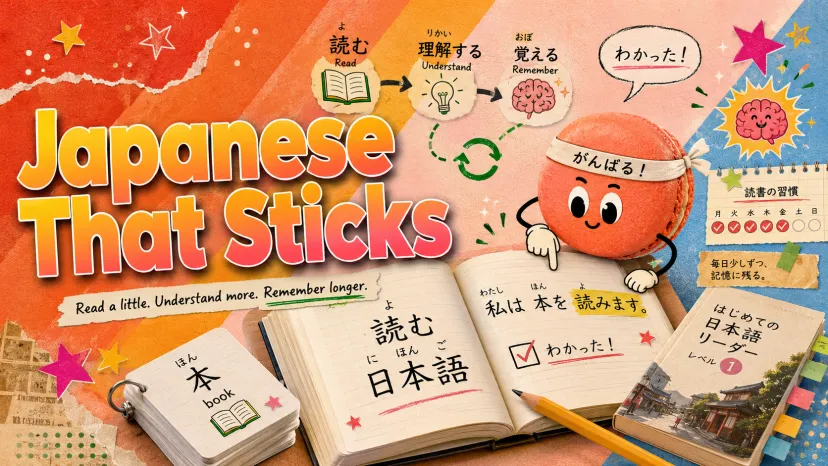
Japanese Language Reading Practice That Actually Sticks
Japanese Language Reading Practice That Actually Sticks
It's 9:40 on a Tuesday night. A graded reader is open on your knees, your phone is in your left hand, and the word you're looking up right now is one you looked up eleven days ago. You even remember the page you first saw it on. You just don't remember what it meant.
That gap is what this piece is about. Not more reading — better returning. Below: how to pick material you'll actually revisit, how to save a word so it survives the week, and what to do when your notes turn into a graveyard.
I'm Mary, and I write about the small habits and tools that make everyday learning easier. I’m interested in the quiet gap between wanting to improve and actually building routines that last.
The short version
Reading once is exposure. Reading again, later, is learning.
Pick material you can go back to without embarrassment.
Save the sentence, not the definition.
Give your old notes a way to find you.
Japanese Reading Practice Needs Repetition
Here's the thing — the part of Japanese language reading practice that fails is almost never the reading. It's the coming back.
I spent one very proud month reading roughly forty pages of a mystery novel. I finished. I retained maybe four words. Not because the pages were too hard, though they were, but because every word I met, I met exactly once. Exposure without return is just a nice evening with a dictionary.
The research on this is unglamorous and stubborn. Words come back when you meet them again after a gap, and the gap matters more than the total minutes you put in — work on spaced review scheduling keeps landing on the same conclusion: what you review, and when, predicts recall better than how long you sat there.
Which is exactly why "read more" is such useless advice. Reading more is easy. Reading the same thing again, three days later, when it's boring and you already know the plot — that's the hard part. That's also the part that works.
A repetition rhythm that survives a bad week
When
What you do
How long
Day 1
Read a new passage. Mark words, don't look them all up.
10–15 min
Day 2
Reread the same passage. Look up only what still blocks you.
5 min
Day 4
Reread once more, aloud.
5 min
Day 10
Read only your saved sentences from that passage.
3 min
Four touches. Under half an hour total. I don't hit all four every time. Nobody does. Three out of four still beats one perfect session followed by silence.
Choose Reading Material You Can Return To
Most reading material is chosen for how impressive it feels on day one. The better question: will you open this again on day four, when the novelty is gone?
The test I use now is embarrassingly simple. Can I finish a chunk of it in under fifteen minutes? Do I know where the ending is? Would rereading it feel like revisiting, not restarting? If a text fails all three, it's a "someday" text, not a practice text.
Difficulty helps here, and the official JLPT level descriptors for reading are useful for a reason nobody advertises — they describe what kind of text you should be able to handle, not which grammar points to memorize. N4 talks about short passages on familiar daily topics. N2 talks about newspaper commentary. Read the descriptors, find where you actually live, then pick material one small step above it. Not four steps.
And a quiet warning: something being level-appropriate doesn't make it re-readable. A workbook passage about renting an apartment is perfectly N3. You will never want to see it twice.
Short passages, graded text, manga snippets, and everyday signs
Four material types, four different jobs.
Short passages. News summaries written for learners, recipe steps, a paragraph of a blog post. Best for the day-1-to-day-4 rhythm above because you can hold the whole thing in your head.
Graded readers. The most under-loved resource in the entire hobby. They're written to be finished, which means they're written to be reread. Start one level below where your pride wants you.
Manga snippets. One page, not one volume. Dialogue-heavy, so it doubles as Japanese speech-style oral-reading practice — read the lines aloud and you're doing something closer to speech than to study. The pictures carry meaning the words haven't handed you yet, which is exactly why beginners can read them at all, and also why you should sometimes cover the panel and check whether you'd understand the line without it.
Everyday signs. Station boards, menus, packaging, the label on the shampoo. Short, high-frequency, and legally free to photograph and keep. One small thing worth knowing: Japan's Agency for Cultural Affairs replaced the seventy-year-old romanization standard in December 2025, adopting Hepburn spellings — し as shi, つ as tsu — in the cabinet notification on romanization. Older textbooks still print si and tu. If a sign and a workbook disagree, that's why.
Copying a sign by hand, kana for kana, is the cheapest Japanese language writing practice there is. You'll notice stroke shapes you've been reading past for months.
Save Words With Context, Not Just Definitions
I kept a word list for two years. 900 entries. Word on the left, English on the right. I could not tell you what a single one of them was doing in a sentence.
A bare definition tells you what a word means. It doesn't tell you where it lives — what it attaches to, what register it belongs to, whether a person says it or only a novel writes it. Context does that. So the unit you save shouldn't be a word. It should be a sentence with the word still inside it.
What a saved entry needs
The full sentence, unchanged.
Where it came from, and the date.
One line on why you stopped: confusing kanji, unexpected particle, the feeling was interesting.
Nothing else. No color coding. No tags you'll never search.
Item three is doing more work than it looks. Vocabulary you connect to yourself — your reaction, your confusion, your reason — sticks better than vocabulary you merely define; there's a decent body of work on the self-reference effect in second-language vocabulary suggesting the personal hook is part of the memory, not decoration on it.
Reading your saved sentences aloud a week later folds in Japanese language pronunciation and oral-reading practice almost by accident. You hear the rhythm of a line you already understand, which is a very different experience from hearing a line you're decoding in real time.
One boundary worth respecting. Copying a sentence or two from a book into private notes sits comfortably inside normal practice; typing up whole chapters and sharing them does not. The U.S. Copyright Office's summary of the four fair use factors is plain-English and worth ten minutes, especially the part about how much of a work you took. Short excerpt, private notebook, your own commentary. That's the shape.
How Personal AI Can Help Build a Reading Memory
Here's the part I resisted for a long time. Every AI I'd tried made me re-explain myself: my level, what I'd read, which kanji I keep confusing. Ten minutes of setup to get five minutes of help.
Macaron works differently, and the difference is Deep Memory — it holds onto what you've told it across sessions, so the sentence you saved from a manga panel in March is still there in June, still attached to the reason you saved it. It's an AI friend that happens to remember your reading, not a place where reading goes to be filed.
What that looks like in practice: you paste a sentence, say why it stopped you, and move on. Weeks later you say "give me the words I flagged from that recipe blog," and they come back with their sentences attached. Ask it to build a small review tracker for your four-touch rhythm and it makes one from a single request — that's the mini-app part, and it's the only part that ever made my review habit survive a bad month.
Where I'd hold back: an AI friend is good at explaining, remembering, and keeping you company at 9:40pm. It is not a Japanese teacher, and it will sometimes give you a confident explanation of a grammar point that a textbook renders differently. I've had that happen twice. Both times the textbook was right.
Also — keep Japanese language proficiency test practice in its own lane. Timed sections and casual reading want opposite things from your brain.
Worth trying if you're tired of re-explaining your level to something that forgot you last Tuesday. Try Macaron with one sentence you've been stuck on.
FAQ
How should learners handle copyrighted text or book excerpts?
Save short excerpts for private study, always with the source noted. Don't rebuild whole chapters in your notes, don't distribute them, and be extra careful with anything a publisher sells as practice material. If you're unsure, the fair use factors linked above are the actual test, and length is only one of the four.
What if romanization and kana practice get mixed together?
Separate them early, then drop the romanization. Romaji is a bridge for the first few weeks, not a parallel track — and since Japan's official spellings changed at the end of 2025, older materials will disagree with new signage anyway. Reading kana slowly beats reading romaji fluently.
When should JLPT practice stay separate from casual reading?
Once you've registered for a level. Test reading is a speed-and-elimination skill under a clock; casual reading is a noticing skill without one. Doing both in the same sitting tends to make you skim the novel and overthink the test. Keep casual reading daily, and give test practice its own two or three blocks a week in the eight weeks before the exam.
What if an AI explanation conflicts with a textbook?
Trust the textbook, then go looking for why they disagree. Usually it's register — a form that's technically correct but nobody writes it that way — or an older romanization convention. An explanation that can't tell you why the other source says something different is an explanation you shouldn't bank on.
How can learners revisit old reading notes without clutter?
Stop archiving and start surfacing. Once a week, pull ten saved sentences at random and read them aloud. Delete the ones that no longer stop you — deletion is progress, not loss. Notes you never reopen aren't a record of learning; they're a record of intending to learn.
It's been about a year of doing it this way. I still keep a word list. It's a lot shorter than the old one, and every entry has a sentence hanging off it like a tail. Some mornings I open it and remember exactly where I was standing when I saved something.
That's not fluency. But it's the first time the reading has felt like it accumulated somewhere instead of just passing through.
Three years in creative consulting, which mostly means I've tried every productivity system out there and abandoned most of them within a week.
I'm not undisciplined. I just figured out early that most tools aren't really built for the way my brain works — and once I accepted that, things got a lot quieter.
I write about what actually helps. Not for everyone. Just maybe for you.