LBM vs Body Fat Percentage — What's the Difference?
Why LBM Matters More Than Scale Weight
How to Use LBM for Fitness Goals
Limitations of LBM Calculators
Put Your LBM to Work in Your Meal Plan
FAQ
Related Reading
Lean Body Mass Calculator: What It Tells You
Lean Body Mass Calculator: What It Tells You
The scale is a frustrating tool. It tells you your total weight — but not whether that weight is mostly muscle, mostly fat, or somewhere in between. Two people can weigh exactly the same and have completely different body compositions, different metabolic rates, and different health profiles.
Lean body mass (LBM) is the measurement that starts to answer the more useful question: what's actually in that number?
What Lean Body Mass Actually Is
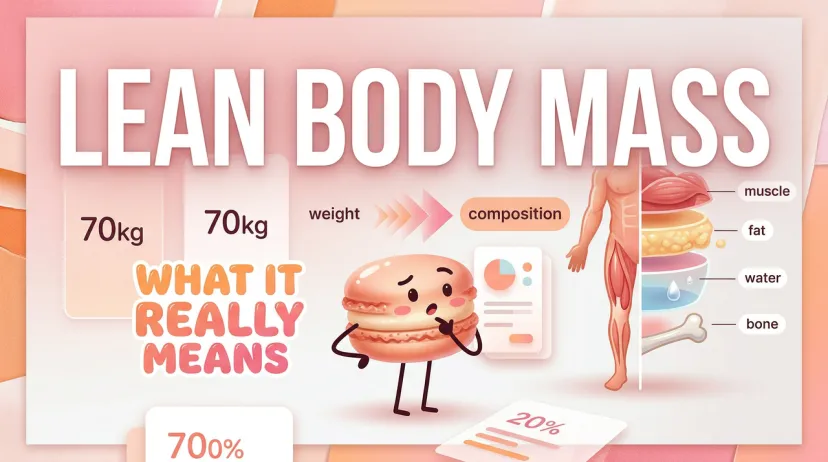
Lean body mass is everything in your body except fat. That includes:
Skeletal muscle
Bone
Organs (liver, kidneys, heart, lungs)
Skin
Blood and water
It's sometimes called fat-free mass, though technically there's a small distinction — lean body mass includes a tiny amount of essential fat in organs and bone marrow, while fat-free mass does not. For practical purposes in fitness and nutrition contexts, the two terms are used interchangeably.
What LBM is not: a measure of muscle alone. Muscle is the largest component of LBM for most active adults, but bones and organs contribute significantly. A 75kg person with 60kg of LBM has 60kg of all these tissues combined, not 60kg of muscle.
Typical LBM as a percentage of total body weight:
Men: approximately 75–90%
Women: approximately 68–85%
These ranges are wide because they vary substantially with age, training history, and body composition.
How a Lean Body Mass Calculator Works
Most LBM calculators use one of three established formulas derived from clinical research, all of which estimate LBM from weight, height, and sex:
Boer Formula (1984) — considered the most widely used clinically:
Men: LBM (kg) = (0.407 × weight in kg) + (0.267 × height in cm) − 19.2
Women: LBM (kg) = (0.252 × weight in kg) + (0.473 × height in cm) − 48.3
James Formula (1976) — one of the earlier validated equations, still used in pharmacological contexts:
All three formulas were developed from studies using body composition measurements, and all three produce results within a few kilograms of each other for people of average build. The spread between them — typically 1–3 kg — is itself a useful indicator of the uncertainty inherent in formula-based estimation.
If you know your body fat percentage from a reliable measurement, there's a simpler and more accurate approach:
LBM = Total body weight × (1 − body fat percentage)
So a 70kg person at 20% body fat has an LBM of 70 × 0.80 = 56kg.
LBM vs Body Fat Percentage — What's the Difference?
They're measuring related but different things.
Body fat percentage tells you what proportion of your total weight is fat — typically expressed as a percentage. It's a ratio, not an absolute number. Someone at 20% body fat has 20% of their total weight as fat tissue and 80% as lean mass.
Lean body mass is the absolute weight of all non-fat tissue. It's a number in kilograms or pounds.
You can have the same LBM but different body fat percentages if total body weight differs. A 70kg person with 56kg LBM is at 20% body fat. An 80kg person with the same 56kg LBM is at 30% body fat. Same lean mass, different fat percentage.
Both metrics are useful. Body fat percentage gives context for composition relative to your overall size. LBM tells you the absolute amount of metabolically active tissue you're carrying — which is what drives your basal metabolic rate and your strength capacity.
Why LBM Matters More Than Scale Weight
The scale's main limitation is that it can't distinguish between fat loss, muscle gain, water fluctuation, and actual weight change. LBM tracking addresses this.
For metabolism: Lean tissue is metabolically active — it burns calories at rest. Fat tissue burns very few. This is why two people at the same weight but different body compositions can have significantly different calorie needs. Higher LBM means higher BMR. When calculating TDEE, using LBM (rather than total body weight) in the Katch-McArdle formula produces more accurate calorie estimates for people with above-average or below-average muscle mass.
For protein targets: Protein recommendations for body composition goals are based on lean mass, not total weight. A 90kg person who is 35% body fat has an LBM of about 58.5kg — and their protein target based on LBM will be lower than if calculated from total body weight. This matters when setting precise nutrition targets.
For tracking progress accurately: During a body recomposition phase — losing fat while maintaining or building muscle — the scale may not move much or at all. LBM tracking reveals what's actually happening: if LBM is stable or increasing while total weight is dropping, you're succeeding even when the scale looks discouraging.
How to Use LBM for Fitness Goals
Setting calorie targets. The Katch-McArdle formula calculates BMR from LBM directly: BMR = 370 + (21.6 × LBM in kg). This is more accurate than the Mifflin-St Jeor equation for people who are significantly more muscular or have more body fat than average.
Setting protein targets. During fat loss, targeting 2.0–2.4g of protein per kg of LBM (rather than total body weight) is a common approach for athletes or people with higher body fat percentages. It prevents protein targets from being inflated by fat mass.
Tracking recomposition over time. Measuring LBM at consistent intervals — every four to six weeks — gives a clearer picture of whether your training and nutrition approach is working than scale weight alone. To do this, you need consistent body fat estimates over time, which requires a consistent measurement method.
Limitations of LBM Calculators
Formula-based estimates have meaningful error margins. A study in PMC compared the Boer, James, and Hume formulas against CT-derived body composition measurements, finding 95% limits of agreement of roughly ±12–13 kg — a considerable range for individuals, though the formulas work better as population-level tools than individual precise measurements.
Very muscular or high body fat individuals are poorly served. All three formulas were developed from populations of average build. They tend to underestimate LBM in people with high muscle mass (bodybuilders, strength athletes) and overestimate it in people with high body fat. If you fall significantly outside the average range, formula-based estimates are less reliable.
LBM naturally decreases with age. After approximately age 30, lean mass declines at roughly 0.5–1% per year — a process called sarcopenia. A calculator doesn't tell you whether your LBM is appropriate for your age or how it compares to your history.
Direct measurement is more accurate. DEXA (dual-energy X-ray absorptiometry) scanning provides a direct measurement of lean mass, fat mass, and bone density, with substantially better precision than formula estimates. For people making serious decisions based on body composition data, a periodic DEXA scan produces more reliable information than any calculator.
For most people tracking fitness progress, formula estimates are a useful starting point. Treat the number as a directional indicator rather than a precise measurement, and use changes over time — rather than a single data point — as the meaningful signal.
Put Your LBM to Work in Your Meal Plan
Knowing your lean body mass makes your nutrition targets more accurate — particularly protein and calorie goals. At Macaron, we built our AI to plan meals around your specific targets and remember your preferences across conversations. Try it free and build a week of eating that's calibrated to what your body actually needs.
FAQ
Is Lean Body Mass the Same as Muscle Mass?
No. Muscle is the largest component of LBM but not all of it. LBM includes bones, organs, skin, blood, and body water — all non-fat tissue. For most adults, skeletal muscle accounts for roughly 40–50% of LBM. The rest is bone, organs, and water. A lean body mass calculator gives you the total of all non-fat tissue, not an isolated muscle measurement.
What's a Good Lean Body Mass?
There's no universal target — LBM depends on your height, sex, age, and fitness level. As a rough reference: men typically have LBM in the range of 75–90% of total body weight; women 68–85%. Higher percentages generally reflect lower body fat and more muscle mass. For fitness goals, the more useful question is whether your LBM is stable or increasing over time, particularly if you're losing weight — which indicates you're losing fat rather than muscle.
How Can I Increase My Lean Body Mass?
The two main levers are resistance training and adequate protein intake. Resistance training creates the stimulus for muscle protein synthesis; protein provides the raw material. Research consistently shows that protein intakes of 1.6–2.2g per kg of body weight, combined with progressive resistance training, are the most effective combination for building and maintaining lean mass. Calorie intake also matters — it's very difficult to gain substantial LBM in a significant calorie deficit.
Hey — I'm Jamie. I try the things that promise to make everyday life easier, then write honestly about what actually stuck. Not in a perfect week — in a normal one, where the plan fell apart by Thursday and you're figuring it out as you go. I've been that person. I write for that person.