MPG Meaning: What Miles Per Gallon Actually Tells You
MPG Meaning: What Miles Per Gallon Actually Tells You

You've seen the number on the window sticker — 32 city, 28 highway — and on a fuel-up app, and in the back of your mind when a road trip is coming. But what does that figure actually promise you, and what does it quietly leave out?
That's the gap worth closing. The mpg meaning most people carry around is "higher is better," which is true but not very useful when you're trying to guess what a specific drive will cost. I’m Mary, a content creator focused on minimalist travel and efficient planning. I hate guesswork, especially when it comes to travel budgets.
This explains it plainly: what miles per gallon really measures, how to work out your own, why the real number drifts from the sticker, and how to turn it into something useful for planning a trip.
The short version:
- MPG = miles you can drive on one gallon of fuel.
- Calculate it: miles driven ÷ gallons used.
- The sticker number is an estimate; your real MPG usually runs lower.
- For a trip, your real MPG is the one worth using.
What MPG Means in Plain English
MPG stands for miles per gallon — simply, how far your car travels on a single gallon of fuel. A 30 MPG car goes about 30 miles per gallon; a 20 MPG car, about 20. Higher means you burn less fuel to cover the same distance.

The catch in the mpg meaning is that the number on the sticker isn't a promise — it's an estimate. As fueleconomy.gov explains in why your mileage will vary, the official figures come from standardized tests meant to let you compare cars fairly, not to predict exactly what you'll get. The EPA's own your mileage may vary page makes the same point: your real number depends on how, where, and what you drive. So treat the sticker MPG as a comparison tool between cars — and your own measured MPG as the one that tells you the truth about your car.
How to Calculate Your MPG
Wondering how do you calculate your mpg without an app doing it for you? It's one division problem, and you only need two numbers from a single tank.
Miles driven
This is how far you went on the fuel you're measuring. The easy way: fill up, reset your trip odometer to zero, drive normally, and at your next fill-up read the trip miles. That figure — say 300 — is your distance. (If you'd rather not reset anything, how do i figure out my miles per gallon still works by subtracting your old odometer reading from the new one.)
Fuel used
At that next fill-up, top the tank back to full and look at how many gallons the pump added — say 10. Because you filled all the way both times, those gallons are exactly what the trip consumed. That's the number a lot of people miss when they ask how do you find mpg.
Basic formula
Now divide: miles ÷ gallons. So 300 ÷ 10 = 30 MPG. That's it — that's how do you figure out your mpg, start to finish. Do it across a few tanks and average them; a single tank can be thrown off by one unusual drive.
Why Real MPG Changes
Here's where the mpg meaning gets practical. Your real number moves around, sometimes a lot, and it's almost always the sticker's optimistic cousin. Three things move it most.
Driving style
How you drive matters more than people expect. Per fueleconomy.gov's driving-more-efficiently guidance, aggressive speeding, hard acceleration, and sharp braking can cut gas mileage substantially — and idling burns fuel while you go nowhere. Smooth and steady beats fast and jerky, every tank.
Traffic and terrain
Stop-and-go city traffic and hilly roads pull your MPG down; steady highway cruising lifts it. The factors laid out by fueleconomy.gov's many factors affect MPG page show why the same car returns very different numbers on a mountain commute versus a flat interstate run.
Car load and weather
Weight and conditions count too. A loaded car, a roof box catching wind, underinflated tires, or cold weather all drag the number down. None of it is dramatic on its own, but stacked together they explain a surprising chunk of the gap between the sticker and your reality.

How MPG Helps With Trip Planning
This is where the number earns its keep. Once you know your real MPG — not the sticker's — you can turn a trip's distance into a fuel estimate worth trusting. Take the miles you'll drive, divide by your real MPG to get gallons, then multiply by the local price per gallon.

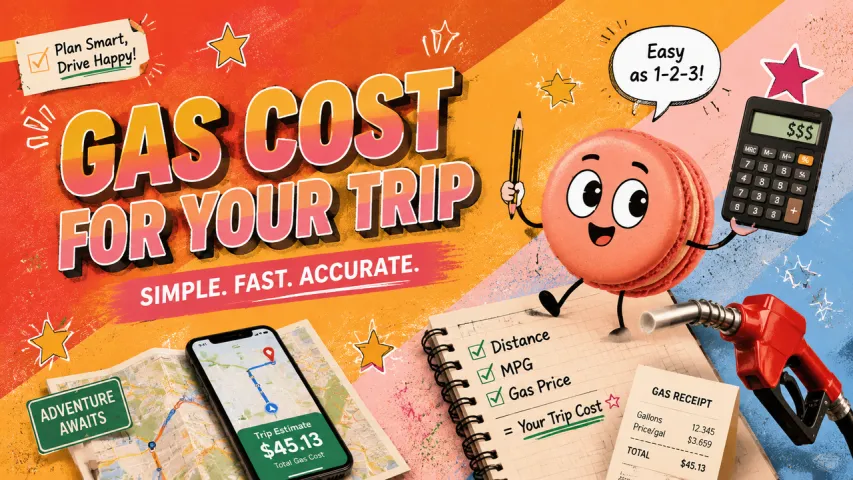
You don't have to do that math by hand. Fueleconomy.gov's trip calculator estimates fuel use for a route, and for a quick per-trip dollar figure you can drop your real MPG straight into a gas-cost calculator for your trip. The key is feeding it your measured MPG, not the showroom one — that single swap is the difference between a guess and a real budget line, which slots neatly into your wider trip budget.

That's the whole point of understanding MPG: not the number itself, but what it lets you predict before you leave.
FAQ
Why is my real MPG often lower than the official car listing?
Because the listing comes from standardized lab tests, not your commute. Your speed, traffic, terrain, cargo, weather, and habits all push the real figure down from the ideal. The sticker is best used to compare one car against another, not to predict your exact mileage — expect your real-world number to land somewhat below it.
Should I track MPG every time I fill up?
You don't need to, but tracking a few tanks gives you a reliable average, which is far more useful than any single reading. One unusual drive — a long climb, a traffic-heavy week — can skew a lone tank. Average three or four and you've got a number you can actually plan around.
What makes MPG less useful for short or city trips?
Cold starts and stop-and-go. Your engine is least efficient before it warms up, so short hops never reach the steady-state efficiency that highway cruising hits. City driving also means constant braking and idling. For those trips, a single MPG figure understates how much the conditions, not the car, are driving fuel use.
How does MPG connect to actual trip fuel cost planning?
Directly: trip cost is roughly (miles ÷ your MPG) × price per gallon. MPG is the middle gear that turns distance into gallons, and gallons into dollars. Use your measured real-world MPG rather than the sticker, and the estimate lands close enough to budget against with confidence.

So the mpg meaning, boiled down: it's miles per gallon, it's easy to measure with one division, and the figure that matters for planning is your real one — not the number on the glass. Work it out across a couple of tanks, keep it handy, and the next time a trip is coming you'll be able to say what the fuel will cost before you've pulled out of the driveway. That's a small thing to know, and a genuinely handy one.
Recommended Reads










Apply to become Macaron's first friends
Read & discover
Free calculators
Company


