The third time I bought paprika in eleven days, I stopped and laughed at myself. Three identical jars. Two of them already opened. One half-empty bottle pushed so far back I'd forgotten it existed twice. That's when I realized my pantry organization wasn't a storage problem — it was a visibility problem dressed up as one.
I'm Maren. I write about the small experiments I run on daily life — the kind that look unremarkable from the outside but quietly decide whether Wednesday goes well or sideways. Pantry organization sits inside that category for me. Most advice I'd read assumed I'd spend a Sunday with matching glass jars and a label maker, becoming a different person by Monday. That's not the experiment I'm interested in. I wanted to know what kind of pantry actually survives a real cooking week.
So I tore mine apart and rebuilt it three times over six weeks. The version I kept is not pretty. But I haven't bought duplicate paprika since.
What pantry organization should actually solve
Forgotten food, duplicate buying, and dinner friction
Here's the gap I noticed: most pantry content focuses on aesthetics, and most food-safety content focuses on shelf life. Neither one talks about the thing that actually wastes my money — not being able to see what I already have when I'm deciding what to cook tonight.
The numbers back this up. The EPA estimates the average household of four loses $2,913 a year to food that gets bought and never eaten. The FDA notes that confusion about packaging dates accounts for roughly 20 percent of consumer food waste on its own. The rest is mostly buried-and-forgotten — the back-of-the-shelf graveyard.
A working pantry is one that lets me answer three questions in under ten seconds: What do I have? What needs to get used soon? What's missing for tomorrow? If a system can't answer those, it's decoration.
How to organize a pantry by real-life use
Daily staples, backup meals, snacks, and cooking shortcuts
My first attempt was alphabetical. It lasted four days. Alphabetical works in a library because you arrive knowing what you're looking for. In a pantry, you're trying to remember what you have. Different problem entirely.
What worked instead was sorting by how often I reach for something, not what category it belongs to. I broke things into four real-use groups: daily staples (oil, salt, pasta, rice, the two spices I actually use), backup meals (canned beans, broth, jarred sauce — the "Wednesday is a disaster" tier), snacks (which migrate to whoever's eating them anyway), and cooking shortcuts (pre-made curry pastes, stock cubes, the things that turn 40 minutes into 15).
The shift was small but specific: daily staples at eye level, backup meals at chest height, snacks wherever they land, shortcuts at the front of the middle shelf where I see them when I open the door tired. The "tired me" placement matters more than the "ideal me" placement.
Pantry zones that make cooking easier
Breakfast, quick dinners, baking, canned goods, and grab-and-go
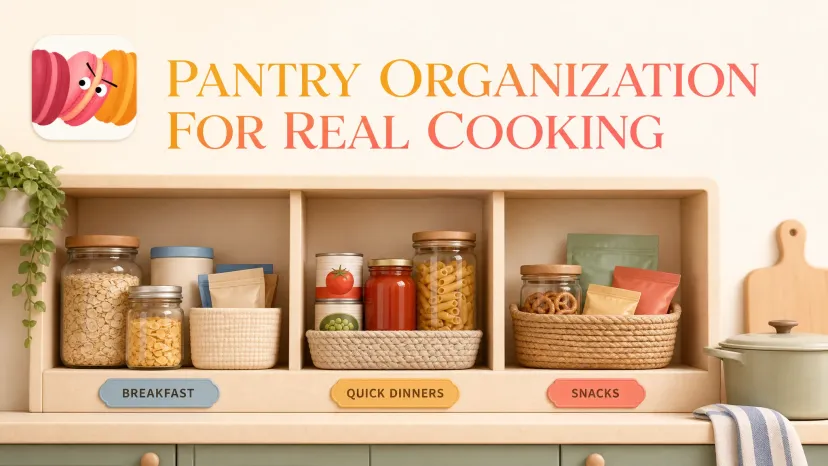
Inside those four use-groups, I built five physical zones. Not because zones look organized — because they answer the what do I cook now question without me having to think.
Breakfast lives together (oats, peanut butter, the one tea I actually drink). Quick dinners get their own shelf — anything I can build a meal around in 20 minutes. Baking gets a single bin, because I bake roughly once a month and it doesn't need real estate. Canned goods sit in a single row, label-out, organized by closest date in front. Grab-and-go (granola bars, nuts, anything I'd take out the door) lives near the door of the pantry where my hand naturally reaches.
The canned-goods row is the only place I bothered with the first-in-first-out method — the principle Virginia Cooperative Extension recommends for keeping older items in front of newer ones. Everything else is just zones plus visibility. I tried to FIFO the whole pantry once. By week two I was rearranging more than I was cooking.
Common mistakes
Pretty containers that hide food and systems that are hard to maintain
I almost stopped at step two — the decant-into-glass-jars step. Pinterest pantries are gorgeous. Mine looked great for nine days. Then I realized I couldn't tell which jar of beige powder was flour and which was confectioners' sugar without opening both. I'd also lost every cooking instruction, every roast date, every "best by" note printed on the original packaging — which the USDA's FoodKeeper app recommends consulting for items past their printed dates anyway.
Pretty containers solved a problem I didn't have (visual uniformity) and created one I did (information loss). The other big mistake: building a system that needs upkeep. If maintaining the pantry takes more than two minutes after a grocery run, I won't do it. Not because I'm lazy — because no one will. Realistic systems beat optimal ones every time.
Pantry organization vs meal planning
Why storage and planning should work together
Meal planning tells me what to cook. Pantry organization tells me what's already possible. They solve different halves of the same problem and most people only do one. A meal plan without pantry visibility means buying things you already own. A visible pantry without any planning means staring at ingredients with no decision energy left.
What I do now is small: a one-minute pantry scan before I write the grocery list, and a Sunday "use this first" shelf where two or three items I want to eat this week sit together at eye level. That's it. The shelf gets emptied every weekend. It's the only ritual I've kept.
FAQ
Q1: What does the author mean by a “visibility problem” in the pantry, and why is it more important than storage space?
A1: The visibility problem refers to not being able to quickly see what you already own when you open the pantry. This leads to duplicate purchases (like buying paprika three times in eleven days) and forgetting ingredients you already have. The author argues this is the real issue causing food waste and extra spending — more critical than simply lacking physical storage space.
Q2: How did the author ultimately organize her pantry? How is this different from traditional methods?
A2: She organized by real-life use and frequency instead of alphabetically or by food category. She created four main use-based groups: daily staples (at eye level), backup meals (at chest height), snacks, and cooking shortcuts. Within these, she set up five practical zones: Breakfast, Quick Dinners, Baking, Canned Goods, and Grab-and-Go. This system is designed for “tired me” rather than “ideal me,” making it easier to decide what to cook quickly.
Q3: Why doesn’t the author recommend using matching glass jars or pretty containers?
A3: Although they look beautiful, uniform containers hide important information such as “best by” dates, cooking instructions, and batch details printed on original packaging. The author found she couldn’t easily tell which jar contained flour versus powdered sugar without opening them. Pretty storage solved a problem she didn’t have (visual uniformity) while creating the problems she did have (forgotten food and lost information).
Q4: How should the First-In-First-Out (FIFO) method be applied according to the article?
A4: The author only applies strict FIFO to the canned goods section (newest items behind, oldest in front). She tried using FIFO for the entire pantry but found it too high-maintenance and abandoned it. For most areas, she prioritizes visibility and frequency of use over perfect rotation. A realistic system that actually gets maintained beats an ideal one that doesn’t.
Q5: How does pantry organization work together with meal planning?
A5: Pantry organization shows you what’s already possible, while meal planning tells you what to cook. The author combines them with two small habits: a quick one-minute pantry scan before making a grocery list, and a dedicated “use this first” spot at eye level for 2–3 items she wants to finish that week. This prevents buying duplicates and reduces decision fatigue during the week.
If your pantry frustrations sound like mine — duplicates, forgotten food, decision fatigue at 6:30 p.m. — the zones-plus-visibility approach is worth a real two-week test. It won't fit if you cook rarely or if your household genuinely needs different food zones per person. It worked for me because I cook five nights a week in a small kitchen with a calendar that lies to my face. That's the setup it's built for. Different setup, probably different system.
I’m Maren, a 27-year-old content strategist and perpetual self-experimenter. I test AI tools and micro-habits in real daily life, noting what breaks, what sticks, and what actually saves time. My approach isn’t about features—it’s about friction, adjustments, and honest results. I share insights from experiments that survive a real week, helping others see what works without the fluff.