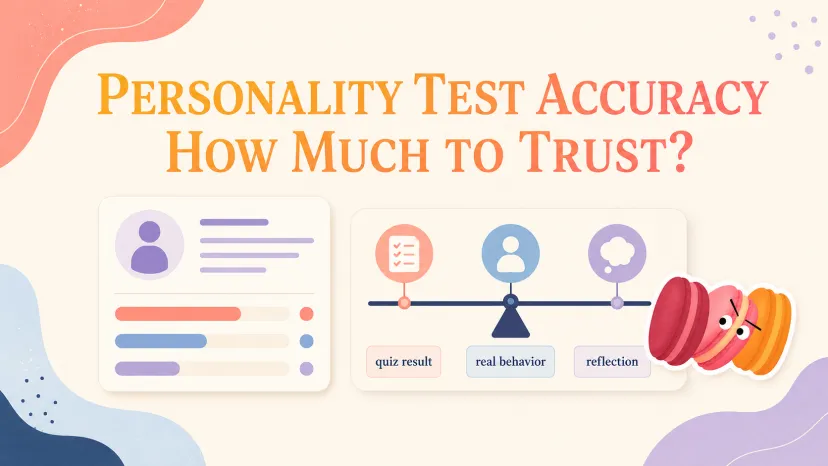
Three weeks into using an AI assistant that actually remembered my preferred work hours, I found myself doing something I hadn't done in years: retaking my MBTI. I wanted to see if the label the app had inferred from my habits matched the four-letter code I'd been carrying around since college. It didn't. Not completely. And that small mismatch stuck with me longer than it should have.
I'm Maren, and I spend a lot of time testing systems that claim to understand behavior — AI tools, habit frameworks, self-tracking apps. Personality tests fall somewhere at the edge of that territory. They show up in job applications, therapy intake forms, team-building workshops, and increasingly, as the backbone logic for apps that claim to "know you." So the question of personality test accuracy isn't abstract to me. It's practical. If these tests don't hold up, the tools built on top of them don't either.
Here's what I found when I actually looked at the research.
What Accuracy Means for Personality Tests
"Accurate" does a lot of work in this conversation, and most people conflate two different things: reliability (do you get the same result if you retake it?) and validity (does it actually measure what it claims to measure?).
A test can be reliable without being valid — you could consistently label everyone by their shoe size and get perfect retest reliability. Validity is harder. It requires showing that scores correlate with real-world behavior, outcomes, or psychological constructs in predictable ways.
Most personality tests struggle with one or both. The question is how much they struggle, and whether that matters for how you're using them.
MBTI: Popular but Contested
The Myers-Briggs Type Indicator assigns you one of 16 four-letter types — INTJ, ENFP, and so on. It was developed in the 1940s by Isabel Briggs Myers and her mother Katharine Cook Briggs, drawing loosely on Carl Jung's theory of psychological types. Today it's one of the most widely administered personality assessments in the world, used in corporate settings, therapy practices, and — let's be honest — an enormous number of Twitter bios.
What the Research Says
The MBTI's scientific standing is genuinely contested, and the debate is more nuanced than either its fans or critics tend to admit.
On reliability, a global study of 1,721 adults who took the MBTI Step I twice between six and fifteen weeks found test-retest reliability coefficients of 0.81 to 0.86 across all four scales, according to the Myers & Briggs Foundation — which is actually respectable by psychometric standards. A large meta-analysis found similar results: the MBTI and its scales yielded scores with strong internal consistency and test-retest reliability estimates, although variation was observed, as reported in a Sage Journals meta-analysis.
That's the official publisher's research, though. Independent studies are messier. Test-retest coefficients from one week to two-and-a-half year intervals ranged from .93 to .69 on the SN scale, .93 to .75 on the EI scale, .89 to .64 on the JP scale, and .89 to .48 on the TF scale, according to research from Western Kentucky University. The Thinking-Feeling scale, in particular, consistently shows weaker reliability across different populations.
Test-Retest Reliability Issues
Here's the part that actually changed how I think about the MBTI. The four-letter type label is less stable than the underlying scale scores. Even when someone's numerical scores don't change much, landing on opposite sides of a midpoint can flip your type entirely — from an "I" to an "E," for example, if your score moves a few points. The MBTI has been found to have poor test-retest reliability by some researchers, with some estimating that nearly 75 percent of test-takers will receive a different result each time they take the test, as noted in a study from Liberty University, though this figure is disputed by MBTI researchers who argue it applies mainly to those who score near the midpoint on any given scale.
The more honest framing: the MBTI is better understood as a spectrum than a sorting hat. Your type label can shift; your underlying tendencies are probably more stable than the label suggests. That's useful to know before you get too attached to four letters.
Big Five: The Academic Standard
The Big Five — Openness, Conscientiousness, Extraversion, Agreeableness, Neuroticism (OCEAN) — is what most research psychologists actually use when they study personality. It emerged from decades of factor analysis work, starting with Gordon Allport's list of trait-describing words in 1936 and refined through the 1990s.
Why Psychologists Prefer It
The practical answer: it predicts things. Research has demonstrated that the Big Five personality traits correlate with important work outcomes such as job performance, training proficiency, and turnover, with an early meta-analysis finding an estimated population correlation of 0.26 between conscientiousness and supervisory ratings of job performance.
That's not a massive correlation, but it's real and replicable. Unlike the MBTI's binary categories, the Big Five measures traits on a continuous scale, which means it captures gradients rather than forcing you into a box. It also avoids the conceptual awkwardness of the MBTI's either-or logic — you're not "introverted or extraverted," you're somewhere on a dimension.
The Big Five is also more honest about what it is. It's descriptive, not explanatory. The Big Five was developed to organize personality traits rather than as a comprehensive theory of personality — it is more descriptive than explanatory and does not fully account for differences between individuals or provide a causal reason for human behavior, as explained on Simply Psychology. That's a meaningful distinction. It tells you where you are; it doesn't tell you why.
One limitation worth noting: most Big Five research has been conducted on WEIRD populations (Western, Educated, Industrialized, Rich, Democratic). A study testing the model in an indigenous Bolivian population found the five-factor structure didn't replicate cleanly, raising questions about how universal the framework really is.
SBTI: No Science, All Vibes
If you've spent any time online recently, you've probably seen SBTI results circulating. SBTI — short for Silly Big Personality Test — is an internet-native personality quiz that turns messy habits, coping styles, and relationship instincts into funny but recognizable result types, and works best as entertainment with a suspiciously sharp mirror attached. It is not a scientific diagnosis, but many people find the descriptions useful because they capture recognizable social and emotional patterns.
That's a fair self-description. I ran through it a few weeks ago mostly out of curiosity, and the result felt strangely accurate — which is what makes these tests interesting and a little dangerous. Personality descriptions tend to be written broadly enough to apply to almost anyone (this is called the Barnum effect), and we're wired to find pattern and meaning in descriptions of ourselves.
SBTI doesn't pretend to be something it isn't. The problem is when people treat results from tests like this as diagnostic truth, or when apps use engagement-optimized personality frameworks as a substitute for genuine behavioral modeling.
Comparison Table
Test
Scientific Basis
Reliability
Validity
Best Use
MBTI
Jungian theory (contested)
Moderate to good (varies by scale)
Weak predictive validity
Self-reflection, team communication
Big Five
Factor-analytic research
Strong
Good predictive validity
Research, clinical assessment
SBTI
None
N/A
Entertainment
Social sharing, casual self-exploration
What Tests Can and Can't Tell You
This is where I landed after spending more time on this than I expected: personality tests are better at prompting reflection than measuring anything definitive.
The Big Five gives you a reasonable snapshot of where you sit on a few well-studied dimensions. The MBTI gives you a framework for thinking about preferences, even if the four-letter label is less stable than it seems. SBTI gives you something to send in a group chat.
What none of them do reliably: predict how you'll behave in a specific situation, capture how you've changed over time, or account for context. Your "score" on conscientiousness in your early twenties may look different at thirty-five. Personality isn't fixed — the Big Five traits remain relatively stable throughout most of one's lifetime but are influenced significantly by genes and the environment, with an estimated heritability of 50%. That's a lot of room for change that a snapshot test won't capture.
The bigger issue is over-reliance. When a label becomes identity, it stops being a tool and starts being a cage. "I'm an INFP so I don't do spreadsheets" is not the same as understanding your actual relationship with structured work.
Better Approaches to Self-Understanding
The research on self-awareness is actually more interesting than the personality test debate. Psychologist Tasha Eurich's work suggests that only around 10–15% of people are genuinely self-aware, despite most believing they are. The gap isn't filled by more testing; it's filled by better observation.
A few approaches that have more evidence behind them than a single test result:
Longitudinal self-tracking. Noticing patterns in your own energy, decisions, and reactions over weeks rather than answering questions about hypothetical preferences. Tracking what activities energize versus drain you over a week — not through elaborate journaling, just mental notes — reveals your values faster than any personality test.
Behavioral feedback. Asking people who observe you regularly how they'd describe you. The gap between self-perception and how others experience you is often more informative than any typology.
Therapy or structured reflection. For anything beyond general curiosity — career decisions, relationship patterns, mental health — therapeutic interventions such as Dialectical Behavior Therapy (DBT) or Cognitive Behavioral Therapy (CBT) often focus on enhancing self-awareness in ways that static personality tests can't replicate.
Targeted assessments used correctly. The Big Five, administered in a professional context and interpreted alongside behavioral data, can be genuinely useful. The key word is "alongside."
FAQ
Is MBTI scientifically valid?
The short answer: partially. Its reliability has improved with newer versions, and some studies support its construct validity. But its predictive validity — its ability to forecast real behavior — is weak compared to the Big Five. Most research psychologists don't use it in clinical or research settings. That doesn't make it useless for self-reflection, but it does mean the four-letter label isn't a stable psychological diagnosis.
What is the most accurate personality test?
For research and prediction purposes, the Big Five (also called the Five-Factor Model or FFM) has the most empirical support. The Big Five construct tends to yield scores that are high in validity and reliability, owing to the strong scientific testing that underpins the system, and has sometimes been referred to as "the only truly scientific personality test." That's a strong claim, but it reflects the consensus among personality researchers fairly accurately.
Why do my test results change?
Several reasons. Mood at the time of testing matters more than people expect. Context shifts your answers — a question about whether you "prefer order" reads differently during a stressful week than a calm one. For the MBTI specifically, people who score near the midpoint on any dimension are likely to flip type labels between tests even when their underlying scores barely move. This is a structural issue with forced-choice, binary-category systems.
Is Big Five better than MBTI?
For predictive validity and scientific grounding, yes. The Big Five has decades of replication across cultures and settings, and it measures continuous traits rather than sorting you into categories. That said, many people find the MBTI more intuitively useful for self-description and communication — the type labels are memorable and the framework is easy to discuss. "Better" depends on what you're using it for.
Are online personality tests reliable?
Most aren't — not in the technical sense. Free online versions of tests are often abbreviated, unvalidated adaptations of longer instruments. The Big Five Inventory exists in validated short forms, but random quiz-site versions may bear little resemblance to the research instrument. Psychology Today's self-tests are intended for informational purposes only and are not diagnostic tools, as clearly stated on the Psychology Today site — that caveat applies to most online personality testing. If you're using results for anything consequential, take the validated, full-length version of an instrument in a structured context.
That mismatch I noticed three weeks ago — between the AI's behavioral inference and my MBTI label — didn't resolve neatly. The AI was tracking what I actually did. The MBTI was tracking how I answered questions about hypothetical preferences. Both are data. Neither is the whole picture.
Worth running one real situation through that lens before you decide which one you trust more.
I’m Maren, a 27-year-old content strategist and perpetual self-experimenter. I test AI tools and micro-habits in real daily life, noting what breaks, what sticks, and what actually saves time. My approach isn’t about features—it’s about friction, adjustments, and honest results. I share insights from experiments that survive a real week, helping others see what works without the fluff.