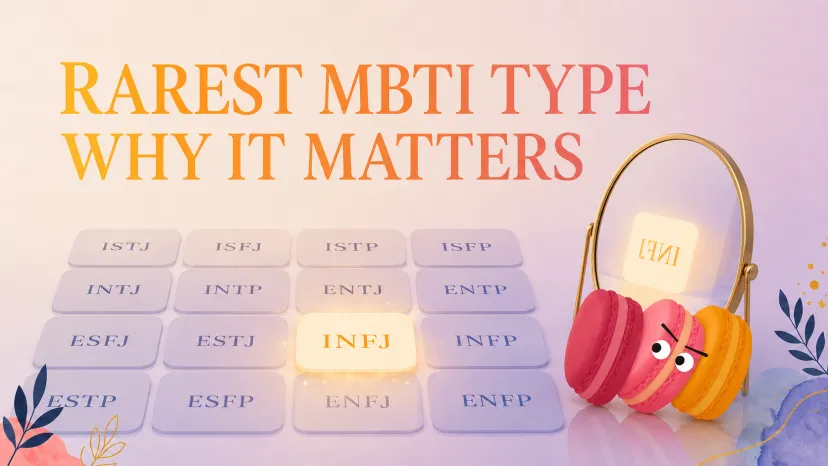
There's a specific kind of loneliness that doesn't come from being alone. I noticed it first in my early twenties — sitting in meetings where decisions got made by gut and consensus, watching the room land somewhere I'd already mapped three moves ahead, and saying nothing because I'd learned that explaining how I got there was harder than just waiting for events to confirm it. That experience tracks with the most introverted types list. That was the year I took the MBTI and typed INFJ. The forum threads called it the rarest personality type in the world. I wasn't sure whether to feel validated or skeptical of the whole framing. When that same pattern-seeking habit shows up in tool setup, I follow a clear walkthrough on how to enable Claude Cowork on your desktop so the agent can handle the file-sorting and research dumps that used to pile up while I overthought the next move.
I'm Maren. Twelve years later, I'm still not entirely sure. But I've tested enough frameworks and read enough real data to separate what the rarity claim actually means from what the internet has turned it into.
MBTI Types Ranked by Rarity
Full Distribution Table
The distribution data varies by source and sample size, but the pattern is consistent. The top four types — ISFJ, ESFJ, ISTJ, and ISFP — account for roughly 46.5% of the U.S. population, while the four rarest types combined represent less than 8%. When I first saw that gap, I nearly fell off my chair. One end of the table is nine times denser than the other.
One thing I want to flag before moving on: some authorities, including the 2024 update of the MBTI® Manual, rank ENTJ as the rarest at 1.8%, reflecting sampling differences. INFJ and ENTJ have been trading that last spot for years depending on who's running the survey. Both sit below 2%. The difference isn't worth arguing about.
Why INFJ Is the Rarest
The Combination That Makes It Uncommon
The question I kept asking when I first encountered this data was why. Not "what does it mean about me," but what actually produces a 1.5% ceiling.
INFJs are rare because their specific combination of cognitive preferences — Introversion, Intuition, Feeling, and Judging — each appear less frequently in the general population, and when stacked together, they produce a statistically uncommon profile. Introverted Intuition, the INFJ's dominant function, is the rarest dominant function across all 16 types.
That's worth sitting with. Introverts make up roughly half the population — that's not the bottleneck. But Intuition as a preference is already outnumbered nearly 3:1 by Sensing in everyday life. Combine that with Feeling in a specific outward-facing direction, then Judging, and you get a function stack that simply doesn't appear often.
The dominant function here is Introverted Intuition (Ni). Introverted Intuition is all about gathering information, finding patterns, and looking for far-reaching implications — like having a detective in your mind, looking for clues, anticipating outcomes, and seeing things that others don't. The auxiliary is Extraverted Feeling (Fe), which orients the INFJ outward toward group harmony and emotional attunement.
Even Carl Jung, who developed the theory of psychological types, said that to the outside world, Introverted Intuition is "the strangest of all" the cognitive functions. Understanding that framing actually helped me more than any "rarest type" forum thread ever did. It stopped being about identity and started being about cognition.
Other Rare Types Worth Knowing
INTJ
INTJ is nearly four times more common among men (3.3%) than women (0.9%), making female INTJs among the rarest personality profiles in the population. INTJs share dominant Ni with INFJs but make decisions through Introverted Thinking rather than Extraverted Feeling. Where I tend to sense where a room is headed emotionally, an INTJ colleague I worked with for two years was more interested in where the system was structurally broken. Same pattern-detection engine, different output.
ENTJ
ENTJ or Commander represents about 1.8% of the population. ENTJs lead with Extraverted Thinking — decisive and externally directed. They share the Intuition preference with INFJs and INTJs, which is exactly why all three cluster near the bottom of the distribution table. N types are genuinely outnumbered nearly 3:1 in daily life. I find that number more explanatory than any rarity statistic.
ENTP
ENTP sits around 3.2% and runs on Extraverted Intuition — generating possibilities outward rather than converging inward. Where I tend to narrow toward a single insight, ENTPs I've known expand in every direction until someone makes them stop. Less rare than INFJ, but still firmly outside the statistical mainstream and similarly prone to the "why doesn't anyone follow my reasoning" experience.
Does Rarity Make a Type Better?
The Rarity Bias
I want to be direct here, because the content ecosystem around this topic does people a real disservice.
Rarity is a statistical property. It describes how often a configuration appears in a sample. It does not describe quality, capability, or value. A type showing up in 1.5% of the population means that combination of cognitive preferences is uncommon — nothing more. I spent a year in my mid-twenties quietly believing the mythology, and the main thing it produced was a convenient reason to stop examining myself closely.
The rarity of the INFJ type is worth understanding because it explains why they often feel different from the people around them. It's not worth using as a badge of specialness that excuses self-examination.
That's about the clearest version of this I've seen written anywhere.
Common Types Are Not Less Interesting
Making up 13.8% of the population, ISFJ is the most common personality type — particularly interesting, considering INFJ, only one letter different, is the rarest. One letter. One cognitive function shift. The population distribution flips completely.
ISFJs lead with Introverted Sensing rather than Introverted Intuition. That produces a type that's grounded in concrete experience, loyal, and deeply reliable — qualities that show up as common precisely because they're useful in most social structures humans have built. Being in 13.8% of the population doesn't make that profile less sophisticated. It means it's well-suited to environments most people actually live in.
Challenges Rare Types Actually Face
This is the part I rarely see covered honestly.
Being a rare type carries real friction — not because of anything mystical, but because I spend most of my time in environments built around more common cognitive preferences. Many INFJs report feeling like aliens in the world, with one INFJ describing her experience as "a perpetual sense of deja vu." I've used that exact phrase to describe certain Monday mornings.
The practical friction I've run into — and seen in others who type rare — breaks down into a few patterns. First, difficulty externalizing reasoning: Ni produces conclusions that feel certain but are hard to trace back through explicit logical steps, which doesn't land well in evidence-driven environments. Second, emotional overextension: INFJs' Feeling function is directed outwardly rather than inwardly, meaning they're less equipped to manage their own emotions independently. I absorb the emotional climate of a room effectively. Managing that without a clear inward orientation takes deliberate work. Third — and this one took me a long time to see — the rarity pressure itself. When I was told my type was the rarest and came with specific gifts, I started performing the type rather than understanding my actual cognition.
Setting aside the "rarest type" framing for a month and working directly with the Myers & Briggs Foundation's official type descriptions is a more grounded starting point than most of what the algorithm will serve you.
FAQ
What is the rarest MBTI type?
INFJ, also known as the Advocate, Counselor, or Idealist, is the rarest type of personality in the general population, representing about 1.5% of the general population in the United States. ENTJ consistently sits within a fraction of a percentage point and the two types trade the last spot depending on the dataset.
How rare is INFJ really?
Consistent data places INFJ between 1.5% and 2% of the population. Among men specifically, INFJ represents only about 0.5% of males tested. For women, the rarest personality types are actually INTJ and ENTJ, each at around 1%, while INFJ ranks third rarest among women at approximately 2%.
What is the most common MBTI type?
ISFJ remains the most common at 13.8% of the population based on 2023–2025 data. The top three — ISFJ, ESFJ, ISTJ — together account for over 35% of the U.S. population.
Does being a rare type mean anything special?
The MBTI is a lens, not a verdict. Knowing you're in a 1.5% cohort explains a lot about why the world can feel disorienting — it doesn't mean the type is superior. The practical implication is more friction in environments built for other cognitive preferences, and a longer search to find people whose reasoning style matches yours.
Can my MBTI type change?
The MBTI measures preferences, not fixed traits. While the MBTI has critics and test-retest reliability varies, the rarity of the INFJ type is supported by consistent data across multiple large-scale administrations of the assessment. Many people find their result shifts between their twenties and thirties as less dominant functions develop. A different result doesn't mean the first was wrong.
I'm still thinking about why the rarity framing has the grip it does. The data is genuinely interesting. The mythology built around it is a different thing entirely — and I'd call it mostly a distraction from the more useful question, which is what any of this actually tells you about how you process the world.
I’m Maren, a 27-year-old content strategist and perpetual self-experimenter. I test AI tools and micro-habits in real daily life, noting what breaks, what sticks, and what actually saves time. My approach isn’t about features—it’s about friction, adjustments, and honest results. I share insights from experiments that survive a real week, helping others see what works without the fluff.