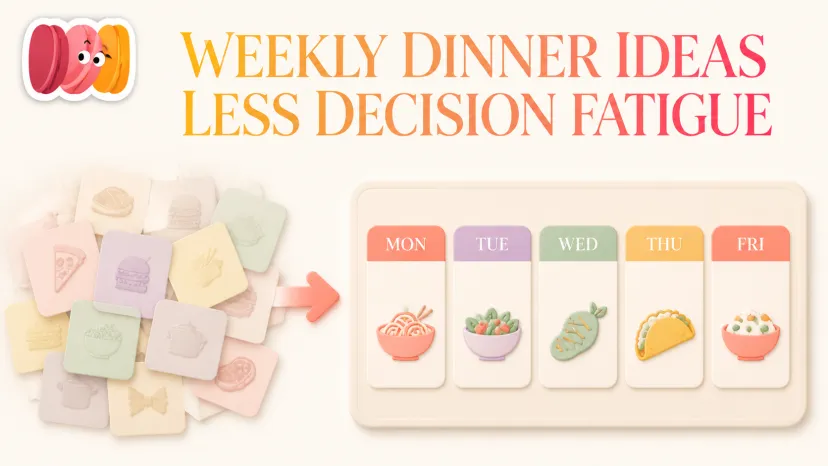
21 specific weekly dinner ideas to anchor your week
How to build a flexible weekly dinner rhythm
Weekly dinner ideas vs weekly meal plan
FAQ
Weekly Dinner Ideas That Reduce Decision Fatigue
Weekly Dinner Ideas That Reduce Decision Fatigue
I ran a small experiment for eleven days. Same job, same kitchen, same grocery store. The only thing I changed was when I decided what to eat for dinner. On the days I decided in the morning, I cooked. On the days I decided at 6:47 p.m. while staring into the fridge, I ordered takeout or ate cereal standing up. Eleven days in, the pattern was so obvious it almost felt rude.
That's the part nobody warned me about. The problem isn't that I don't know how to cook. The problem is the decision itself — and by Wednesday evening, I'm out of decisions. As an INFJ I overthink every system until I can see where it leaks; as an ISFP about how I actually live, I refuse to follow any rule that feels miserable by Wednesday. So a rigid Sunday meal-prep plan was always going to lose. Hi, I’m Maren! What I needed was a softer scaffold. The kind that holds when the week goes sideways.
This is a list of weekly dinner ideas — not a meal plan. I'll explain the difference.
Why weekly dinner decisions feel exhausting
Researchers describe decision fatigue as the gradual decline in decision quality after a long stretch of choices, and as a recent integrative review on decision fatigue describes, the deterioration shows up most sharply in low-stakes daily choices we underestimate. Dinner is exactly that kind of choice. I've made hundreds of micro-decisions by 6 p.m. — and "what's for dinner" lands at the worst possible moment.
There's a second layer. As The Decision Lab notes on choice overload, the brain starts looking for shortcuts when options pile up. My shortcut used to be Uber Eats. Yours might be the same chicken-and-rice you ate yesterday.
Repetition, preferences, time, and grocery uncertainty
Four things stack: I get bored fast, my partner doesn't, weeknights have wildly different time budgets, and I never know what's actually in the fridge. Any framework that ignores even one of these collapses by Thursday.
Weekly dinner ideas by night type
The shift that worked for me: stop planning seven meals. Start planning five night types.
Fast night — under 25 minutes, one pan, no ambition.
Comfort night — slow but easy. Something that smells like the apartment is yours.
Leftover night — a built-in reuse slot, not an emergency.
No-cook night — a board, a salad, a bowl. Permission to not cook.
Family night (or "together night" if you live alone) — the one meal that's actually shared.
Anchoring meals to night types — not days — is the same logic the USDA's MyPlate weekly meal-planning guide recommends: easier dishes on busy days, longer ones when there's time.
21 specific weekly dinner ideas to anchor your week
Fast-night options
Sheet-pan gnocchi with cherry tomatoes and feta
Soba noodles with peanut sauce and shredded carrots
Black bean quesadillas with whatever cheese is open
Pesto orzo with frozen peas and a fried egg
Shrimp and broccoli stir-fry over rice
Comfort-night options
Lentil soup with a swirl of yogurt and crusty bread
One-pot chicken and rice (skin-on thighs, bay leaf, lemon)
Baked ziti with hidden spinach
Miso butter salmon with rice and cucumbers
Leftover-night options
Fried rice using whatever protein is left
Frittata with last night's roasted vegetables
Quesadilla with leftover taco filling
Ramen bowl with a soft egg and yesterday's greens
No-cook options
Big Greek salad with rotisserie chicken and pita
Cheese and charcuterie board with grapes and crackers
Smoked salmon bagels with cream cheese and cucumber
Pick two anchor nights — the ones that almost never move. For me, that's Sunday roast chicken and Wednesday leftover-night. Everything else floats. Use ingredient overlap deliberately: the Sunday chicken becomes Monday's quesadilla becomes Wednesday's fried rice. The EPA's home food-waste guidance frames this same logic as "shop your fridge first" — and it's the single thing that cut my grocery spending most.
Keep two backup meals in the freezer or pantry for the night the plan dies. Mine: frozen dumplings and a jar of good marinara.
Weekly dinner ideas vs weekly meal plan
A weekly meal plan is a fixed schedule. Monday: chicken. Tuesday: pasta. Wednesday: stir-fry. It works beautifully on paper and collapses the first time work runs late.
Weekly dinner ideas are a menu of defaults. I have five night types and a list to draw from. Tuesday could be fast night or no-cook night depending on how the day went. Same ingredients. Different decision load.
FAQ
Q: What’s the real difference between a weekly meal plan and weekly dinner ideas?
A: A meal plan is rigid — it assigns specific recipes to specific days. Weekly dinner ideas are flexible. You plan by “night types” (Fast, Comfort, Leftover, No-cook, Family) instead of fixed dishes. This way, if Tuesday goes sideways, you can switch to a no-cook or leftover night without the whole plan falling apart.
Q: How do you actually reduce decision fatigue with this system?
A: By limiting your choices. Instead of asking “What should I cook tonight?” you only ask “What type of night is this?” Once you know it’s a Fast night or Leftover night, you pull from a short, pre-approved list. Anchoring two consistent nights (like Sunday roast chicken and Wednesday leftovers) creates a soft rhythm that survives real life.
Q: Can this approach work if my household has very different schedules and preferences?
A: Yes. That’s exactly why night types are useful. Fast nights and No-cook nights handle busy or tired evenings, while Family night and Comfort night cover the days when you want connection or something cozy. Ingredient overlap (using the same chicken or vegetables across multiple nights) keeps shopping simple and reduces conflict.
Q: How do you prevent boredom when repeating similar meals?
A: Rotate within the same night type. For example, one Fast night can be sheet-pan gnocchi, the next can be black bean quesadillas. The format stays easy, but the flavors change. The article’s list of 21 ideas gives you enough variety while keeping decision-making light.
Q: What should I do when the week completely derails?
A: Keep two reliable backup meals in the freezer or pantry (e.g., frozen dumplings or a good jar of marinara with pasta). The system is built around the reality that some weeks will collapse. Having safe defaults prevents you from defaulting to expensive takeout while still protecting your energy.
I'm running this for another month to see whether it survives a stretch of travel weeks. The collapse, when it comes, is what I'm actually watching for. That's where the next note will start.
I’m Maren, a 27-year-old content strategist and perpetual self-experimenter. I test AI tools and micro-habits in real daily life, noting what breaks, what sticks, and what actually saves time. My approach isn’t about features—it’s about friction, adjustments, and honest results. I share insights from experiments that survive a real week, helping others see what works without the fluff.