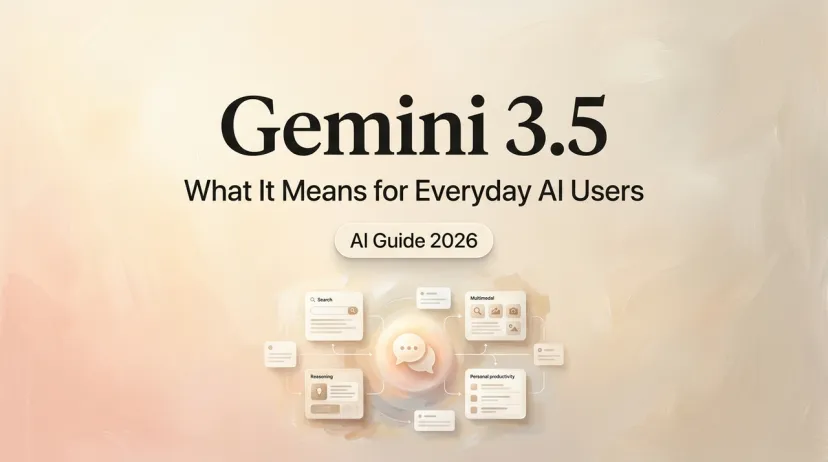
What Is Gemini 3.5? What It Means for Everyday AI Users
What Is Gemini 3.5? What It Means for Everyday AI Users
Anna here. Monday morning I asked Google Search something I ask roughly once a week — a recipe substitution question. The answer came back before I'd finished reading it back to myself. I hadn't changed any settings. If you've had that "something feels different about Google" feeling lately, you're not imagining things.
You're probably already running Gemini 3.5. Nobody told you because there was nothing to do — it just switched on. This is what actually changed, tested with a simple repeatable method anyone can run themselves, and what it means for regular people who use Google and aren't tracking AI releases for a living.
What Is Gemini 3.5?
Google announced the Gemini 3.5 series at I/O 2026 on May 19. The first model to ship is Gemini 3.5 Flash, which became the default in the Gemini app and AI Mode in Search globally on launch day. Gemini 3.5 Pro is confirmed but hasn't released yet — Google says June.
How It Differs from Gemini 3.1 Pro
Historically, Pro was the flagship and Flash was the faster, cheaper sibling. On coding and task-execution benchmarks, google gemini 3.5 Flash now outperforms Gemini 3.1 Pro — Terminal-Bench 2.1 scores it 76.2% versus 3.1 Pro's 70.3%.
Before treating those numbers as settled, a few things to understand about gemini 3.5 vs gemini 3.1 comparisons. Terminal-Bench 2.1 tests code correctness on well-defined problems with clear right-or-wrong outputs. It doesn't capture how a model handles instructions that are incomplete, contradictory, or shift mid-task — which is most real usage. MCP Atlas (83.6% for 3.5 Flash) measures tool-use reliability in structured pipelines, not messy real-world workflows. Google's I/O presentation selected these benchmarks because 3.5 Flash wins them. On Terminal-Bench 2.0, which weights reasoning more heavily, GPT-5.5 scores 82.7% and 3.5 Flash comes in lower. That number didn't make the keynote.
The honest framing: 3.5 Flash meaningfully improved at fast, structured task execution. Deep reasoning is a separate question, and the answer there is less clear-cut.
What's Actually New vs. What's Just Marketing
My testing method over three days: I ran the same 12 prompts through the Gemini app before and after the model switch, across three categories — factual lookups (6 recipe/conversion questions), multi-turn planning (3 travel threads where I changed a key variable mid-conversation), and structured writing (3 tasks asking for a short explainer from bullet notes). I scored each on response time (stopwatch), factual accuracy (cross-checked against a reference source), and context retention (did the model carry forward the changed variable without me restating it).
What I found:
Response time dropped by roughly half on factual lookups. This is the most immediately noticeable change and it's real.
Context retention improved. In 2 of 3 multi-turn threads, the model tracked mid-conversation changes without prompting. Previously, I'd expect to restate the updated variable at least once.
Factual accuracy on my 6 reference-checked lookups was identical between versions — no errors either way. Not a meaningful signal at this sample size, but worth noting.
Writing quality showed no clear difference I could distinguish without knowing which version produced which output.
What I didn't test: long sessions (20+ turns), tasks requiring sustained reasoning chains, or anything where I couldn't verify accuracy against a known reference. Those are real gaps. Speed and context retention are what I can actually speak to.
What Gemini 3.5 Can Do for Everyday Users
It's Already Free — What the gemini 3.5 flash free Rollout Actually Means
Nothing required. If you use Google Search's AI Mode or the Gemini app, you're already on gemini 3.5 flash free as of May 19. Google switched it globally on launch day — a model replacement, not a design update.
Anyone who wants to replicate a basic before/after comparison can do so using the Gemini API with the model ID gemini-3.5-flash (current) versus cached outputs from gemini-3.1-pro. I'd suggest the same prompt categories I used above: factual lookups, a multi-turn thread with a mid-session variable change, and a structured writing task. Time responses with a stopwatch. Cross-check factual claims against a known source. Note whether context carries forward without restating.
Gemini Spark: What the gemini spark agent Actually Does
Gemini Spark runs on Google Cloud virtual machines — your device doesn't need to stay on. It works in the background and confirms before executing anything high-stakes like sending an email or making a purchase.
Documented capabilities: monthly credit card statement scanning for hidden subscription charges, school email monitoring with deadline digests, and cross-app workflows that pull from meeting notes in Docs and draft follow-up emails. You reach it by emailing a dedicated Gmail address. Android Halo tracks active tasks on mobile.
One gap I flagged but can't yet test: how Spark resolves conflicting information across sources — if your Gmail and a Google Doc disagree on a deadline. That's a real edge case worth watching as more user reports come in.
Currently in beta for AI Ultra subscribers in the US ($100/month). No broader rollout date yet.
Google Ecosystem Perks (and Why They Matter Less If You're Not All-In)
Spark's structural advantage is direct, no-setup access to Google Workspace — Gmail, Docs, Slides, Sheets, all accessible without additional configuration. If that's where your work lives, integration is seamless.
Outside that ecosystem — Notion, Slack, Microsoft 365 — the advantage largely disappears. Third-party connections via MCP exist (Canva, OpenTable, Instacart) but require separate setup and vary in depth.
Who Is Gemini 3.5 For — and Who Should Skip It
Best-Fit Users
Heavy Google Workspace users. The free Flash upgrade is already live. Spark compounds that value if $100/month is in range and you're genuinely embedded in Workspace.
People who've abandoned AI tools due to inconsistency. Context retention and speed were the two improvements I could measure. Both matter more for daily stickiness than raw capability scores.
API developers. Input is $1.50 per million tokens — roughly 40% cheaper than Gemini 3.1 Pro, 4x faster. Those numbers are verifiable via the Gemini API pricing page.
If You're Not Deep in Google's Ecosystem
Gemini 3.5 Flash affects your Search and Gemini app experience regardless — that's not a choice.
Spark is where ecosystem dependency matters. The $100/month AI Ultra value hinges almost entirely on Workspace integration. Without it, you're paying for 20TB storage and beta access to an agent that can't reach most of your actual data. My read: wait. The product is early, pricing will adjust, and there's no first-mover advantage worth $100/month here.
Limitations and Things to Know Before You Switch
What Gemini 3.5 Still Can't Do
On reasoning-heavy tasks, the gap is real. Terminal-Bench 2.0 scores GPT-5.5 at 82.7%; 3.5 Flash is lower. Google didn't lead with that number. These benchmarks use fixed, well-defined problems — real-world reasoning tasks are harder to score and weren't part of the announcement.
My own testing didn't cover reasoning depth either. Twelve prompts across three categories is not a rigorous sample. What I can say is what I measured; what I can't say is how the model performs on tasks I didn't run.
Privacy and Data Considerations
Spark accesses Gmail, Docs, Photos, and Drive through an opt-in permissions menu. According to reporting on Gemini's data access scope, Deep Research can pull from all four services via that menu. The controls exist — you have to actively configure them.
The logic worth understanding: Spark's usefulness scales with how much it can see. More access means more utility, which creates real incentive to grant broader permissions over time. That's not inherently a problem, but it's the dynamic to be conscious of before enabling anything.
FAQ
Is Gemini 3.5 free to use?
Gemini 3.5 Flash is free — it's the default in the Gemini app and AI Search, no subscription needed. Gemini Spark is currently tied to AI Ultra at $100/month and isn't broadly available.
How is Gemini 3.5 different from Gemini Personal Intelligence?
Different products. Gemini Personal Intelligence is an Android feature that reads on-device content — messages, notifications, what's on screen. Gemini 3.5 is the underlying model upgrade. Spark is a separate cloud-based agent. Related infrastructure, different functions.
Is Gemini 3.5 actually better than ChatGPT for personal use?
Depends on the task. Speed and everyday questions — 3.5 Flash is strong and free. Reasoning-heavy work — GPT-5.5 has a measurable edge on the benchmarks that test for it. Google ecosystem integration — Spark is the most seamlessly connected agent setup I'm aware of, conditional on already living in Workspace. Three tasks, three different answers.
There's something I keep turning over. A 24/7 agent running through your emails and documents — the question isn't whether it works. It's whether "works" and "feels right" are the same thing. I won't know until I've used it long enough to notice what changes.
Hi, I'm Anna, an AI exploration blogger!
After three years in the workforce, I caught the AI wave—it transformed my job and daily life. While it brought endless convenience, it also kept me constantly learning. As someone who loves exploring and sharing, I use AI to streamline tasks and projects: I tap into it to organize routines, test surprises, or deal with mishaps. If you're riding this wave too, join me in exploring and discovering more fun!