Last Tuesday I spent twenty-two minutes explaining SBTI to my group chat. Not because I'm an expert. Because I'd taken it twice, gotten two completely different results, and somehow couldn't stop thinking about why that didn't bother me at all.
That's Maren's entry point here — not "I'm a content strategist who tracks internet trends" — just the fact that I've been turning this thing over in my head for days and I'm ready to put it somewhere useful.
So. What is SBTI, and why is it everywhere right now?
What Is SBTI
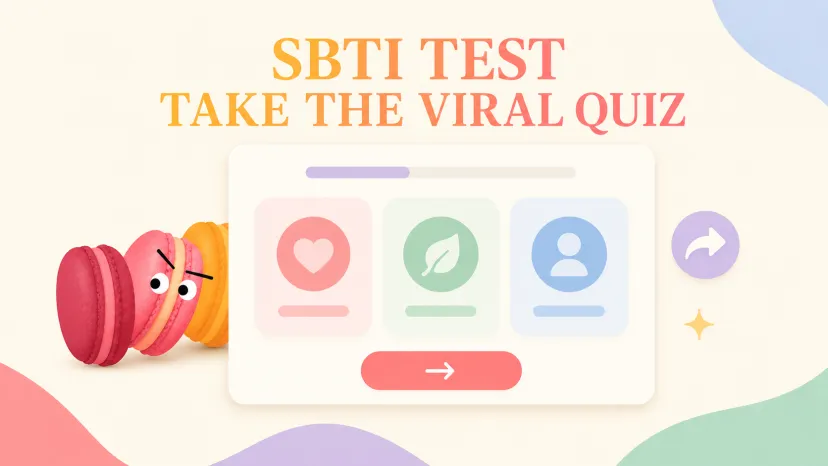
SBTIstands for Silly Big Personality Test. That's the official-ish translation. The name carries a second joke in Chinese — "SB" abbreviates a fairly crude insult (shǎbī, roughly "idiot"), which means the quiz is mocking you before you've even clicked start. That's kind of the whole point.
The quiz presents users with roughly 30 questions that score responses across 15 dimensions grouped into five broader categories: self-awareness, emotion, attitude, action drive, and social style. Results map to one of 27 distinct four-letter personality types, each paired with a short, irreverent description and a radar chart.
Unlike MBTI, SBTI makes no claim to scientific validity and positions itself explicitly as entertainment.
That's not a caveat. That's the entire premise.
Origin Story: A Bilibili Creator and a Drinking Intervention
SBTI was created by a Bilibili content creator, originally as a lighthearted attempt to convince a friend to quit drinking. After going live, the test unexpectedly took off and spread like wildfire.
Read that again. The quiz that crashed servers and hit 40 million searches in a day started as a private intervention for one person's alcohol problem. The creator has stressed that the quiz is not rooted in psychology or science — in a note at the end of the test, she said it was originally made simply to persuade a friend who liked drinking to quit. She even included a hidden "drunk" personality type for people who answered certain questions a specific way. Nobody told her it would become a cultural moment.
Before going viral, the creator was just an ordinary recent graduate. Her videos feature no elaborate camera work or carefully crafted viral moments — just a slightly exhausted girl speaking directly to the camera about her daily life.
That context matters. This wasn't engineered to spread. It spread because it felt real.
How It Went From Zero to Server Crash
On April 9, 2026, the quiz exploded. A related Bilibili video drew more than 2 million views within a day, searches for "sbti" on the WeChat Index reached 40.85 million, and discussions across social platforms surpassed 20 million. The original site quickly overloaded and went down under the traffic surge, prompting multiple mirror versions and English-language ports to appear almost immediately.
People frantically shared their results, propelling this somewhat crude webpage to the peak of traffic. Some mentioned they received completely different results from two consecutive tests — but "accuracy" was never the goal. "Resonance" was.
That's the detail that keeps snagging me. Same person, two tests, two different types — and it didn't shake anyone's attachment to their result. Because the result isn't the point. The feeling of recognition is.
How the SBTI Test Works
What the Questions Look Like
The questions are, to put it gently, not what you'd find on a HR personality assessment.
One question asks what a user would do after sitting on the toilet for more than 30 minutes with constipation. Another asks whether "most people are kind," with one answer option reading: "Actually, there are more evil hearts in the world than hemorrhoids." A third states, "This question has no topic; please choose blindly."
That last one is genuinely my favorite. It's structurally honest about what the whole thing is.
The test uses 31 questions across 15 scored dimensions — covering things like self-esteem, attachment security, motivation orientation, and social expression. It's not random. There's a logic to it. The absurdity is in the framing, not the underlying structure.
How to Access the Test
The original site is Chinese-only and has crashed multiple times. Several English ports now exist — sbti.dev and sbtitest.io are the most stable ones at time of writing. Verify the link before publishing, because this has already changed twice since the quiz went live.
No registration required. Takes 5–8 minutes. Free.
All SBTI Personality Types at a Glance
Quick Breakdown
There are 27 core types. Then each type gets a suffix letter — L, W, S, H, B, or Q — that reflects your current emotional state. So your full result looks something like DEAD-S or CTRL-B.
The suffixes are L (love-oriented), W (workaholic), S (slacker/lying-flat), H (hot-tempered), B (breakdown), and Q (emotionally stable).
DEAD — Described as the rarest personality in China. Can ignore more than 99 unread group messages but slowly replies "Received" when a deadline approaches.
MALO — You never evolved. You're still in the joyful era of swinging from trees and lighting up at the sight of a banana. You saw through civilisation's bluff.
IMSB — Two soldiers live in your brain and they never stop fighting: "I'm going for it!" vs "I'm an idiot." Outcome: you stare at someone's retreating back and Google "how to fix social anxiety."
SHIT — Described as "the only known rare personality type in the universe" — someone who "says the world is a piece of shit and that it should just end already."
CTRL, FAKE, ATM-er, DRUNK, SOLO, SEXY, BOSS, OH-NO are all in there too. The full 27-type list with suffix combinations produces over 150 possible results.
SBTI vs MBTI — Not the Same Thing
I want to be careful here, because I've seen people conflating these two in ways that get both wrong.
Science vs Meme Culture
The MBTI was developed in the 1940s based on Carl Jung's theory of psychological types. The Myers-Briggs Company reports that as many as 1.5 million assessments are administered annually, including to employees of most Fortune 500 companies. It has decades of psychometric refinement behind it. That doesn't mean it's controversy-free — Wikipedia's entry on MBTI notes that the scientific community has widely regarded it as pseudoscience, and test-retest reliability has been questioned — but the intent was always measurement, not entertainment.
SBTI doesn't pretend to measure anything. That's a feature, not a bug.
Why People Treat Them Differently
The logic of MBTI is to understand oneself and then find one's place — built on the assumption of a performance-based society, where individuals can identify their optimal role through assessment and maximize their value within that role.
SBTI flips that entirely. SBTI has nothing. Its only function is to make you smile and say, "Yes, that's me."
One is a framework for optimization. The other is a mirror that doesn't ask you to improve what you see.
Why SBTI Hit a Nerve
Self-Roast as Social Currency
People repost SBTI results less as formal self-assessments than as quick, recognizable jokes about their current state. The appeal lies less in accuracy than in recognition: users see the label, laugh, and feel that it somehow fits.
This is the social mechanic. Getting DEAD or SHIT isn't embarrassing — it's a flex. You're demonstrating self-awareness through self-deprecation. That's a very specific kind of social currency that MBTI never quite enabled in the same way. Nobody posts their MBTI result as a joke. Everyone posts their SBTI result as one.
Emotional Release Disguised as Fun
The Beijing News noted that SBTI "is lighter and more fun, hitting young people's sense of humor and emotion" and "gives test-takers more room for dark humor and for using absurdity to break down life's pressures."
In 2024, Xiaohongshu named "abstract" its word of the year, defining it officially as "an increasing number of people choosing to laugh off surprises and difficulties with a light-hearted, ironic twist." SBTI is that tendency crystallized into a four-letter code you can screenshot and send to your group chat.
The test didn't create this mood. It gave it a format.
FAQ
Is SBTI a real personality test?
Depends what you mean by "real." It has a genuine scoring structure — 31 questions, 15 dimensions, 27 typed outcomes. The questions aren't random. But it makes no scientific claims and the creator has explicitly said it was made for entertainment. Think of it as a personality framework with meme literacy, not a psychometric instrument.
Is the SBTI test free?
Yes. Completely free, no registration required. Takes roughly 5–8 minutes. Multiple English-language versions exist at sbti.dev and sbtitest.io. The original is Chinese-only and has faced multiple outages — check the link at publish time.
Why is the SBTI site always down?
Because the original site crashed multiple times within 24 hours of the quiz going viral on April 9, 2026 — mirror versions and English-language ports appeared almost immediately. A small creator's server was not built for 40 million WeChat searches in a single day. If you hit a dead link, try one of the mirror domains listed above.
How many SBTI types are there?
27 core types, plus a suffix letter (L/W/S/H/B/Q) that reflects emotional state. That suffix system means your result is technically a combination like DEAD-S or MALO-B rather than just the base type. The full type breakdown at Sixth Tone covers the cultural context behind some of the more unusual labels.
Is SBTI available in English?
Yes, though the original is Chinese-only. Third-party English ports at sbti.dev and sbtitest.io run the same question set with translation. Some phrasing loses nuance in translation — a few questions lean heavily on Chinese internet slang — but the experience is mostly intact. If a question reads weirdly, it's probably a translation artifact, not a bug.
I'm still not entirely sure what my actual SBTI type is. The two results I got were different enough that I'm planning to run it a third time with less caffeine and a slower scroll pace.
But here's what I do know: a quiz that started as a drinking intervention for one person turned into a collective pressure valve for millions. That's not an accident of virality. That's a very specific kind of timing.
You'll know within the first five questions whether this is going to land for you.
I’m Maren, a 27-year-old content strategist and perpetual self-experimenter. I test AI tools and micro-habits in real daily life, noting what breaks, what sticks, and what actually saves time. My approach isn’t about features—it’s about friction, adjustments, and honest results. I share insights from experiments that survive a real week, helping others see what works without the fluff.