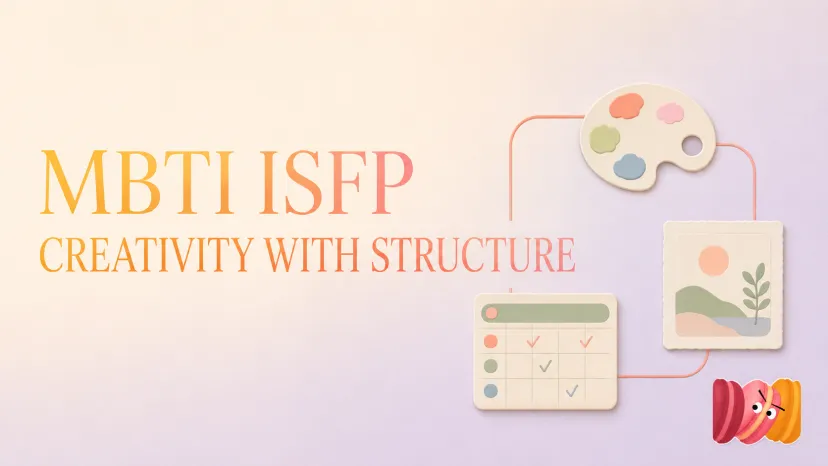
For three weeks I shared a project doc with a designer who would not, under any circumstances, fill in the timeline column. She'd send back the most beautiful mood boards I'd seen all year — and a Notion table with one blank week and a small flower emoji where the deadline should have been. I almost flagged it. Then I opened her file again and realized the work was already done. Just not in the boxes I'd built.
That's when the ISFP question stopped being abstract for me. As an INFJ I build systems for a living — I run micro-experiments on my own routines, then write them up. So watching someone produce excellent work outside the structure I'd designed wasn't a workflow problem. It was a signal that I'd been designing the wrong shape.
I’m Maren. I started paying attention. Reading. Asking. What I'm writing here isn't a profile of myself — it's what I've learned about MBTI ISFP from working alongside them, and where my own structure-loving instincts had to bend.
What MBTI ISFP means for creativity and freedom
The four letters stand for Introverted, Sensing, Feeling, Perceiving. But the type doesn't really live in the letters. It lives in the cognitive function stack underneath — and that's the part most surface guides skip.
ISFPs lead with Introverted Feeling, paired with Extraverted Sensing. The full ISFP cognitive function stack places Fi as dominant, Se as auxiliary, Ni tertiary, and Te inferior. Translated out of the jargon: they make decisions through a private, personal sense of what matters, and they take in the world through immediate sensory experience. Not theories. Not five-year plans. What's in the room, right now, that feels true.
Creativity, sensitivity, present-moment living
The popular nickname is "the Artist" or "the Adventurer," and both undersell what's actually going on. The reason ISFPs are called artists isn't because every one of them paints — it's because they treat life itself as a canvas for self-expression. The aesthetic sense is real, but it's a consequence of leading with Fi-Se, not the identity itself.
What this looks like in practice: a sharp eye for texture, mood, what feels off in a room. A strong internal compass for personal values. A real reluctance to perform for an audience.
How ISFP patterns show up in daily life
The designer I mentioned never explained her process. I had to piece it together by watching what she actually did — which, as it turns out, is the only way you learn anything useful about an ISFP.
Taste, mood, flexibility, personal expression
A few patterns I noticed, then later read about and confirmed:
Mood is a real input, not a vibe. When the lighting was wrong, the work was wrong. Moving her laptop to a different window fixed both.
Plans collapse under pressure but skills don't. Hand her a brief on Monday with a Friday deadline and she'd disappear. Hand her a beautiful problem and she'd send something back by Wednesday.
Direct critique lands harder than expected. ISFP sensitivity to criticism is well documented — they can read constructive feedback as a personal attack. I learned this the hard way, the day I gave feedback the way I'd want to receive it.
I almost stopped at the second pattern. The third is the one that actually changed how I work with her.
What helps the spark stay alive
Here's the part I'd been getting wrong: I was treating "no structure" as the ISFP preference. It's not. It's rigid structure that ISFPs resist — not structure itself. The distinction is small and it's everything.
The ISFP need for flexibility comes directly from auxiliary Extraverted Sensing — they need room to move, explore, and respond to their environment in real time. Monotony is the actual enemy. Repetition kills the spark. Containers, used well, don't.
What I've watched work, across the ISFPs I now know reasonably well:
Capture systems instead of planning systems. A place to dump ideas the moment they arrive — voice notes, screenshots, half-sentences. Sorting happens later, if at all.
Deadlines as suggestions with a real "by when" only on the final beat. Soft mid-points, hard end-points.
Permission to switch projects without guilt. A second active track keeps the first one alive.
Mood logs, not productivity logs. What was the light like. What music. What did the room feel like when the good work happened.
The mood log one surprised me. The ISFP aesthetic streak isn't decorative — it's how the type processes whether something is working. Tracking the environment of good work, rather than the output of it, turns out to be the thing that compounds.
A gentle system that fits ISFPs
I've been testing a personal AI setup with the designer I mentioned, mostly to see whether AI tools can hold ideas without flattening them. Three weeks in, the only feature she uses consistently is the part where it remembers context across sessions — so she doesn't have to re-explain herself every time she opens it.
That's the whole hack, actually. ISFPs don't need a smarter planner. They need something that doesn't make them justify the shape of their own process every time they show up.
For the system itself: a creative log that accepts photos, screenshots, fragments. Reminders that ask how are you feeling today before they ask what are you doing today. A weekly review that's mostly looking back at what was made, not auditing what wasn't. That's it.
Worth trying if your setup looks anything like hers.
FAQ
How can ISFPs add structure without feeling trapped?
Use containers, not schedules. A folder for ideas, a notebook for sketches, one calendar block per week for review — not a daily plan. The structure should hold the work, not direct it.
What creative-log systems suit ISFP flexibility?
Anything that captures fast and sorts later. Voice memos, a photo album set aside for screenshots, a single notes app where everything dumps in chronological order. The way 16Personalities describes Adventurers — life as a canvas — applies here too: the log should feel like a sketchbook, not a database.
How do ISFPs balance freedom with getting things done?
Through immediate, sensory engagement with the actual work. Plans don't motivate ISFPs. Materials do. Open the file. Touch the thing. Momentum follows contact.
Why do ISFPs resist rigid routines or long-term plans?
Because their dominant cognitive stack is Fi-Se — personal values plus present-moment sensing. The role of Introverted Sensing as the Critical Parent means that routines built around past patterns feel particularly suffocating to this type. Si lives in how it's always been done, which is exactly the frame an ISFP's dominant Fi keeps pushing against.
Can personal AI help ISFPs organize ideas without limiting creativity?
It can, if it remembers context and doesn't impose a schema. The win isn't smarter planning — it's not having to re-explain yourself every session. That's the small friction that quietly drains creative energy.
I'm still working out where the boundary is — between the structure I want to offer and the freedom an ISFP actually uses. Not sure I'll land it cleanly. But the flower emoji in the deadline column makes more sense to me now than it did three weeks ago.
I’m Maren, a 27-year-old content strategist and perpetual self-experimenter. I test AI tools and micro-habits in real daily life, noting what breaks, what sticks, and what actually saves time. My approach isn’t about features—it’s about friction, adjustments, and honest results. I share insights from experiments that survive a real week, helping others see what works without the fluff.