I've had the same argument with three different people in three different years. Different topics, different relationships — same structural breakdown every time. Energy differences often show up first among the most introverted MBTI types. One of us wanted to talk through the feeling first. The other wanted to get to the solution. Neither felt heard. Both walked away drained. Understanding those recurring patterns is also useful when designing Gemini prompts for personal intelligence that adapt to how different people actually communicate and decide.
At some point I stopped blaming the specific person and started wondering if there was a pattern underneath. That's what pulled me into MBTI compatibility — not as a dating filter, but as a way to understand why certain dynamics feel like swimming upstream no matter how much both people try.
Hi, I’m Maren! I spent close to two weeks reading research, cross-referencing community data, and stress-testing what I found against real dynamics I'd actually lived through. Here's what held up.
Quick Look
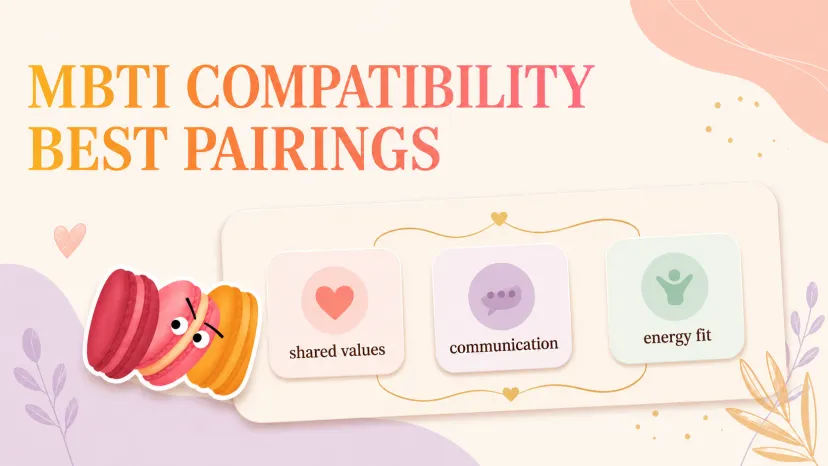
The best pairings run on cognitive functions, not matching letters
Opposites can attract — but only when at least one shared axis exists as a bridge
Friendship compatibility favors similar information-processing territory
Work pairings fail most often when J/P dynamics have no agreed decision protocol
No chart replaces what two real people actually do with their differences
How MBTI Compatibility Works
I used to think compatibility meant matching letters — I with I, F with F. That's not how it works.
The real engine underneath is the cognitive function stack. Every MBTI type runs four cognitive functions in a specific order, shaping how you take in information, make decisions, and move through the world. There are four core compatibility pairings between cognitive functions: Ti–Te, Fi–Fe, Si–Se, and Ni–Ne. When two people share these functions but run them in complementary directions — one introverted, one extraverted — communication develops a kind of natural flow that's hard to manufacture.
Cognitive Function Pairing
Take INFJ and ENTP. The INFJ runs Ni–Fe–Ti–Se. The ENTP runs Ne–Ti–Fe–Si. They share Ti and Fe — just in swapped positions. Types that share a dominant-auxiliary axis may communicate more naturally than types with the same letters but different function stacks. The "golden pair" concept in type literature — pairings like INFJ–ENTP or INTJ–ENFP — is based on complementary function stacks where each type's dominant function mirrors the other's secondary.
That's what I kept coming back to. The functions, not the letters.
Why Opposites Sometimes Attract
I almost missed this part. Opposites-attract is real in MBTI — but it comes with a non-negotiable condition.
Types that differ on all four dimensions share no cognitive function preferences and process the world in completely different ways. In the short term, this difference is exciting. Long-term, it creates communication fatigue and recurring misunderstandings. The most successful "opposite" pairings involve at least one shared preference that creates a bridge, plus high emotional intelligence on both sides.
INTJ and ENFP differ on three of four letters. But both run intuition as their dominant axis. That shared N is the bridge. Without it, you're not getting "opposites attract" — you're getting two people exhausted by the cost of translating each other indefinitely. That shared N is the bridge. Without it, you're not getting "opposites attract" — you're getting two people exhausted by the cost of translating each other indefinitely.
Best Romantic Pairings
Top 5 Most Compatible Couples
These pairings come up consistently across both community-reported data and cognitive function theory. Not because they're frictionless — because the friction they do have tends to be productive rather than circular.
INFJ + ENTP
This was the pairing I found most consistently cited across everything I read. This was the pairing I found most consistently cited... often considered one of the strongest golden pairs in MBTI literature. INFJ and ENTP compatibility is considered one of the strongest, as these two types complement each other in many ways. Both are intuitive and creative, and the ENTP's extroverted nature can help draw out the introspective INFJ. Their differences in thinking and feeling lead to stimulating discussions and mutual personal growth.
The INFJ brings emotional depth. The ENTP brings perspective-shifting energy. Neither gets bored.
INTJ + ENFP
The ENFP's passion for life and boundless creativity can ignite a spark in the INTJ's analytical mind. Their shared intuition forges a deep understanding between them, while the ENFP's warmth and empathy help the INTJ feel safe revealing their vulnerable side.
This one works because each partner genuinely fills what the other lacks — not as a compromise, but as a complement.
INFP + ENFJ
Both run the Fi–Fe axis in complementary directions. INFPs are most compatible with other Intuitive-Feeling types — ENFJ, ENFP, and INFJ. The ENFJ's ability to externalize feelings helps the INFP say what they usually keep private. The INFP's depth gives the ENFJ something to anchor to when they spread too thin.
ISTJ + ESFP
One builds the structure, the other keeps it from going stale. ISFJs and ESFPs find a balance between stability and excitement — one is nurturing and dependable, while the other brings spontaneity and adventure. The ISTJ–ESFP dynamic follows the same logic, just more practically grounded.
INTP + ENTJ
One builds the models. The other ships them. In relationships, this works as long as neither person treats the other's decision-making process as a flaw to correct rather than a difference to work with.
Top 5 Most Challenging Couples
These aren't impossible — but they require more deliberate effort than most pairings, and I think it's worth being honest about that rather than burying it in footnotes.
INTJ + ESFP — opposite on all four dimensions, no shared cognitive bridge to fall back on
INFP + ESTJ — one makes decisions through personal values, the other through external standards; this gap surfaces in nearly every daily choice
ENTP + ISFJ — the ENTP's drive to question everything runs directly against the ISFJ's preference for established methods
INFJ + ESTP — intuition vs. sensation as a dominant mode creates a fundamental difference in how each person notices the world in the first place
ENFP + ISTJ — the tension between spontaneity and structure tends to start small and compound quietly until it isn't small anymore
Best Friendship Pairings
Friendship compatibility in MBTI runs differently from romantic compatibility. I noticed this early in my research. You don't need complementary functions as much as you need similar processing territory — someone whose brain moves in roughly the same direction as yours, even if the specifics differ.
Intuitive types gravitate toward other intuitives — not because sensors aren't interesting, but because every type within a quadra shares the same cognitive functions, creating a natural camaraderie based on similar ways of seeing and engaging with the world.
The strongest friendship pairings I kept finding:
INTP + ENTP — they share a love of ideas and debate that most people find exhausting; these two find it genuinely energizing. Conversations go long and get weird fast.
INFJ + INFP — both introverted intuitives with feeling. Deep loyalty, low drama, and a shared instinct to take conversation seriously.
ENFP + ENFJ — extroverted and feeling-dominant, they match each other's energy and enthusiasm. The ENFJ helps the ENFP follow through; the ENFP helps the ENFJ loosen up.
ISTP + ESTP — sensor-thinking types who prefer doing things together over processing feelings about things. Low maintenance, high practical trust.
The friendships that need the most work: intuitive-sensor combinations where one person keeps asking "but why does this matter" and the other keeps asking "but what do we actually do about it."
Best Work Pairings
Here's the part that surprised me most going in. I assumed similar types would make the best teams. I was wrong.
In teams, type diversity predicts innovation while type similarity predicts smooth execution. High-performance teams often mix N and S, T and F deliberately to cover different cognitive ground. Research on team composition found that teams with complementary thinking styles outperformed personality-homogeneous teams on complex problem-solving, while homogeneous teams executed routine tasks faster.
So it depends entirely on what you're building.
For innovation and strategy, NT + NF pairings — like INTJ + ENFJ, or ENTP + INFP — generate ideas at the conceptual level and then connect them to human systems. For execution and operations, SJ + SP pairings cover both planning and real-time adaptability. The SJ holds the process steady; the SP troubleshoots what the process didn't anticipate.
The work pairing that consistently underperforms when left unmanaged: J + P at senior levels without an explicit decision-making agreement. The Judger wants closure. The Perceiver wants more information. Without a shared process norm, that becomes a recurring standoff dressed up as a meeting.
Compatibility Table (All 16 Types)
This is a simplified overview — not a verdict, a starting point. Read across, not down.
Your Type
Strongest Romantic
Strong Friendship
Most Challenging
INFJ
ENTP, ENFP
INFP, INTJ
ESTP, ESFP
INTJ
ENFP, ENTP
INTP, ENTJ
ESFP, ISFP
INFP
ENFJ, INFJ
INTP, ENFP
ESTJ, ENTJ
INTP
ENTJ, ENFJ
ENTP, INTJ
ESFJ, ISFJ
ENFJ
INFP, ISFP
ENFP, INFJ
ISTP, INTP
ENTJ
INTP, INFP
INTJ, ENTP
ISFP, INFP
ENFP
INTJ, INFJ
ENFJ, ENTP
ISTJ, ESTJ
ENTP
INFJ, INTJ
INTP, ENFP
ISFJ, ESFJ
ISFJ
ESTP, ESFP
ISTJ, ISFP
ENTP, ENTJ
ISTJ
ESFP, ESTP
ISFJ, ESTJ
ENFP, INFP
ISFP
ENFJ, ESFJ
ISFJ, INFP
ENTJ, ENTP
ISTP
ESFJ, ESTJ
ESTP, INTP
ENFJ, INFJ
ESFJ
ISTP, ISFP
ISFJ, ENFJ
INTP, ENTP
ESTJ
ISFP, ISTP
ISTJ, ENTJ
INFP, ENFP
ESFP
ISTJ, ISFJ
ESTP, ENFP
INTJ, INFJ
ESTP
ISFJ, ISTJ
ISTP, ESFP
INFJ, INFP
Why Compatibility Charts Are Not Rules
This is the part most MBTI guides skip because it doesn't make for a clean headline. I'm including it because leaving it out makes everything above misleading.
MBTI type shows weak-to-moderate associations with relationship outcomes — far weaker than Big Five traits, attachment styles, and communication quality. The practical conclusion: MBTI is a useful communication framework for understanding differences, not a reliable compatibility filter.
That means the table above is a tool for anticipating friction points, not for ruling people out before you've seen how they actually show up.
Individual Growth Matters More
The line I kept returning to after all that reading: a mature "bad match" is infinitely better than an immature "good match."
Type describes default tendencies in people who haven't done much work on themselves. A psychologically healthy INTJ and a psychologically healthy ENFP don't look like the "challenging pairing" version of that combination. They look like two people who find each other genuinely interesting and know how to work with the gaps instead of around them.
What research actually shows predicts relationship success:
Emotional stability (low neuroticism)
Secure attachment style
Communication quality
Shared core values — not shared personality type
MBTI gives me the why behind friction points. It doesn't tell me whether two specific people can handle friction together. That part I have to watch for myself.
FAQ
What MBTI types are most compatible?
There's no single answer, but pairings with complementary cognitive function stacks appear most consistently. You are most compatible with types in the opposite quadra — those that have the opposite functions in the same stack positions. For example, INFP and ENFJ, or INTP and ENTJ. These pairings let each person's strengths naturally support the other's blind spots without either feeling like they're constantly compensating.
Can incompatible types make it work?
Yes — but it requires deliberate effort that more naturally matched pairs simply don't need as much of. The most successful "opposite" pairings involve at least one shared preference that creates a bridge, plus high emotional intelligence on both sides. Without those two things, the translation cost of every disagreement compounds quietly over time. "Can it work" is the wrong question. "Are both people willing to do what it actually requires" is the one worth asking.
Is MBTI compatibility scientifically proven?
Not in a strong sense. Studies show that couples who have taken the MBTI report higher relationship satisfaction — but this may reflect the general benefit of any reflective self-awareness tool rather than specific type pairings. Big Five Agreeableness, Conscientiousness, and low Neuroticism predict relationship satisfaction far more strongly than any MBTI dimension. I use MBTI as a starting point for understanding communication differences, not as a clinical compatibility predictor.
What type is compatible with everyone?
No type is universally compatible — adaptability comes from psychological maturity, not from type. That said, ENFJs and ESFJs are most often cited as broadly adaptable in relational contexts because their dominant or auxiliary function is Extraverted Feeling (Fe), which is naturally tuned toward reading and responding to others' emotional states. Even so, they have harder pairings too.
Should I filter potential partners by MBTI type?
I wouldn't. Understanding cognitive functions can help us see behavioral patterns associated with each type — but this theory won't bring your future partner to you, and it won't make any relationship perfect, because that depends entirely on the work both people put in. I use type to understand why certain dynamics feel the way they feel. I don't use it to disqualify someone before I've seen how they actually show up.
That's where two weeks of reading landed me. Not "find your perfect type" — but "understand the patterns, then pay attention to the actual person in front of you."
The chart is useful. The conversation it starts is more useful. A few real interactions will tell you more than any table ever could. I'd start there.
I’m Maren, a 27-year-old content strategist and perpetual self-experimenter. I test AI tools and micro-habits in real daily life, noting what breaks, what sticks, and what actually saves time. My approach isn’t about features—it’s about friction, adjustments, and honest results. I share insights from experiments that survive a real week, helping others see what works without the fluff.