Session Continuity and Personal Continuity Are Different
Where Deep Memory Fits in a Life Agent
Privacy and Control Trade-Offs
FAQ
Conclusion
Previous Posts
DeepSeek Harness Memory Is Not Personal AI Memory
DeepSeek Harness Memory Is Not Personal AI Memory
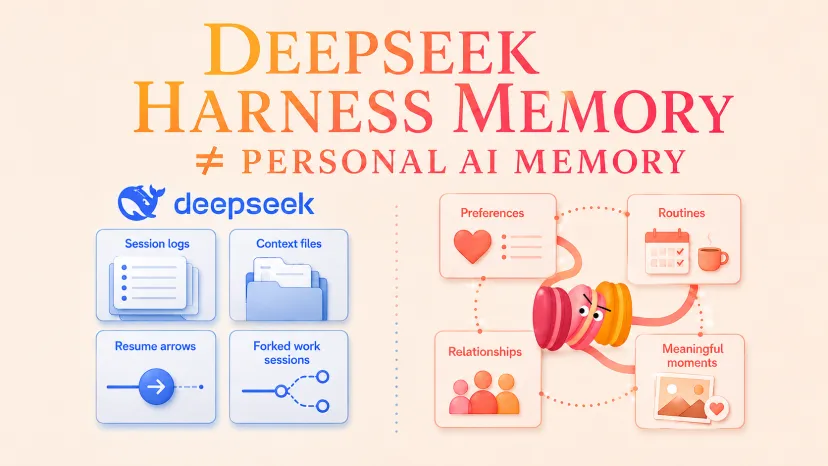
DeepSeek Harness memory and Personal AI memory solve different problems. An event-backed session can reconstruct a work stream so an agent can continue, branch, or review it. That does not automatically mean the system knows a person's preferences, routines, relationships, or life context across time.
The simplest distinction is between task continuity and personal continuity. DeepSeek Harness preserves what happened in an agent session. Personal AI memory is meant to make future support more relevant to the person using it. A life agent may need both, but one does not prove the other.
DeepSeek Harness is in developer preview, and its official repository warns of compatibility-breaking changes. The descriptions below reflect the official materials reviewed above.
What DeepSeek Harness Stores in a Session Log
Before looking at memory claims, it helps to identify the thing being preserved. DeepSeek's session documentation defines a session as an append-only log of typed SessionEvent records. It calls that log the single source of truth for an agent's interaction history.
Append-Only Events as the Source of Context
“Append-only” means new records are added in sequence instead of rewriting earlier ones. Events can represent user and assistant messages, tool results, boundaries, and other session state.
The result is traceability: the system has an ordered record from which it can rebuild conversation state. The durable record and the model's current input are not the same thing.
How Model-Visible History Is Reconstructed
DeepSeek Harness does not store a separate master copy of the model-visible conversation. Its deriveMessages() process projects selected events into the history the model sees. Structural records do not become messages.
Compaction can replace a range on this visible surface with a summary. The original events remain in the append-only log; they are shadowed in the current model-facing view rather than erased from the canonical history. This distinction matters whenever someone treats “the transcript,” “the context,” and “the log” as interchangeable.
How Resume, Fork, and Replay Support Continuity
These functions work with recorded session history; they are not evidence of a personal profile.
Resume Continues an Existing Work Stream
Resume loads a persisted session into a live agent. The persistence documentation describes backends that preserve session events and prepare them for resumption. The agent continues from recorded work rather than an empty session.
Fork Creates a New Branch from Recorded History
Fork creates a child from a stable prefix of a live session. Selected events are deep-cloned, while metadata records the parent and inherited boundary. The child can then develop separately.
That is branching, not personalization. The fork inherits recorded work up to a chosen point; it does not inherit a proven understanding of the user's identity or life.
Replay Rebuilds What Happened
Replay re-derives the session's projections from the same events. It is not the model privately recalling a person; the evidence lives in the log.
What Personal AI Memory Is Designed to Do
Personal AI memory asks a different question: what user-approved information should remain useful beyond one work stream? For a broader experience-level explanation, see AI long-term memory.
Preferences, Routines, and Relationships Across Time
Personal continuity may involve preferences, routines, life background, or relationships. A food preference might shape later meal ideas; a recurring constraint might change a plan.
The test is whether relevant personal context can be reused accurately when it helps—not merely whether old text exists.
User Control Over What Is Remembered
Personal memory raises questions a log cannot answer: Can users correct, forget, review, or scope what influences later suggestions?
Those controls should be verified product by product. A durable record does not automatically provide consent, correction, review, or forgetting controls.
Session Continuity and Personal Continuity Are Different
The two lanes make the boundary clearer:
Session lane: event history → reconstructed transcript or context → resume, fork, or replay → task continuity.
Personal lane: user-approved preference or life context → correction and forgetting controls → reuse in relevant moments → personal continuity.
The lanes can overlap. A personal agent may preserve a task while drawing on long-term context. But one lane does not establish the other or imply the same storage design.
Reconstructing a Task Is Not Understanding a Person
A session log can support faithful continuation by recording requests, answers, and tool results. It does not establish why a preference matters, whether it is current, or whether it belongs elsewhere.
Calling both things “memory” hides this difference. One restores a recorded sequence. The other attempts to carry forward a useful, revisable picture of the person.
Context Length Is Not Long-Term Personalization
A larger context window fits more material into one request. It does not decide what should persist, what belongs to a user, what changed, or what should be forgotten.
Compaction makes the distinction visible: model-facing context can be summarized while the underlying Harness events remain. Capacity affects what fits now; personalization depends on how relevant personal information is selected, governed, and reused later.
Where Deep Memory Fits in a Life Agent
Macaron's current first-party app page describes Deep Memory as remembering preferences and context over time. Its Deep Memory guide also connects prior context with personalized mini-app creation. These are product descriptions of personal continuity, not claims about DeepSeek Harness architecture.
Turning Past Preferences into Better Daily Support
The value is reuse. Remembered preferences or background can improve a later suggestion without requiring repetition. That supports a person across moments rather than restoring one job.
Accuracy still matters. Remembered context can become stale, incomplete, or inappropriate for a new situation. Personalization is useful only when the system applies it with suitable boundaries.
Connecting Memory to Personal Mini-Apps
Macaron's first-party materials say it builds practical tools tailored to users and describe memory informing personalized mini-apps. A meal planner, for example, may be more useful when relevant dietary preferences are carried into its design.
That is the limited connection supported here: remembered personal context can shape a tailored tool. It does not mean Macaron uses DeepSeek Harness, shares its session format, or offers the same Resume, Fork, Replay, or persistence behavior.
Privacy and Control Trade-Offs
Both lanes can contain sensitive material. A work log may preserve prompts, outputs, tool activity, and failures; personal memory may preserve preferences, stories, relationships, and life context.
Durable Logs and Personal Data Need Different Safeguards
For a durable session, ask where the log is stored, who can access it, how long it remains, and what happens to branches and copies. For personal memory, also ask how a person can review, correct, scope, or forget information and how it influences later results.
The official Harness architecture confirms persistence mechanisms; it does not make every installation automatically private or secure. Likewise, Macaron's first-party pages support the stated personalization use, but this article does not infer retention, encryption, deletion, export, or training practices that those reviewed materials do not establish.
FAQ
Can users search old sessions by keyword?
Confirmed, with a scope caveat. The official session query docs define cross-session and within-session full-text search over semantic event text, including messages, reasoning, tool activity, todos, and status details. Because Harness is composable and in developer preview, the exact user interface and enabled provider can vary by installation.
Can one session be transferred to another installation?
Not confirmed. The reviewed official documentation describes JSONL and SQLite persistence, raw-artifact access for supported backends, and strict format-version checks. It does not establish a supported user workflow for exporting a session from one installation and importing it into another with all dependencies, credentials, configuration, and compatibility intact.
What happens to a fork after deleting its parent session?
Not confirmed. The architecture documents deep-cloned seed events and parent-lineage metadata, but the reviewed official materials do not define parent-deletion behavior or promise that deletion cascades—or does not cascade—to a fork. Check the current official documentation or project support before relying on either outcome.
Does context compaction remove the original event history?
Confirmed: it changes the model-visible surface, not the append-only source log. The official compaction documentation says a successful summary replaces selected visible surface nodes with a summary node while recording the shadowed range and event sequence numbers in the log.
Are session titles generated from stored conversation content?
Sometimes. The title documentation allows provider-generated, fallback, and user-supplied titles. An automatic provider receives eligible human-message text and records which message sequence numbers informed the title. A manual rename has no such source messages and stops automatic title generation until explicitly refreshed.
Conclusion
DeepSeek Harness memory is best described as event-backed task continuity. It preserves and reconstructs agent sessions so work can be resumed, forked, replayed, searched, and compacted under documented rules.
Personal AI memory serves a different purpose: carrying relevant, controllable personal context into future moments. A system can support both lanes, but session persistence is not proof of personalization, and personalization is not proof of any particular session architecture. Keeping that boundary visible makes both the usefulness and the privacy questions easier to evaluate.
저는 Maren, 27세 콘텐츠 전략가이자 끊임없는 자기 실험가입니다. 일상 생활에서 AI 도구와 마이크로 습관을 테스트하며, 무엇이 실패하고, 무엇이 지속되며, 무엇이 실제로 시간을 절약하는지 기록합니다. 제 접근법은 기능이 아니라 마찰, 조정, 그리고 솔직한 결과에 중점을 둡니다. 실제 일주일 동안 살아남은 실험에서 얻은 인사이트를 공유하여, 다른 사람들이 불필요한 장식 없이 실제로 효과 있는 방법을 볼 수 있도록 돕습니다.