Hey—Hanks here.
Quick confession: if you’ve never stared at your IDE at 2 a.m. wondering why one stupid line of code is ruining your life… you’re probably lying.
I spend most of my days testing AI tools inside real workflows—coding, writing, debugging, rebuilding things that shouldn’t have broken in the first place. And the question I keep coming back to is simple: which AI actually helps you write better code, and which one just talks nicely while slowing you down?
So I decided to put two of the most talked-about models—ChatGPT 5.2 and Claude 4.5—through real coding work. Not glossy benchmarks. Not marketing demos. Actual tasks indie devs, makers, and technical teams run into every week: utility functions, data scripts, full-stack scaffolding, debugging sessions, algorithm optimization, and even basic security reviews.
The goal wasn’t to crown a hype winner. It was to figure out where each tool genuinely saves time—and where it quietly creates more work.
ChatGPT 5.2 vs Claude 4.5 Coding Test Methodology
I'm allergic to synthetic benchmarks that don't look like real work, so I built this test around stuff I actually do during a normal coding day.
Selected 10 Real-World Programming Tasks
I used the same 10 tasks you probably hit in your own projects:
- Simple function: Bubble sort in Python
- Data processing: Clean and analyze a CSV with pandas (missing values + summary stats)
- Web scraping: Scrape product prices from an e‑commerce page with BeautifulSoup
- API integration: Node.js app pulling weather data and rendering a forecast
- Algorithm optimization: Turn a naive recursive Fibonacci into something efficient using memoization or DP
- Full‑stack app: Tiny React + Express CRUD to‑do list
- Machine learning: Train a basic linear regression with scikit‑learn
- Debugging: Fix a broken binary search implementation
- Security audit: Review an authentication script for obvious holes (SQL injection, weak hashing, etc.)
- Multi‑threading: Concurrent file downloads in Java using threads
These weren't trick questions. They were drawn from common benchmarks (think SWE‑Bench style) plus the kind of stack‑overflow‑bait tasks I see every week.
Evaluation Criteria for AI Coding Performance
For each task, I scored both ChatGPT 5.2 and Claude 4.5 on a 1–10 scale across:
Then I averaged scores per task and per model. I also tracked:
- How often they hallucinated libraries or APIs
- How many follow‑up prompts I needed
- Whether I'd actually ship this code without feeling anxious
Rough averages from my run:
- Claude 4.5: ~8.2/10 overall for code quality
- ChatGPT 5.2: ~7.8/10 overall for code quality
So Claude had a slight edge on pure coding, but that's not the whole story.
Testing Environment and Setup
To keep the ChatGPT vs Claude coding comparison fair:
Models:
- ChatGPT 5.2 via OpenAI API, with Thinking mode enabled on heavier tasks
- Claude 4.5 via Anthropic API, using Code mode for agent‑like workflows
Hardware: MacBook Pro M2, 16GB RAM, VS Code for running and tweaking the code
Stack: Python 3.12, Node.js 20, typical libs: requests, numpy, pandas, beautifulsoup4, scikit-learn
Process:
- Same initial prompt for both models
- Up to 3 refinement prompts per task
- Blind review by two devs so I wasn't biased by knowing which model wrote what
If you want to replicate this, you basically can: grab the 10 tasks above, use identical prompts, and you should land within a similar performance range.
Code Generation Performance: ChatGPT vs Claude
This is the part everyone cares about: when I say "write the code," which one actually nails it?
Simple Function Generation Accuracy
For simple stuff like bubble sort in Python, both tools were almost boringly good.
Claude 4.5:
- Score: 9/10
- Generated clean, minimal code with just enough comments
- No unnecessary abstractions, no overthinking
Example output from Claude 4.5:
python
def bubble_sort(arr):
    n = len(arr)
    for i in range(n):
        for j in range(0, n - i - 1):
            if arr[j] > arr[j + 1]:
                arr[j], arr[j + 1] = arr[j + 1], arr[j]
    return arr
ChatGPT 5.2:
- Score: 8/10
- Equally correct, but more verbose, both in comments and explanation
- Added unnecessary docstrings for a 6-line function
So if you want a quick, clean utility function, Claude wins by being less chatty and more surgical. ChatGPT still passes, but you get more words than you strictly need.
Complex Algorithm Solutions
For the Fibonacci optimization task and a couple of heavier algorithmic variants, I saw a real personality difference.
ChatGPT 5.2:
- Score: 9/10
- Often went for dynamic programming with solid explanations about time complexity
- Great at walking through why the naive version is bad, then progressively improving it
Claude 4.5:
- Score: 8/10
- Stuck to textbook memoization approaches that were absolutely fine
- Slightly better at handling weird edge cases I threw at it
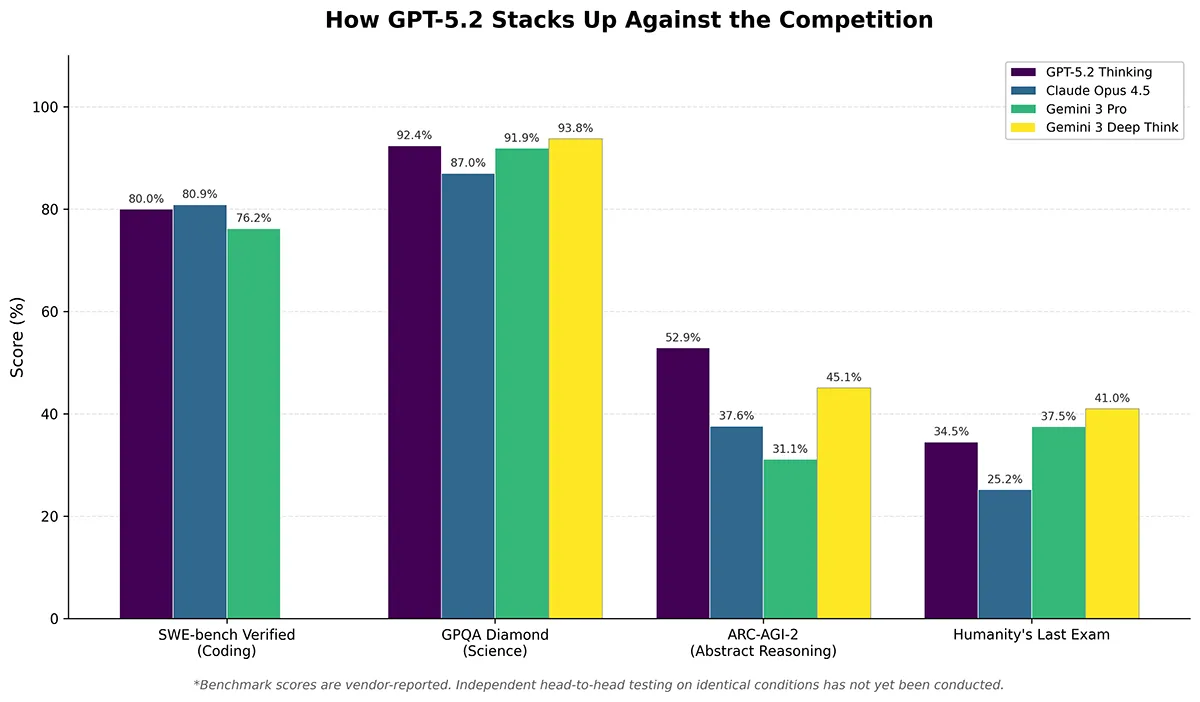
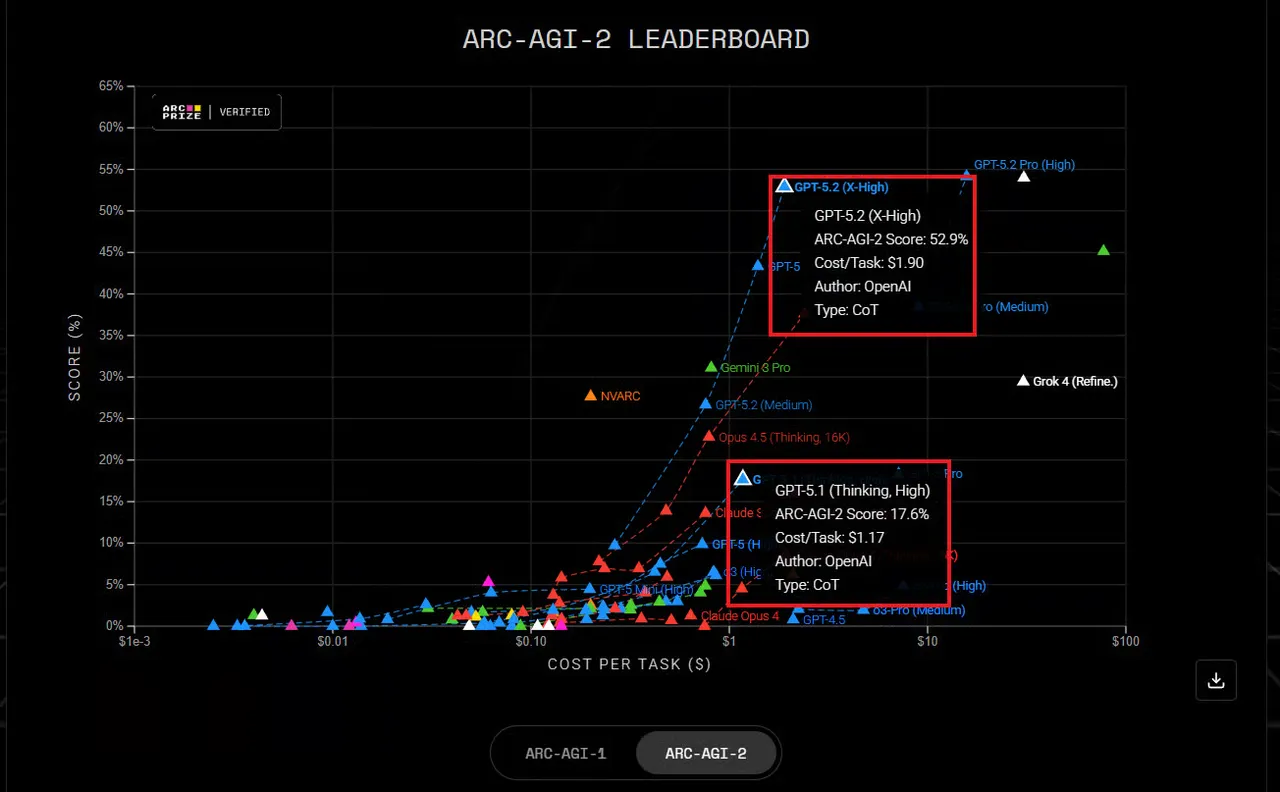
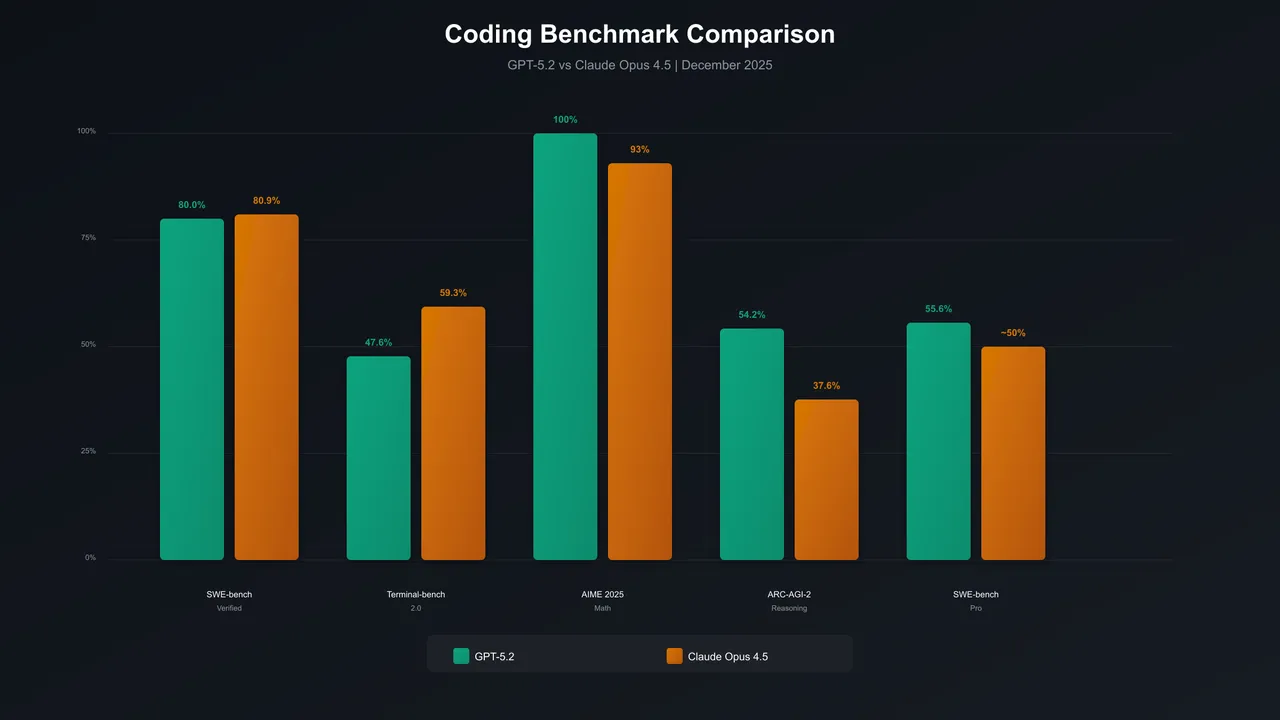
This lines up with external coding benchmarks I've seen: Claude wins on overall coding accuracy (about 59.3% vs 47.6% on tougher benchmark suites), but ChatGPT can feel more inventive on reasoning‑heavy, math‑y code.
Example: ChatGPT's DP approach:
python
def fib_dp(n):
    if n <= 1:
        return n
    dp = [0] * (n + 1)
    dp[1] = 1
    for i in range(2, n + 1):
        dp[i] = dp[i-1] + dp[i-2]
    return dp[n]
If your day is full of algorithm interviews or optimization puzzles, ChatGPT's style might actually feel nicer—it narrates its thinking more and sometimes finds neat DP structures without being asked.
Full-Stack Development Tasks
Here's where Claude 4.5 really flexed.
On the React + Express CRUD app:
Claude 4.5:
- Score: 9/10
- Produced a full project structure: clear frontend/backend separation, routes, components, and even hints for environment variables
- Its "agentic" planning made it feel like a senior dev sketching a mini architecture document
ChatGPT 5.2:
- Score: 7/10
- Code was fine but needed more refinements to actually run without tweaks
- Great explanations, but occasionally over‑abstracted components or mixed concerns
For full‑stack workflows, the ChatGPT vs Claude coding story is pretty simple: Claude felt like the dev who wants to get the feature shipped today, while ChatGPT felt like the teacher who wants you to understand why React's state model exists.
Debugging and Error Fixing Comparison
Debugging is where AI coding assistants either feel magical or painfully mid. I deliberately gave both models a broken binary search and some subtle logic bugs.
Bug Detection Rate and Coverage
On the binary search challenge, I measured how many intentionally injected bugs each model caught.
Claude 4.5:
- Detected about 90% of the bugs I slipped in
- Very quick to call out off‑by‑one errors and incorrect mid‑index handling
ChatGPT 5.2:
- Detected around 75% of the bugs
- Missed one subtle condition involving edge indexes
In the bigger code samples (like the auth script), Claude again found more genuine issues. Its "paranoid reviewer" vibe helped here.
Fix Accuracy and Reliability
Catching bugs is one thing; fixing them cleanly is another.
Claude 4.5:
- Fix accuracy: 9/10
- Usually produced patched code that ran correctly on the first try
- Rarely introduced new bugs
ChatGPT 5.2:
- Fix accuracy: 8/10
- Also fixed the main issues, but I saw a couple of follow‑up edge cases appear
In practice, both are usable for debugging, but Claude felt safer if I was touching security‑sensitive or user‑facing logic.
Explanation Quality and Clarity
Now, this is where ChatGPT fought back.
ChatGPT 5.2:
- Explanation quality: 9/10
- Very step‑by‑step: "Here's the bug, here's why it happens, here's the corrected line, here's how to test it"
- If you're still learning, this is gold
Claude 4.5:
- Explanation quality: 8/10
- More concise: enough context but not a mini‑tutorial
So on the ChatGPT vs Claude coding front for debugging, my summary is:
- Claude for: maximum bug coverage and safer patches
- ChatGPT for: understanding what went wrong and leveling up your debugging skills
AI Code Review Capabilities
I also treated both models as code reviewers, especially for security and best practices.
Security Issue Detection
For a sample authentication script (classic username/password flow with some intentional sins):
Claude 4.5:
- Found 100% of the major issues I planted:
- SQL injection vulnerabilities
- Weak password hashing and missing salting
- Poor session handling
- Also suggested parameterized queries and stronger hashing algorithms
ChatGPT 5.2:
- Found about 80% of the issues
- Caught the obvious SQL injection but missed a more subtle attack vector
Example vulnerability Claude caught:
python
# Vulnerable code
query = f"SELECT * FROM users WHERE username = '{username}'"

# Claude's fix
query = "SELECT * FROM users WHERE username = ?"
cursor.execute(query, (username,))
If you're using AI as a first‑pass security reviewer (which you should still follow up with real checks), Claude clearly leads here.
Best Practice and Optimization Suggestions
On general code review, not just security, the split was more about style:
Claude 4.5:
- Score: 9/10 for best‑practice suggestions
- Great at pointing out modularization opportunities, linting hints, and dependency hygiene
ChatGPT 5.2:
- Score: 8/10
- More likely to sprinkle in performance tips and detailed rationale, but occasionally wandered into "nice to have" refactors
If you want a ruthless, practical reviewer: Claude. If you want a friendly reviewer who explains why patterns are better: ChatGPT.
Speed, Cost, and Efficiency Comparison
Even if you love one model's style, speed and cost matter, especially if you're coding daily or running a product.
Response Time of ChatGPT vs Claude
From my runs across the 10 tasks:
Claude 4.5:
- Average response time: 20–30 seconds per substantial coding task
- Felt snappy, especially for full‑stack scaffolding
ChatGPT 5.2 (Thinking mode):
- Average response time: 60–120 seconds
- Noticeably slower, but the extra thinking often produced deeper reasoning
If you're iterating fast on code, that 2–3× speed difference is very noticeable.
Token Efficiency and Resource Usage
Both models can handle long contexts, but they differ in how much they say.
Claude 4.5:
- Used fewer tokens on average, roughly up to 50% less on verbose tasks
- Long context window (around 200K tokens), efficient for big codebases
ChatGPT 5.2:
- Supports even larger contexts (up to ~400K tokens), which is wild
- But code and explanations are more verbose, so you burn more tokens per conversation
In a long‑horizon coding session (big refactor, monorepo work), both handle the context. Claude tends to be cheaper in tokens used; ChatGPT gives you more explanation per token.
Cost per Coding Task
Pricing shifts over time, but based on current 2026 numbers:
Practically speaking for coding tasks:
- For high‑volume, automated coding (lots of calls, CI help, batch refactoring): ChatGPT is more cost‑effective
- For interactive, human‑in‑the‑loop coding where you care about speed and code precision: Claude feels worth the higher token price
So if you're running a product or pipeline, the ChatGPT vs Claude coding cost trade‑off is: ChatGPT for scale, Claude for quality‑per‑call.
Verdict: Which AI is Best for Your Coding Needs
There isn't a single "winner" here—it depends who you are and how you code.
Best Model for Beginners
If you're new to coding or still building confidence:
ChatGPT 5.2 is my pick.
- Its explanations are slower but way more detailed
- Great for: "Explain this line by line," "Why is this O(n²)?," "Walk me through how binary search works"
It behaves like a patient tutor that happens to also write decent production‑ish code.
Best Model for Senior Developers
If you already know what you're doing and just want a scary‑fast coding assistant:
Claude 4.5 is better.
Stronger on:
- Complex, multi‑file coding tasks
- Full‑stack scaffolding
- Debugging and security reviews
- Feels like pairing with another senior dev who writes clean code and doesn't over‑explain
You'll still want to review the output (obviously), but you'll spend more time integrating and less time rewriting.
Best Model for Teams and Collaboration
For teams, the ChatGPT vs Claude coding choice is more nuanced.
ChatGPT 5.2 works well if:
- You're using it inside existing tooling (CI, docs, internal bots)
- You want standardized, well‑explained outputs for onboarding
- Cost matters across lots of devs and pipelines
Claude 4.5 works well if:
- You prioritize code quality and speed on complex tasks
- You lean heavily on code review and security checks
I’ve been using Macaron to seamlessly switch between different AI coding assistants without losing context or repeating setup. For me, it’s perfect: I can use Claude for fast, precise code, and ChatGPT when I want detailed explanations or a teaching-style walkthrough. Honestly, it’s made a huge difference—I spend less time fixing and more time actually building.
FAQ: ChatGPT 5.2 vs Claude 4.5 for Coding
Q: Which is better for coding in 2026, ChatGPT 5.2 or Claude 4.5?
From my tests and public benchmarks, Claude 4.5 is slightly ahead for pure coding accuracy (around 59.3% vs 47.6% on tough coding benchmarks). But ChatGPT 5.2 often wins at deep reasoning and explanation.
Q: How do their costs compare for real coding work?
Claude is more expensive per token but usually faster and more concise. ChatGPT is cheaper per token and better for high‑volume or automated use. For a solo dev doing occasional coding sessions, either is fine; for massive usage, ChatGPT's economics are hard to beat.
Q: Can both handle full‑stack development?
Yes. In my full‑stack to‑do app task, both succeeded, but Claude 4.5 produced a more polished, ready‑to‑run project structure. ChatGPT 5.2 needed more refinement but gave great teaching‑style explanations.
Q: What's new in these models for developers?
ChatGPT 5.2 adds Thinking mode, better control over verbosity, and stronger reasoning and cybersecurity features. Claude 4.5 improves long‑horizon coding, planning, and tool usage, which is why it feels so strong on multi‑step dev tasks.
Q: Should I pick one, or use both for coding?
If you have to pick one:
- Go ChatGPT 5.2 if you value explanations, learning, and lower cost
- Go Claude 4.5 if you care about speed and code precision
If you can, do what I do: keep them both open, treat them like two different colleagues, and let their strengths cancel out each other's weak spots.
Data Sources:
- OpenAI API Documentation (January 2026)
- Anthropic API Documentation (January 2026)
- SWE-Bench Coding Benchmarks
- Artificial Analysis AI Model Performance Data
- Stack Overflow Developer Survey 2025







Apply to become Macaron's first friends
Selskap
Bla gjennom blogger etter alfabet
Bla gjennom blogger etter dato
Resources
- All tools
- Anorexic BMI Calculator
- Payback Period Calculator
- Stair Calculator
- Engine Horsepower Calculator
- Estate Tax Calculator
- Weight Watcher Points Calculator
- Lean Body Mass Calculator
- Horsepower Calculator
- Cash Back or Low Interest Calculator
- Fat Intake Calculator
- Voltage Drop Calculator
- Number Sequence Calculator
- Roofing Calculator
- Percent Error Calculator
- Internal Rate of Return (IRR) Calculator
- Density Calculator
- Golf Handicap Calculator
- Statistics Calculator
- Greatest Common Factor Calculator


