Affirmation Generator
An affirmation generator is most useful when the wording feels believable enough to repeat in a real moment, not just inspiring on a good day. Macaron shapes affirmations around your current emotional context so the result feels more specific, practical, and easier to use.
Affirmation Generator
This reflection module helps you notice what kind of affirmation is most likely to feel believable, useful, and easy to repeat right now. It focuses on your current mindset so the words you generate can fit real life, not just sound uplifting on paper.
This is a self-reflection tool, not a diagnosis or a substitute for professional support.
Please answer every question before viewing your result.
This module is for reflection and everyday self-support, not for diagnosing mood, anxiety, or any other condition. If your distress feels intense, persistent, or unsafe, consider reaching out to a qualified professional or a trusted person right away.
Why Personalized Affirmations Feel More Usable
An affirmation generator works best when it gives you language that feels emotionally credible, especially in moments of stress, self-doubt, or harsh inner dialogue. People often search for affirmation tools because they want more than a random positive quote. They want words that fit the situation they are actually in, whether that means calming down, rebuilding confidence, or finding a steadier way to speak to themselves.
Macaron uses the affirmation generator as a reflection-based AI tool, which means it can adapt the tone and focus of the prompt instead of relying on a fixed library of generic phrases. That matters because the same person may need reassurance one day, courage the next, and self-forgiveness after that. A useful generator should respond to the emotional job you need the words to do, not just the category you clicked.
Search behavior around affirmation generators shows a common pattern: users want personalized, daily, or category-based support such as confidence, self-love, motivation, boundaries, or emotional recovery. This page is designed around that intent, so the tool feels useful whether you are starting your morning, resetting after a hard conversation, or trying to interrupt negative self-talk. The value is in matching the moment, not just producing a pleasant sentence. For a related Macaron page, see AI Personal Assistant - Macaron at https://macaron.im/ai-personal-assistant.
A good affirmation is usually not the most dramatic one. It is the one you can actually say without resistance. That is why many people prefer softer, grounded wording over overly upbeat lines that feel disconnected from their real experience. The right generator should help narrow that gap by producing language that sounds calm, specific, and realistic enough to repeat when your energy is low.
This affirmation generator is not a clinical intervention or a substitute for professional care. It is a practical support tool for people who want more thoughtful self-talk, more consistent encouragement, and a simple way to return to language that feels steady rather than forced. Compared with large quote libraries, Macaron is better for context-aware phrasing; compared with dedicated therapy apps, it is lighter and faster, but it does not replace deeper mental health support.
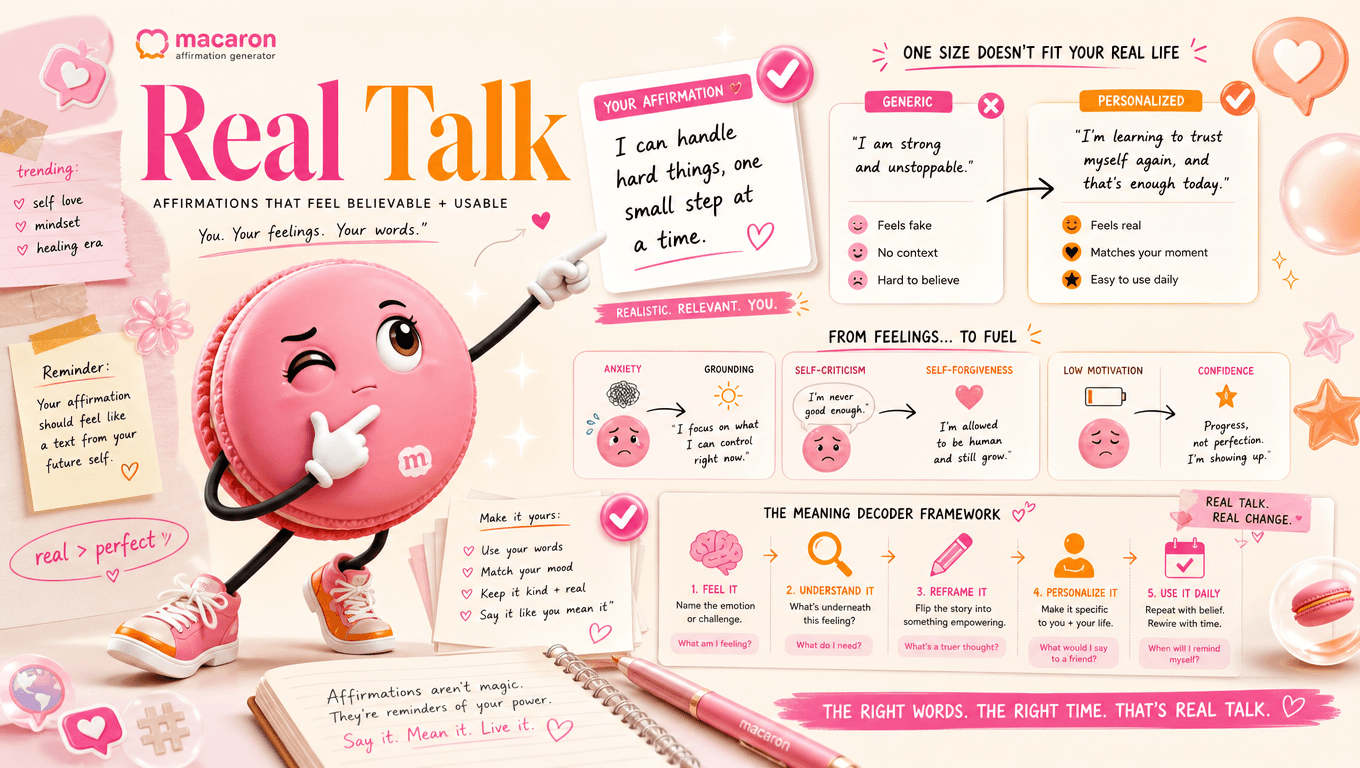
Why Personalized Affirmations Feel More Usable
Generic affirmations can sound encouraging and still miss the point if they do not match what you are feeling. A personalized generator helps narrow the gap between what sounds positive and what actually feels believable, which is important when someone is dealing with anxiety, self-criticism, or low motivation. Macaron encourages you to think about the emotion underneath the request, the kind of reassurance that would feel natural, and whether you need grounding, confidence, or self-forgiveness. That makes the output more likely to be repeated in real life instead of being saved and forgotten. The tradeoff is that personalized wording can feel less instantly polished than a generic quote, but it is usually more usable in the moment.
How Macaron Structures This Reflection
Macaron organizes the affirmation process around the emotional context you bring into it, rather than treating every request the same way. That includes the tone you are in, the type of support you want, and the part of your self-talk that feels most difficult right now. This matters because people often search for affirmation generators when they are not looking for inspiration in general. They are looking for a phrase that fits a specific moment, whether that is before a conversation, after a setback, or during a quiet reset. Compared with static affirmation sites, this approach is more adaptable; compared with full journaling apps, it is faster and easier to start.
Different Affirmation Styles for Different Needs
Not every affirmation should sound the same. Some situations call for grounding language that helps you slow down and feel steady, while others call for self-worth, courage, or recovery after disappointment. A useful generator should be able to support those different needs without making the language feel exaggerated. That is why users often respond better to affirmations that are calm, direct, and emotionally matched to the moment rather than overly enthusiastic or abstract. Macaron is strongest when you want a phrase that feels tailored to a specific emotional task, while broader quote apps may still be better if you want to browse a large library for inspiration.
More About Affirmation Generator
Generic affirmation lists often fail because they ignore context. A phrase that sounds uplifting in isolation can feel awkward when you are anxious, frustrated, grieving, or simply tired. Macaron’s approach is to start from the emotional moment first, then shape the wording so the affirmation has a better chance of feeling usable. That makes it more practical for real routines, especially when the goal is to interrupt a specific thought pattern rather than collect inspirational lines.
Many affirmation tools on the web focus on random generation, large quote banks, or broad categories like confidence and self-love. Those can be helpful for browsing, but they do not always solve the main problem, which is finding a phrase that matches your current need. This page emphasizes that difference so users know when personalization matters. If you want quick variety, random generators can be enough; if you want a phrase that fits your mood, context-aware wording is usually more effective.
The strongest use cases for an affirmation generator are often small and specific. People use it before a difficult meeting, after a setback, during a morning routine, or when they notice self-criticism becoming repetitive. In those moments, the best affirmation is usually short, calm, and believable enough to repeat without pushing back against it. Macaron is useful for those moments because it can aim for emotional fit rather than dramatic inspiration, which is often what makes the difference between a phrase you read once and one you actually use. Another useful Macaron comparison is AI Calorie Tracker: How It Works and Best Options - Macaron at https://macaron.im/blog/ai-calorie-tracker.
Macaron can also support different tones of affirmation depending on what the user needs most. Some people need grounding and regulation, while others need encouragement, boundaries, or recovery language after disappointment. That flexibility helps explain why affirmation generators are often searched alongside terms like daily affirmations, positive affirmations, and personalized affirmations. The advantage is specificity; the limitation is that it still depends on the quality of the prompt and the user’s willingness to choose wording that feels honest instead of aspirational only. For a broader Macaron context, How to Use AI as a Personal Assistant: 30 Prompts That Actually Work at https://macaron.im/blog/ai-personal-assistant-prompts can help you compare the decision from another angle.
Because affirmation prompts can include sensitive emotional details, privacy matters too. Users are often asking for a tool they can trust with personal context, not just a novelty generator. The page therefore keeps the focus on practical support, clear expectations, and a simple daily habit that can be revisited whenever inner language needs a reset. Compared with social or public quote tools, this is better suited to private reflection, though dedicated note-taking apps may still be preferable if you want long-form journaling and deeper organization.
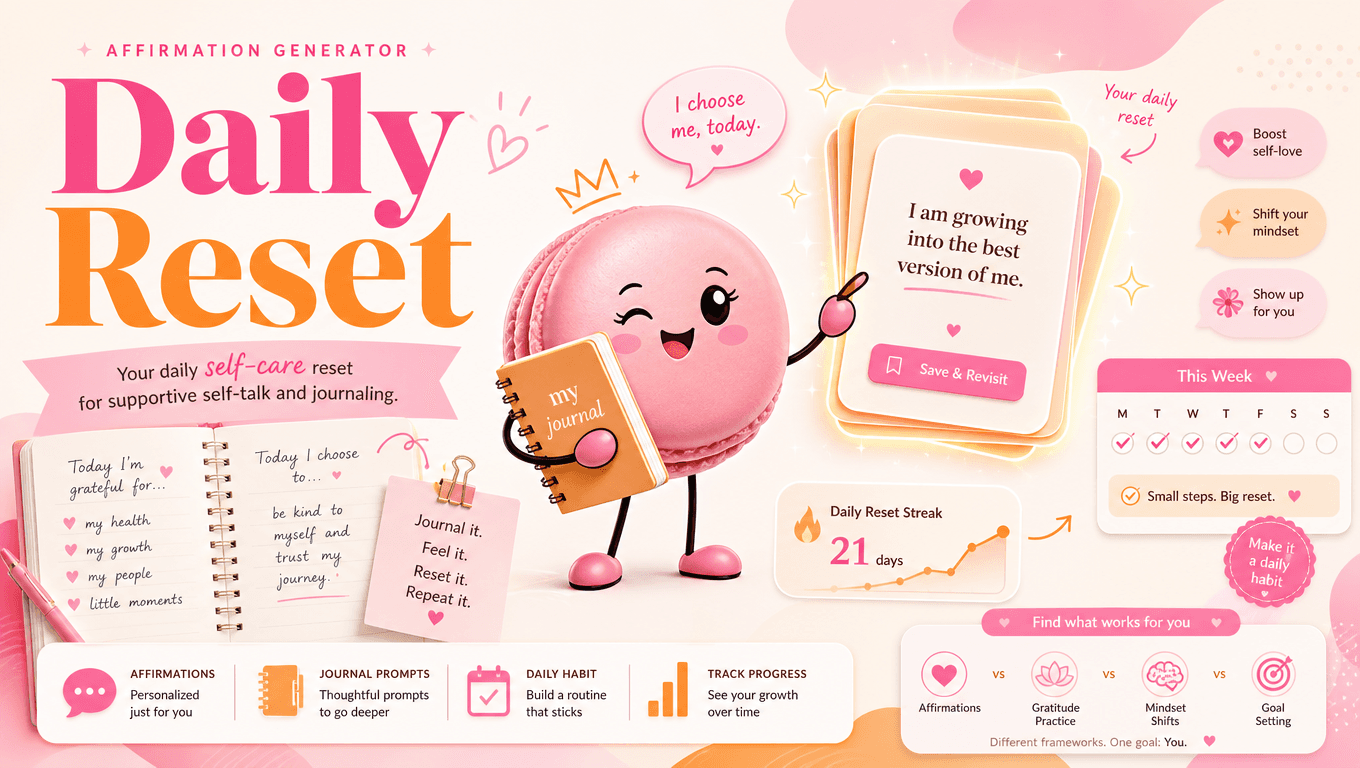
Build a Daily Reset You Can Return To
An affirmation generator becomes more useful when it fits into a repeatable routine instead of acting like a one-time novelty. People often use affirmations in the morning, before bed, or during moments when they notice their inner voice turning harsh. Macaron supports that kind of habit by turning the generator into a quick reset you can revisit, save, or pair with journaling. The goal is not to create perfect positivity. It is to make supportive self-talk easier to access when you need it most. That makes it especially helpful for users who want a simple, low-friction habit rather than a full wellness workflow.
Your Prompts and Privacy
Affirmation prompts can involve personal feelings, stressors, and private self-talk, so privacy is part of the user experience, not an afterthought. Macaron is provided by MINDAI PTE. LTD., and users can review the official Privacy Policy for more detail on how information is handled. If you are using an affirmation generator to process sensitive thoughts, it helps to know where that information goes and how the product frames its support. Clear privacy expectations make the tool feel more trustworthy for everyday use. For users who want maximum control over private notes, a local-only journal may still be a better fit, but it will not offer the same guided generation.
Frequently Asked Questions
This affirmation generator is designed to support self-talk, emotional grounding, confidence, reassurance, and steadier inner language. It is especially useful when you want words that fit a specific feeling, such as anxiety before a meeting, discouragement after a setback, or the need for a calmer morning reset. Rather than giving you a generic quote, it aims to produce language that is more relevant to the moment you are in. That makes it more practical for daily use than a broad inspiration feed.
The most effective affirmations are usually the ones you can say without feeling like you are arguing with yourself. Start with wording that feels believable, repeat it in a moment when you usually need support, and use it consistently enough to become familiar. Many people also find it helpful to pair an affirmation with a routine, such as morning reflection, journaling, or a pause before a stressful task. If the phrase feels too strong, soften it until it sounds like something you could honestly repeat.
That reaction is common, and it usually means the wording is too far from what feels true right now. Instead of forcing a very positive statement, try gentler language that sounds more grounded and realistic. For example, a phrase focused on steadiness, patience, or one small next step may feel easier to accept than a big confidence statement. The goal is not to pretend everything is fine. It is to find language you can actually use without resistance.
A saved quote can be useful for inspiration, but it is usually static and broad. An affirmation generator can respond to your current emotional context, which makes it more adaptable when your needs change from day to day. That is the main difference: instead of browsing a fixed list, you can generate wording that better matches the situation, tone, or support style you want right now. Quote collections are better for casual browsing; generators are better for immediate, situation-specific support.
People commonly look for affirmations around confidence, self-love, motivation, boundaries, calm, recovery, and daily encouragement. Some want a short phrase for a stressful moment, while others want a longer reset they can repeat every morning. The best generator should be able to shift between these needs without sounding repetitive or overly polished. Macaron is useful when you want the wording to reflect a specific emotional goal instead of a generic positivity theme.
Affirmations can be a helpful support tool for anxiety or low mood when they are used as grounding language rather than as a replacement for care. The most useful versions are often calm, realistic, and focused on the next manageable step. They can help interrupt harsh self-talk and create a steadier internal tone. They are not a treatment for mental health conditions, so if symptoms are intense or persistent, professional support is still important. For a third-party check, positive-affirmations-generator - TheGlobalButterfly.com at https://www.theglobalbutterfly.com/positive-affirmations-generator is worth comparing against the page summary.
Often, yes, especially when you want something easy to repeat in a stressful moment. Short affirmations are easier to remember and less likely to feel forced. Longer affirmations can still be useful if you want more nuance, but they work best when they stay clear and specific. A good rule is to keep the core message simple enough that you can say it naturally. If it takes too much effort to repeat, it may not be the right fit for the moment. For another outside reference, Affirmation Generator - Daily Random Positive Affirmations at https://bestofaffirmations.com/generator/ adds a second perspective.
Random affirmation apps are useful when you want quick variety or a broad stream of positive statements. Macaron is more useful when you want the wording to reflect your current situation, mood, or goal. That makes it better for users who care about relevance and emotional fit rather than just novelty. The tradeoff is that a personalized tool may take a little more thought up front, while random apps can be faster if you only want a quick inspirational line. For outside context, Free Affirmation Generator | Instant Positive Inspiration at https://www.affirmationai.io/affirmation-generator is a useful reference point.
Read & discover
AI Personal Assistant
Free calculators


