Anxiety Quiz
An anxiety quiz is often used as a quick self-check when worry, tension, or stress starts affecting sleep, focus, or day-to-day functioning. Macaron turns that check-in into a guided reflection, while making clear that it is not a clinical screening or diagnosis.
Anxiety Quiz
This anxiety quiz is a calm self-reflection tool to help you notice patterns in worry, tension, and stress. It can highlight what feels most active right now so you can choose a practical next step.
This is a self-reflection module, not a clinical screening or diagnosis.
Please answer every question before viewing your result.
This quiz is for self-reflection only and cannot tell you whether you have an anxiety disorder. If you feel unsafe, are having thoughts of harming yourself, or your distress is severe or rapidly worsening, seek immediate help from local emergency services or a crisis line right away.
What This Reflection Can Help You Notice
An anxiety quiz is most useful when you want a structured pause, not a label. People usually search for one because they are noticing persistent worry, physical tension, trouble relaxing, or a sense that stress is starting to spill into work, school, or relationships. Macaron treats that moment as a practical check-in, helping you slow down enough to notice what is happening before you decide what it means.
Macaron frames the anxiety quiz as a guided reflection tool, which means it helps you sort through symptoms, triggers, and impact in a more organized way. That can be helpful when your experience feels vague, mixed, or hard to explain in a single sentence. Instead of asking only whether you feel anxious, it helps you look at how often the feeling appears, what seems to set it off, and how much it interferes with daily life.
common user discussions for anxiety quizzes often point to formal screeners like the GAD-7, which are built to estimate symptom severity over a recent time window. This page is different: it is designed for personal check-in and pattern recognition, not for diagnosing an anxiety disorder. That difference matters because a self-reflection tool can be useful even when you are not ready for a clinical conversation. For a related Macaron page, see How to Use AI as a Personal Assistant: 30 Prompts That Actually Work at https://macaron.im/blog/ai-personal-assistant-prompts.
A good anxiety quiz should help you notice what is happening, not just whether you feel “anxious” in general. That includes whether the worry feels constant or situational, whether your body is staying on alert, and whether sleep, concentration, or daily routines are being affected. Macaron leans into that broader view so the result reflects lived experience, not just a narrow symptom count.
Because anxiety can look different from person to person, the value of a quiz is often in clarification. It can help you decide whether you are dealing with everyday stress, a temporary spike in worry, or something that deserves more support from a professional. The tradeoff is that a reflection tool is less precise than a formal screening instrument, but it can be easier to use when you want context first.
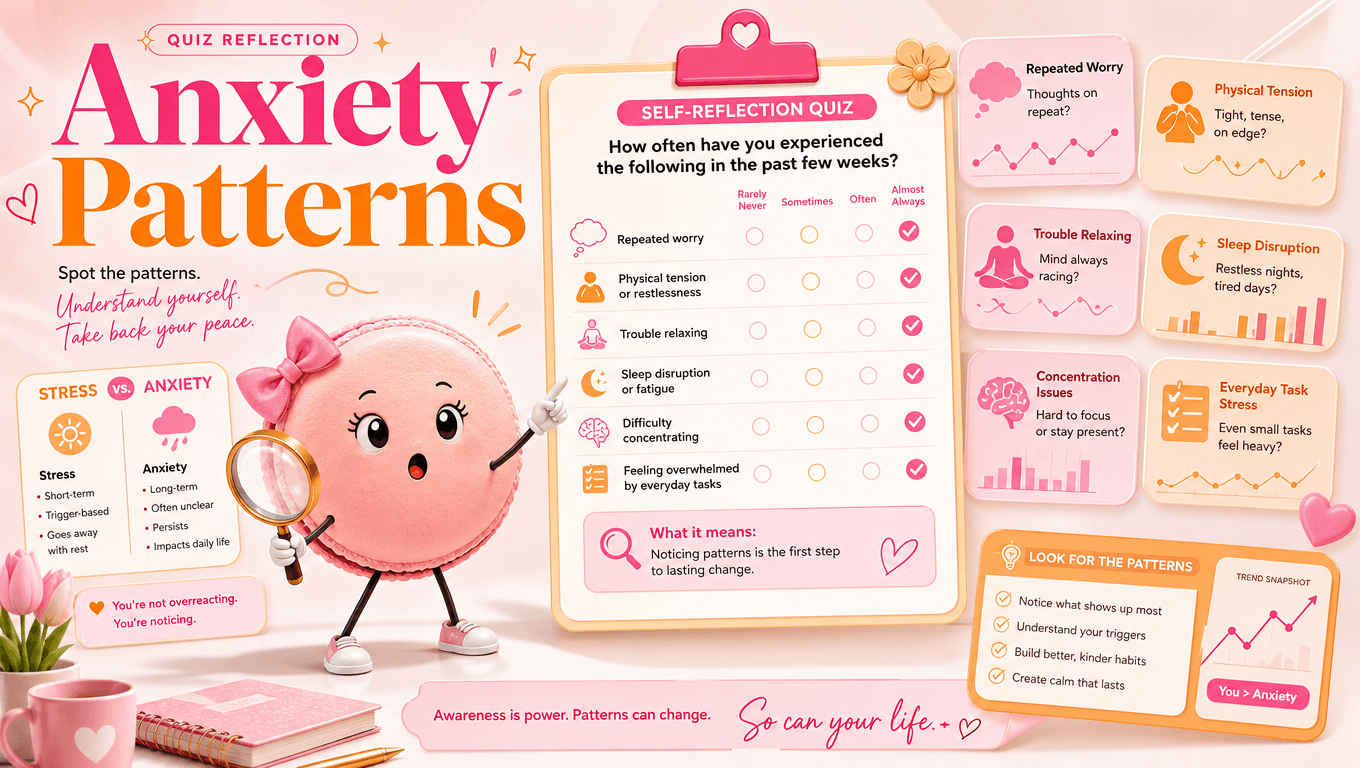
What This Reflection Can Help You Notice
Macaron helps you look for the patterns that anxiety quizzes commonly surface, such as repeated worry, physical tension, trouble relaxing, and stress that keeps returning even when nothing urgent is happening. It also encourages you to notice whether anxiety is affecting sleep, concentration, or your ability to get through ordinary tasks. That matters because many people search for an anxiety quiz when they cannot tell whether they are simply stressed or dealing with something more persistent. The value is in making the pattern visible enough to describe clearly, whether to yourself or to someone else.
How Macaron Structures This Reflection
Macaron structures the reflection around the parts of anxiety that are easiest to miss in daily life: how often anxious feelings show up, what tends to trigger them, how much they interfere with routines, and whether your current coping tools still feel effective. This approach is useful when your experience is mixed, because anxiety can show up as both mental worry and physical strain. It also helps separate a temporary stressful moment from a broader pattern that may need more attention. Compared with a static quiz, the guided format is better at connecting symptoms to context.
What Your Result Can Clarify
Your result is meant to make the pattern easier to read, not to turn it into a diagnosis. It can help you see whether the main issue is constant worry, stress tied to a specific trigger, or anxiety that is starting to affect sleep, focus, or daily functioning. It can also clarify whether your current coping strategies feel adequate or whether the result points toward a more realistic next step, such as talking to someone or tracking symptoms over time. That makes the result more actionable than a simple score alone.
More About Anxiety Quiz
Many anxiety quizzes focus on the same core signals because those are the patterns people most often notice first: repetitive worry, restlessness, muscle tension, trouble relaxing, and difficulty concentrating. Macaron keeps that practical focus so the reflection stays tied to everyday experience instead of abstract mental health language. That makes it easier for users who know something feels off but do not have the vocabulary to describe it precisely.
The quiz also helps you think about context, not just symptoms. A person may feel anxious because of a specific trigger, like deadlines, health concerns, conflict, or uncertainty, while another may notice broader strain that shows up across the day. That distinction matters because the next step is often different. If the anxiety is situational, a short-term coping plan may help; if it is broad and persistent, a longer conversation or tracking pattern may be more useful.
Some users want to know whether their score means mild, moderate, or more severe anxiety. While formal screeners often use score ranges to estimate severity, Macaron is careful not to present itself as a diagnostic scale. Instead, it helps you interpret what your answers suggest about current strain and coping capacity. The tradeoff is less clinical precision, but the benefit is a more conversational result that is easier to act on without overreading a number. Another useful Macaron comparison is How Macaron AI Tackles the Problem with Traditional Task Lists at https://macaron.im/blog/macaron-ai-daily-planning-guide.
The most useful result is usually one that points to action. Rather than stopping at a number or a vague summary, Macaron connects the reflection to grounding ideas, check-in habits, and language you can use if you want to talk to someone about what you are experiencing. That is especially helpful for people who want a next step that fits real life, not just a mental health term or a generic reassurance. For a broader Macaron context, When Nano Banana Meets Macaron: Next‑Level AI Image Editing ... at https://macaron.im/blog/macaron-ai-essential-personal-assistant-features can help you compare the decision from another angle.
If your anxiety feels overwhelming, unsafe, or hard to manage alone, the right next step is not another quiz. In that situation, immediate support from a licensed professional or crisis resource is more appropriate, and Macaron makes that distinction explicit so the page stays responsible and clear. Competitor screeners may be better if you specifically want a standardized severity score, but Macaron is stronger when you want reflection plus practical direction.
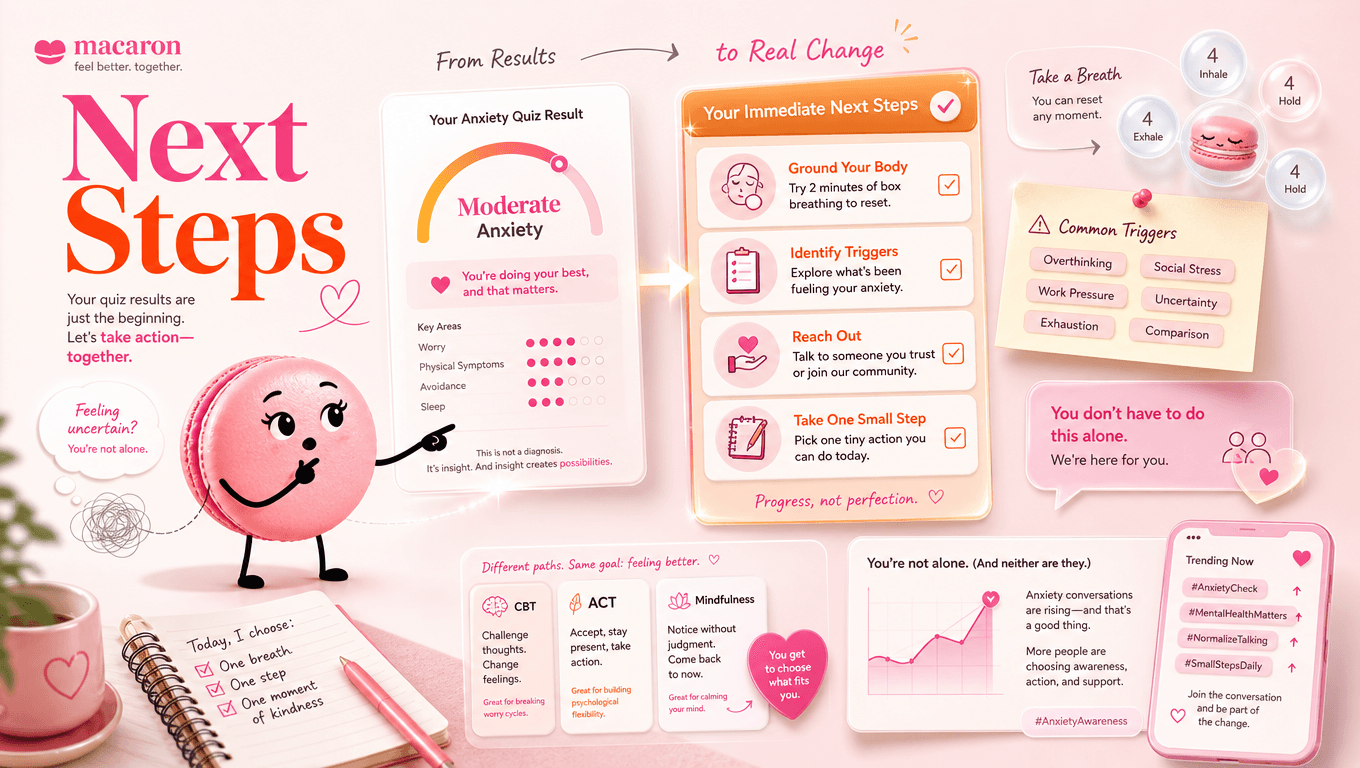
Immediate Next Steps
Macaron helps turn the anxiety quiz into something practical by suggesting next steps that fit the level of strain you are noticing. That may include a short grounding exercise, a calmer check-in routine, a prompt to name likely triggers, or a simple way to ask for support. The goal is to move from uncertainty to a concrete action, especially if you searched for an anxiety quiz because you want to know what to do after noticing symptoms. This is useful for users who want guidance immediately after the reflection, not just a result they have to interpret on their own.
If You Need Immediate Support
This self-check is not meant for emergencies or for situations where anxiety feels unsafe, overwhelming, or out of control. If you are in crisis, thinking about harming yourself, or unable to stay safe, contact emergency or crisis support right away. In the United States, call or text 988. In the United Kingdom and Ireland, call 116 123. If you are elsewhere, use a local crisis line or a directory such as findahelpline.com. A quiz can help with reflection, but it should never replace urgent human support when safety is the issue.
Your Responses and Privacy
Anxiety quizzes often involve sensitive information about mood, stress, and coping, so privacy matters. Macaron is provided by MINDAI PTE. LTD., and the page points users to the official Privacy Policy for details on how reflection data is handled. If you have questions about privacy or data use, the listed contact email gives you a direct way to ask before or after using the quiz. That transparency is important for users who want to think carefully before sharing personal mental health information online.
Frequently Asked Questions
This anxiety quiz asks about the kinds of experiences people usually mean when they search for one: frequent worry, tension in the body, trouble relaxing, stress triggers, and whether anxiety is affecting sleep, focus, or daily routines. It is designed to help you notice patterns, not to test you on mental health knowledge. The questions are meant to be practical and easy to answer even if you are not sure how to describe what you are feeling.
After you get your result, focus on the pattern rather than the label. Ask yourself what seems most present right now: constant worry, a specific trigger, physical tension, or difficulty coping with daily demands. Then choose one realistic next step, such as a grounding exercise, a short reflection, or reaching out for support. If the result makes you more concerned, it is reasonable to speak with a licensed professional instead of trying to interpret it alone.
Seek professional support if anxiety is becoming persistent, disruptive, or hard to manage on your own, especially if it is affecting sleep, work, school, relationships, or your ability to function. Crisis support is the right choice if you feel unsafe, overwhelmed, or are thinking about harming yourself. A quiz can help you notice a pattern, but it should not delay urgent help when the situation feels serious.
This page is an AI-guided self-check, so it is meant to help you reflect on symptoms and context in a more personal way. Formal anxiety screeners, such as clinical tools used in healthcare settings, are built to estimate symptom severity and support professional assessment. Macaron is not presenting this quiz as a diagnostic instrument, so the result should be read as a starting point for reflection rather than a medical conclusion.
No. It can help you notice whether your experience resembles common anxiety patterns, but it cannot diagnose an anxiety disorder. Diagnosis depends on a fuller clinical conversation that considers duration, severity, impact, and other possible causes. Macaron is designed to support self-understanding and help you decide whether a professional conversation would be useful. If you want a diagnosis or treatment plan, a licensed clinician is the right next step.
Score-based tests are useful when you want a standardized severity estimate, and they can be especially helpful in clinical or formal settings. Macaron takes a different approach by focusing on guided reflection, context, and practical next steps. That makes it better for users who want to understand what is driving their stress and what to do next. The tradeoff is that it does not give the same kind of formal score interpretation. For a third-party check, Mental Health Screening Generalized Anxiety Disorder 7-item (GAD-7) at https://www.hiv.uw.edu/page/mental-health-screening/gad-7 is worth comparing against the page summary.
The most important symptoms are the ones that affect your daily life: worry that keeps returning, feeling on edge, muscle tension, trouble relaxing, sleep disruption, concentration problems, and avoidance of ordinary tasks. It also helps to notice whether symptoms are tied to a specific situation or show up across many parts of the day. Macaron is designed to help you connect those details so the result feels more useful than a simple yes-or-no answer. For another outside reference, free online anxiety test - MHA Screening at https://screening.mhanational.org/screening-tools/anxiety/ adds a second perspective.
Yes, because stress and anxiety often overlap. A reflection like this can help you tell whether you are dealing with a temporary stress response, a specific trigger, or a more persistent pattern of worry and tension. That distinction matters because the next step may be different in each case. If the issue is mainly stress, practical changes may help; if worry and tension keep returning, it may be worth looking more closely at anxiety. For outside context, Generalized Anxiety Disorder Test / Quiz - Psychology Today at https://www.psychologytoday.com/us/tests/health/anxiety-test is a useful reference point.
Read & discover
AI Personal Assistant
Free calculators


