Anxiety Test
An anxiety test should help you understand what is happening, not just label it. Macaron offers a guided self-check for worry, tension, and overwhelm, with structured reflection and practical follow-up, while remaining a self-reflection tool rather than a diagnosis.
Anxiety Test
This self-reflection module helps you notice how worry, tension, and overwhelm may be showing up in daily life. It is designed to support clearer insight and next steps, not to label you or replace professional care.
This is a self-reflection tool, not a diagnosis or clinical screening.
Please answer every question before viewing your result.
If your anxiety feels overwhelming, is getting worse, or includes thoughts of harming yourself, seek immediate support from local emergency services or a crisis line right away. This module is for self-reflection only and cannot tell you whether you have an anxiety disorder.
What Is an Anxiety Test
Anxiety test searches usually come from a specific need: people want to know whether what they are feeling is ordinary stress, a pattern worth paying attention to, or something that may need professional support. Macaron is designed for that in-between moment, when you want a calm, structured check-in instead of a vague quiz result or a clinical form that feels hard to approach. It aims to make the first step feel manageable without pretending that a single screen can explain everything about your mental health.
In practice, an anxiety test is a screening-style self-check that asks about common experiences such as persistent worry, restlessness, difficulty relaxing, trouble sleeping, and how much anxiety is affecting work, school, relationships, or routines. The point is not to diagnose you from one page of answers, but to help you notice patterns that may otherwise be easy to dismiss or normalize. That makes it useful for people who want a clearer read on what has changed recently.
Macaron keeps the experience simple enough to finish, but specific enough to be useful. Instead of stopping at a score, it organizes your responses into a clearer reflection of what seems most active right now, such as frequency, triggers, coping strain, and whether anxiety is affecting concentration or daily functioning. That structure helps users compare their answers with real-life impact rather than treating every anxious feeling as the same. For a related Macaron page, see Catalysing Macaron's Capabilities with Claude & DeepSeek Updates at https://macaron.im/blog/macaron-claude-deepseek-integration.
That matters because many people searching for an anxiety test are not looking for a label first. They are looking for clarity about whether their worry is becoming harder to manage, whether their sleep or focus has changed, or whether they should talk to someone they trust. A good self-check should answer those practical questions in plain language, while also leaving room for uncertainty when the pattern is mixed or situational.
Macaron is built for that next step. It helps you move from uncertainty to a more grounded read on your situation, while keeping the limits of self-assessment clear: this is a reflective tool, not a medical diagnosis, and serious or worsening symptoms should be discussed with a qualified professional. That tradeoff is intentional, because the app is meant to be approachable and actionable rather than clinically exhaustive.
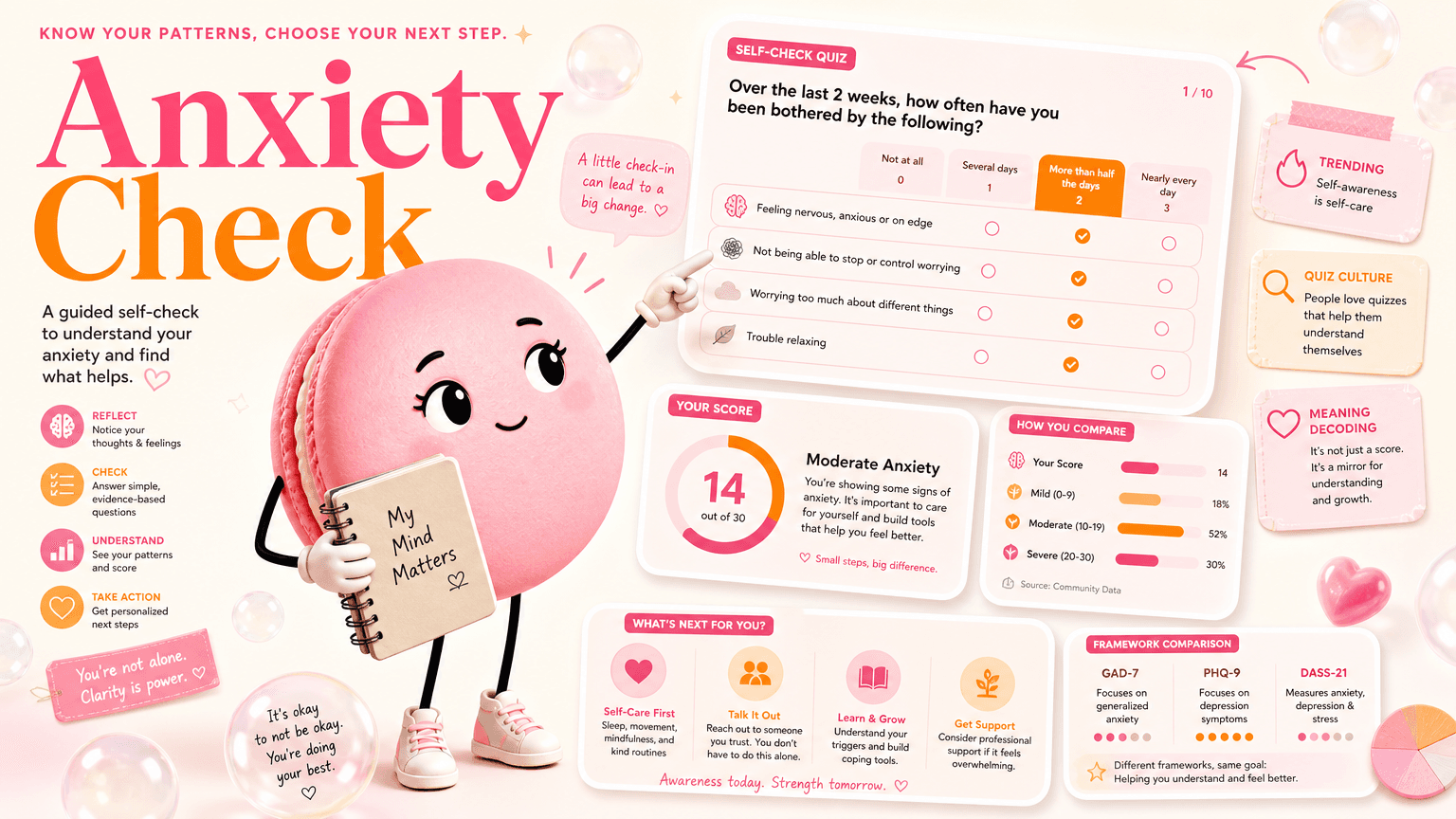
What Is an Anxiety Test
An anxiety test is a structured self-check used to reflect on worry, tension, and the ways stress may be affecting daily life. in common user language, this term often overlaps with screening tools like the GAD-7, which ask about symptoms over a recent time period rather than trying to explain your whole mental health history. Macaron uses that same self-check idea in a more guided format, helping you notice patterns, compare them with your day-to-day experience, and understand whether the impact feels mild, persistent, or disruptive. It is most useful when you want a clearer starting point before deciding whether to self-manage, talk to someone, or seek professional input. Compared with a static questionnaire, Macaron is better for users who want interpretation and next steps; compared with a clinician-led assessment, it is faster and less intimidating, but also less definitive.
Key Features of Macaron Anxiety Test
### Guided Question Flow The anxiety test uses a short, focused set of prompts that reflect the kinds of symptoms people commonly search for, including worry that is hard to control, restlessness, overthinking, and stress that affects sleep or concentration. The goal is to make the questions feel recognizable without becoming overwhelming. That balance helps people answer honestly instead of abandoning the process halfway through. ### Pattern-Based Result Macaron turns your answers into a structured reflection that highlights likely themes rather than reducing everything to a single vague label. That helps users see whether the main issue is frequency, triggers, daily disruption, or a sense that coping is becoming harder than usual. The result is more useful for self-understanding than a bare score, though it is still not a substitute for a clinical evaluation. ### AI-Guided Next Steps After the anxiety test, Macaron suggests practical ways to respond, such as journaling prompts, a calmer check-in routine, or a conversation starter for a therapist, doctor, or trusted person. This matters because many people search for an anxiety test when they want direction, not just information. The tradeoff is that the guidance is general-purpose, so it can point you forward without replacing personalized care. ### Privacy Access Because anxiety-related answers can be sensitive, Macaron connects the experience to its privacy policy, contact details, and data-rights information. That gives users a chance to review how responses may be collected, used, and retained before they begin. Competitor quizzes often bury this detail until after completion; Macaron makes it easier to check first, which is especially relevant for users who are cautious about mental health data. ### Clear Self-Reflection Boundary The experience is positioned as a self-reflection tool, not a diagnosis. That distinction is important for searchers who want a useful screening-style check without being misled into thinking an online result can replace a clinician’s evaluation. Some competitor tools feel more clinical, which can be helpful for users who want a familiar screening format, but Macaron is better for people who want a calmer, more conversational entry point.
How to Start the Anxiety Test
### Answer the Questions Start by moving through the prompts honestly and at your own pace. The most useful anxiety test results usually come from recent, concrete experiences, such as how often worry shows up, whether you can relax, and whether stress is affecting sleep, focus, or daily routines. If your symptoms vary by situation, answer for the period that feels most representative rather than trying to average your whole life. ### Review the Result When you reach the result, look for the themes that match your current life rather than focusing only on a score. A helpful anxiety test should make it easier to recognize patterns, such as persistent overthinking, physical tension, or stress that feels harder to recover from than usual. If the result feels partly accurate and partly off, that can still be useful information about what is situational versus what is more persistent. ### Take One Next Step Use the result to choose a single action that fits your situation. That might mean journaling for a few days, tracking triggers, adjusting a routine, or bringing the result into a conversation with someone you trust if the symptoms feel more serious or persistent. Macaron is strongest when you use it as a bridge from noticing to acting, not as a final verdict.
How This Anxiety Test Works
This anxiety test is an AI-guided self-reflection tool built to organize common anxiety signals into a clearer picture. It does not try to diagnose a disorder from one interaction. Instead, it looks at the kinds of patterns people often ask about when they search for anxiety screening online, including worry control, physical tension, sleep disruption, concentration problems, and how much the symptoms interfere with normal routines. It considers five parts of recent experience: Key points include how often worry or anxious feelings show up; whether stress affects sleep, focus, or routines; whether certain situations raise distress; how manageable things feel right now; whether more support feels necessary. That mix helps the result reflect both symptom presence and day-to-day impact, which is where many generic quizzes are too thin. Macaron then uses those responses to generate a structured reflection result and supportive next-step guidance. That makes the experience more practical for people who want to understand what is changing, what may be driving it, and what to do next, while keeping the limits of self-assessment clear. The main tradeoff is that the tool prioritizes clarity and usability over a long clinical questionnaire.
More About Anxiety Test
Anxiety test results are most useful when the questions reflect how anxiety shows up in real life, not just whether you feel nervous in the abstract. Macaron’s guided flow focuses on common patterns people recognize, such as repeated worry, physical tension, trouble settling down, and the way stress starts to spill into sleep, focus, or routine tasks. That makes the experience more relevant for everyday users than a generic mood quiz, while still keeping the format short enough to complete.
A strong anxiety test also needs to account for severity and context. Two people may both feel anxious, but one may only notice it before a presentation while another feels it most days and struggles to function normally. Macaron’s result format is designed to surface that difference so the output feels more grounded and less like a generic personality label. Competitor tools sometimes do this with a clinical score; Macaron does it with a more readable explanation of what seems to matter most.
The next step is where many online anxiety tests fall short. People often finish a quiz with a score, then wonder what to do with it. Macaron adds reflection prompts and practical follow-through ideas so the result can support journaling, a self-check habit, a conversation with a clinician, or a decision to seek more help. That is especially helpful for users who want a tool they can return to, not just a one-time answer. Another useful Macaron comparison is Best AI Personal Assistant in 2025: A Test Suite You Can Reuse at https://macaron.im/blog/ai-personal-assistant-test.
Privacy is especially important for mental health-related searches because users are often sharing sensitive details about mood, stress, and coping. Macaron links the experience to its published privacy policy and data-rights information so users can review how responses are handled before they begin, rather than discovering those details after the fact. Some larger screening sites may feel more established, but Macaron is more explicit about making the privacy check part of the experience. For a broader Macaron context, Macaron App - Download for iOS & Android at https://macaron.im/macaron-app can help you compare the decision from another angle.
For anyone comparing options, the difference is usually not whether a test asks about anxiety symptoms, but whether it helps interpret them responsibly. Macaron aims to make the process calmer, more structured, and more actionable, while staying careful about the boundary between self-reflection and professional assessment. That makes it a better fit for users who want guidance and context; users who want a strictly standardized clinical screener may still prefer a dedicated medical questionnaire.
If You Need Immediate Support
This self-check is not a substitute for urgent help, and it should not be used to decide whether a crisis is “serious enough.” If you feel unsafe, unable to stay in control, or are thinking about harming yourself, contact crisis support right away and do not wait for a test result to tell you what to do. A screening tool can help with reflection, but it cannot triage emergencies or replace immediate human support when safety is at risk. Key points include United States: Call or text **988** ([Suicide & Crisis Lifeline](https://988lifeline.org/about/)); United Kingdom & Ireland: Call **116 123** ([Samaritans](https://www.samaritans.org/how-we-can-help/contact-samaritan/talk-us-phone/), free); International directory: [findahelpline.com](https://findahelpline.com). If there is immediate danger, call local emergency services or go to the nearest emergency department. If you are unsure whether what you are experiencing is urgent, err on the side of reaching out now rather than waiting for the anxiety test to clarify it.
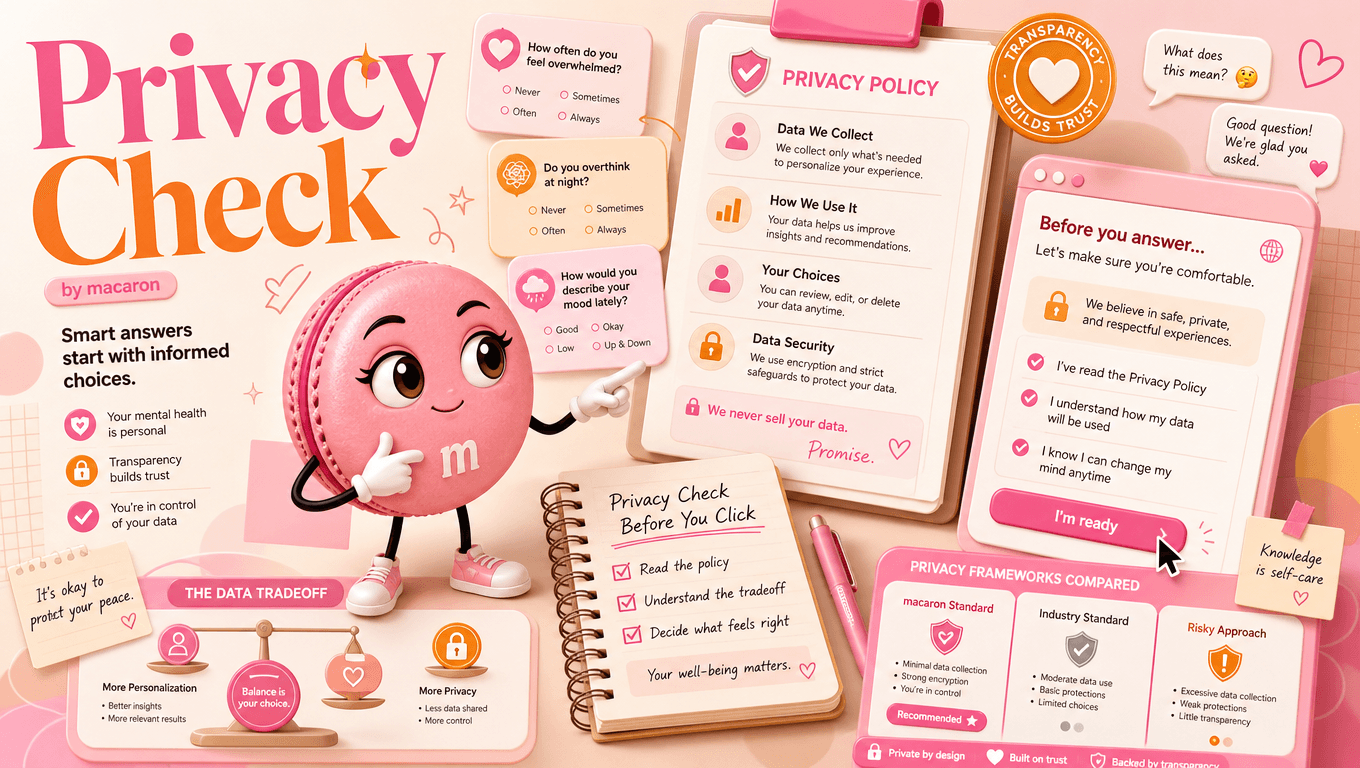
Your Responses and Privacy
Mental health-related responses can reveal sensitive details about stress, coping, and daily functioning, so privacy matters as much as the result itself. Macaron is provided by **MINDAI PTE. LTD.**, and its official [Privacy Policy](https://macaron.im/privacy-policy) explains how information is collected, used, disclosed, protected, and retained across its services. That transparency is useful for users who want to understand the data handling tradeoff before they answer personal questions. Before starting this anxiety test, review the policy for details on: Key points include what information Macaron collects; how responses are used to provide and improve the service; how long information is retained; how to request access, correction, or deletion; how to contact Macaron with privacy questions. If you are comparing with competitor screening sites, this is one area where Macaron is intentionally more upfront about the data conversation. Privacy contact: `contact@macaron.im`
What You Can Do With This Anxiety Test
### Get a Clear Check-In Use the anxiety test when you want to make sense of worry, tension, or overwhelm that has started to affect your day. It can help you separate a temporary stressful stretch from a pattern that feels more persistent. That makes it useful for students, professionals, and anyone trying to understand whether their stress is becoming harder to manage. ### Prepare for a Real Conversation Bring the result into a conversation with a therapist, doctor, counselor, or someone you trust. A structured self-check can make it easier to explain what you have been noticing and where it is affecting your life. Compared with a generic quiz, Macaron gives you more language to describe the pattern, which can make the conversation more productive. ### Build a Support Habit Use the anxiety test as a repeatable starting point for journaling, tracking triggers, or checking in with yourself over time. Repeating the same kind of reflection can make changes easier to spot, especially when symptoms come and go. The main tradeoff is that it is not a formal tracker with clinical scoring, but for many users that simplicity makes it easier to keep using.
Frequently Asked Questions
No. This anxiety test is a self-reflection and screening-style tool, not a medical diagnosis, treatment plan, or substitute for professional evaluation. It can help you notice patterns such as frequent worry, restlessness, or stress that affects sleep and focus, but it cannot determine the cause of those symptoms on its own. If your concerns are persistent, worsening, or affecting daily functioning, a licensed clinician can give a more complete assessment.
Use the result as a starting point, not an endpoint. Look for the themes that best match your recent experience, such as how often worry appears, whether it is affecting sleep or concentration, and whether you feel able to manage it. Then choose one practical next step, like journaling, changing a routine, tracking triggers, or talking with a professional or trusted person if the pattern feels more serious.
Take it seriously and respond based on how you actually feel, not just the wording of the result. If you feel unsafe, unable to cope, or at risk of harming yourself, contact a licensed mental health professional, local emergency services, or crisis support right away. If the symptoms are not an emergency but still feel intense or persistent, schedule a professional evaluation as soon as you can.
Macaron’s official [Privacy Policy](https://macaron.im/privacy-policy) explains how user information is collected, used, disclosed, protected, and retained. Because anxiety-related answers can be sensitive, it is a good idea to review the policy before starting so you understand what data may be stored, how it may be used to provide the service, and how to request access, correction, or deletion if needed.
A generic anxiety quiz often gives you a score and stops there. Macaron is designed to do more with the same kind of self-check by helping you interpret the pattern, think through what it means in daily life, and choose a next step that fits your situation. That makes it more useful for people who want clarity, context, and follow-through rather than a one-line result.
Clinical screeners like GAD-7 are standardized questionnaires designed for consistent symptom screening, often in a healthcare context. Macaron is more conversational and action-oriented: it still asks about common anxiety patterns, but it focuses on helping you reflect on what the answers mean and what to do next. That makes it easier to use casually, though a clinician-administered screening is still better when you need formal assessment. For a third-party check, Mental Health Screening Generalized Anxiety Disorder 7-item (GAD-7) at https://www.hiv.uw.edu/page/mental-health-screening/gad-7 is worth comparing against the page summary.
You can use it as a general check-in if school pressure, exams, or performance stress are what you are noticing, but it is not limited to test anxiety specifically. If your main issue is exam-related nerves, you may also want strategies tailored to preparation, sleep, and pre-test routines. Macaron is better at helping you understand the broader anxiety pattern, while specialized study tools may be better for exam-specific coaching. For another outside reference, free online anxiety test - MHA Screening at https://screening.mhanational.org/screening-tools/anxiety/ adds a second perspective.
There is no single right schedule. Some people use a self-check when symptoms first feel noticeable, then repeat it later to see whether sleep, focus, or worry has changed. Others use it after a stressful period or before a conversation with a professional. The useful part is consistency: if you retake it, use similar time frames and answer honestly so you can compare patterns rather than chase a score. For outside context, Generalized Anxiety Disorder Test / Quiz - Psychology Today at https://www.psychologytoday.com/us/tests/health/anxiety-test is a useful reference point.
Read & discover
AI Personal Assistant
Free calculators


