Anxiety Tracker
An anxiety tracker is most useful when anxious days start to feel interchangeable and you need a clearer record of what happened, what you felt, and what helped. Macaron turns that reflection into a structured daily check-in, while making clear it is not a diagnosis or a replacement for professional care.
Anxiety Tracker
This check-in helps you notice how anxiety tends to show up in your day, what seems to set it off, and what helps it settle. Use it as a practical reflection tool for patterns over time, not as a label for who you are.
This is a self-reflection module, not a diagnosis or clinical assessment.
Please answer every question before viewing your result.
This module is for self-reflection only and cannot tell you whether you have an anxiety disorder. If anxiety feels overwhelming, lasts a long time, interferes with daily life, or includes thoughts of self-harm, please seek support from a qualified professional or local crisis service right away.
Why Tracking Anxiety Daily Can Change What You Notice
Anxiety often becomes easier to understand when you stop relying on memory alone and start recording what was happening in the moment. A daily tracker lets you capture the situation, the thoughts that showed up, the physical sensations you noticed, and how intense the anxiety felt. That record can turn a vague bad day into something more specific, which is often the first step toward seeing patterns instead of only symptoms.
Macaron treats anxiety tracking as guided reflection rather than a clinical assessment. That distinction matters because many people do not need a score as much as they need a practical way to revisit context, timing, and recovery later. The tracker is designed to help you notice what tends to happen before, during, and after anxious moments without making the process feel like a test you have to pass.
People usually look for an anxiety tracker when a mood note is not enough. They want to log triggers, body sensations, coping actions, and what happened afterward because those details often explain why one situation felt overwhelming while another passed more quickly. That kind of detail is especially useful when anxiety shows up in fragments, such as racing thoughts, tightness in the chest, or a sudden urge to avoid something. For a related Macaron page, see How Macaron AI Tackles the Problem with Traditional Task Lists at https://macaron.im/blog/macaron-ai-daily-planning-guide.
Tracking is also valuable when anxiety seems tied to routines or environments. Commuting, work pressure, social events, sleep disruption, and even certain times of day can all shape how stress builds and how long it takes to settle. Over time, a consistent log can show whether the same conditions keep appearing around your hardest moments, or whether recovery improves when you change one part of the routine.
The best anxiety tracker is usually the one you can actually keep using. If the process becomes too detailed, it can start to feel like another source of pressure, which defeats the purpose. Macaron keeps the focus on a few useful signals so you can stay consistent, learn from repetition, and avoid turning self-monitoring into a second problem on top of the anxiety itself.
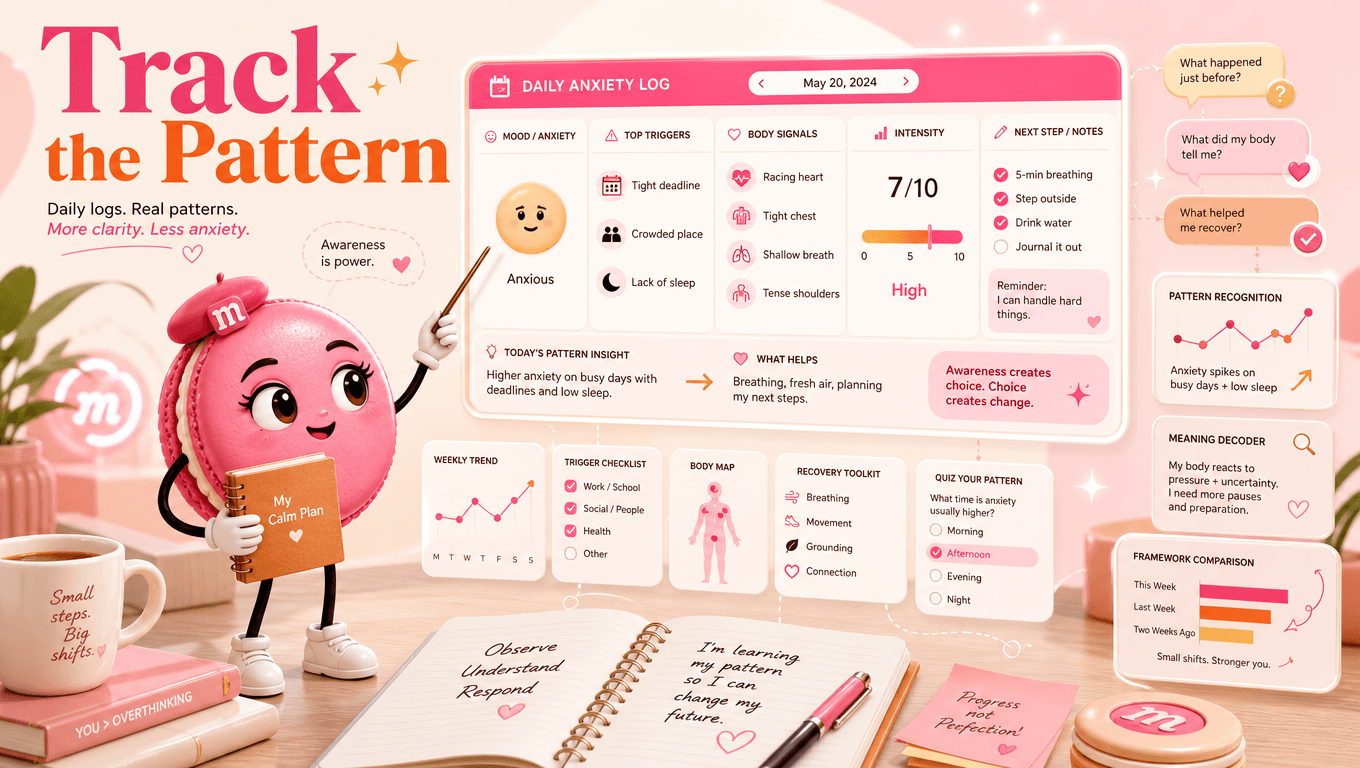
Why Tracking Anxiety Daily Can Change What You Notice
Anxiety can feel random when you only remember the worst moments, but a simple log makes the pattern easier to see. Macaron helps you capture what happened before the spike, what you noticed in your body, how intense the feeling was, and what you did next. That gives you a clearer view of whether the issue is a specific trigger, a repeated environment, or a recovery habit that is not working as well as you hoped.
How Macaron Structures This Reflection
Macaron keeps the check-in structured so you do not have to decide from scratch what to write each time. The tracker centers on the same core details: date and time, situation, thoughts, physical sensations, coping actions, and how quickly you settled afterward. That consistency makes later comparison easier, especially when you want to understand whether the anxiety is tied to one event or part of a broader pattern.
Spot Patterns, Triggers, and Recovery Gaps
Repeated entries can reveal more than a single anxious moment ever could. You may notice that certain people, tasks, places, or times of day reliably raise stress, or that some coping habits help only briefly before symptoms return. Macaron is useful here because it helps you compare entries over time, which can make recovery gaps, recurring triggers, and the difference between temporary stress and persistent anxiety much easier to identify.
More About Anxiety Tracker
A strong anxiety tracker starts with a log that is simple enough to use on an ordinary day. The most useful fields are usually date, time, situation, intensity, and physical symptoms, because those basics are enough to show patterns without asking you to write a long journal entry every time. That balance matters: the tracker should support awareness, not become a chore that you avoid.
Macaron organizes the reflection around the details people most often need to compare later. It helps you note what was happening before the anxious moment, what thoughts or body sensations were present, what coping step you tried, and whether the feeling eased or lingered. That structure is helpful when you are trying to separate a one-off stressor from a repeated trigger, or when you want to understand what actually changes the outcome.
The real value of anxiety tracking usually comes from repetition. One difficult moment can be hard to interpret, but several entries can show whether stress rises around certain tasks, locations, people, or times of day. That kind of context is what helps many users move from a general sense of overwhelm to a more specific picture of what is driving the anxiety and where it tends to show up. Another useful Macaron comparison is How to Use AI as a Personal Assistant: 30 Prompts That Actually Work at https://macaron.im/blog/ai-personal-assistant-prompts.
Tracking can also expose recovery gaps that are easy to miss in the moment. If the same coping strategy keeps appearing without much relief, or if symptoms return quickly after the stressful event ends, the log makes that visible. That can help you adjust routines, choose grounding methods more deliberately, or describe the pattern more clearly when you talk to a clinician, counselor, or trusted support person. For a broader Macaron context, AI Personal Assistant: What to Look For in 2026 - Macaron at https://macaron.im/blog/ai-personal-assistant-what-to-look-for-2026 can help you compare the decision from another angle.
Because anxiety logs often contain sensitive health and life details, privacy and safety matter. Macaron keeps the experience centered on reflection and pattern recognition rather than diagnosis, and it is important to remember that severe anxiety, safety concerns, or thoughts of self-harm need immediate professional or crisis support. The tracker is a tool for understanding patterns, not a substitute for urgent care when the situation is serious.
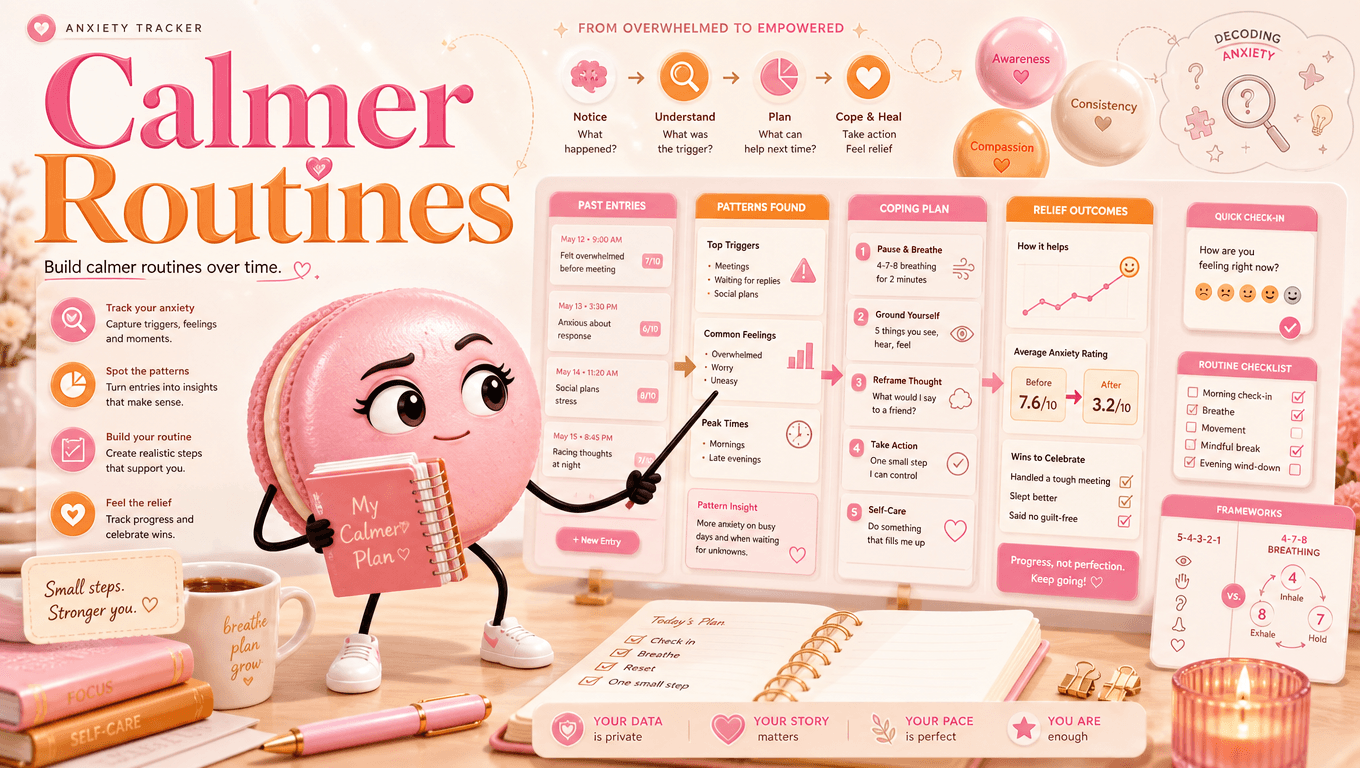
Build Calmer Routines Over Time
A tracker becomes more useful when it helps you act on what you notice, not just store entries. Macaron encourages a repeatable routine by making it easier to see what tends to happen before anxiety rises, which coping steps you actually use, and whether those steps lead to real relief or only temporary distraction. That can help you build a more realistic plan for the next stressful moment, based on your own history rather than guesswork.
If You Need Immediate Support
Anxiety tracking can improve awareness, but it is not meant for moments when you need urgent help. If you do not feel safe, if anxiety is becoming unmanageable, or if you are thinking about harming yourself, contact crisis support right away instead of trying to work through it alone. In the United States and Canada, call or text 988. In the United Kingdom and Ireland, call 116 123. Elsewhere, use a local emergency number or a trusted crisis directory such as findahelpline.com.
Your Entries and Privacy
Anxiety logs can include sensitive details about health, routines, relationships, and stressful events, so it is worth being selective about what you record. Macaron is provided by MINDAI PTE. LTD., and users should review the official Privacy Policy to understand how data is handled. A practical approach is to record only the details that help with pattern recognition, while avoiding unnecessary personal information. For privacy questions, contact contact@macaron.im.
Frequently Asked Questions
This anxiety tracker is built to capture the details that usually matter most for pattern recognition: what was happening, how intense the anxiety felt, what physical sensations showed up, what coping response you used, and how long it took to settle. That makes it easier to compare different days and see whether certain situations, times, or habits are linked to stronger reactions. It is meant for reflection and awareness, not diagnosis.
The simplest approach is usually the best one. Track only a few repeatable details, such as the trigger, the intensity, and whether anything helped you recover. You do not need to write a long journal entry every time, and you do not need to capture every feeling perfectly. The tracker should reduce confusion, not create a new task that feels hard to keep up with.
Tracked anxiety should be taken more seriously when it starts affecting sleep, work, school, relationships, daily functioning, or your sense of safety. It is also important to seek help if symptoms are getting more frequent, more intense, or harder to calm down with your usual coping strategies. In those situations, a licensed mental health professional or crisis support is more appropriate than self-tracking alone.
A one-time quiz gives you a snapshot, which can be useful but limited. An anxiety tracker shows how symptoms change across days, settings, and routines, so you can notice patterns that a single score would miss. That includes timing, triggers, body reactions, and recovery speed. In practice, the tracker is better for understanding change over time, while a quiz is better for a quick check-in.
The most useful entries usually include the situation, the time, the intensity of the anxiety, body sensations, thoughts that came up, and what you did to cope. If you want to keep it lightweight, start with just the trigger and the intensity, then add one or two notes about what helped or what made it worse. The goal is to create a record you can compare later, not to document everything perfectly.
Yes. Triggers are often easier to see across several entries than in the middle of an anxious moment. A tracker can show whether anxiety tends to rise around certain people, places, tasks, times of day, or sleep patterns. It can also reveal less obvious links, such as stress building after poor rest or after several demanding events in a row. That kind of pattern is hard to spot without repetition.
Yes. Many people experience anxiety first through the body, such as tightness, restlessness, nausea, shallow breathing, or a racing heart. Logging those sensations can be just as useful as noting thoughts or emotions, because physical symptoms often show up before the anxious feeling is fully recognized. Recording them helps you compare episodes and may make it easier to notice early warning signs sooner. For a third-party check, Mental Health Self-Tracking Preferences of Young Adults With ... at https://pmc.ncbi.nlm.nih.gov/articles/PMC10589825/ is worth comparing against the page summary.
A digital tracker is usually easier to revisit, compare, and keep consistent over time, which makes pattern recognition simpler. The tradeoff is that some people prefer paper because it feels more private, less stimulating, or easier to use during a stressful moment. Paper can also be better for free-form reflection. Macaron is strongest when you want structure and later comparison, while paper may suit users who want maximum simplicity. For another outside reference, Anxiety Tracker: Symptom Tracking For Improved Awareness at https://missionconnectionhealthcare.com/blog/anxiety-symptom-tracker-what-it-is-how-to-use-it/ adds a second perspective.
If you want a very open-ended journal, a printable worksheet, or a clinician-specific screening tool, another method may fit better. Some competitors are also stronger if you want a dedicated therapy workflow or a formal assessment like GAD-7. Macaron is most useful when you want a structured, low-friction daily check-in that helps you notice patterns over time without turning the process into a long questionnaire. For outside context, [PDF] Anxiety Tracking Log | Cornell Health at https://health.cornell.edu/sites/health/files/pdf-library/anxiety-tracking-log.pdf is a useful reference point.
Read & discover
AI Personal Assistant
Free calculators


