Attachment Assessment
An attachment assessment can help when closeness, reassurance, trust, or distance keep shaping the same relationship patterns. Macaron uses guided reflection to help you notice how you respond to intimacy, uncertainty, and emotional availability, while making clear that this is not a clinical diagnosis or substitute for professional evaluation.
Attachment Assessment
This self-reflection module helps you notice how you respond to closeness, trust, reassurance, and conflict in relationships. It is designed to highlight patterns you may recognize across dating, family, friendships, or long-term partnerships.
This is a self-reflection tool, not a diagnosis or clinical assessment. Your answers can suggest patterns, but they cannot determine your attachment style with certainty.
Please answer every question before viewing your result.
This module is for reflection only and cannot diagnose attachment style, trauma, or any mental health condition. If relationship distress feels overwhelming, unsafe, or tied to panic, abuse, self-harm, or trauma symptoms, consider reaching out to a licensed professional or a trusted support line in your area.
Why Attachment Patterns Matter
An attachment assessment is useful when relationship stress keeps returning in familiar forms: worrying when someone is slow to reply, feeling uneasy when closeness increases, or pulling back when emotions become intense. Those reactions can look different across dating, long-term partnerships, family relationships, and friendships, which is why they are often hard to recognize while you are in them. Macaron helps you slow the pattern down enough to see what is actually being triggered.
Macaron treats attachment assessment as guided reflection rather than a clinical diagnosis. The goal is to help you notice how you respond to closeness, uncertainty, emotional availability, and repair after conflict in everyday language. That matters because many people already know they feel “off” in relationships, but they do not have a clear way to describe whether the issue is fear of abandonment, discomfort with dependence, or difficulty trusting consistency.
People often search for a result that neatly says anxious, avoidant, secure, or disorganized. Real relationship behavior is usually more mixed than that. You may want connection and still brace for disappointment, or value independence while also needing reassurance when a bond feels important. A useful attachment assessment should make room for those overlaps instead of forcing a single label that misses the context of your actual relationships. For a related Macaron page, see AI Calorie Tracker: How It Works and Best Options - Macaron at https://macaron.im/blog/ai-calorie-tracker.
Attachment is usually expressed through habits, not just identity. The same person may seem secure with one partner and guarded with another, especially if trust has been damaged, communication is inconsistent, or past experiences have made reassurance feel unreliable. That is why a good assessment should pay attention to triggers, timing, and the kind of relationship you are in, not only to broad style categories.
This page is designed to help you use the result as a starting point for reflection, not as a verdict on your character. The more useful question is not whether you are “good” or “bad” at relationships, but what your pattern is trying to protect you from and what kind of connection would feel safer, steadier, and more workable in real life.
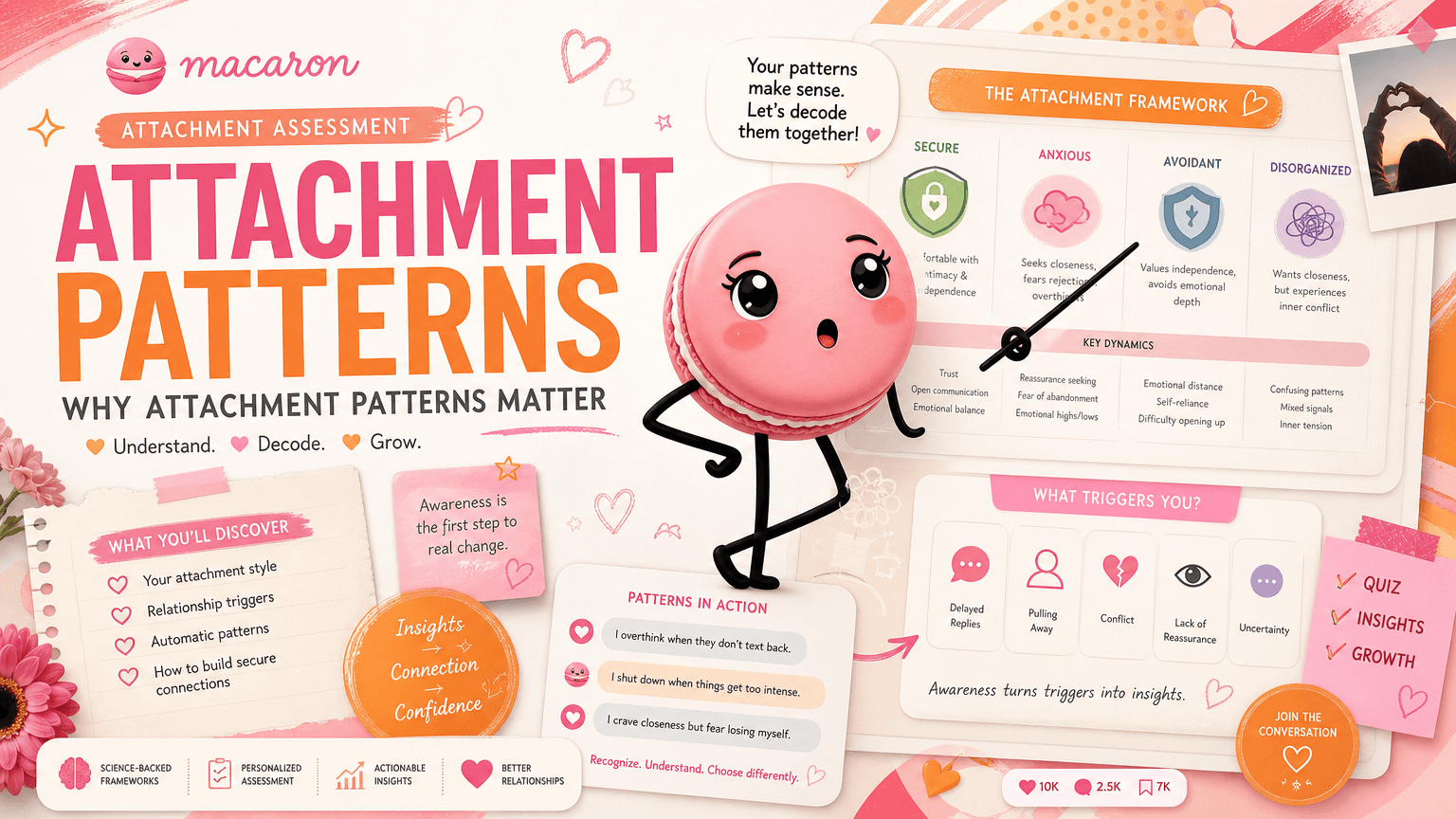
Why Attachment Patterns Matter
An attachment assessment is useful because relationship habits often become automatic long before they become understandable. You may notice the same cycle in different forms, such as worrying when someone is slow to reply, feeling crowded when a partner wants more closeness, or alternating between wanting intimacy and protecting yourself from it. Macaron helps surface those patterns so you can connect them to real triggers instead of treating them as random mood shifts. That matters because attachment patterns often influence how people interpret silence, conflict, affection, and reassurance, even when the relationship itself is not clearly unsafe.
How Macaron Structures This Reflection
Macaron structures this reflection around the practical signals people usually notice first: how comfortable closeness feels, how much reassurance you tend to need, whether trust comes easily, and what happens when conflict needs repair. It also leaves room for mixed patterns, since many adults do not fit a single neat category. Someone may look avoidant when overwhelmed, anxious when uncertain, or more secure in one relationship than another. That structure helps the assessment feel closer to real relationship behavior and less like a one-size-fits-all quiz.
What Your Result Can Clarify
Your result is meant to create clarity, not a label you have to defend. It can help you identify which closeness pattern feels most familiar, what situations tend to trigger insecurity or withdrawal, and how those reactions affect communication over time. For example, you may realize that conflict is not the main issue, but rather the fear of being misunderstood, dismissed, or left waiting too long for reassurance. That kind of insight is useful because it points to the specific change that would make relationships feel steadier.
More About Attachment Assessment
An attachment assessment is most helpful when you want to understand recurring relationship reactions rather than just get a quick label. People often search for a free or fast quiz, but the real value comes from seeing how your answers connect to lived patterns such as overthinking texts, shutting down during conflict, or feeling uneasy when a relationship becomes more serious. Macaron is designed to make those patterns easier to recognize and discuss in plain language.
Macaron’s reflection structure focuses on the parts of attachment that show up in daily life: how you react to closeness, what reassurance means to you, whether trust feels easy or effortful, and how you handle repair after tension. That makes the result more practical than a simple style name, because it points toward the situations that actually trigger your pattern. It is especially useful for people who want to understand behavior, not just theory.
The page also addresses a common gap in attachment tools. Some people want one definitive score, while others want a deeper explanation of why they behave differently with different people. A useful attachment assessment should leave room for both, since attachment can shift with context, relationship safety, and the quality of communication. Macaron leans into that ambiguity instead of pretending every relationship response comes from one fixed category. Another useful Macaron comparison is AI Calorie Tracker - Macaron at https://macaron.im/ai-calorie-tracker.
Instead of treating the result as a verdict, Macaron frames it as a prompt for change. That can include noticing what you ask for when you feel insecure, identifying when you withdraw to self-protect, or recognizing which conversations escalate because the underlying need for safety was never named clearly. The tradeoff is that this kind of reflection takes more effort than a one-line quiz, but it usually gives you more usable insight. For a broader Macaron context, How Macaron AI Tackles the Problem with Traditional Task Lists at https://macaron.im/blog/macaron-ai-daily-planning-guide can help you compare the decision from another angle.
The goal is not to force a perfect secure style overnight. It is to help you move toward more stable connection through reflection, pattern tracking, and more intentional communication, while staying realistic about the fact that meaningful change usually happens gradually and in specific relationships. For users who want a quick label, simpler quizzes may feel easier; for users who want next steps, Macaron is built to be more actionable.
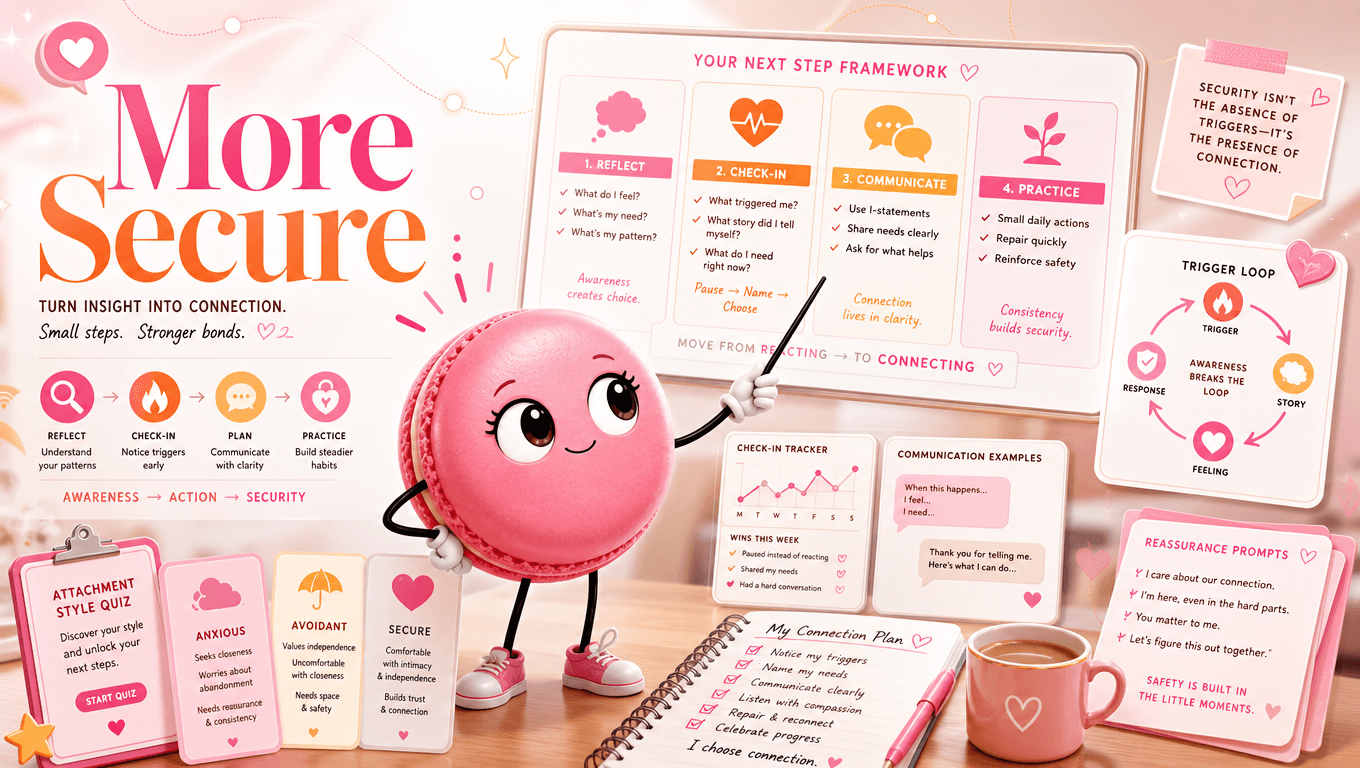
Move Toward More Secure Connection
Macaron turns the attachment assessment into next steps by helping you translate insight into action. That can include reflection prompts that make your pattern easier to describe, check-ins that show when the same trigger keeps repeating, and communication planning that helps you name reassurance needs before frustration builds. It also supports habits that strengthen steadier connection, such as pausing before reacting, asking for clarity directly, or noticing when old assumptions are shaping the conversation more than the present moment is. This is useful for people who want practical change, though users who prefer a therapist-led interpretation may still want outside support.
If You Need Immediate Support
This self-check is not a substitute for professional help, especially if relationship distress is intense, you feel unsafe, or the reflection brings up thoughts of self-harm. In those situations, it is better to pause the assessment and contact crisis support or a licensed professional right away. If you are looking for immediate help, the United States and Canada can call or text 988, the United Kingdom and Ireland can call 116 123, and international users can search a local helpline through findahelpline.com. A self-assessment can clarify patterns, but it cannot replace urgent care.
Your Responses and Privacy
Relationship reflection data can be sensitive, especially when it touches on trust, conflict, family history, or past hurt. Macaron is provided by MINDAI PTE. LTD. and the official Privacy Policy explains how information is handled. If you are comparing tools, this matters because many quick quizzes are easy to take but vague about what happens to your responses afterward. Macaron’s tradeoff is that it asks for more thoughtful input in exchange for a more useful reflection experience. Privacy contact: contact@macaron.im
Frequently Asked Questions
This attachment assessment focuses on the relationship behaviors that usually reveal attachment patterns in real life: trust, closeness, reassurance, conflict, repair, and how you respond when emotional availability feels uncertain. It is less about giving you a clinical label and more about helping you notice what tends to happen when connection feels secure, inconsistent, or too intense. That makes it useful for people who want a practical reading of their patterns rather than a purely theoretical explanation.
Use the result as a starting point, not a final judgment. The most helpful next step is to pick one recurring pattern, such as withdrawing during conflict or needing repeated reassurance, and then look at what usually triggers it. From there, you can decide whether the next change should be a boundary, a clearer request, a calmer repair conversation, or a different way of interpreting uncertainty. The value is in turning insight into one concrete adjustment.
That reaction is common, especially if the result touches a sensitive relationship pattern or brings up old experiences of rejection, distance, or inconsistency. If it feels uncomfortable, slow down, take a break, and avoid using the result to criticize yourself. If the reflection feels overwhelming, unsafe, or connected to thoughts of self-harm, stop using the tool and reach out to a licensed professional or crisis support immediately.
No. Attachment patterns are often stable enough to feel familiar, but they are not permanent. They can shift through self-awareness, safer relationships, better communication, and repeated experiences that make closeness feel more predictable. Many people also notice that their attachment responses change depending on the partner, the level of trust, or the stress they are under, which is another reason an attachment assessment should be read as a snapshot rather than a life sentence.
Macaron is built to do more than assign a style name. Quick quizzes can be useful for a fast first look, but they often stop at a label and leave you to interpret it on your own. Macaron focuses on the situations behind the pattern, such as reassurance seeking, withdrawal, or conflict repair, and then helps you think about what to do next. The tradeoff is that it asks for more reflection, but the result is usually more actionable.
Yes. Many people show mixed patterns depending on the relationship, the level of trust, and what is happening in their life at the time. You might feel secure with one person and guarded with another, or become more anxious when a relationship feels uncertain. That is one reason attachment assessments should be read as context-sensitive rather than absolute. Mixed results are common and often more realistic than a single fixed category. For a third-party check, Relationship Attachment Test - Psychology Today at https://www.psychologytoday.com/us/tests/relationships/relationship-attachment-style-test is worth comparing against the page summary.
No. This assessment is for reflection and relationship insight, not diagnosis. Attachment patterns can overlap with stress, trauma history, communication habits, and other emotional concerns, but a self-check cannot determine whether a mental health condition is present. If you are worried about your wellbeing, your relationships, or your safety, the best next step is to speak with a licensed clinician who can look at the full picture. For another outside reference, ASQ-SF - Attachment Style Questionnaire – Short Form - NovoPsych at https://novopsych.com/assessments/formulation/attachment-style-questionnaire-short-form-asq-sf/ adds a second perspective.
The most useful next step is usually one concrete change that matches the pattern you noticed. That could mean asking for reassurance more directly, slowing down before reacting, naming a boundary earlier, or planning a repair conversation after conflict. If the pattern feels deeply tied to past hurt or keeps repeating across relationships, journaling or guided reflection can help, but a therapist or counselor may be better for deeper work. For outside context, Attachment Style Quiz: Free & Fast Attachment Style Test at https://www.attachmentproject.com/attachment-style-quiz/ is a useful reference point.
Read & discover
AI Personal Assistant
Free calculators


