Burnout Assessment
A burnout assessment can help when stress starts affecting motivation, patience, focus, or your ability to bounce back after rest. Macaron uses guided reflection to clarify where strain is showing up, while making clear that this is not a clinical diagnosis or a substitute for professional care.
Burnout Assessment
This burnout assessment is a guided self-reflection to help you notice patterns in exhaustion, detachment, overload, and recovery. It is designed to make your experience easier to understand so you can choose a next step that fits your situation.
This is a self-reflection tool, not a diagnosis or medical evaluation.
Please answer every question before viewing your result.
If your burnout feels severe, keeps worsening, or comes with hopelessness, panic, substance use changes, or thoughts of self-harm, seek immediate support from a qualified professional or local emergency service. This reflection is not a diagnosis and cannot tell you whether you need medical or mental health care.
Why Burnout Does Not Look the Same for Everyone
A burnout assessment is most useful when stress stops feeling temporary and starts changing how you think, work, and recover. People often search for this term when they are not sure whether they are simply tired, under pressure, or moving into a more persistent pattern of exhaustion that rest alone is not fixing. Macaron is designed for that uncertainty, helping you slow down and examine what is actually changing in daily life.
Macaron treats the burnout assessment as a structured reflection, not a medical label. It helps you examine common burnout signals such as emotional depletion, mental distance, overload that keeps returning, and the sense that even normal tasks now take more effort than they should. That makes it more useful than a vague quiz when you want to understand which part of the pattern is strongest and what may be driving it.
common user discussions for burnout assessment often mix formal tools with informal quizzes, so it helps to separate a screening-style self-check from a validated clinical instrument. Some established measures focus on exhaustion and disengagement at work, while others look at broader strain, which is why the wording and interpretation can vary across sources. Macaron sits in the reflective middle ground: practical, structured, and clear about its limits. For a related Macaron page, see How to Use AI as a Personal Assistant: 30 Prompts That Actually Work at https://macaron.im/blog/ai-personal-assistant-prompts.
This page is designed for that ambiguity. It gives you a clearer way to think about whether burnout is building, whether it is already affecting daily functioning, and whether the pressure is coming from work, caregiving, relationships, or a wider identity-level overload that makes recovery feel harder than expected. That broader view matters because burnout is often discussed as a job problem even when the strain is coming from several directions at once.
The goal is not to overstate certainty. It is to help you notice patterns early, compare what you are experiencing with common burnout dimensions, and decide whether your next step should be rest, boundary changes, workload reduction, or support from a licensed professional. Macaron is especially useful for people who want a clearer self-check before they decide whether the issue is manageable on their own or needs more support.
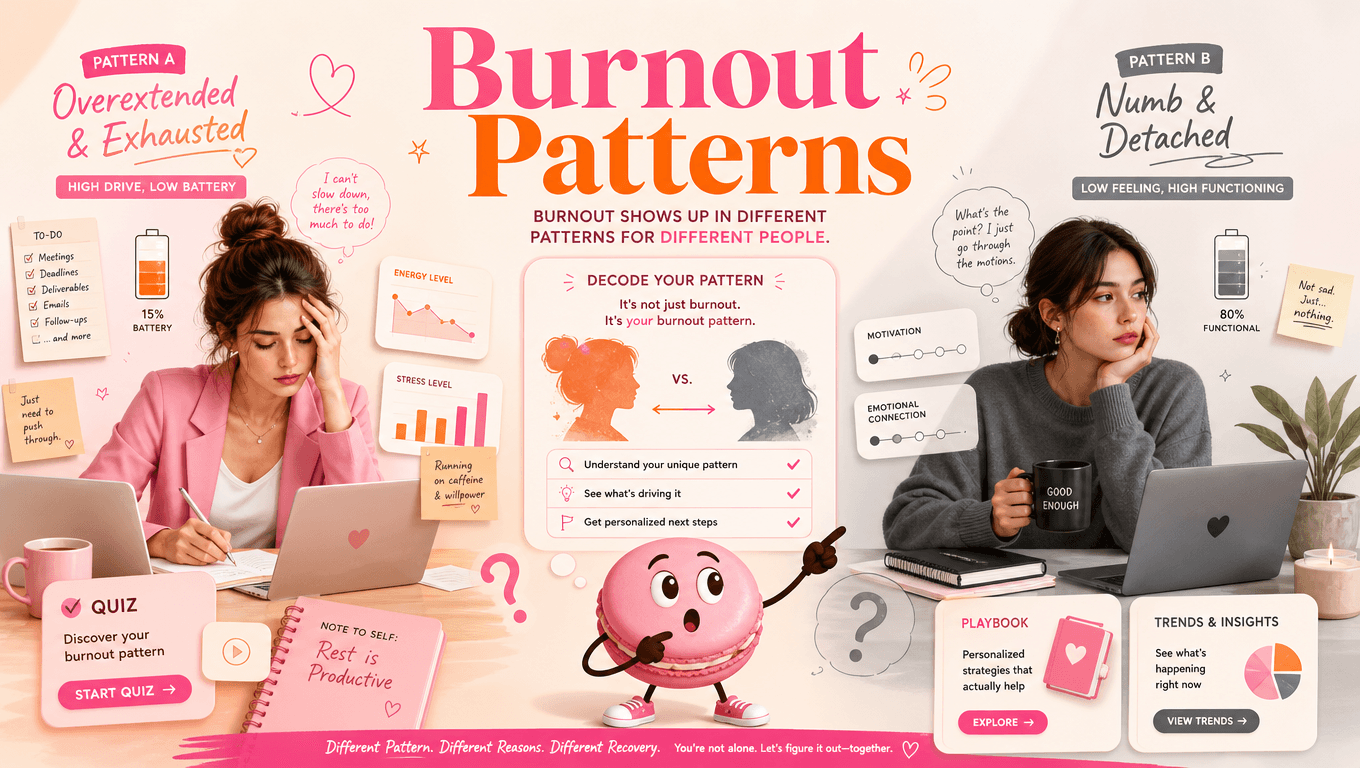
Why Burnout Does Not Look the Same for Everyone
A burnout assessment is useful because burnout can present in different combinations, and the mix matters. One person may feel physically drained but still emotionally engaged, while another may feel numb, detached, or unusually cynical even if they are still getting through the day. Macaron helps you look at the full pattern instead of assuming burnout always means one obvious symptom. Common signs include persistent exhaustion, loss of motivation, emotional distancing, and the feeling that rest does not fully restore you. That broader view is helpful for people whose burnout is easy to miss because they are still functioning on the outside.
How Macaron Structures This Reflection
Macaron structures the reflection around the main dimensions people usually want to understand when they search for a burnout assessment. That includes emotional exhaustion, overload and pressure, detachment or numbness, recovery difficulty, and how much the strain is affecting daily functioning. This structure helps separate a temporary stressful week from a more persistent pattern, and it makes it easier to see whether the issue is mainly workload, emotional depletion, or a broader recovery problem. Compared with a simple score, this kind of breakdown is more actionable because it points toward the kind of change that may actually help.
What Your Result Can Help You Notice
Your result is meant to show where the strain is concentrating so you can respond more precisely. Instead of only asking whether you are burned out, it can help you notice whether the problem is building gradually, already affecting work or relationships, or showing up as a specific pattern such as detachment, exhaustion, or reduced resilience. That kind of reading is useful when you are unsure whether to rest, change boundaries, reduce demands, or seek more formal support. It also helps you avoid overreacting to a bad day while still taking a real pattern seriously.
More About Burnout Assessment
A burnout assessment is valuable because burnout rarely appears as one single symptom. For some people it looks like constant fatigue and brain fog. For others it shows up as irritability, cynicism, emotional numbness, or a growing sense of distance from work, people, or responsibilities that used to feel manageable. Macaron is built to surface that mix instead of reducing everything to one generic label.
Macaron organizes the reflection around the patterns that show up most often in burnout guidance and self-check tools: exhaustion, mental distance, overload, reduced recovery, and changes in day-to-day functioning. That makes it easier to compare what you are feeling with the kind of language people actually use when they search for burnout help. It is especially useful when you know something is off but cannot tell whether the main issue is energy, attitude, or capacity.
The result is meant to help you interpret the pattern, not just score it. If the strongest signal is exhaustion, the next question may be about sleep, workload, and rest quality. If detachment is more prominent, the issue may be emotional shutdown, resentment, or feeling disconnected from your role rather than simple tiredness. That interpretation step is where Macaron adds value for people who want more than a pass-fail style quiz. Another useful Macaron comparison is AI Calorie Tracker - Macaron at https://macaron.im/ai-calorie-tracker.
Macaron also helps translate the assessment into practical next steps. That can include noticing which demands are hardest to recover from, identifying where boundaries are leaking, and deciding whether you need a short-term reset, a longer recovery plan, or outside support because the strain has started affecting functioning or safety. The tradeoff is that this is still a reflective tool, so it can guide action but does not replace a clinician when symptoms are complex or severe. For a broader Macaron context, AI Meal Planner - Macaron at https://macaron.im/ai-meal-planner can help you compare the decision from another angle.
Because burnout language is often used loosely online, the page also keeps the limits clear. This is a reflective tool, not a substitute for a validated assessment or professional evaluation, and it should be taken more seriously when symptoms are affecting sleep, mood, concentration, relationships, or your ability to cope. Compared with formal tools like BAT, MBI, or OLBI, Macaron is more accessible and practical for self-reflection, while those instruments remain better for formal assessment, clinical use, or standardized comparison.
Build a Recovery Roadmap That Feels Realistic
Macaron turns the burnout assessment into next steps that are easier to act on in real life. The roadmap can include reflection prompts, energy check-ins, ideas for reducing overload, and recovery planning that fits the level of strain you are actually experiencing. It also helps you think about when self-management is not enough and when it may be time to ask for help from a manager, clinician, or other support person. That makes it more useful than a static result because it connects insight to a plan you can actually follow.

If You Need Immediate Support
A burnout assessment can help with awareness, but it is not the right tool for a crisis. If you feel unsafe, overwhelmed to the point of losing control, or are thinking about harming yourself, seek immediate support rather than trying to interpret the result on your own. Crisis lines and local emergency services can help you get through the moment and connect you to the right level of care. Macaron is best used for reflection and planning, not for deciding whether urgent help is needed.
Your Responses and Privacy
Reflection about stress and burnout can involve sensitive personal information, especially if it touches on work pressure, mental health, or safety concerns. Macaron is provided by MINDAI PTE. LTD., and the privacy policy explains how responses are handled. If you are comparing tools, it is reasonable to check privacy terms before sharing anything detailed, especially when the assessment feels personal or you may want to revisit the result later. For users who value privacy, that transparency is a meaningful advantage over tools that are less clear about data handling.
Frequently Asked Questions
This burnout assessment focuses on the core patterns people usually mean when they search for burnout help: exhaustion, overload, detachment, difficulty recovering, and the way stress is affecting everyday functioning. It is designed to help you notice whether the strain feels temporary or more persistent, and whether the main issue is fatigue, emotional distance, or a broader sense that your usual coping methods are no longer working well. Macaron emphasizes pattern recognition over a single score.
Start with the strongest pattern in the result and ask what is driving it. If exhaustion is highest, look at sleep, workload, and recovery time. If detachment stands out, consider whether you are emotionally shutting down or feeling disconnected from what you do. Then choose one realistic next step, such as reducing one demand, protecting rest, or reaching out for support if the strain is already affecting daily life. The goal is to turn insight into one concrete change.
Burnout should be taken more seriously when it starts affecting sleep, mood, concentration, relationships, work performance, or your ability to cope with ordinary tasks. It also deserves more attention if you feel increasingly numb, hopeless, or unable to recover even after rest. If safety is a concern or you are thinking about self-harm, do not rely on a self-check alone. Contact a licensed professional or crisis support right away. A reflective tool can help you notice the problem, but it cannot replace urgent care.
A quick burnout quiz usually gives a fast snapshot, while a burnout assessment is often more structured and better at showing which part of burnout is most active. That matters because burnout is not always just tiredness. It can involve exhaustion, mental distance, overload, and reduced recovery all at once. A more structured assessment helps you interpret the pattern instead of treating every result as the same kind of burnout. Macaron is designed to support that interpretation step.
No. Work is a common source of burnout, but burnout-like strain can also come from caregiving, parenting, study pressure, relationship stress, or a long period of feeling overextended. Macaron is useful because it does not force every problem into a workplace-only frame. That said, formal tools often focus on job-related burnout, so they may be better if you need a standardized work measure. For broader life strain, a reflective assessment can be more flexible.
Macaron is designed for guided self-reflection, while validated tools such as BAT, MBI, and OLBI are built for standardized measurement and are better suited to formal evaluation. Macaron’s advantage is accessibility: it helps you understand the pattern and decide what to do next without requiring you to interpret technical scoring. The tradeoff is that it is not a clinical instrument, so if you need a formal assessment or workplace reporting, a validated tool may be more appropriate. For a third-party check, Burnout Check-in Tool - Beyond Blue at https://www.beyondblue.org.au/mental-health/work/burnout/burnout-check-in-tool is worth comparing against the page summary.
That is a common reason people use a burnout assessment. Sometimes the issue is not whether you can keep functioning, but whether you are doing so at a cost that keeps building. Macaron can help you identify which demands are draining you fastest and which changes are most realistic, even if you cannot stop everything at once. In that situation, small boundary changes, recovery time, and support from someone who can reduce pressure may matter more than a dramatic reset. For another outside reference, Burnout Assessment Tool at https://burnoutassessmenttool.be/start_eng/ adds a second perspective.
It can help you decide whether professional help is worth considering, but it cannot make that decision for you. If the result shows persistent exhaustion, strong detachment, worsening mood, or difficulty functioning, it is reasonable to talk with a licensed professional. If you are unsure, use the assessment as a prompt: is this affecting sleep, work, relationships, or safety? If the answer is yes, getting support is usually a sensible next step rather than waiting for the problem to become more severe. For outside context, Burnout at Work Test / Quiz | Psychology Today at https://www.psychologytoday.com/us/tests/career/burnout-at-work is a useful reference point.
Read & discover
AI Personal Assistant
Free calculators


