Burnout Quiz
A burnout quiz is most useful when tiredness starts to feel deeper than ordinary stress and rest does not seem to restore you. Macaron turns that check-in into a guided reflection on exhaustion, overload, detachment, and recovery difficulty, while making clear that it is not a clinical diagnosis.
Burnout Quiz
This reflection helps you notice whether your tiredness looks more like ordinary stress, ongoing overload, emotional distance, or difficulty recovering. It is designed to support self-understanding and next steps, not to label you.
This is a self-reflection tool, not a clinical diagnosis or medical assessment.
Please answer every question before viewing your result.
If your exhaustion feels severe, keeps worsening, or comes with hopelessness, panic, or thoughts of self-harm, seek immediate support from a qualified professional or local emergency services. If you are unsure whether this is burnout or something else, a healthcare or mental health professional can help you sort that out.
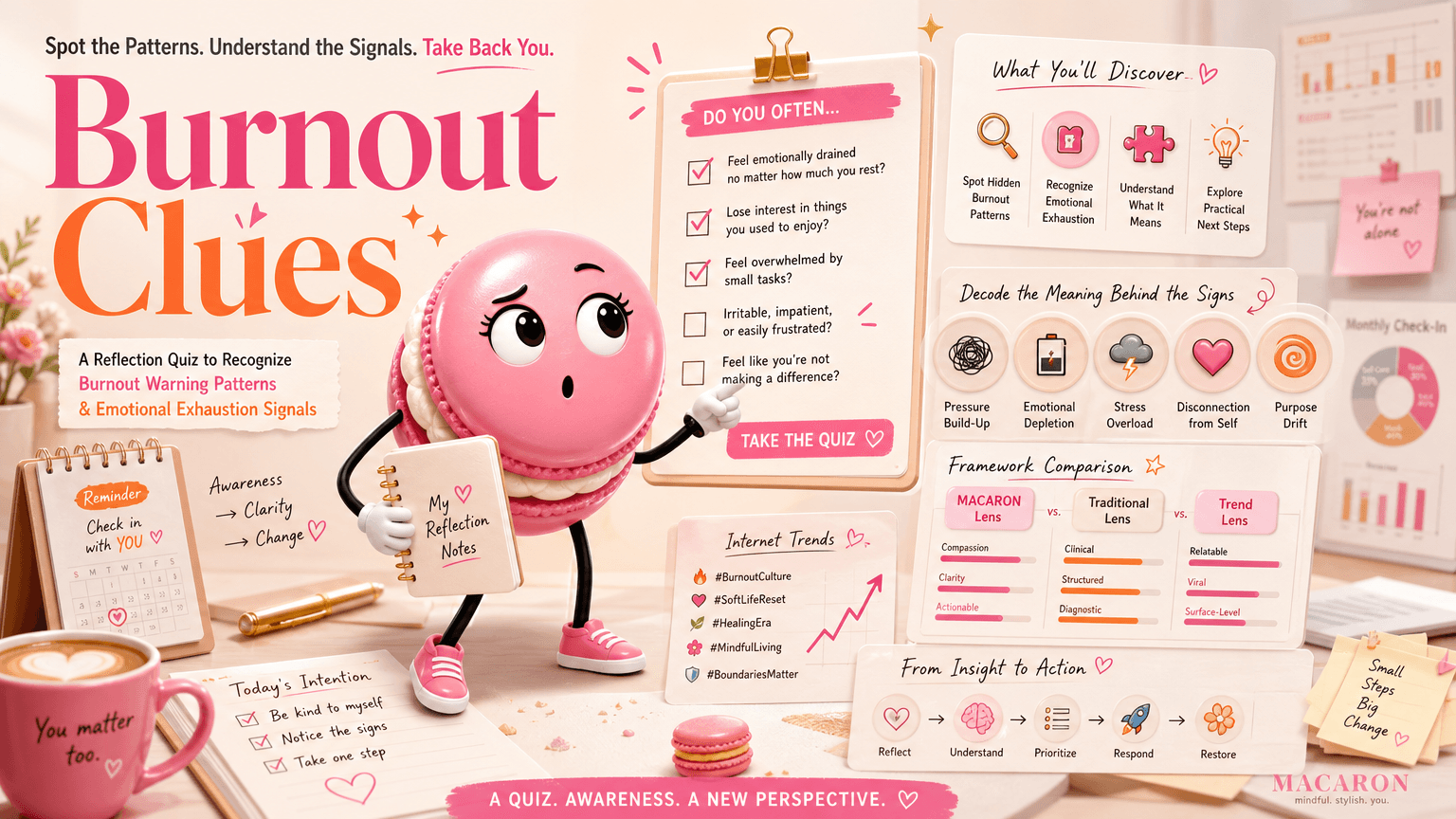
What This Reflection Can Help You Notice
A burnout quiz is useful when you are trying to tell the difference between ordinary tiredness and a deeper kind of strain that keeps building even after sleep, weekends, or time off. People usually look for this kind of check-in when they feel mentally drained, less motivated, more irritable, or oddly detached from work, study, caregiving, or daily responsibilities, but cannot tell whether the problem is stress, burnout, or something else entirely.
Macaron uses the burnout quiz as a guided reflection rather than a formal screening test, so the goal is to help you notice patterns that are easy to miss in everyday life. That includes emotional exhaustion, feeling overloaded by routine demands, and the sense that recovery takes longer than it should. The value is in making the pattern clearer and more actionable, not in labeling you or turning a rough period into a diagnosis.
Many burnout quizzes focus narrowly on work stress, but burnout can show up in other settings too, including school, parenting, caregiving, job searching, or long stretches of pressure with little room to recover. That is why this reflection is framed around how stress affects energy, focus, patience, and functioning, instead of only asking whether you feel busy. The broader framing makes it more useful for people whose strain does not fit a single work-only story. For a related Macaron page, see How to Use AI as a Personal Assistant: 30 Prompts That Actually Work at https://macaron.im/blog/ai-personal-assistant-prompts.
This kind of check-in is especially helpful when the signs are mixed. Some people feel numb or cynical, while others still care deeply but feel too depleted to keep up. Others notice physical fatigue, trouble starting tasks, or a growing sense that even small demands feel heavier than before. A good burnout quiz should help you sort through those differences so you can see whether the main issue is exhaustion, overload, detachment, or a combination of all three.
Macaron’s approach is designed to give you a clearer starting point for action. If the result suggests overload, detachment, or difficulty recovering, you can use that information to think about boundaries, rest, workload, or support. If the result looks more like general stress than burnout, that distinction is still useful because it points toward different next steps. The tradeoff is that a guided reflection is less precise than a clinical assessment, but it is faster and easier to use when you need orientation now.
What This Reflection Can Help You Notice
Macaron helps you look for the patterns that usually prompt someone to search for a burnout quiz in the first place. That includes feeling worn down for a long time, becoming emotionally flat or detached, losing interest in work or study, and noticing that rest does not seem to restore your energy the way it used to. The point is not to prove burnout from one answer, but to help you identify whether the signs are clustering in a way that deserves attention and a practical response.
How Macaron Structures This Reflection
Macaron organizes the check-in around the parts of burnout that people most often describe in real life: emotional exhaustion, overload, detachment, difficulty recovering, and strain on everyday functioning. This matters because burnout is often described vaguely as being “tired,” even when the real issue is a mix of mental depletion, reduced capacity, and growing distance from responsibilities. A structured reflection makes it easier to tell which part is strongest and what kind of support may fit best, especially when the signs overlap with stress or low mood.
What Your Result Can Clarify
Your result is meant to make the pattern easier to read, not to assign blame or create a diagnosis. It can help you see what seems to be draining you most, whether emotional distance is increasing, and whether stress is starting to affect sleep, concentration, patience, or basic functioning. It can also help you decide whether the most realistic next step is a small reset, a workload change, or a conversation with someone who can help. That kind of clarity is often more useful than a vague feeling that something is wrong.
More About Burnout Quiz
Macaron helps you reflect on the signs that show up most often in burnout quizzes, including persistent exhaustion, emotional distance, reduced motivation, and the feeling that effort is no longer producing the same sense of progress. These are the patterns people usually mean when they ask whether they are burned out rather than just tired. The reflection is meant to help you notice what has changed, how long it has been going on, and whether the strain is affecting more than one part of life, such as work, relationships, sleep, or concentration.
The quiz is structured around the core dimensions that commonly appear in burnout discussions: emotional exhaustion, overload, detachment, difficulty recovering, and reduced day-to-day functioning under stress. That structure matters because burnout is often confused with temporary fatigue, low mood, or a rough week. By separating these pieces, the check-in can help you see whether the issue is mainly workload, emotional depletion, loss of engagement, or a combination of all three. Competitor tools often stop at a score; Macaron is more useful when you want a clearer explanation of what the score is pointing to.
Your result is written to support interpretation, not self-judgment. Instead of treating burnout like a personal failure, the result helps you ask practical questions such as what is draining you fastest, whether your ability to recover has changed, and where stress is starting to affect sleep, focus, patience, or follow-through. That kind of clarity is useful when you are deciding whether to rest, reduce commitments, or reach out for support. The tradeoff is that this is not a formal diagnostic instrument, but that also makes it easier to use as a first step. Another useful Macaron comparison is AI Personal Assistant: What to Look For in 2026 - Macaron at https://macaron.im/blog/ai-personal-assistant-what-to-look-for-2026.
Macaron also connects the quiz to next steps, because a burnout check-in is only useful if it leads somewhere. That may include short-term recovery ideas, daily energy tracking, reflection prompts, or a closer look at overload patterns that keep repeating. For some people, the next step is adjusting routines or boundaries. For others, it is recognizing that the level of strain is no longer manageable alone and that outside support is worth considering. This is where Macaron is more action-oriented than many static quizzes that end with a label and little else. For a broader Macaron context, When Nano Banana Meets Macaron: Next‑Level AI Image Editing ... at https://macaron.im/blog/macaron-ai-essential-personal-assistant-features can help you compare the decision from another angle.
If the result suggests severe distress, the page also makes room for immediate support rather than pushing you to keep self-assessing. Burnout can overlap with anxiety, depression, or crisis-level stress, especially when sleep, mood, or safety are affected. In those cases, the most useful next step is not another quiz but timely help from a licensed professional or crisis resource. That safety-first framing is important because the best burnout tool should know when self-reflection is no longer enough.
Immediate and Long-Term Recovery Steps
Macaron turns the burnout quiz into something practical by linking the reflection to next steps that fit different levels of strain. In the short term, that may mean noticing energy patterns, reducing avoidable overload, or protecting recovery time more intentionally. Over the longer term, it may mean reviewing commitments, rebuilding routines, or getting support if the pressure has become chronic. The aim is to move from vague concern to a clearer plan, while recognizing that recovery often requires both small changes now and bigger changes later.
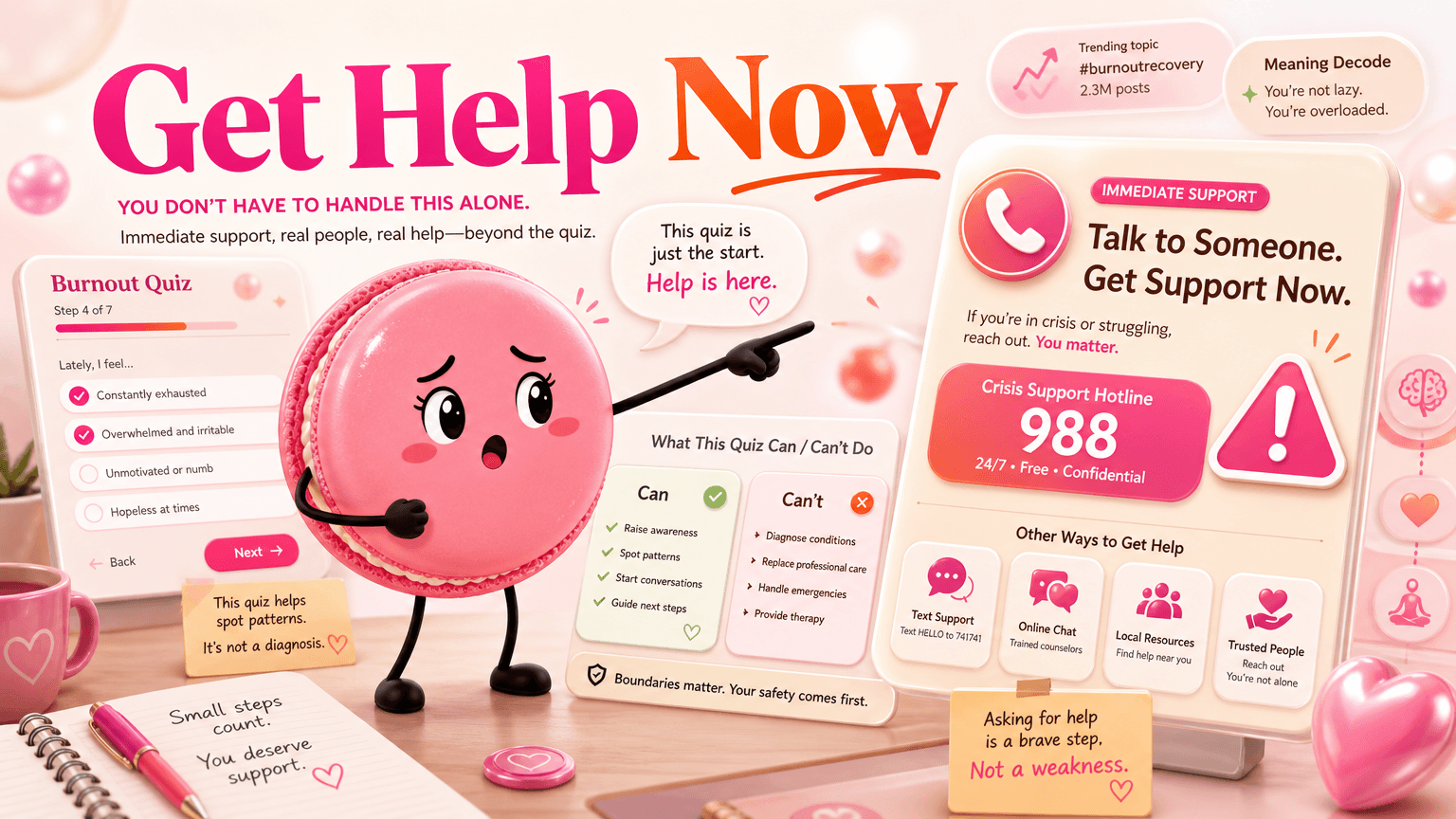
If You Need Immediate Support
A burnout quiz can help with self-understanding, but it should not be used to manage a crisis. If you feel unsafe, overwhelmed to the point of panic, or worried about harming yourself, the right next step is immediate support from a crisis line or emergency service. Burnout can overlap with more serious mental health concerns, so urgent symptoms should be treated as urgent rather than waiting for a result to explain them. That boundary is one reason a good burnout page should be clear about what it can and cannot do.
Your Responses and Privacy
Because burnout and stress reflections can involve sensitive personal information, privacy matters. Macaron is provided by MINDAI PTE. LTD., and the page points users to the official privacy policy so they can understand how data is handled. If you are cautious about entering personal details into any quiz, that caution is reasonable, especially when the topic involves emotional strain, work pressure, or mental health. Compared with some competitor tools that feel generic or ad-heavy, a privacy-aware experience can make the check-in feel more trustworthy.
Frequently Asked Questions
This burnout quiz focuses on the signs people most often use to describe burnout, such as exhaustion, overload, detachment, difficulty recovering, and stress affecting everyday functioning. It is designed to help you notice whether the problem is mainly tiredness, chronic pressure, or a deeper pattern of depletion. That makes it more useful than a simple “how stressed are you” check-in, especially if you are trying to understand whether rest alone is likely to help.
Start by looking at the strongest pattern in the result rather than the overall score alone. If exhaustion is the main issue, recovery and rest may be the first priority. If overload is the main issue, reducing commitments or setting boundaries may matter more. If detachment or low functioning stands out, it may be time to seek support or talk through what has been building. The result is most useful when it leads to one concrete next step.
Burnout should be taken seriously when it starts affecting sleep, mood, concentration, relationships, work, school, or your ability to cope with ordinary demands. It is especially important to get help if you feel hopeless, unsafe, or unable to keep functioning at a basic level. In those cases, a licensed professional or crisis support is more appropriate than another self-check. If symptoms are escalating, do not wait for a quiz result to validate what you are already noticing.
This page is a guided reflection tool, not a standardized clinical screening. Formal burnout measures are usually built for professional assessment, while this quiz is designed to help you quickly notice patterns and think about next steps. It can be useful for orientation, but it should not be treated as a diagnosis or a substitute for evaluation. The advantage is speed and clarity; the tradeoff is less clinical precision.
Yes. Although many burnout tools focus on jobs, burnout can also come from school, caregiving, parenting, volunteering, chronic family stress, or any situation where demands stay high and recovery stays limited. That is why a useful burnout quiz should ask about energy, detachment, and functioning more broadly, not only about job satisfaction. If your strain comes from several areas at once, a broader reflection is often more accurate than a work-only test.
Stress usually means you feel pressure and may still believe things will improve if the load changes. Burnout often adds exhaustion, detachment, and a sense that recovery is not working well enough. Depression can overlap with both, especially when mood, motivation, sleep, or self-worth are affected. A quiz can help you notice patterns, but it cannot reliably separate these conditions on its own. If symptoms are persistent or severe, professional evaluation is the better next step. For a third-party check, Symptoms of Burnout: Am I Burnt Out? Test - ADDitude at https://www.additudemag.com/symptoms-of-burnout-test/?srsltid=AfmBOopwGOhHiYgI-hLO_huESy-xEP8nieRzTPiVoE1OJ2nuAK25WXU0 is worth comparing against the page summary.
That is a common situation, especially for people with caregiving duties, deadlines, or limited flexibility. In that case, the most realistic goal may not be a full break but a smaller reduction in load, better boundaries, or more intentional recovery between demands. Macaron is useful here because it can help you identify which part of the strain is most urgent. Even if you cannot stop everything, you may still be able to change one pressure point. For another outside reference, Burnout Check-in Tool - Beyond Blue at https://www.beyondblue.org.au/mental-health/work/burnout/burnout-check-in-tool adds a second perspective.
Macaron provides the quiz as a private reflection experience, and the page directs users to the official privacy policy so they can review how data is handled. If you are careful about entering personal information, that is a sensible habit for any mental health or stress tool. Privacy expectations can vary across apps, so it is worth checking the policy before sharing sensitive details. If confidentiality is a top concern, that should be part of choosing any quiz. For outside context, Burnout at Work Test / Quiz | Psychology Today at https://www.psychologytoday.com/us/tests/career/burnout-at-work is a useful reference point.
Read & discover
AI Personal Assistant
Free calculators


