Burnout Test
A burnout test is useful when stress starts to feel chronic rather than occasional, especially if it is affecting energy, motivation, focus, or your ability to recover. Macaron turns that self-check into guided reflection, while making clear it is not a clinical diagnosis or formal burnout inventory.
Burnout Test
This burnout test is a guided self-reflection to help you notice patterns like exhaustion, detachment, overload, and difficulty recovering. It is designed to support clarity and next steps, not to label you or replace professional care.
This is a self-reflection tool, not a diagnosis or clinical assessment.
Please answer every question before viewing your result.
If you are feeling hopeless, unable to function, or thinking about harming yourself, seek immediate help from local emergency services or a crisis line right away. This reflection is not a substitute for medical, psychological, or workplace advice, and it cannot determine whether you have burnout or another condition.
What This Reflection Can Help You Notice
A burnout test is most useful when you are no longer asking whether you are “a little stressed” and instead wondering why rest is not restoring you. People usually search for this kind of check when fatigue, irritability, or mental fog have started to affect work, study, caregiving, or everyday decisions. The goal is not to label every hard week as burnout, but to help you notice when strain has become persistent and harder to shake.
Macaron uses the burnout test as a guided reflection rather than a medical score. That matters because burnout is often described through overlapping patterns, including emotional exhaustion, detachment, and a growing sense that effort is not translating into recovery. A reflective format can help you slow down and compare what you feel now with how you normally function, which is often the first step in understanding whether the problem is workload, chronic stress, or a broader burnout pattern.
common user discussions for burnout tests often mix different approaches, from quick check-ins to longer questionnaires and workplace-focused inventories. Some tools emphasize work-related cynicism or inefficacy, while others look at exhaustion across personal, work, and client-related life. Macaron is positioned for people who want a clearer self-check without assuming that burnout only happens in one setting or only looks one way. For a related Macaron page, see How to Use AI as a Personal Assistant: 30 Prompts That Actually Work at https://macaron.im/blog/ai-personal-assistant-prompts.
This page is designed to help you interpret the term in a practical way. A burnout test can be a useful starting point if you are trying to separate temporary pressure from a pattern that is affecting sleep, motivation, concentration, or emotional distance. It can also help when the confusion is not “Am I stressed?” but “Why does everything feel harder than it should, even after I rest?”
The result is meant to support next steps, not end the conversation. If your answers suggest that exhaustion or detachment is becoming more frequent, the most helpful response is usually to reduce overload, protect recovery time, and decide whether outside support would make sense. If you are in immediate distress or feel unsafe, a self-check is not enough and crisis support should come first.
What This Reflection Can Help You Notice
Macaron helps you reflect on patterns such as rising exhaustion, reduced motivation, irritability or numbness, mental distance from work or study, and difficulty recovering after rest. These are the kinds of signs people often look for when they are unsure whether they are simply overextended or moving into burnout. The point is not to count every bad day, but to notice whether the same strain keeps returning and whether recovery is taking longer than it should.
How Macaron Structures This Reflection
Macaron structures this reflection around emotional exhaustion, overload, detachment, recovery difficulty, and effect on daily functioning. That mix is useful because burnout rarely shows up as one isolated symptom. Someone may still be getting through the day but feel emotionally flat, while another person may feel highly reactive yet still productive. By separating these areas, the test helps you see whether the main issue is depletion, disconnection, or the way stress is spilling into ordinary tasks.
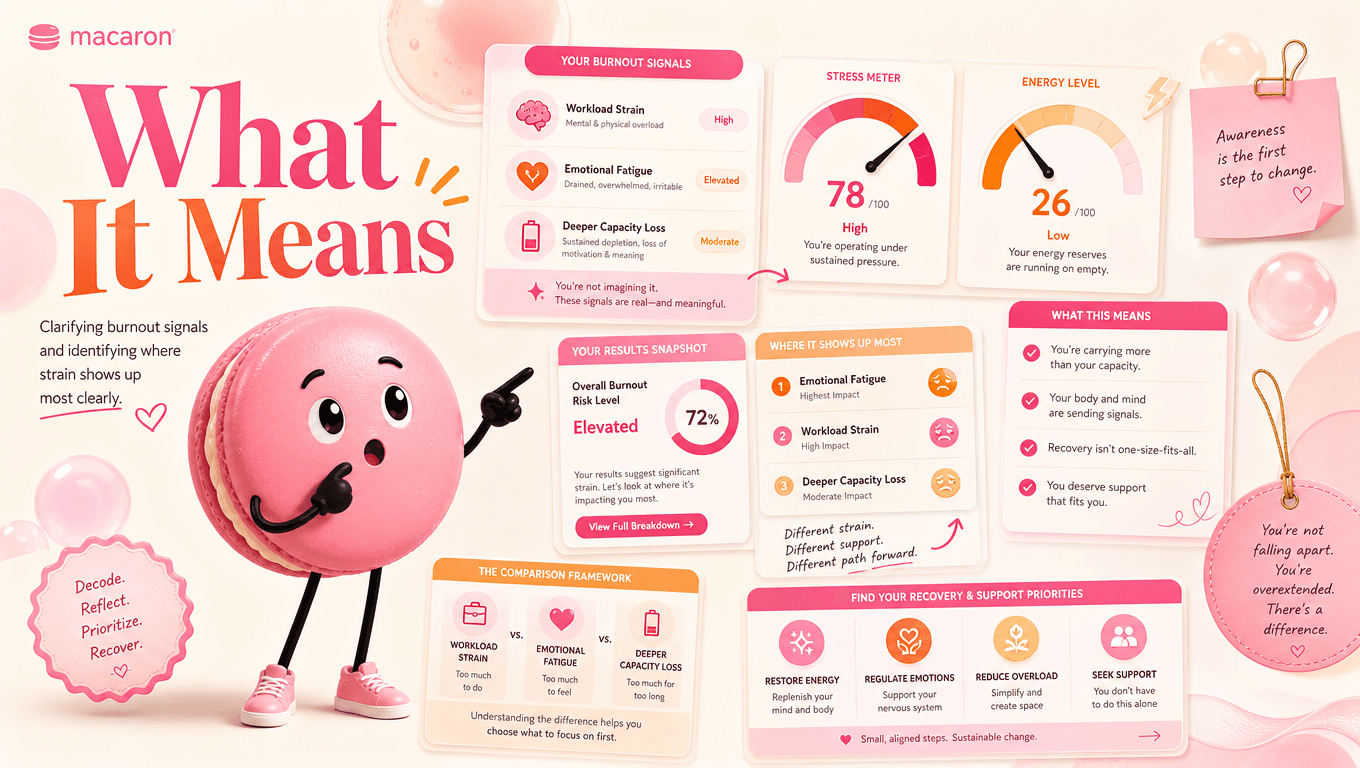
What Your Result Can Clarify
Your result is there to help you notice where strain is showing up most clearly. It can help you reflect on how much energy feels depleted, whether detachment is growing, where stress is leaking into daily life, and what kind of recovery or support feels most urgent. This is especially helpful when you know something is off but cannot tell whether the problem is workload, emotional fatigue, or a deeper loss of capacity.
More About Burnout Test
Macaron helps you notice the patterns that people commonly mean when they search for a burnout test. That includes not only feeling tired, but feeling drained in a way that sleep does not fully fix, losing patience more quickly, or becoming emotionally flat toward work or responsibilities. These details matter because burnout is often experienced as a combination of exhaustion and disconnection, not just low energy.
The reflection also helps clarify where burnout may be showing up in daily life. Some people notice it first in work performance, such as procrastination, reduced concentration, or a sense that starting tasks feels unusually heavy. Others notice it in relationships, where they feel less present, more irritable, or less able to care about things that used to matter. A useful burnout test should make room for those differences instead of assuming one universal symptom pattern.
Macaron structures the check around emotional exhaustion, overload, detachment, recovery difficulty, and impact on functioning because those are the areas that most often separate ordinary stress from a more concerning pattern. That structure is helpful when you are unsure whether you are simply busy or actually running out of capacity. It gives you a way to compare how much strain is present, how long it has lasted, and whether it is starting to affect your ability to work, rest, or think clearly. Another useful Macaron comparison is AI Personal Assistant: What to Look For in 2026 - Macaron at https://macaron.im/blog/ai-personal-assistant-what-to-look-for-2026.
The result is intended to clarify what kind of support may be most relevant. For some people, the next step is practical, such as reducing commitments, changing routines, or protecting sleep and downtime. For others, the more important question is whether the exhaustion is tied to anxiety, depression, workplace pressure, caregiving load, or another issue that needs professional attention. A good burnout test should help you see those possibilities more clearly rather than oversimplifying them. For a broader Macaron context, When Nano Banana Meets Macaron: Next‑Level AI Image Editing ... at https://macaron.im/blog/macaron-ai-essential-personal-assistant-features can help you compare the decision from another angle.
Macaron also keeps the limits of self-checks visible. Burnout questionnaires online vary widely in length, focus, and rigor, and many are built for specific contexts such as work stress. This page is meant to be a thoughtful starting point, not a substitute for diagnosis or treatment. If your answers point to severe distress, safety concerns, or an inability to function, the right next step is human support, not more self-testing.
Start Recovery with More Clarity
Macaron helps turn the burnout test into next steps through reflection prompts, daily energy check-ins, overload reduction ideas, recovery planning, and clearer next steps for outside support. That matters because burnout is often maintained by vague pressure and unclear boundaries. A structured follow-up can help you decide what to pause, what to delegate, what to monitor, and when it may be time to talk with a professional.
If You Need Immediate Support
This self-check is not a substitute for professional help. If distress feels overwhelming, if you feel unsafe, or if you are thinking about harming yourself, please contact crisis support right away. For urgent help, the United States uses 988, the United Kingdom and Ireland use 116 123, and international options are available through findahelpline.com. If you are unsure whether your situation is serious enough, it is safer to reach out sooner rather than wait.
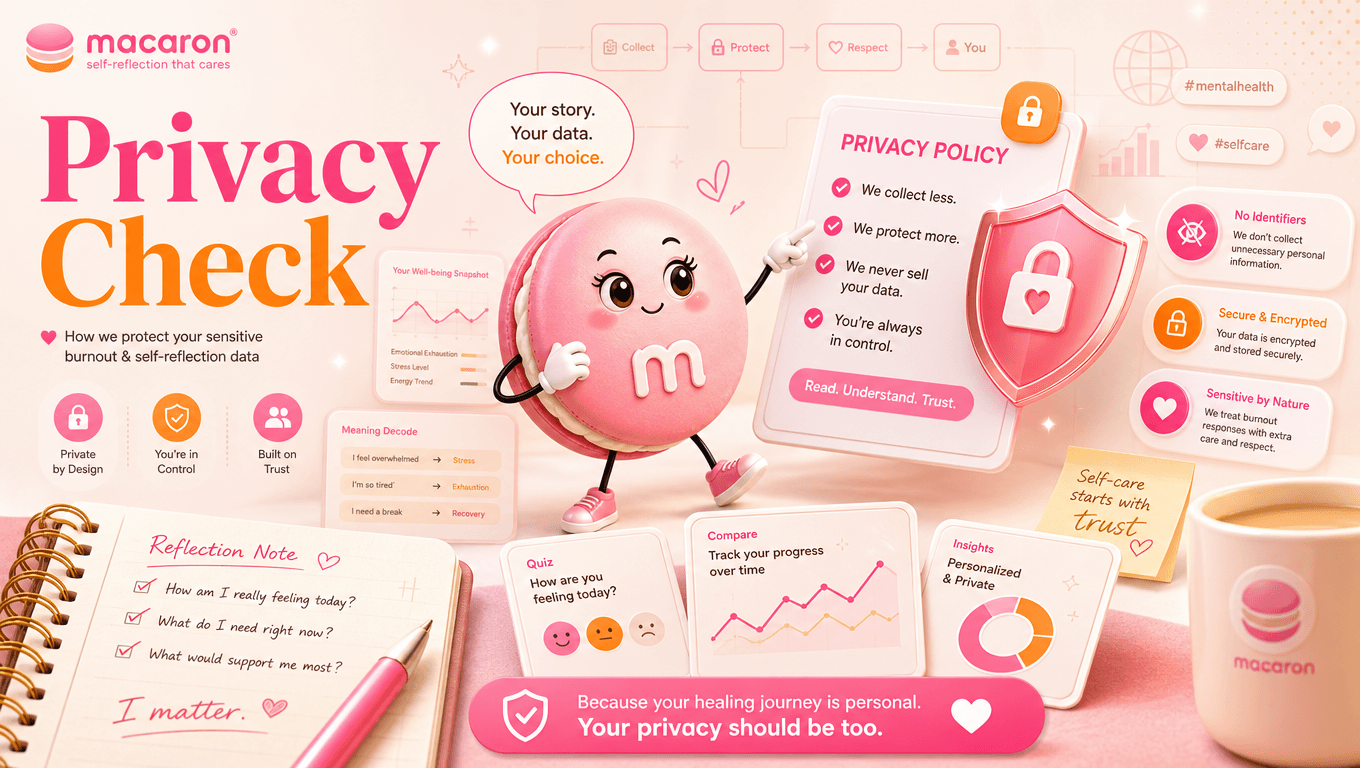
Your Responses and Privacy
Stress-related reflection data is sensitive, especially when it touches on work pressure, emotional exhaustion, or mental health concerns. Macaron is provided by MINDAI PTE. LTD., and the official Privacy Policy explains how information is handled. If privacy is a deciding factor for you, it is reasonable to review the policy before starting and to use the listed contact, contact@macaron.im, if you need clarification.
Frequently Asked Questions
This burnout test focuses on the patterns people most often associate with burnout: exhaustion, overload, detachment, difficulty recovering, and the way stress affects day-to-day functioning. It is meant to help you notice whether the problem is just temporary pressure or a more persistent pattern that is starting to change how you work, rest, and relate to responsibilities.
Start with the strongest pattern in the result instead of trying to fix everything at once. If exhaustion is highest, protect recovery time and reduce demands where possible. If detachment stands out, look at what is making work or study feel emotionally distant. If the result suggests significant strain, consider outside support, especially if the pattern has been building for a while.
Burnout should be taken to a licensed professional when it is affecting sleep, mood, concentration, relationships, work performance, or your ability to cope. It is also important to seek help sooner if you feel unsafe, hopeless, or unable to function normally. A self-check can point to strain, but it cannot tell you whether another condition is also involved.
This page offers AI-guided reflection for personal insight, not a standardized clinical measure. Formal burnout inventories are usually built around specific formal models, scoring methods, and validation standards, while this tool is designed to help you think through your experience in a more conversational way. It is useful for clarity, but it should not be treated as a diagnosis.
Yes. Although many burnout tools focus on job stress, burnout-like exhaustion can also build up in caregiving, study, parenting, volunteering, or any role with sustained pressure and limited recovery. That is one reason Macaron frames the reflection more broadly than a workplace-only quiz. If your strain comes from multiple parts of life, a broader check can be more useful than a work-only inventory.
Ordinary stress usually improves when the pressure eases or you get enough rest. Burnout is more likely when exhaustion, detachment, or reduced effectiveness keep showing up even after breaks, or when the same demands keep leaving you depleted. The difference is often about persistence, recovery, and whether your usual coping strategies still work. If you are unsure, track the pattern for a few days and compare it with your normal baseline. For a third-party check, Burnout Check-in Tool - Beyond Blue at https://www.beyondblue.org.au/mental-health/work/burnout/burnout-check-in-tool is worth comparing against the page summary.
Mixed results are common because burnout does not always appear in a neat pattern. You may feel exhausted but still engaged, or detached without feeling completely drained. In that case, look at which area is most disruptive in daily life and what has changed recently. Macaron is useful here because it separates exhaustion, overload, detachment, and recovery difficulty instead of forcing one simple label. For another outside reference, Burnout self-test | Hedepy at https://hedepy.com/tests/burnout-syndrome-test adds a second perspective.
The information you enter is sensitive, so it is reasonable to review the Privacy Policy before starting. Macaron is provided by MINDAI PTE. LTD., and the policy explains how data is handled. If privacy matters to you because your answers involve work pressure, health concerns, or personal stress, checking the policy first is a practical step. You can also contact contact@macaron.im with questions. For outside context, Burnout at Work Test / Quiz | Psychology Today at https://www.psychologytoday.com/us/tests/career/burnout-at-work is a useful reference point.
Read & discover
AI Personal Assistant
Free calculators


