Emotional Availability Test
An emotional availability test can help when closeness matters to you, but openness, trust, or consistency still feels difficult to sustain. Macaron uses guided reflection to help you examine vulnerability, emotional expression, and conflict patterns without treating the result like a diagnosis.
Emotional Availability Test
This self-reflection module helps you notice how you respond to closeness, vulnerability, conflict, and trust in relationships. It is designed to highlight patterns you may want to understand better, not to label you or your relationship.
This is a self-reflection tool, not a diagnosis or clinical assessment.
Please answer every question before viewing your result.
This module is for reflection only and cannot determine your attachment style, relationship health, or mental health status. If your answers bring up distress, fear, or memories of harm, consider reaching out to a trusted person or a qualified mental health professional for support.
Why Emotional Availability Matters in Relationships
An emotional availability test is most useful when you want closeness but keep noticing friction around trust, consistency, or emotional openness. People often search this term because they are trying to understand a relationship pattern, not just score themselves on a quiz. Macaron frames the test as a reflective tool for noticing how you respond when connection feels real, messy, or vulnerable, especially when your usual coping style starts to interfere with intimacy.
common user discussions around this topic often mix self-check quizzes, dating advice, and red-flag lists, which can make the term feel vague. In practice, emotional availability is less about being naturally expressive and more about whether you can stay present, respond honestly, and tolerate emotional closeness without shutting down or disappearing. That distinction matters because someone can care deeply and still struggle to show it consistently, particularly under stress or in relationships that feel high stakes.
Macaron’s emotional availability test focuses on the situations people commonly use to judge this trait in real life: how you talk about feelings, what happens during conflict, whether you can name needs directly, and whether you pull back when intimacy increases. Those patterns often show up in dating, long-term relationships, and even in how someone talks about past relationships or support systems, which makes them more useful than abstract personality labels. For a related Macaron page, see Best AI Personal Assistant in 2025: A Test Suite You Can Reuse at https://macaron.im/blog/ai-personal-assistant-test.
This page is designed to help you read your result with context rather than self-judgment. A lower score or a guarded pattern does not automatically mean you are incapable of connection. It may point to fear, habit, past experience, attachment patterns, or a learned way of protecting yourself when closeness feels risky, and that context is often more useful than the label itself when you are deciding what to change next.
The goal is not to decide whether you are "good" or "bad" at relationships. It is to identify where openness feels easiest, where it breaks down, and what kind of support would make emotional connection feel steadier. That makes the emotional availability test more practical than a simple yes-or-no label, especially for people who want insight they can actually use in dating or committed relationships.
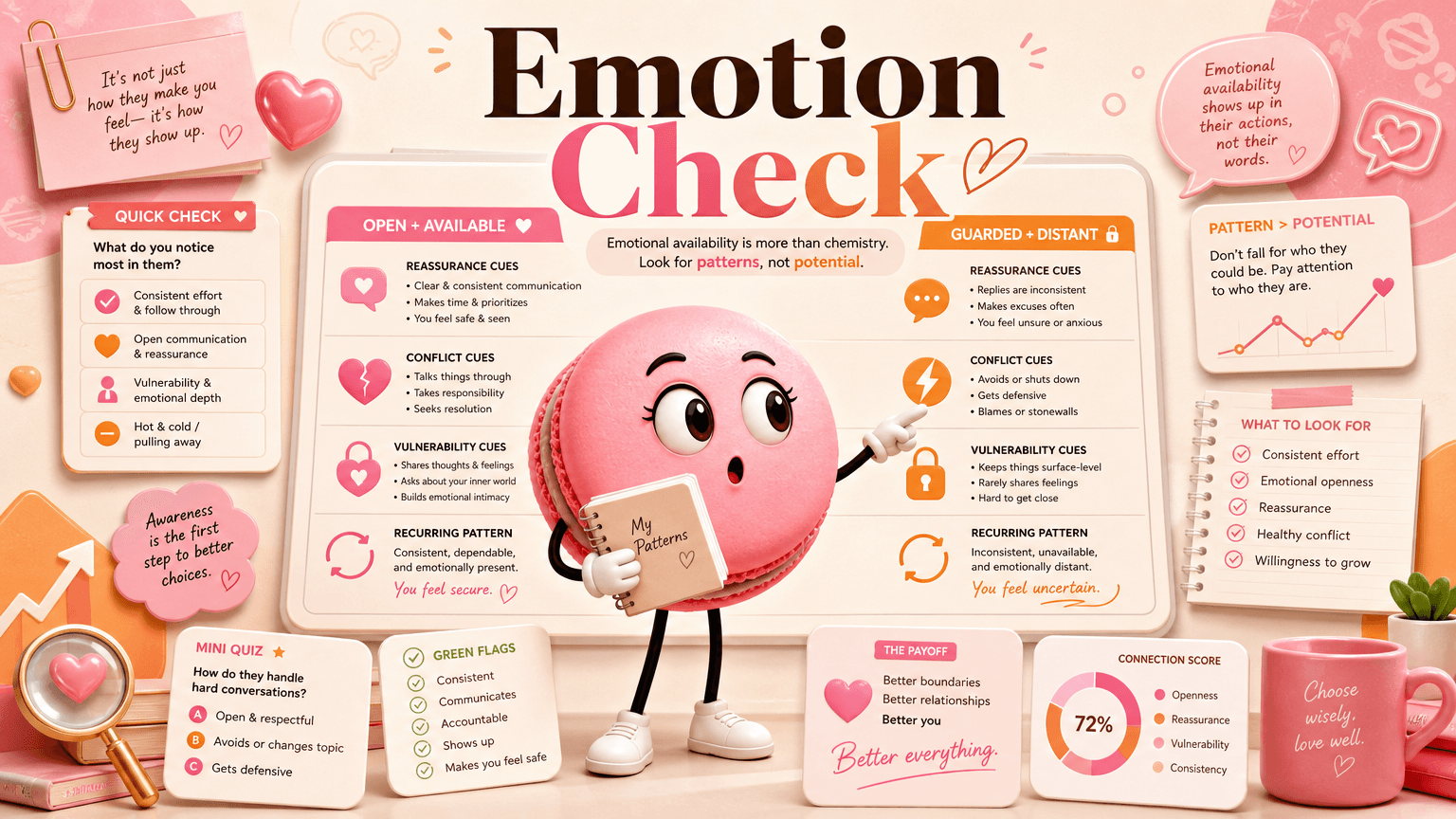
Why Emotional Availability Matters in Relationships
An emotional availability test is useful because attraction alone does not tell you whether a relationship can hold up under stress, disappointment, or vulnerability. Emotional availability affects how people respond when a partner needs reassurance, when conflict becomes uncomfortable, or when closeness starts to feel demanding. Macaron helps you look for recurring patterns such as wanting connection but pulling back, staying guarded when conversations get personal, struggling to express feelings clearly, feeling present one day and distant the next, or shutting down when tension rises. Those patterns often explain why a relationship feels unstable even when the intention to connect is real.
How Macaron Structures This Reflection
Macaron structures this reflection around the parts of emotional life that usually reveal the most about availability in relationships. That includes comfort with vulnerability, how easily you open up during closeness, whether trust leads to more honesty or more caution, how you handle conflict or emotional pressure, and whether your dating patterns show consistency or avoidance. This structure matters because emotional availability is rarely one single trait. It is usually a mix of how you communicate, how you protect yourself, and how you respond when another person asks for more emotional presence.
What Your Result Can Help You Notice
Your result is meant to support awareness, not self-judgment or overanalysis. It can help you notice where openness feels natural, which situations trigger withdrawal, whether fear shows up as silence or distance, and whether your current relationship habits are helping you feel safe or keeping you disconnected. In many cases, the most useful insight is not a label but a pattern: for example, being open at the start of dating but guarded once commitment becomes more serious. That kind of detail can make the next step much clearer.
More About Emotional Availability Test
An emotional availability test works best when it looks at behavior in context, not just at whether someone says they want a relationship. Many people appear interested in closeness but still avoid direct emotional conversations, change the subject when feelings come up, or keep relationships at a safe distance. Macaron helps you notice those patterns in a structured way so the result is easier to interpret and more useful for deciding what to do next.
The reflection also helps clarify a common confusion in search intent: emotional availability is not the same as being highly emotional, openly dramatic, or constantly verbal about feelings. A person can be quiet and still emotionally available if they can respond honestly, stay engaged during hard moments, and make room for another person’s experience. The test is meant to separate expression style from relational openness, which is especially helpful for people who assume they are "bad at feelings" when the real issue is avoidance or fear.
Macaron structures the check around the moments that usually reveal the most: vulnerability, trust, conflict, and emotional pressure. Those are the situations where people often either lean in or protect themselves. Looking at those patterns can help you understand whether distance shows up only under stress or whether it is part of a broader relationship style, such as difficulty naming needs, discomfort with dependence, or a habit of keeping conversations surface-level. Another useful Macaron comparison is AI Calorie Tracker - Macaron at https://macaron.im/ai-calorie-tracker.
The result is meant to point toward next steps, not to freeze you into a fixed identity. If the test highlights withdrawal, guardedness, or difficulty naming needs, that can suggest useful follow-up work such as communication practice, reflection on triggers, or noticing which relationships feel safest. The value is in identifying the pattern clearly enough to do something with it, rather than treating the score as a permanent verdict on your capacity for connection. For a broader Macaron context, Best Free AI Calorie Trackers You Can Start Today - Macaron at https://macaron.im/blog/free-ai-calorie-tracker can help you compare the decision from another angle.
Because relationship reflection can touch sensitive material, Macaron also keeps the experience grounded in care and privacy. If the result brings up distress that feels overwhelming, it is important to treat that separately from the self-check itself and seek support when needed. The test can be a starting point for insight, but it should never replace real help when safety or mental health is at risk, especially if the pattern connects to trauma, depression, or persistent relationship distress.
Practical Ways to Become More Open
Macaron turns the emotional availability test into something you can actually use by connecting the result to concrete next steps. That may include reflection prompts that help you name what you feel, check-ins that reveal when you start to withdraw, communication planning for difficult conversations, or support for putting fears and needs into words. The point is not to force instant vulnerability. It is to build steadier openness through small, repeatable habits that make emotional contact feel less overwhelming and more manageable over time, especially for people who want change without being pushed into oversharing.
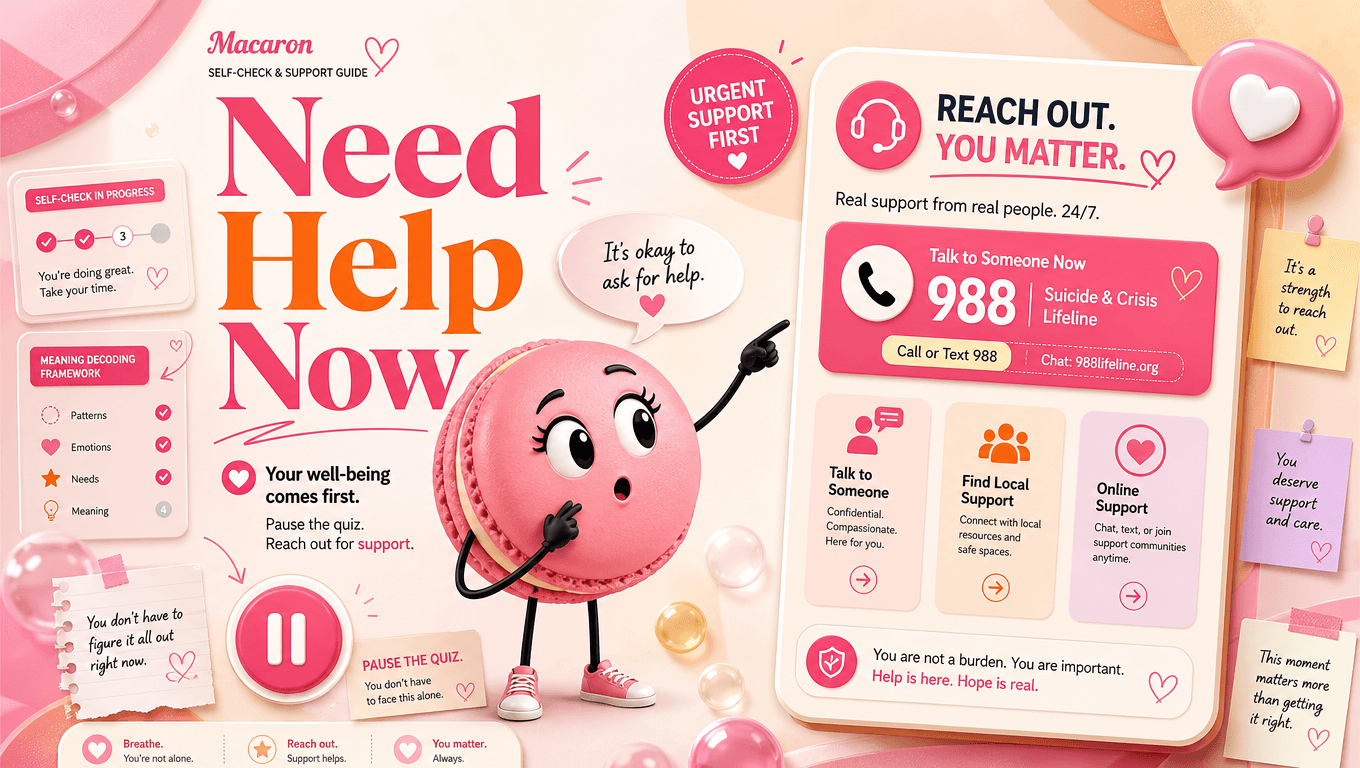
If You Need Immediate Support
This self-check is not a substitute for professional help, especially if the result brings up intense distress, safety concerns, or thoughts of self-harm. If relationship pain feels overwhelming, it is better to pause the quiz and reach out for support right away. In the United States, call or text 988. In the United Kingdom and Ireland, call 116 123. If you are elsewhere, use an international directory such as findahelpline.com to locate local crisis support. A reflective tool can help with insight, but urgent support should come first when safety is involved.
Your Responses and Privacy
Relationship reflection data can be sensitive, especially when it touches attachment history, conflict style, or fear of closeness. Macaron is provided by **MINDAI PTE. LTD.** See the official [Privacy Policy](https://macaron.im/privacy-policy). Privacy contact: `contact@macaron.im`. This matters because users comparing emotional availability tools often want more than a score; they want a private place to think honestly about patterns they may not be ready to discuss elsewhere.
Frequently Asked Questions
This emotional availability test focuses on the parts of relationships that usually reveal openness or guardedness: vulnerability, trust, emotional expression, comfort with closeness, and how you respond when feelings or conflict become harder to manage. It is less about whether you are naturally talkative and more about whether you can stay engaged, honest, and present when connection requires emotional risk. That makes it useful for dating, long-term relationships, and self-reflection.
Start with the pattern that feels most accurate or most surprising, then connect it to a real relationship situation. You might notice that you open up easily at first but withdraw under pressure, or that you struggle to name needs directly. From there, choose one next step such as journaling, practicing a direct conversation, or asking for support from a therapist or trusted person if the pattern feels persistent. The goal is to turn insight into one concrete action.
That insight can still be very useful. Pulling back does not automatically mean you do not care or that something is wrong with you. It may point to fear, past hurt, a habit of self-protection, or difficulty tolerating emotional intensity. Seeing the pattern clearly is often the first step toward understanding when it appears and what helps you stay present instead of shutting down. If it feels familiar across relationships, it may be worth exploring more deeply.
No. Emotional availability is not the same as being loud, highly verbal, or emotionally intense. Someone can be quiet and still be emotionally available if they can respond honestly, listen well, tolerate closeness, and engage in difficult conversations without disappearing. Expression style matters less than whether the person can stay open and responsive in a relationship. This distinction helps avoid confusing introversion or calmness with emotional distance.
Early dating can feel easy because the stakes are lower, so the real test is what happens when expectations, conflict, or deeper vulnerability appear. If you stay engaged when a conversation becomes personal, can name what you need, and do not disappear when things feel uncertain, that suggests more genuine availability. If you are warm at first but become guarded as closeness increases, the issue may be comfort with novelty rather than sustained emotional openness.
Yes. Emotional availability is not always fixed across every context. A person may feel open with one partner and guarded with another because of trust, safety, communication style, or unresolved history. That is one reason Macaron focuses on patterns rather than a single label. If your result changes depending on the relationship, it can be a clue that the environment matters as much as your personality or intentions. For a third-party check, Emotional Detachment Test: Am I Emotionally Unavailable? Quiz at https://www.proprofs.com/quiz-school/story.php?title=are-you-emotionally-unavailable-quiz is worth comparing against the page summary.
Common signs include avoiding direct conversations about feelings, changing the subject when things get personal, shutting down during conflict, keeping relationships superficial, or saying you want closeness while repeatedly creating distance. Some people also struggle to name needs, minimize their own emotions, or become defensive when a partner asks for more honesty. One sign alone is not enough to define a pattern, but repeated behavior across situations can be informative. For another outside reference, Am I Emotionally Unavailable Quiz - Marriage.com at https://www.marriage.com/quizzes/am-i-emotionally-unavailable-quiz adds a second perspective.
Macaron is designed to be more reflective and action-oriented than a simple score-based quiz. Instead of stopping at a label, it helps you connect the result to vulnerability, trust, conflict, and closeness, then think about what to do next. That is useful for people who want practical insight rather than a generic personality verdict. Competitor quizzes may be faster or more entertaining, but they can be better if you want a quick entertainment-style check rather than a more structured reflection. For outside context, Emotional Availability Test / Quiz - Psychology Today at https://www.psychologytoday.com/us/tests/relationships/emotional-availability-test is a useful reference point.
Read & discover
AI Personal Assistant
Free calculators


