Emotional Exhaustion Test
An emotional exhaustion test can help when you are still getting through the day but feel drained, flat, irritable, or slow to recover underneath. Macaron uses guided reflection to help you notice patterns of depletion, reduced capacity, and strain without treating the result as a diagnosis.
Emotional Exhaustion Test
This self-reflection module helps you notice whether you have been running low on emotional energy, patience, and recovery capacity. It is designed to highlight patterns you can act on, not to label you or explain everything at once.
This is a self-reflection tool, not a diagnosis or medical assessment.
Please answer every question before viewing your result.
If your exhaustion feels severe, keeps worsening, or comes with hopelessness, panic, thoughts of self-harm, or trouble functioning, seek urgent support from a qualified professional or local crisis service. This reflection is not a diagnosis and cannot tell you the cause of what you are feeling, but it can help you decide whether you need more support now.
Signs of Emotional Exhaustion You Should Not Ignore
An emotional exhaustion test is most useful when the problem is not obvious collapse but a quieter sense that your inner reserves are running low. People often search for this kind of test when they are still meeting responsibilities, yet feel less patient, less present, or less able to bounce back after ordinary stress. Macaron is designed to help you name that experience more clearly, especially when the signs have been gradual and easy to dismiss as normal pressure.
In practice, emotional exhaustion can look different from simple tiredness. You may feel emotionally flat, unusually irritable, detached from people or tasks, or unable to recover even after sleep or a break. Some people also notice that small demands feel heavier than they should, or that they are functioning on autopilot. That is why this page focuses on the lived pattern of depletion rather than a single score or label.
The search intent behind emotional exhaustion test is often mixed. Some people want a quick self-check, while others are trying to understand whether what they feel is burnout, stress, depression, or just a rough week. Macaron’s reflection format is meant to clarify those patterns without forcing one explanation too early. That can be useful when the main question is not “What is wrong with me?” but “What is this feeling, and what should I do about it?” For a related Macaron page, see How to Use AI as a Personal Assistant: 30 Prompts That Actually Work at https://macaron.im/blog/ai-personal-assistant-prompts.
This page is not a clinical assessment and should not be read as a diagnosis. It is a structured way to notice how exhaustion shows up in mood, patience, motivation, relationships, and daily functioning. That matters because emotional exhaustion is often overlooked until it starts affecting work quality, home life, or the ability to care about things that normally matter. A self-check can make the pattern easier to see before it becomes harder to manage.
If the result suggests significant strain, the most useful next step is usually not to push harder. It is to identify what is draining you, what recovery has been missing, and whether support, workload changes, or professional help would be more appropriate than another attempt to simply rest it off. Macaron is strongest when it helps you move from vague depletion to a more concrete plan.
Signs of Emotional Exhaustion You Should Not Ignore
An emotional exhaustion test is useful because the warning signs are often subtle at first and easy to explain away as stress, a busy schedule, or a bad mood. Macaron helps you look for recurring patterns such as feeling emotionally spent after ordinary interactions, becoming numb or detached, snapping more quickly than usual, or caring less because you simply do not have the capacity to keep giving. It also helps you notice when rest does not seem to restore your usual patience, interest, or emotional range, which is often the point where the problem deserves more attention. Compared with many quick quizzes, Macaron is more useful for people who want to understand the pattern behind the feeling, not just whether they are “stressed.”
How Macaron Structures This Reflection
Macaron structures this reflection around the parts of exhaustion people usually feel before they can fully explain it. That includes current emotional depletion, irritability or numbness, how much stress you can still absorb, whether recovery feels possible after rest, and how the strain is affecting work, home life, and relationships. This structure matters because emotional exhaustion is rarely just one symptom. It is usually a pattern across mood, energy, and functioning, and the reflection is meant to make that pattern easier to recognize. The tradeoff is that this approach is more interpretive than a rigid scoring quiz, but it gives you a more practical picture of what is changing and where it is showing up.
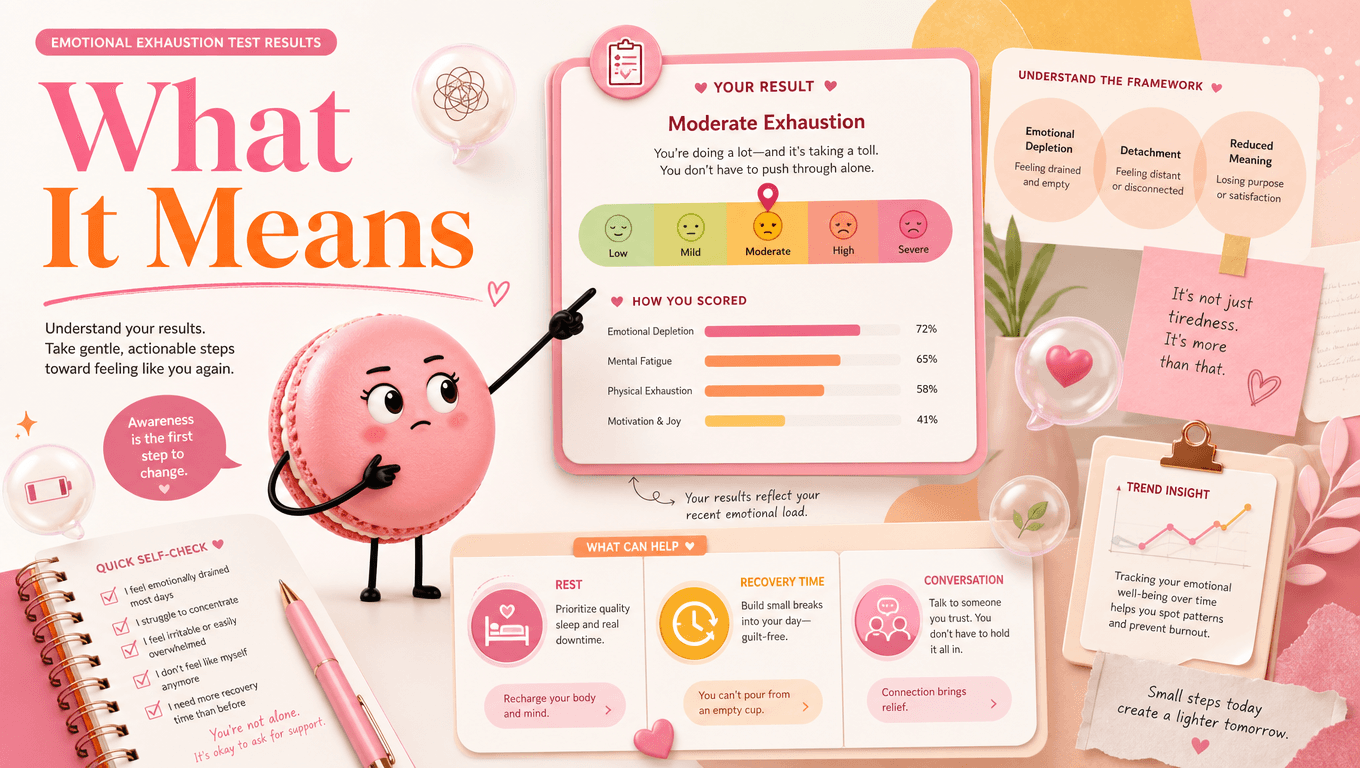
What Your Result Can Help You Notice
Your result is meant to highlight where the strain is showing up most clearly, not to put a fixed label on you. It can help you notice whether the exhaustion feels temporary or persistent, whether your emotional range has narrowed, and whether certain situations are draining you more than others. It can also point to the kind of support that may be most relevant, such as reducing overload, protecting recovery time, or talking to someone if the pattern has started affecting sleep, work, or relationships. That makes the result more actionable than a generic burnout quiz, though it still cannot replace a clinician if symptoms are severe or complex.
More About Emotional Exhaustion Test
An emotional exhaustion test is helpful because depletion often accumulates in small, easy-to-ignore ways. Many people do not notice the shift until they are more reactive, less engaged, or surprised by how little stress they can tolerate. A good reflection tool makes those changes easier to see before they become harder to manage, especially when the issue has been building alongside work pressure, caregiving, conflict, or prolonged uncertainty.
Macaron’s approach is built around the patterns people commonly search for when they ask whether they are emotionally exhausted. That includes feeling spent after routine demands, losing emotional range, becoming detached, or noticing that rest no longer restores the same way it used to. The goal is to make those signals easier to interpret, while also helping you distinguish short-term strain from a more persistent pattern that may need a different response.
The result is most useful when it helps you separate temporary strain from a more persistent pattern. A rough week can improve with sleep and time off, but ongoing exhaustion often affects patience, concentration, relationships, and motivation in ways that keep repeating. That distinction matters because it changes what kind of response is likely to help. Competitor quizzes often stop at a score; Macaron is more useful when you want to connect the result to everyday decisions about workload, boundaries, and recovery. Another useful Macaron comparison is How Macaron AI Tackles the Problem with Traditional Task Lists at https://macaron.im/blog/macaron-ai-daily-planning-guide.
Instead of treating the result as a verdict, Macaron uses it as a starting point for action. That can mean noticing where overload is coming from, identifying which situations drain you fastest, and deciding whether you need lighter demands, better recovery habits, or outside support. The emphasis is on practical clarity, not alarm. The tradeoff is that this kind of guided reflection is less like a formal psychological inventory and more like a decision aid, which is often better for next steps but less definitive for comparison. For a broader Macaron context, When Nano Banana Meets Macaron: Next‑Level AI Image Editing ... at https://macaron.im/blog/macaron-ai-essential-personal-assistant-features can help you compare the decision from another angle.
Because emotional exhaustion can overlap with burnout, anxiety, low mood, and physical fatigue, the page also keeps the boundaries clear. If symptoms are severe, persistent, or tied to safety concerns, a self-check is not enough on its own. In those cases, the most responsible next step is professional or crisis support. That boundary is important because some users want reassurance, while others need urgency; Macaron is designed to support both without overpromising what a self-test can tell you.
Restore Emotional Energy More Gradually
Macaron helps turn the emotional exhaustion test into a more workable next step by pairing reflection with small recovery actions. That may include prompts that help you identify what is draining you, check-ins that show whether your energy is improving, and ideas for reducing overload before it becomes overwhelming again. The point is not to promise a quick fix. It is to help you rebuild capacity in a way that fits the reality of emotional depletion, which often improves best through steady changes rather than one dramatic reset. This is especially useful if you are functioning but feel chronically overextended, because the tool can help you choose one change that is realistic enough to keep.
If You Need Immediate Support
This self-check is not a substitute for professional help, especially if your distress feels intense, you feel unsafe, or you are having thoughts of self-harm. Emotional exhaustion can overlap with more serious mental health concerns, and a test cannot judge urgency on its own. If you need immediate support, contact crisis services right away. In the United States, call or text 988. In the United Kingdom and Ireland, call 116 123. For other locations, use a trusted international helpline directory such as findahelpline.com. If you are unsure whether your symptoms are urgent, err on the side of getting help sooner rather than later.
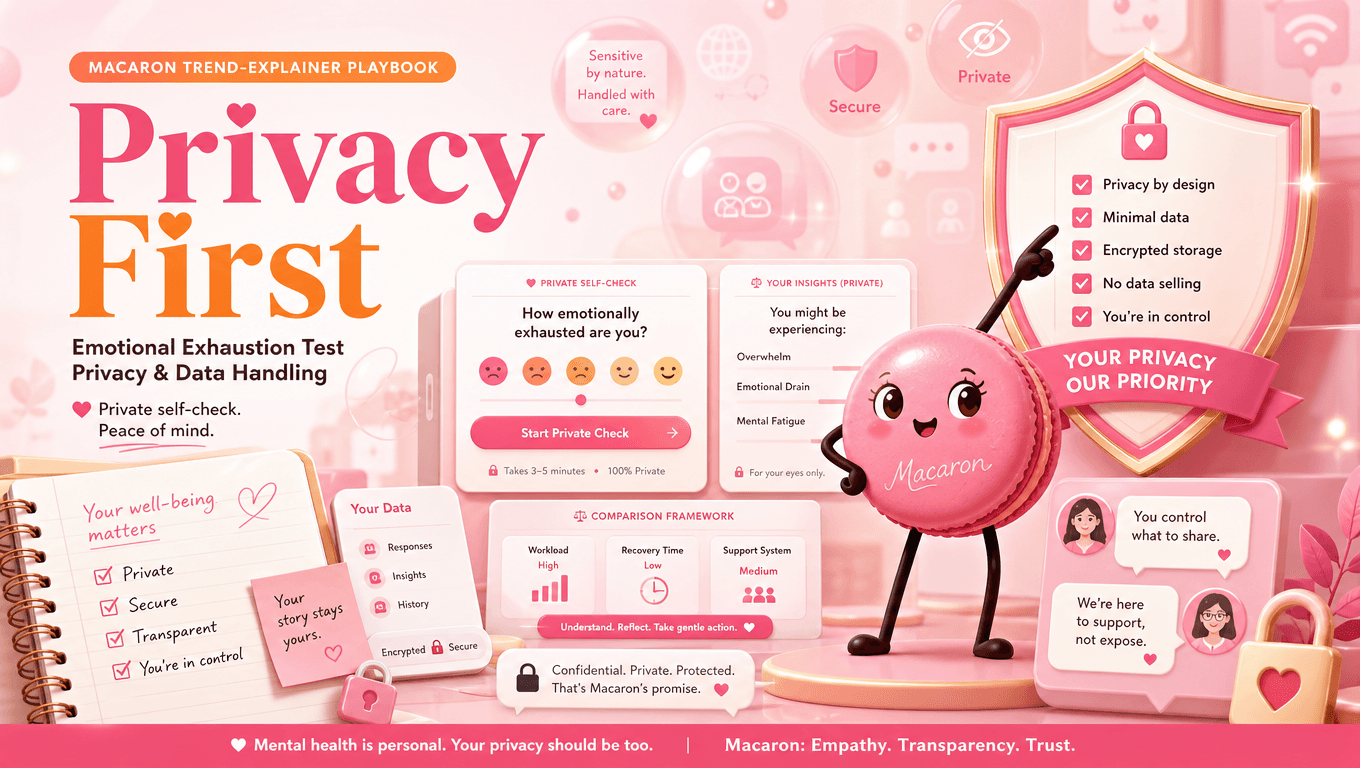
Your Responses and Privacy
Reflection about stress and emotional exhaustion can involve sensitive personal information, so privacy matters. Macaron is provided by MINDAI PTE. LTD., and the official privacy policy explains how data is handled. If you are comparing tools or deciding whether to use an online emotional exhaustion test, it is reasonable to check privacy terms first, especially when the questions touch on mood, coping, or mental health. For privacy questions, you can also contact contact@macaron.im. That transparency is useful for users who want a self-check without feeling like their responses are being turned into a marketing profile.
Frequently Asked Questions
This emotional exhaustion test focuses on the signs people most often notice when they feel depleted rather than simply busy. That includes feeling emotionally spent, numb, irritable, less able to care, slower to recover after rest, and more affected by ordinary demands than usual. It is meant to help you recognize the pattern of exhaustion across mood, energy, and daily functioning, not to replace a clinical evaluation or assign a diagnosis.
Start with the strongest pattern the result highlights, then choose one practical response instead of trying to fix everything at once. For some people that means reducing overload, for others it means protecting recovery time, setting a boundary, or asking for support. If the result suggests the exhaustion is persistent or affecting sleep, work, relationships, or safety, it is a good idea to speak with a licensed professional.
Take it more seriously when the exhaustion is not improving with rest, is affecting your ability to function, or is starting to change your mood, sleep, relationships, or sense of safety. It should also be treated with extra care if you feel detached, hopeless, or unable to cope the way you normally would. In those situations, a self-check is not enough, and professional or crisis support may be appropriate.
Being tired usually improves after sleep, rest, or a lighter day. Emotional exhaustion tends to feel deeper and less responsive to ordinary recovery. People often describe it as feeling flat, drained, impatient, or disconnected, even when they have technically rested. The difference is not just how much energy you have, but whether your emotional capacity and resilience have started to narrow in a way that keeps repeating.
They overlap, but they are not always identical. Emotional exhaustion is one of the core experiences people associate with burnout, especially when stress has been ongoing for a long time. Burnout usually also involves reduced effectiveness, cynicism, or feeling detached from work or responsibilities. Macaron keeps the focus on the exhaustion itself so you can notice the pattern first, then decide whether it looks more like burnout, stress overload, or something else.
Yes. Work is a common source, but emotional exhaustion can also come from caregiving, family conflict, chronic uncertainty, grief, social pressure, or being the person others rely on too often. Some people are most drained by emotional labor rather than job tasks. That is one reason Macaron does not limit the reflection to work stress alone. It helps you identify the situations that are taking the most out of you, wherever they happen. For a third-party check, Burnout self-test | Hedepy at https://hedepy.com/tests/burnout-syndrome-test is worth comparing against the page summary.
A short quiz can be useful if you want a fast check, but it often stops at a score or a broad label. Macaron is more useful when you want to understand what is driving the exhaustion and what to do next. It uses guided reflection to connect symptoms with daily patterns, which can be more actionable. The tradeoff is that it is less like a formal inventory and more like a practical self-assessment. For another outside reference, Burnout at Work Test / Quiz | Psychology Today at https://www.psychologytoday.com/us/tests/career/burnout-at-work adds a second perspective.
That can happen, especially if you are used to pushing through stress or if the strain has not yet become constant. A mild result does not mean your experience is unimportant. It may simply mean the pattern is early, uneven, or tied to a specific situation. If you still feel off, look at sleep, workload, conflict, and recovery time, and consider repeating the reflection later or talking with someone if the feeling persists. For outside context, Emotional Exhaustion Test – Takes 3 Minutes - Calmerry at https://calmerry.com/blog/burnout/emotional-exhaustion-test/ is a useful reference point.
Read & discover
AI Personal Assistant
Free calculators


