Emotional Intelligence Assessment
An emotional intelligence assessment is most useful when it helps you notice how you label emotions, respond under pressure, and affect other people in everyday interactions. Macaron offers an AI-guided reflection experience that organizes those patterns into clearer, more actionable insight, while remaining distinct from a clinical or standardized EQ test.
Emotional Intelligence Assessment
This self-reflection module helps you notice how you recognize emotions, respond under pressure, and affect other people in everyday situations. It is designed to turn an emotional intelligence assessment into practical insight you can use in communication, stress, and relationships.
This is a self-reflection tool, not a diagnosis or a formal EQ test.
Please answer every question before viewing your result.
This reflection is for personal insight only and does not measure emotional intelligence with clinical precision. If the questions bring up distress, conflict, or thoughts of harming yourself or someone else, pause the exercise and reach out to a trusted person or local emergency support right away.
What This Reflection Can Help You Notice
An emotional intelligence assessment is usually searched for by people who want more than a personality label. They want to understand how emotions show up in real situations, such as conflict, feedback, stress, or moments when communication breaks down. That makes the term broad, because it can refer to a quiz, a self-assessment, or a more structured appraisal of EQ-related habits. Macaron is built for that practical intent, helping you connect emotional patterns to the situations where they actually affect your choices, tone, and relationships.
Macaron approaches the emotional intelligence assessment as guided reflection rather than a formal psychometric instrument. The goal is to help you examine recurring patterns in self-awareness, regulation, empathy, and relationship behavior, so the result feels connected to daily life instead of abstract scoring alone. That makes it useful for people who want insight they can act on, while also being honest about the tradeoff: it is less standardized than a validated clinical or workplace assessment.
Many people looking for an emotional intelligence assessment are trying to answer a practical question: what happens to my judgment, tone, or patience when emotions rise? This page is designed to surface those patterns in context, including the difference between how you think you handle emotions and how you actually respond when pressure builds. That distinction matters because EQ is often easiest to describe in calm moments and hardest to observe when you feel rushed, criticized, or misunderstood. For a related Macaron page, see AI Personal Assistant - Macaron at https://macaron.im/ai-personal-assistant.
Because emotional intelligence is often discussed through different models, searchers can be unsure what a good assessment should measure. Common frameworks emphasize self-awareness, self-management, social awareness, and relationship management, while other approaches focus on perceiving emotions, regulating emotions, and understanding emotional impact. Macaron keeps the reflection broad enough to be useful without pretending to be a clinical benchmark, which helps users compare their habits across models instead of getting trapped by one score or label.
This emotional intelligence assessment is intended for personal insight, not diagnosis. If you want a clearer starting point for understanding your emotional habits, the value here is in seeing patterns, tradeoffs, and likely growth areas with enough structure to make the next step feel practical. It is especially helpful for people who already know they want to communicate better, stay steadier under stress, or understand how their behavior lands with others, but do not know where to begin.
What This Reflection Can Help You Notice
Macaron helps you look at the situations where EQ becomes visible in real life, not just in theory. That can include emotional pressure at work, misunderstandings in close relationships, conflict recovery after a tense exchange, or moments when stress makes it harder to stay patient and accurate. The reflection is especially useful when you suspect the issue is not whether you have emotions, but how quickly they shape your tone, attention, and choices. It helps you notice patterns that are easy to miss in the moment, such as overexplaining, shutting down, reacting before you have fully processed what you feel, or reading neutral feedback as personal criticism.
How Macaron Structures This Reflection
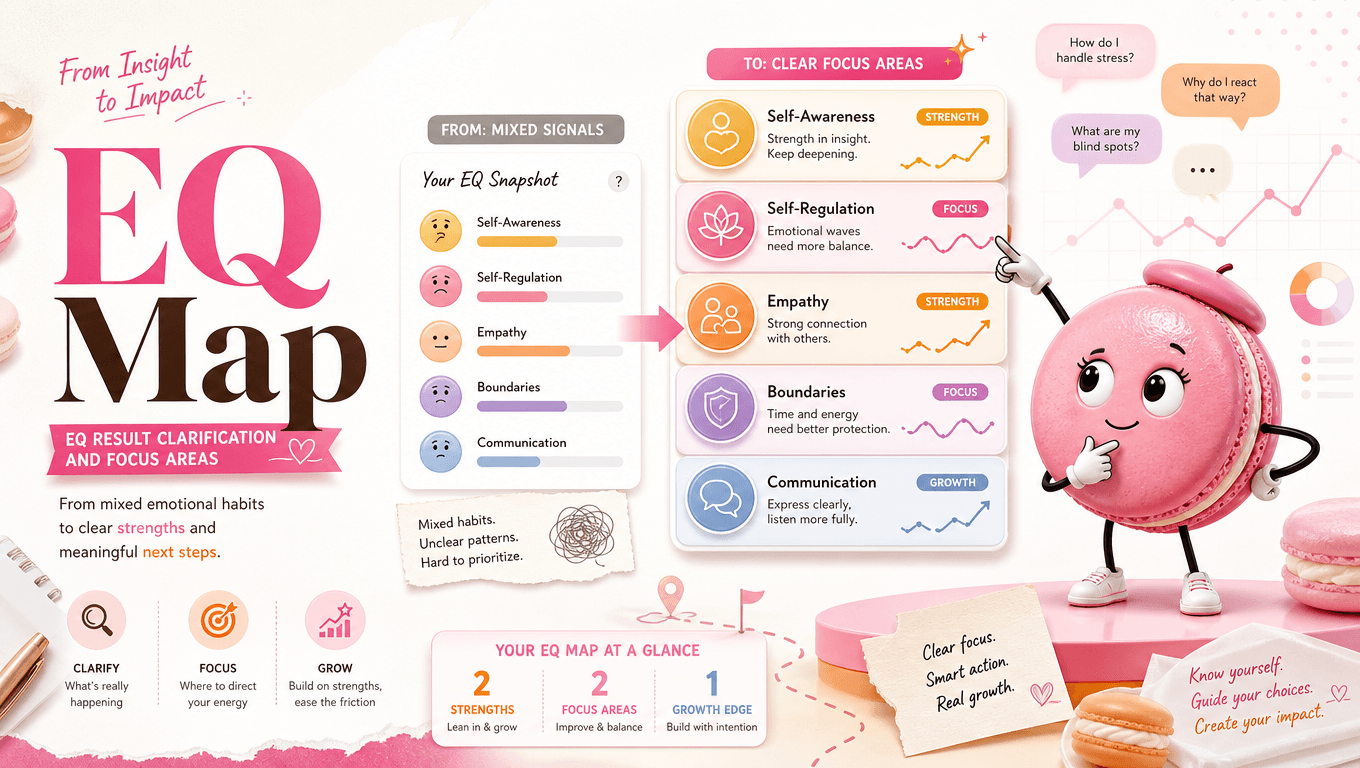
Macaron organizes the assessment around five recurring EQ areas that show up in most modern frameworks: self-awareness, emotional regulation, empathy, communication, and stress response. That structure matters because emotional intelligence is not just about being calm or expressive. It also includes recognizing what you feel, understanding how others may read your behavior, and adjusting your response when the situation is emotionally loaded. By separating these dimensions, the reflection makes it easier to see whether the challenge is awareness, control, perspective-taking, or interaction style, which is more useful than treating EQ as a single all-or-nothing trait.
What Your Result Can Clarify
Your result is meant to help you decide where to focus first, especially if your emotional habits feel mixed or inconsistent. It can show where your awareness is steady, where emotions become harder to regulate, how empathy influences your relationships, and where communication changes when you are under strain. That is useful because many people assume they have a single EQ problem, when the real issue is more specific, such as strong empathy but weak boundaries, or good self-awareness but inconsistent stress management. The result helps narrow that ambiguity into a more workable starting point, which is often the hardest part of improving emotional skills.
More About Emotional Intelligence Assessment
People often use an emotional intelligence assessment when they are trying to make sense of repeated friction, not just one-off mood changes. Macaron helps you reflect on moments where emotions affect communication, such as feeling misunderstood, reacting too quickly, recovering after conflict, or noticing that stress changes how you listen and respond. That makes it more useful for everyday behavior than for abstract self-description, especially if you want to understand why the same kinds of conversations keep going sideways.
The structure of the reflection follows the kinds of dimensions that appear repeatedly in EQ guidance and popular assessments. That usually includes self-awareness, emotional regulation, empathy, communication, and stress response, which gives you a useful lens for comparing how you feel internally with how you show up externally. The advantage of this approach is clarity: instead of asking whether you are simply “good with emotions,” it helps you see which part of the process is strong and which part breaks down first.
A useful result should do more than say you are strong or weak at EQ. It should clarify where your awareness is reliable, where emotions tend to escalate, and where your behavior shifts under pressure. That kind of interpretation is especially helpful when you are deciding what to work on first instead of trying to improve everything at once. Macaron is designed to make that prioritization easier, while acknowledging that some users will still prefer a formal assessment if they need standardized scoring or comparison across teams. Another useful Macaron comparison is Best AI Personal Assistant in 2025: A Test Suite You Can Reuse at https://macaron.im/blog/ai-personal-assistant-test.
Macaron is designed to turn reflection into a repeatable practice, because emotional intelligence is usually developed through patterns, not one-time answers. The prompts and check-ins are meant to help you notice triggers, reset your communication, and practice calmer responses in situations that tend to pull you off balance. That makes it a good fit for people who want a lightweight way to build awareness over time, though it is less suited to users who want a single, test-like result with strict scoring rules. For a broader Macaron context, Macaron Novel App Download at https://macaron.im/playbook/macaron-novel-app can help you compare the decision from another angle.
If the process brings up distress, the right next step may not be more self-reflection. Emotional intelligence tools are useful for insight, but they are not a substitute for professional support when emotions feel overwhelming, unsafe, or hard to manage alone. The page keeps that distinction clear so users can read the result with appropriate caution and context. That boundary is important because the most helpful EQ tool is not always the most intense one; sometimes the best next step is support, rest, or a conversation with a qualified professional.
Build a Long-Term EQ Practice
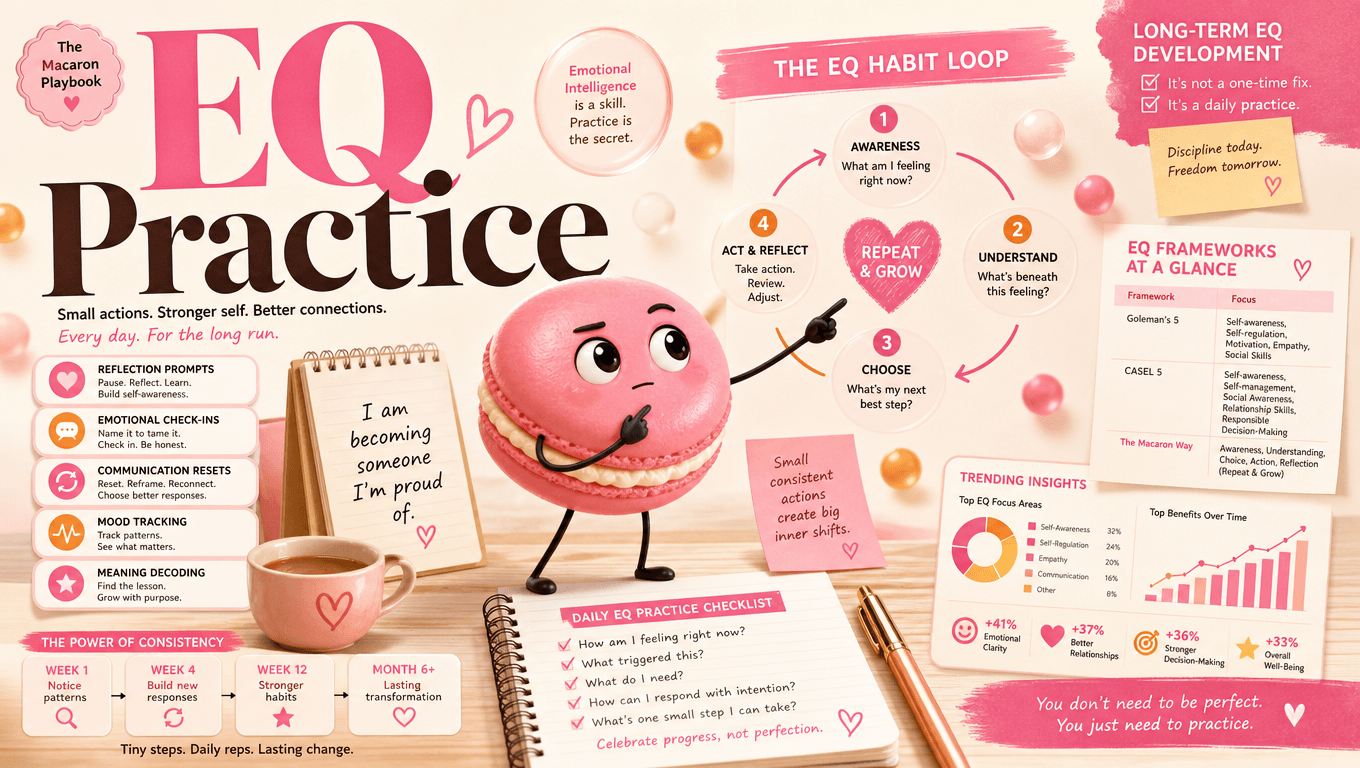
Macaron turns the emotional intelligence assessment into an ongoing practice rather than a one-time score. The idea is to create small habits that help you notice emotional patterns earlier and respond with more intention. Reflection prompts can help you review a difficult conversation, emotional check-ins can help you track changes in mood or tension, and communication resets can help you slow down before reacting. Over time, those habits make it easier to connect insight with behavior, which is where EQ development usually becomes visible in everyday life. This is especially useful for people who learn best through repetition and context rather than through a single test result.
If You Need Immediate Support
This self-check is not a replacement for professional care, especially if your distress feels intense, persistent, or unsafe. If the reflection brings up thoughts of self-harm, panic, or a sense that you cannot stay safe on your own, pause the exercise and contact crisis support right away. In the United States, call or text 988. In the United Kingdom and Ireland, call 116 123. If you are elsewhere, use a trusted international directory such as findahelpline.com to locate local support quickly. The most responsible use of an EQ tool is knowing when insight is no longer enough.
Your Responses and Privacy
Emotional reflection can involve sensitive information about relationships, stress, and mental state, so privacy matters. Macaron is provided by MINDAI PTE. LTD., and the official Privacy Policy explains how your data is handled. If you are deciding whether to use an emotional intelligence assessment online, it is reasonable to check what is collected, how it is stored, and how to contact the provider with questions. For privacy-related concerns, you can reach the team at contact@macaron.im. Users who value discretion may appreciate that this page makes the privacy question explicit instead of treating it as an afterthought.
Frequently Asked Questions
A quick quiz can be useful for a rough impression, but an emotional intelligence assessment is better when you want to understand patterns that repeat across situations. It gives more context around how you recognize emotions, manage them under pressure, and affect other people through tone, timing, or empathy. That makes it more helpful for self-reflection, especially if you are trying to improve communication or reduce conflict rather than just get a score.
Start with the dimension that causes the most friction in daily life, because that is usually where change will feel most relevant. If you often react quickly, begin with emotional regulation or stress response. If you misunderstand other people or miss cues, start with empathy or social awareness. If you know what you feel but struggle to express it clearly, self-awareness and communication may be the better place to begin.
If the reflection starts to feel heavy, pause and step away. Emotional intelligence work should increase clarity, not push you past your limits. It can help to return later with more support, or to stop entirely if the process is bringing up distress that feels difficult to manage. If you feel unsafe, unable to cope, or concerned about harming yourself, contact a licensed professional or crisis support immediately.
This page is designed for guided self-reflection, not for clinical diagnosis or standardized measurement. Formal EQ assessments are usually built around validated scoring methods, specific administration rules, and interpretation standards. Macaron is meant to help you think through emotional patterns in a practical way, so you can identify strengths, blind spots, and likely growth areas without treating the result as a professional evaluation.
Most emotional intelligence assessments look at how well you notice emotions, understand what they mean, regulate your reactions, and respond to other people in a way that supports communication. Some tools emphasize self-awareness and self-management, while others focus more on empathy or relationship skills. Macaron uses reflection to help you think through those dimensions in context, so the result is tied to behavior rather than just a label.
Yes. Emotional intelligence is usually treated as a set of skills and habits that can develop with practice, feedback, and better self-observation. People often improve by noticing triggers earlier, pausing before reacting, asking clearer questions, and learning how their tone affects others. Macaron is useful here because it supports repeated reflection, but the tradeoff is that progress depends on what you do with the insight, not on the assessment alone. For a third-party check, Free Emotional Intelligence Test - Global Leadership Foundation at https://tests.globalleadershipfoundation.com/geit/eitest.html is worth comparing against the page summary.
Mixed results are common because emotional intelligence is not one skill. You may be strong in empathy but less steady under stress, or highly self-aware but less effective in communication during conflict. That does not mean the result is wrong; it usually means your strengths and blind spots are uneven. The most useful next step is to focus on the dimension that creates the most practical problems, rather than trying to fix everything at once. For another outside reference, Emotional Intelligence Test | EQ 2.0 Appraisal Test - TalentSmartEQ at https://www.talentsmarteq.com/test/ adds a second perspective.
Macaron is strongest for personal reflection, especially if you want to understand how emotions affect communication, stress, and relationships in everyday life. It can also be helpful for workplace self-awareness, but it is not a formal hiring, promotion, or team-selection tool. If you need standardized benchmarking, a validated workplace assessment may be better. If you want a more flexible, reflective experience that helps you think through patterns, Macaron is a better fit. For outside context, Emotional Intelligence Test / Quiz - Psychology Today at https://www.psychologytoday.com/us/tests/personality/emotional-intelligence-test is a useful reference point.
Read & discover
AI Personal Assistant
Free calculators


