Emotional Intelligence Quiz
An emotional intelligence quiz is useful when you want a quick read on how you notice feelings, manage pressure, and respond to other people in everyday situations. Macaron turns that check-in into guided reflection, while making clear that it is not a clinical assessment or diagnostic tool.
Emotional Intelligence Quiz
This emotional intelligence quiz is a short self-reflection on how you notice feelings, respond under pressure, and relate to other people. It is designed to help you spot patterns you can build on, not to label you or measure your worth.
This is a self-reflection tool, not a diagnosis or clinical assessment.
Please answer every question before viewing your result.
This quiz is for self-reflection only and cannot tell you whether you have a mental health condition or a relationship problem. If the questions bring up distress, conflict, or a sense of being overwhelmed, consider talking with a trusted person or a qualified professional for support.
What This Reflection Can Help You Notice
An emotional intelligence quiz is most useful when you want a practical snapshot of how you handle emotions in real situations, not a vague personality label. People often search for EQ quizzes because they want to understand why they stay calm in some moments, react quickly in others, or feel unsure about how they come across when tension rises. Macaron keeps that focus on everyday behavior, so the result is easier to connect to actual conversations, decisions, and stress points.
Macaron frames the emotional intelligence quiz as guided reflection, which matters because many EQ searches are really about interpretation. Users are often trying to tell the difference between self-awareness, emotional regulation, empathy, and communication habits, so the quiz emphasizes observable patterns rather than abstract theory. That makes it more useful if you want to compare how you think you respond with what you actually do when pressure, criticism, or conflict shows up.
This kind of check-in can be especially helpful if you have seen different EQ models online and are unsure what counts as a meaningful result. Some quizzes emphasize recognizing and labeling emotions, while others focus on self-management, social awareness, or relationship skills. Macaron keeps the experience simple while still pointing to those common EQ dimensions, so you can read the result without needing to decode a complicated framework first. For a related Macaron page, see How to Use AI as a Personal Assistant: 30 Prompts That Actually Work at https://macaron.im/blog/ai-personal-assistant-prompts.
The result is designed to show patterns, not to rank your worth or replace a formal screening. That makes it easier to read the outcome as a starting point for reflection, especially if you are trying to understand what happens when you are criticized, stressed, interrupted, or asked to read someone else’s tone. The value is in seeing where your reactions are steady and where they become less reliable under pressure.
If you are using an emotional intelligence quiz to decide what to work on next, the most useful insight is usually specific. Look for the situations that trigger your strongest reactions, the moments where you listen well, and the places where emotion gets in the way of communication. Those details are often more actionable than a broad score, because they point to habits you can actually practice in daily life.
What This Reflection Can Help You Notice
Macaron helps you look at the kinds of situations that usually reveal EQ patterns in daily life, such as criticism, conflict, pressure, and emotionally loaded conversations. The reflection can help you notice whether you tend to pause before reacting, whether you can name what you feel in the moment, and whether you pick up on other people’s tone or body language. It is especially useful when you want to understand not just how you feel, but how those feelings shape your communication, patience, and follow-through under stress. That makes the result more practical than a generic score, because it connects emotional habits to real interactions you can recognize.
How Macaron Structures This Reflection
Macaron organizes the emotional intelligence quiz around the areas most often associated with EQ in common test models and search intent. That includes self-awareness, emotional regulation, empathy, communication habits, and stress response. Framing the quiz this way makes the result easier to read because it separates internal awareness from outward behavior. It also helps users compare what they think they do with what they actually do when a conversation becomes tense or emotionally complicated. The tradeoff is that this format is less formal than a long psychometric test, but it is faster and easier to use when you want a clear, everyday read.
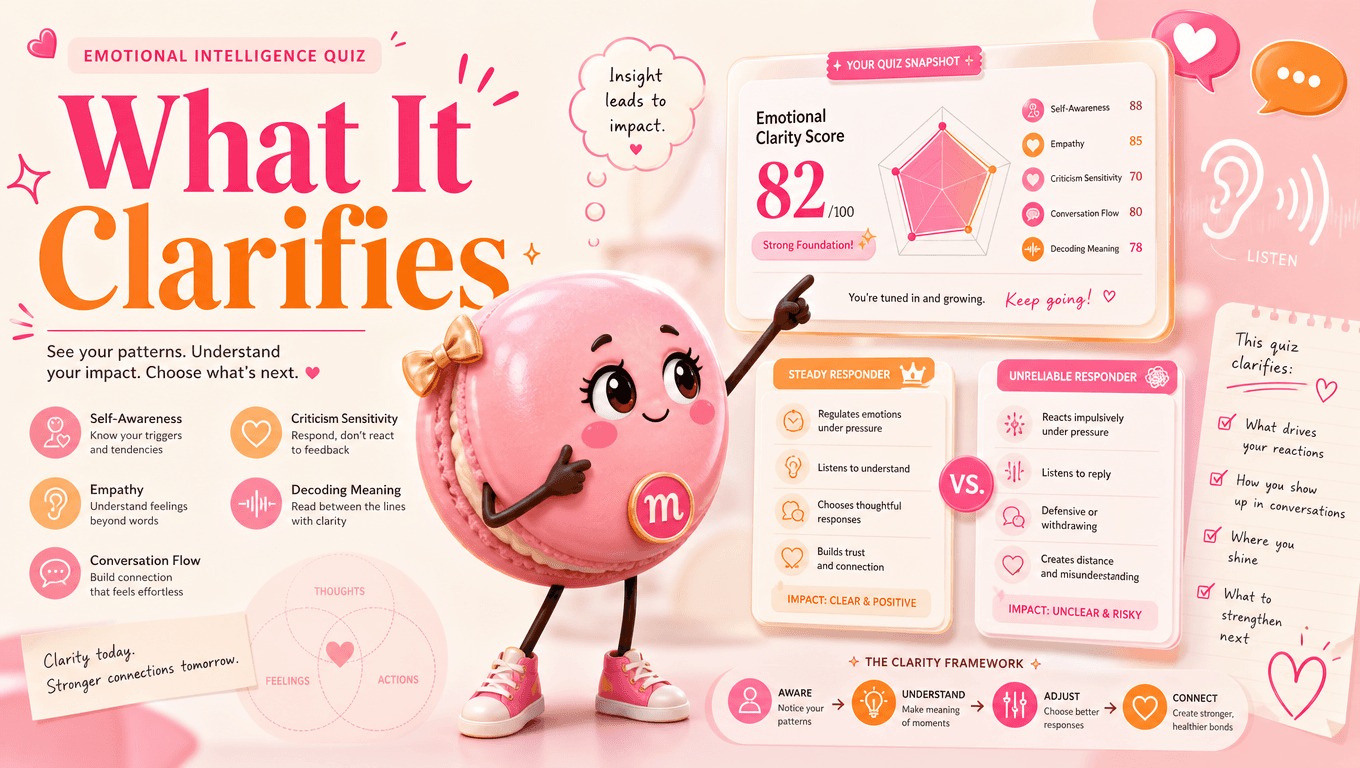
What Your Result Can Clarify
The result is meant to show where your emotional habits feel steady and where they become less reliable under pressure. It can clarify whether your awareness of your own feelings is strong, whether your reactions get sharper when you feel criticized, and whether empathy changes the way you respond in conversation. It can also point to communication patterns that help connection, such as listening well, or patterns that create distance, such as reacting too quickly or assuming intent before checking it. That kind of detail is useful because it turns a broad concept like EQ into specific behaviors you can notice and improve.
More About Emotional Intelligence Quiz
Many people take an emotional intelligence quiz because they want to understand how EQ shows up in ordinary interactions, not just in leadership or workplace language. Macaron keeps the focus on real-life moments such as handling criticism, noticing tension early, or recognizing when stress changes the way you speak and listen. That makes the page more useful for people who want a practical self-check they can relate to immediately, rather than a test that feels detached from daily life.
The quiz is structured around core EQ themes that appear repeatedly in common models and in how people search for emotional intelligence tests: self-awareness, emotional regulation, empathy, communication habits, and stress response. That helps the result feel more interpretable, especially for users comparing different quizzes and wondering what each one actually measures. It also gives the result a clearer shape, so you can see whether your strengths are mostly internal, social, or tied to how you handle pressure.
Instead of treating emotional intelligence as one fixed trait, the result can help you separate strengths from friction points. You may notice that you read people well but struggle to pause before reacting, or that you stay composed under pressure but miss emotional cues in conversation. Those distinctions are often where the most useful insight lives, because they show where your habits support connection and where they may create misunderstandings. That is more actionable than a single label like high or low EQ. Another useful Macaron comparison is Catalysing Macaron's Capabilities with Claude & DeepSeek Updates at https://macaron.im/blog/macaron-claude-deepseek-integration.
Macaron also turns the quiz into a practical reflection tool, which matters because many users are not just looking for a score. They want a simple way to build better habits, such as pausing before replying, checking in with their own feelings, or listening more carefully when a conversation becomes tense. The benefit is that the next step is concrete. The limitation is that it will not replace deeper coaching, therapy, or a formal assessment when you need a more rigorous evaluation. For a broader Macaron context, Novel Reader Online - Macaron at https://macaron.im/novel-reader-online can help you compare the decision from another angle.
Because emotional intelligence is broad and sometimes loosely defined online, it helps to be careful about what the quiz can and cannot do. This page is meant to support self-reflection and next-step thinking, while staying clear that it is not a clinical assessment, a formal EI screening, or a substitute for professional guidance. That honesty is important for trust, and it also helps users choose the right tool for the job instead of expecting one quiz to answer every question about their emotional life.
Three Small Ways to Build EQ
Macaron turns the quiz into action by suggesting small habits that are realistic to practice in daily life. That might include a short pause before replying, a one-minute check-in to name what you are feeling, or a reset after a tense exchange so you can listen more clearly. These micro-habits matter because EQ usually improves through repeated practice, not one big breakthrough, and they are easier to sustain when the goal is specific and manageable. This approach is especially helpful for users who want practical follow-through instead of a score they will forget after reading.
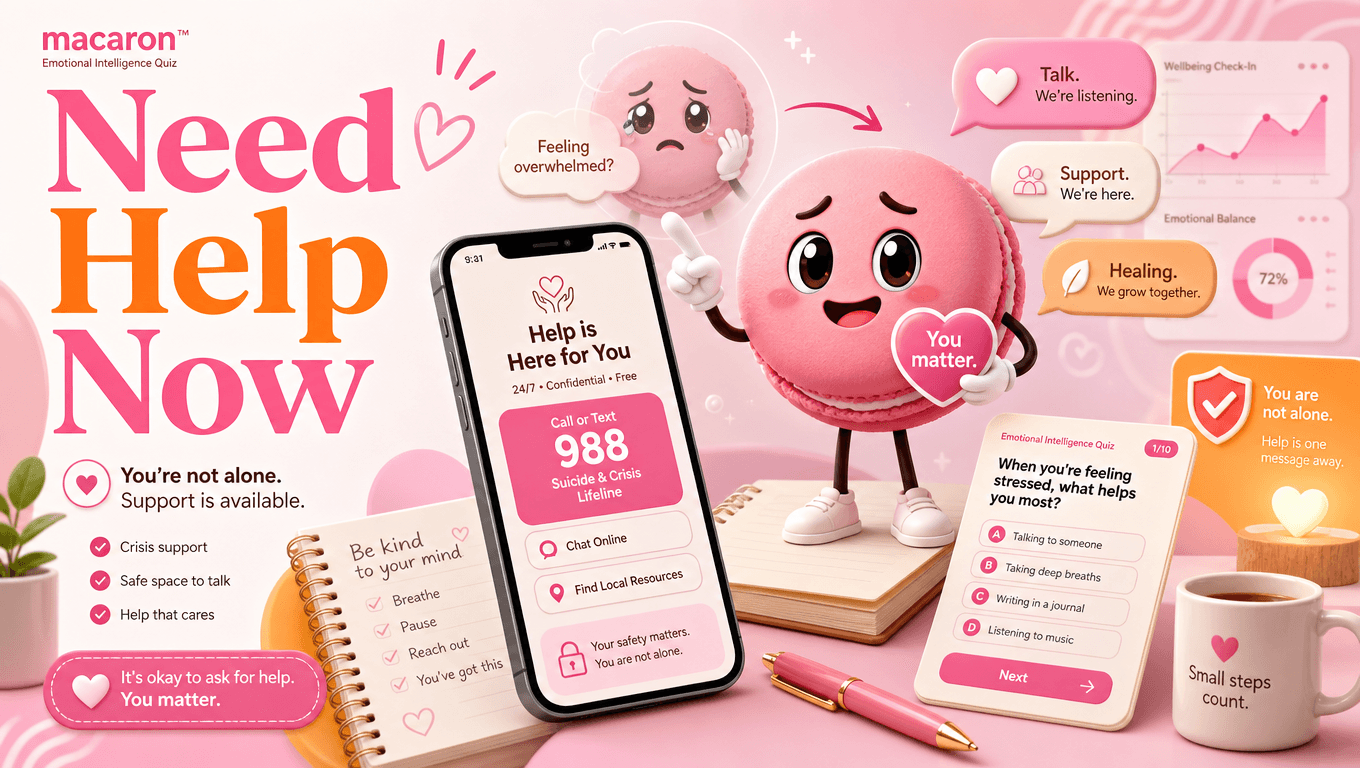
If You Need Immediate Support
This self-check is not designed for crisis care or mental health diagnosis. If the process brings up intense distress, if you feel unsafe, or if you are thinking about harming yourself, it is important to contact immediate support rather than continue the quiz. In the United States, call or text 988. In the United Kingdom and Ireland, call 116 123. If you are elsewhere, use a trusted international directory such as findahelpline.com to locate local help quickly. The quiz can support reflection, but it should never replace urgent human support when safety is a concern.
Your Responses and Privacy
Emotional reflection can involve sensitive information, especially when the quiz asks about stress, conflict, or personal reactions. Macaron is provided by MINDAI PTE. LTD., and the official Privacy Policy explains how responses are handled. If you have questions about data or privacy, you can also contact `contact@macaron.im`. Keeping this information visible helps users decide whether they are comfortable sharing reflective answers before they begin. That transparency matters because trust is part of the experience when a quiz asks about emotions, relationships, and personal coping patterns.
Frequently Asked Questions
This emotional intelligence quiz is designed as a quicker check-in, so it is easier to use when you want a practical sense of your EQ without a long assessment flow. Longer EQ tests often go deeper into scoring, subscales, or formal measurement models, while this page is built for reflection and pattern recognition. If you are mainly trying to understand how you respond to stress, criticism, or other people’s emotions, the shorter format can be a better fit.
Start with the area that feels most familiar in your daily life, or the one that creates the most friction. For many people, that means looking first at stress response, emotional regulation, or communication habits, because those are the places where EQ shows up most clearly. If one part of the result feels especially accurate, use that as your starting point and ask what situations tend to trigger it. That usually leads to more useful reflection than focusing on the overall score alone.
If the quiz brings up discomfort, pause and step away if you need to. Emotional reflection can feel personal, especially when it touches on conflict, criticism, or difficult relationships. If the experience feels overwhelming, unsafe, or connected to thoughts of self-harm, stop the quiz and contact a licensed professional or crisis support right away. The goal is insight, not pressure. It is completely reasonable to return later when you feel more grounded.
This page offers AI-guided reflection, not a standardized or clinical EQ screening. Formal screenings usually follow a validated testing method and are used for more specific measurement purposes, while this quiz is meant to help you notice patterns in self-awareness, empathy, and communication. It is best understood as a starting point for self-understanding rather than a definitive evaluation. If you need a formal result for formal assessment, hiring, or clinical use, a validated assessment is the better choice.
Most EQ models group emotional intelligence into a few recurring areas: recognizing your own emotions, managing your reactions, noticing other people’s feelings, and using that awareness to communicate well. Some frameworks also include relationship management or social awareness as separate skills. This quiz reflects those common themes so the result is easier to interpret. The exact labels vary by model, but the practical question is the same: how well do you notice, understand, and respond to emotions in real situations?
Yes. Emotional intelligence is often treated as a set of skills that can be strengthened with practice, feedback, and reflection. People usually improve by learning to pause before reacting, naming emotions more accurately, listening more carefully, and noticing patterns in stressful situations. Progress is often gradual, which is why small habits matter. A quiz can help you identify where to focus, but the improvement comes from repeated use in everyday conversations and decisions. For a third-party check, Emotional Intelligence Quiz - Greater Good Science Center at https://greatergood.berkeley.edu/quizzes/ei_quiz/take_quiz is worth comparing against the page summary.
Yes, because EQ shows up in both settings. At work, it can affect how you handle feedback, conflict, deadlines, and team communication. In relationships, it can shape how you listen, respond to tension, and repair misunderstandings. This quiz is useful when you want to see which situations trigger your strongest reactions and where you already communicate well. It can help you choose one or two habits to practice, rather than trying to change everything at once. For another outside reference, Test Your Emotional Intelligence | Free EQ Quiz From IHHP at https://ihhp.com/free-eq-quiz/ adds a second perspective.
Macaron is better for fast, guided reflection and for turning results into practical next steps. More formal EQ tools are usually stronger when you need standardized scoring, deeper subscales, or a method that can be compared across people. The tradeoff is that formal tools can feel less conversational and less immediate. Macaron is a good fit if you want clarity and action; a formal assessment is better if you need measurement precision. For outside context, Emotional Intelligence Test / Quiz - Psychology Today at https://www.psychologytoday.com/us/tests/personality/emotional-intelligence-test is a useful reference point.
Read & discover
AI Personal Assistant
Free calculators


