Emotional Intelligence Test
An emotional intelligence test is most useful when it helps you understand how you notice, label, regulate, and express emotions in real situations. Macaron turns that idea into an AI-guided reflection, not a clinical score, so you can read your patterns with more clarity and less guesswork.
Emotional Intelligence Test
This self-reflection helps you notice how you recognize, understand, and respond to emotions in everyday situations. It focuses on patterns in awareness, empathy, communication, and stress response so you can turn insight into practical next steps.
This is a self-reflection module, not a diagnosis or a clinical assessment.
Please answer every question before viewing your result.
This reflection is meant for personal insight, not for diagnosing mental health conditions or measuring your worth. If the questions bring up distress, or if you are dealing with overwhelming emotions, relationship conflict, or thoughts of self-harm, please reach out to a trusted person or a qualified mental health professional right away.
What This Reflection Can Help You Notice
An emotional intelligence test is usually searched for by people who want more than a vague personality label. They want to understand how emotions affect attention, decision-making, conflict, and recovery after stress, especially when reactions feel faster or harder to explain than they should. Macaron is built for that kind of practical self-check, helping you look at patterns that show up in ordinary moments rather than forcing everything into a single score.
Macaron uses the emotional intelligence test as a guided reflection that helps you examine everyday patterns in language that is easier to use. Instead of treating EQ as a single number, it encourages you to look at how self-awareness, empathy, and regulation show up in ordinary conversations, pressure, and emotional turning points. That makes it more useful for people who want to understand what is happening before they try to change it.
Many well-known EQ tests focus on related skills such as recognizing emotions, understanding what they mean, expressing them clearly, and managing them under pressure. That broader framing matters because people often confuse emotional intelligence with being calm all the time, when the real issue is usually how quickly you notice what is happening and how well you respond to it. Macaron keeps that distinction visible so the result feels more actionable. For a related Macaron page, see Novel Reader Online - Macaron at https://macaron.im/novel-reader-online.
This page is intentionally careful about what the result means. It is not a standardized psychological assessment, not a diagnostic tool, and not a substitute for a licensed evaluation, so the value is in reflection rather than labeling. That makes it useful for readers who want insight into patterns without overreading a score. The tradeoff is that you get less clinical precision than a formal assessment, but more room to interpret the result in everyday life.
If you are trying to decide whether your EQ challenge is more about self-awareness, emotional control, empathy, or communication, this reflection gives you a structured place to start. It is designed to help you identify the pattern that feels most familiar, most disruptive, or most worth improving first. People who benefit most are often those who want a clear next step, not just reassurance that emotional intelligence matters.
What This Reflection Can Help You Notice
Macaron helps you notice the parts of emotional intelligence that are easiest to miss in daily life, especially when emotions feel automatic. You can look at how fast you identify what you are feeling, whether stress makes you more reactive or more withdrawn, how empathy changes the tone of conversations, and how well you recover after difficult interactions. These are the kinds of patterns people usually want from an emotional intelligence test when they are trying to understand why certain situations keep repeating. The value is not in judging yourself, but in seeing which situations reliably pull you off balance.
How Macaron Structures This Reflection
Macaron organizes the reflection around five practical areas: self-awareness, emotional regulation, empathy, communication, and stress response. That structure helps keep the result readable because emotional intelligence is often discussed in broad terms, while real-life struggles are usually more specific. For example, someone may communicate well when calm but lose clarity under pressure, or they may be empathetic with others but disconnected from their own emotional cues. This format makes it easier to connect a general EQ concept to a concrete pattern you can recognize and work on.
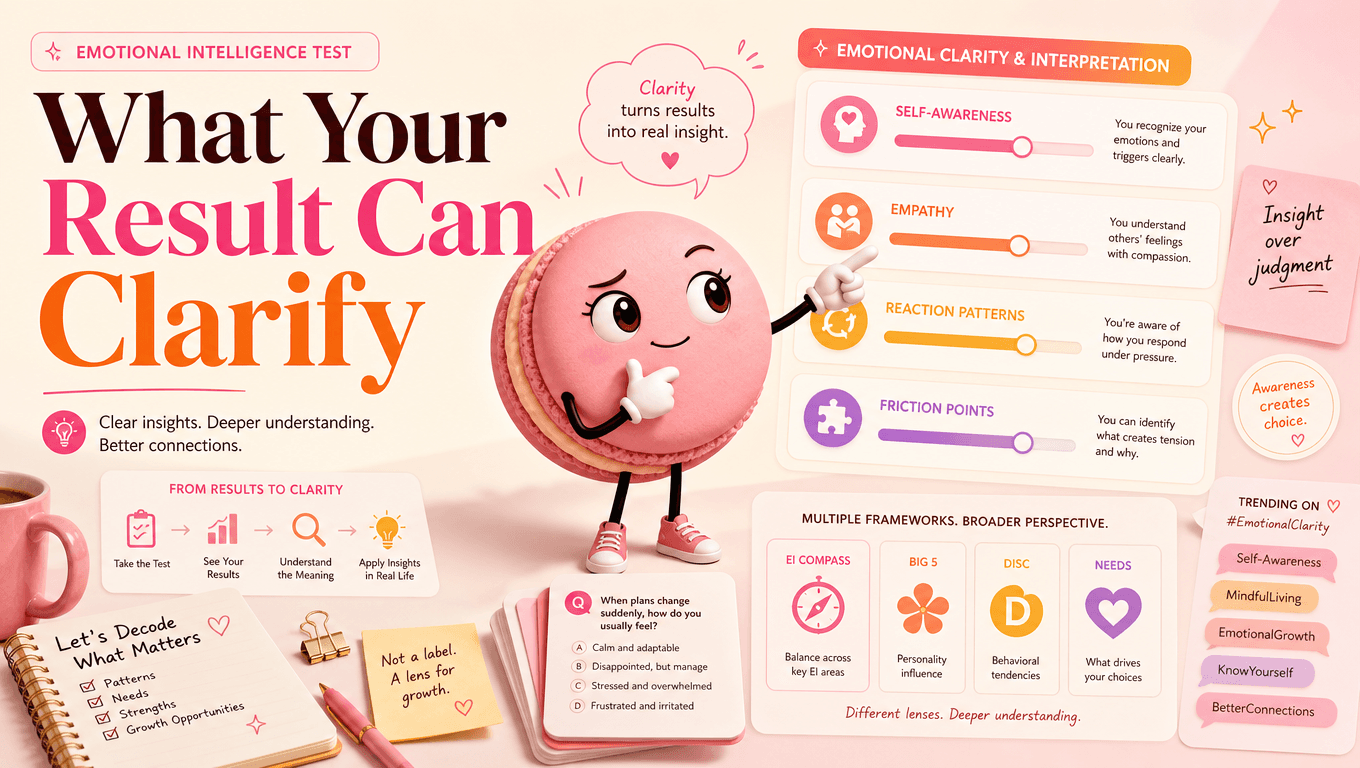
What Your Result Can Clarify
Your result is designed to support interpretation, not self-judgment. It can help you see where your awareness feels steady, where reactions intensify quickly, how empathy affects connection, and which pattern is most likely driving friction in your day-to-day life. That kind of clarity is useful because many people search for an emotional intelligence test hoping to find a single answer, when what they really need is a more precise starting point. Macaron is strongest when you want to move from a broad feeling of 'I struggle with emotions' to a more specific, usable insight.
More About Emotional Intelligence Test
Macaron helps you reflect on patterns such as how quickly you notice your own emotions, whether you can name them accurately, and whether you tend to understand them only after the moment has passed. That distinction matters because many people feel emotionally reactive without realizing the first challenge is often awareness, not control. Compared with apps that only hand back a score, Macaron is more useful for people who want to understand the sequence behind their reactions.
The reflection also looks at how pressure changes your behavior in conversations, work, and relationships. common user discussions for emotional intelligence tests often mention managing emotions under pressure, and that is because stress can make even strong communicators interrupt more, withdraw, overexplain, or misread other people’s intent. Macaron surfaces that context so you can tell whether the issue is emotional intensity itself, or the way intensity changes your communication style.
Macaron structures the experience around self-awareness, emotional regulation, empathy, communication, and stress response so the result feels easier to interpret. Those categories mirror the way many EQ tests are described in practice, but they also help you separate a general feeling of being 'bad with emotions' from a more specific pattern you can actually work on. That is a practical advantage over broader personality tools, though formal assessments may still be better if you need standardized scoring. Another useful Macaron comparison is Best AI Personal Assistant in 2025: A Test Suite You Can Reuse at https://macaron.im/blog/ai-personal-assistant-test.
Your result is meant to clarify where your strengths already show up and where friction tends to appear. For example, you may be good at noticing others’ feelings but slower to recognize your own, or you may understand emotions well in hindsight but struggle to stay steady in the moment, which points to different next steps. That kind of differentiation is especially helpful for users who want to improve relationships, leadership, or conflict handling without guessing which skill to practice first. For a broader Macaron context, Best Meal Planning Apps in 2026 - Macaron at https://macaron.im/blog/best-meal-planning-apps can help you compare the decision from another angle.
Macaron then turns the reflection into practical habits instead of leaving you with a static score. That can include short check-ins, listening resets, pause-before-reacting routines, and small empathy practices that fit into daily life, which is often what people want when they search for an emotional intelligence test with actionable feedback. The tradeoff is that these habits are intentionally lightweight, so they are easier to use consistently but less exhaustive than a full coaching or clinical program.
Practical Ways to Build EQ
Macaron turns the reflection into small actions that are easier to repeat than a one-time insight. You may be prompted to pause before replying, check in with your emotional state, listen for what is not being said, or practice a simple empathy habit after tense moments. These steps matter because EQ tends to improve through repeated awareness and response patterns, not through abstract advice alone. This approach works well for busy users who want something they can apply immediately, though people looking for deep training may still prefer a structured course or coach.
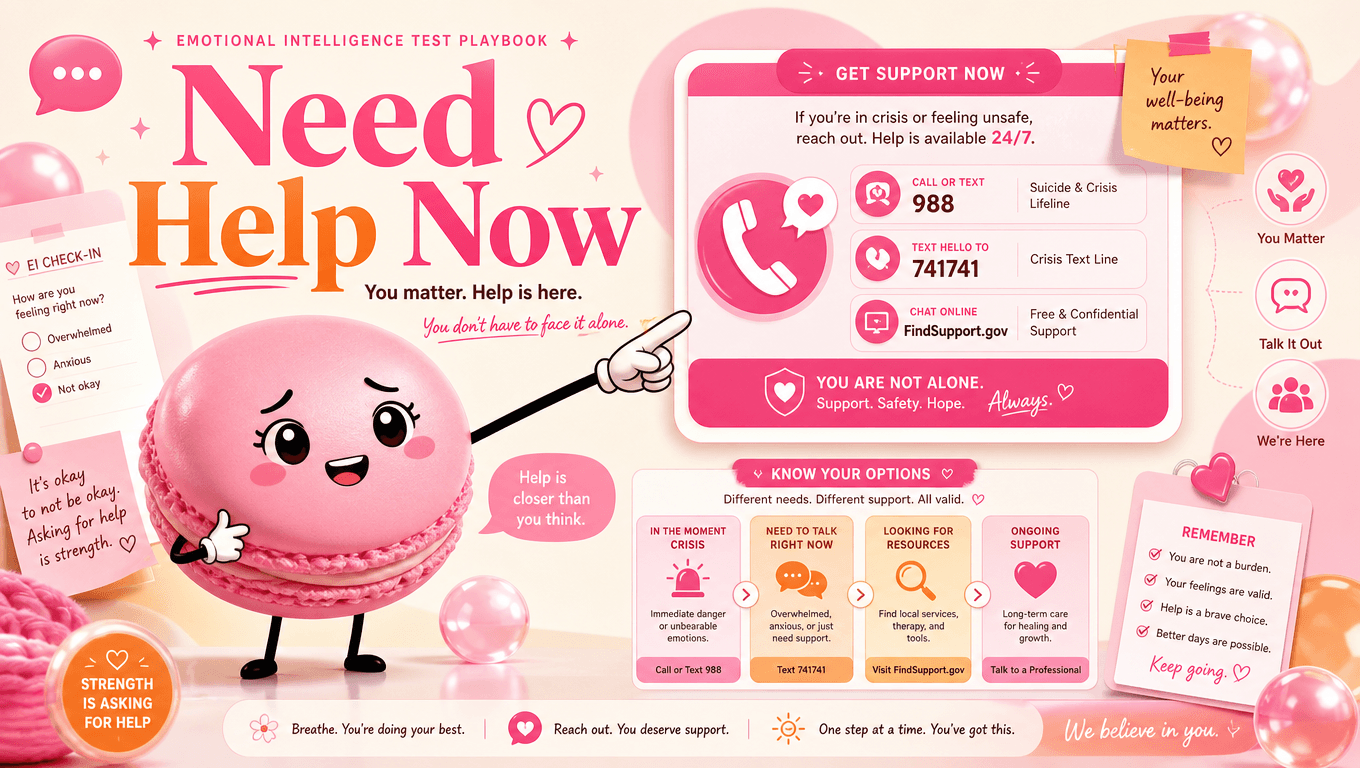
If You Need Immediate Support
This reflection is not a crisis tool, and it should not be used as a substitute for professional help when distress feels overwhelming. If you feel unsafe, unable to cope, or worried about harming yourself, contact crisis support right away. In the United States, call or text 988. In the United Kingdom and Ireland, call 116 123. If you are elsewhere, use findahelpline.com to locate local support quickly. Macaron is best for reflection and habit-building, not urgent mental health intervention.
Your Responses and Privacy
Emotional reflection data can be sensitive because it often reveals patterns around stress, relationships, and self-perception. Macaron is provided by MINDAI PTE. LTD., and the official Privacy Policy explains how information is handled. If you have questions about privacy or data use, you can also contact contact@macaron.im for more information. That transparency matters for users who want to think carefully about what they share, especially when the reflection touches on personal habits, conflict patterns, or emotional triggers.
Frequently Asked Questions
This emotional intelligence test focuses on the core skills people usually mean when they search for EQ: noticing your own emotions, regulating reactions, understanding other people’s feelings, communicating clearly, and handling stress without losing perspective. It is meant to highlight patterns you can reflect on, not to reduce emotional intelligence to a single score. If you want a practical read on how emotions affect your daily choices, this is a good starting point.
Start with the pattern that feels most familiar in real life or most disruptive when you are under pressure. For some people that is emotional reactivity, for others it is difficulty naming feelings, reading other people, or staying clear in conflict. The most useful first step is usually the one that explains the situations you keep running into. Macaron is designed to help you find that starting point without forcing a one-size-fits-all interpretation.
If the reflection brings up discomfort, pause and step away before trying to interpret everything at once. That reaction can happen when a question touches a sensitive pattern or a stressful memory. If you feel overwhelmed, unsafe, or worried about your wellbeing, reach out to a licensed professional or crisis support rather than continuing on your own. A useful EQ reflection should create clarity, not pressure you to push through distress.
This page offers AI-guided reflection for everyday insight, which is different from a formal EQ assessment that may use standardized scoring, validated instruments, or professional interpretation. The goal here is to help you think more clearly about your emotional patterns and possible next steps, not to provide a clinical or psychometric diagnosis. Formal assessments are better when you need comparability or formal-grade measurement; Macaron is better when you want practical self-understanding.
Macaron is designed to make emotional reflection accessible, so you can explore your EQ patterns without needing a complicated setup. The main value is in the guided interpretation and the next-step habits that follow, rather than in a long assessment process. If you are comparing options, free quizzes elsewhere may be faster, but they often stop at a score. Macaron is more useful when you want the result to lead somewhere practical.
The reflection centers on self-awareness, emotional regulation, empathy, communication, and stress response. Those five areas are useful because they separate emotional intelligence into skills you can actually notice in daily life. Someone may be strong in empathy but weaker in self-regulation, or clear in communication but slow to recognize their own feelings. Breaking EQ into these parts makes the result easier to act on than a broad label like 'high' or 'low' emotional intelligence. For a third-party check, Emotional Intelligence Test | EQ 2.0 Appraisal Test - TalentSmartEQ at https://www.talentsmarteq.com/test/ is worth comparing against the page summary.
Use the result to choose one pattern to work on first, then connect it to a small habit you can repeat in real situations. For example, if stress makes you reactive, practice a pause before replying. If you miss your own feelings, add a brief check-in during the day. If empathy is the issue, slow down and listen for context before responding. The best use of an EQ reflection is not self-criticism; it is picking one change that fits your actual life. For another outside reference, Free Emotional Intelligence Test - Global Leadership Foundation at https://tests.globalleadershipfoundation.com/geit/eitest.html adds a second perspective.
They answer different questions. Personality tests describe stable tendencies, while emotional intelligence tests focus more on how you notice, interpret, and respond to emotions in context. If you want to understand communication, conflict, and stress reactions, an EQ reflection is often more directly useful. If you want a broader picture of temperament or behavior style, a personality test may be better. Many people use both because they complement each other rather than compete. For outside context, Emotional Intelligence Test / Quiz - Psychology Today at https://www.psychologytoday.com/us/tests/personality/emotional-intelligence-test is a useful reference point.
Read & discover
AI Personal Assistant
Free calculators


