Emotional Journal
An emotional journal helps when feelings are hard to name in the moment and even harder to interpret later. Macaron adds structure with mood check-ins, reflection prompts, and pattern tracking so you can notice what repeats without turning journaling into a chore.
Emotional Journal
This short reflection module helps you notice how you tend to use an emotional journal, especially when feelings are hard to sort out in the moment. It is designed to highlight patterns in awareness, expression, and follow-through so you can make journaling feel more useful and less overwhelming.
This is a self-reflection tool, not a diagnosis or clinical assessment.
Please answer every question before viewing your result.
This module is for self-reflection and personal insight only. If journaling brings up overwhelming distress, panic, thoughts of self-harm, or a sense that you are not safe, please reach out to a trusted person, local emergency services, or a mental health professional right away.
Why Emotional Journaling Can Change What You Notice
An emotional journal is most useful when feelings move quickly, overlap, or seem bigger than the event that triggered them. Writing gives you a pause between reaction and interpretation, which makes it easier to notice what you actually felt, what was happening around you, and how your body or thoughts responded. That pause is often the difference between vague frustration and a clearer understanding of what is driving it.
Macaron turns emotional journaling into a guided process instead of a blank page. You can record mood, context, triggers, and reflections in a consistent format, which matters because many people can describe one difficult day but struggle to compare several days side by side. The structure helps you see whether stress, sleep, relationships, or workload are shaping your emotional state in repeatable ways.
In practical terms, an emotional journal is a tool for self-reflection, emotional awareness, and pattern recognition. It is not a diagnosis tool or a substitute for professional mental health support, and it works best when you use it to observe rather than judge. That framing keeps the practice useful even when your entries are messy, incomplete, or emotionally charged. For a related Macaron page, see Best Free AI Calorie Trackers You Can Start Today - Macaron at https://macaron.im/blog/free-ai-calorie-tracker.
People searching for an emotional journal often want to know what to write, how to begin, and whether it is different from a diary or mood tracker. The short answer is that emotional journaling focuses less on the day’s events alone and more on the feelings underneath them, including intensity, triggers, body sensations, recovery time, and recurring thoughts that shape how the experience lands.
The value builds over time. You do not need to write something profound every day for the journal to matter. What matters is creating a reliable record of how your emotions move, what tends to set them off, and which responses help you recover more steadily. That record can make your reactions feel less random and your choices feel more intentional.

Why Emotional Journaling Can Change What You Notice
An emotional journal can change what you notice because it turns a vague feeling into something you can review later with more context. In the moment, emotions often show up as tension, irritation, sadness, numbness, or overwhelm without a clean label. Writing them down helps separate the feeling from the event, then compare it with triggers, thoughts, body sensations, and the conditions that made the reaction stronger or easier to calm. That kind of review is especially useful when memory alone is too fuzzy to show a pattern.
How Macaron’s Emotional Journal Works
Macaron organizes emotional journaling into a simple sequence so you are not left wondering what to write next. A typical entry can begin with a mood check-in, then move into what happened, what seemed to trigger the feeling, and one or two reflection prompts that deepen the entry without making it feel clinical. The follow-up questions are especially helpful when your first answer is broad or vague, because they guide you from “I felt bad” toward a more specific understanding of what was actually going on.
Discover Patterns in Your Emotions
Over time, your entries can show whether certain moods are isolated reactions or part of a repeating cycle. You may notice that some feelings appear after poor sleep, difficult conversations, too much stimulation, or long stretches of pressure, while others fade quickly once you rest, change your environment, or slow down. This kind of pattern recognition is the main reason people use an emotional journal: it gives you a clearer view of what keeps happening, not just how one day felt in isolation.
More About Emotional Journal
An emotional journal is useful because feelings can be vivid in the moment and blurry later. Writing them down gives you a way to compare what you felt, what was happening around you, and whether the reaction was tied to a specific event, a repeating stressor, or a longer emotional pattern. That comparison is what turns a private note into something you can actually learn from.
Macaron structures the emotional journal around mood check-ins, reflection prompts, trigger notes, and follow-up questions. That structure helps people who want guidance without being pushed into long entries, since many users only need a few focused questions to get past the blank page. It is a practical middle ground between an empty notebook and a rigid worksheet.
Over time, the entries can reveal patterns that are easy to miss in memory alone. You may notice certain people, times of day, environments, or internal pressures that consistently affect your mood, along with the difference between a temporary spike in stress and a more persistent emotional strain. That makes the journal useful for both immediate reflection and longer-term self-observation. Another useful Macaron comparison is 20 AI Tools to Upgrade Your Daily Life - Macaron - Macaron App at https://macaron.im/blog/macaron-app-ai-tools-daily-life.
The tool is also designed to support emotional growth in a realistic way. That means helping you name feelings more precisely, compare today’s state with earlier entries, and see small signs of progress even when the progress is uneven or slow. For many users, the biggest benefit is not dramatic insight; it is having a steadier way to understand themselves without second-guessing every reaction. For a broader Macaron context, How Macaron AI Tackles the Problem with Traditional Task Lists at https://macaron.im/blog/macaron-ai-daily-planning-guide can help you compare the decision from another angle.
An emotional journal should also leave room for safety and privacy. If writing starts to feel overwhelming, it is appropriate to pause and seek support, and if you are using a journaling tool for sensitive reflections, it is worth understanding how your entries are handled and what privacy controls are available. That tradeoff matters: more structure can make journaling easier, but it also means you should be thoughtful about where your personal reflections live.
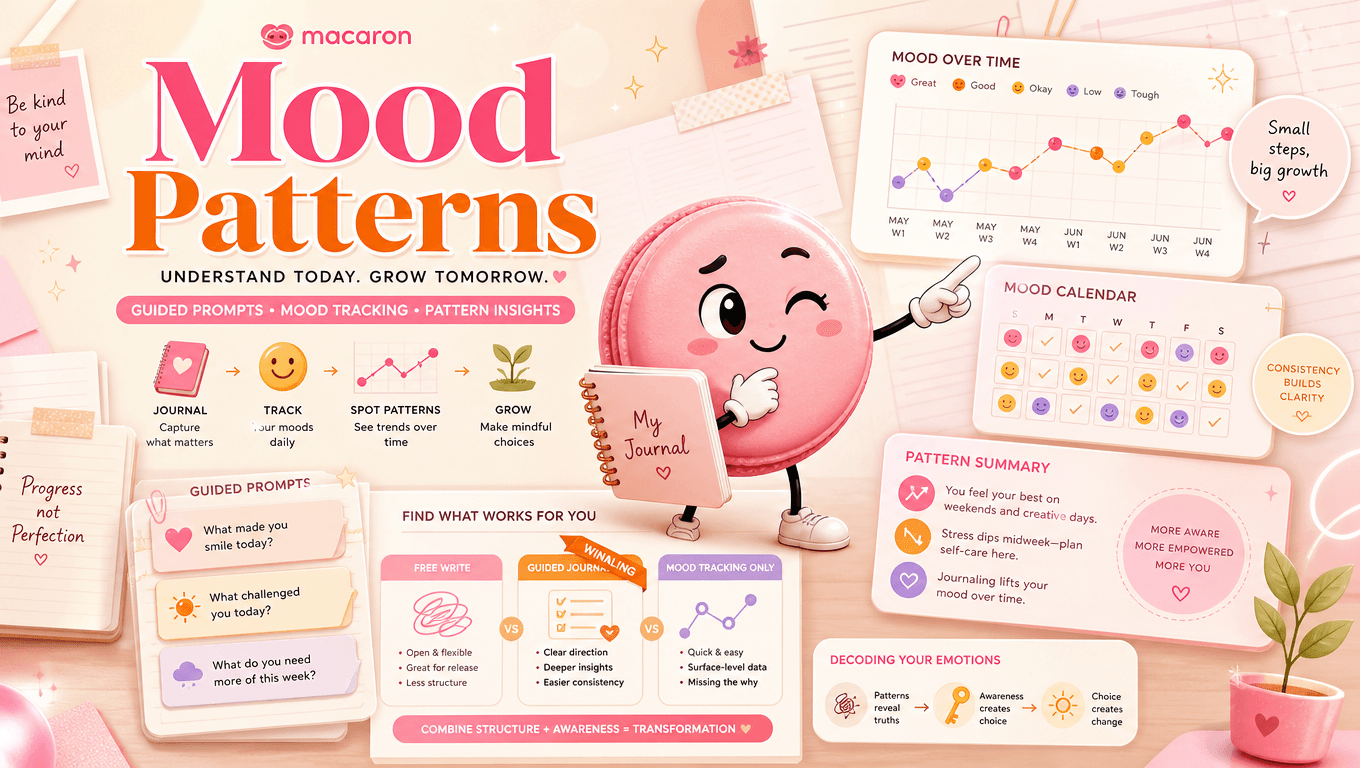
Support Emotional Growth Over Time
Macaron helps make emotional journaling feel sustainable by giving you a repeatable structure instead of asking you to invent one from scratch each day. Guided prompts can reduce overthinking, daily mood tracking can make changes easier to compare, and pattern summaries can help you notice progress that might otherwise be easy to overlook. For many people, the real benefit is not writing more, but understanding themselves with more consistency and less second-guessing. That said, people who prefer completely freeform writing may find the structure a little less expressive than a blank-page journal.
If You Need Immediate Support
This journaling tool is for reflection, not crisis care. If writing brings up intense distress, panic, thoughts of self-harm, or any sense that you may not be safe, stop the exercise and contact immediate support right away. In the United States, you can call or text 988. In the United Kingdom and Ireland, Samaritans can be reached at 116 123. If you are elsewhere, use a local crisis line or a trusted international directory such as findahelpline.com, and call emergency services if danger is immediate. A guided journal can help with awareness, but it should never replace urgent human support when safety is at stake.
Your Entries and Privacy
Emotional journal entries often contain sensitive details about relationships, stress, health, and private thoughts, so privacy is part of the product experience, not an afterthought. Macaron is provided by MINDAI PTE. LTD., and its Privacy Policy explains how information is collected, used, disclosed, protected, and retained. If you plan to use the journal regularly, it is worth reviewing the policy for retention, deletion, and privacy request details before you store information you would not want handled casually. Competitor apps sometimes offer more established export or archival workflows, so privacy-conscious users should compare those controls before committing.
Frequently Asked Questions
An emotional journal is useful for tracking moods, naming feelings more accurately, and spotting what tends to trigger or calm them. People often use it to understand recurring emotional patterns, compare how they react in different situations, and make sense of stress that feels confusing in the moment. It can also help you notice progress over time, especially when you review several entries instead of judging one day in isolation.
Keep the entry small and specific. A simple format works well: what I feel, what was happening, and one thing I noticed about the reaction. You do not need to explain every emotion or write a polished reflection each time. Emotional journaling is usually more helpful when it captures an honest snapshot than when it tries to produce a perfect answer.
That can happen, especially if the entry touches on stress, grief, conflict, or unresolved experiences. If the feeling becomes too intense, pause the session, ground yourself, and come back later only if it feels manageable. If you feel unsafe, overwhelmed, or at risk of harming yourself, reach out to a licensed professional or crisis support right away rather than continuing to journal through it.
A regular diary usually records what happened during the day, while an emotional journal focuses more on the feeling behind the event. It pays closer attention to mood, triggers, body sensations, emotional intensity, and how you responded. That makes it more useful for self-awareness and pattern recognition, especially if your goal is to understand why certain situations affect you the way they do.
A useful entry usually includes the feeling itself, what happened before it, and anything that seemed to intensify or soften it. You can also note body sensations, thoughts that repeated, and what you did next. If you want a simple template, try: “I felt ___ when ___, and I noticed ___.” That keeps the entry focused without forcing a long explanation.
Not exactly. A mood tracker usually captures a quick rating or label, while an emotional journal adds context, triggers, and reflection. The journal helps explain why the mood changed and what it may connect to. Many people use both together: the tracker for quick check-ins and the journal for deeper understanding. Macaron is useful here because it combines structure with reflection instead of treating them as separate tools. For a third-party check, Emotional Journaling: How to Use Journaling to Process Emotions at https://dayoneapp.com/blog/emotional-journaling/ is worth comparing against the page summary.
There is no single correct schedule. Some people write daily because it makes patterns easier to spot, while others only journal after a strong reaction or a meaningful event. The best cadence is the one you can keep without turning the practice into a burden. If you want clearer pattern recognition, more regular check-ins help; if you want less pressure, shorter and less frequent entries can still be valuable. For another outside reference, Emotion Journal - Amazon.com at https://www.amazon.com/emotion-journal/s?k=emotion+journal adds a second perspective.
Macaron is more guided than a blank notebook app, so it is better for people who want prompts, mood check-ins, and a clearer path from feeling to reflection. That structure helps when you do not know where to start. The tradeoff is that users who want a highly customizable writing space may prefer a more open-ended journaling app. Macaron is strongest when you want guidance and pattern awareness in one place. For outside context, The Emotions Journal By Switch formal assessment at https://switchresearch.org/products/the-emotions-journal?srsltid=AfmBOoq6euXsRpWlRT8f45NeUrTG2eQQT0V-EBE9bNI9OEbxqh3QijK6 is a useful reference point.
Read & discover
AI Personal Assistant
Free calculators


