Emotional Regulation Test
An emotional regulation test can help when feelings escalate quickly, stay intense, or make it hard to respond the way you want. Macaron focuses on patterns like triggers, recovery time, and coping habits so you can understand what is working, what is not, and what to try next.
Emotional Regulation Test
This self-reflection module helps you notice how your emotions tend to rise, settle, and affect your choices in everyday life. It focuses on patterns like triggers, recovery time, and coping habits so you can better understand what supports you and what gets in the way.
This is a self-reflection tool, not a diagnosis or clinical assessment.
Please answer every question before viewing your result.
If your emotions feel unmanageable, lead to self-harm thoughts, or seriously affect your safety, relationships, or daily functioning, please reach out to a licensed mental health professional or local crisis support. This module is for reflection and awareness only, and it cannot tell you whether you have a mental health condition.
What Emotional Regulation Really Affects
An emotional regulation test is often useful when your reactions feel bigger than the situation, or when it takes a long time to settle after stress, conflict, or disappointment. People usually search for this kind of test when they want a clearer baseline, not a label, and when they are trying to understand whether their emotions are becoming harder to manage in daily life. That makes the goal practical: notice patterns early enough to respond differently, rather than waiting until emotions have already taken over.
Macaron looks at emotional regulation as a pattern across the day, not a single moment. That means paying attention to what tends to set off strong reactions, whether you recover quickly or stay activated, and how your usual coping strategies affect communication, focus, and relationships. This broader view is useful because emotional regulation often changes by context. You may seem steady in one setting and overwhelmed in another, which can reveal where support or new habits would help most.
common user discussions for emotional regulation tests often mix together different ideas, including emotion regulation questionnaires, emotional dysregulation quizzes, and broader self-assessments. Some tools focus on reappraisal and suppression, while others look at overwhelm, avoidance, impulsivity, or recovery after stress. Macaron keeps the focus on practical self-reflection so you can interpret the result without confusing it with a clinical diagnosis. That tradeoff is intentional: you get a clearer everyday picture, while more formal assessment tools may offer deeper clinical detail. For a related Macaron page, see How Macaron AI Tackles the Problem with Traditional Task Lists at https://macaron.im/blog/macaron-ai-daily-planning-guide.
This emotional regulation test is designed to help you notice patterns that are easy to miss in the moment. For example, you may be able to hold it together at work but feel flooded at home, or you may react quickly in conflict but recover fast afterward. Those differences matter because they point to specific habits, situations, and support needs rather than a vague sense that something is wrong. The most useful insight is often not how intense the feeling was, but what happened before and after it.
The goal is clarity, not self-criticism. If the result shows strengths, that can help you protect them. If it shows gaps, that can help you choose one small change at a time, such as pausing before responding, naming the feeling earlier, or planning a better recovery routine after hard moments. Macaron is especially helpful for people who want a structured starting point and a way to turn insight into action without having to build a plan from scratch.
What Emotional Regulation Really Affects
An emotional regulation test is useful because regulation affects much more than visible outbursts. It can shape how quickly you recover after conflict, whether you can think clearly under pressure, and whether emotions push you toward shutting down, overexplaining, or acting before you have fully processed what is happening. Macaron helps you notice these less obvious patterns so the result reflects real-life functioning, not just how intense a feeling looks from the outside. That makes it more useful for everyday decisions, like whether you need a pause, a boundary, or a different recovery routine.
How This Emotional Regulation Test Is Structured
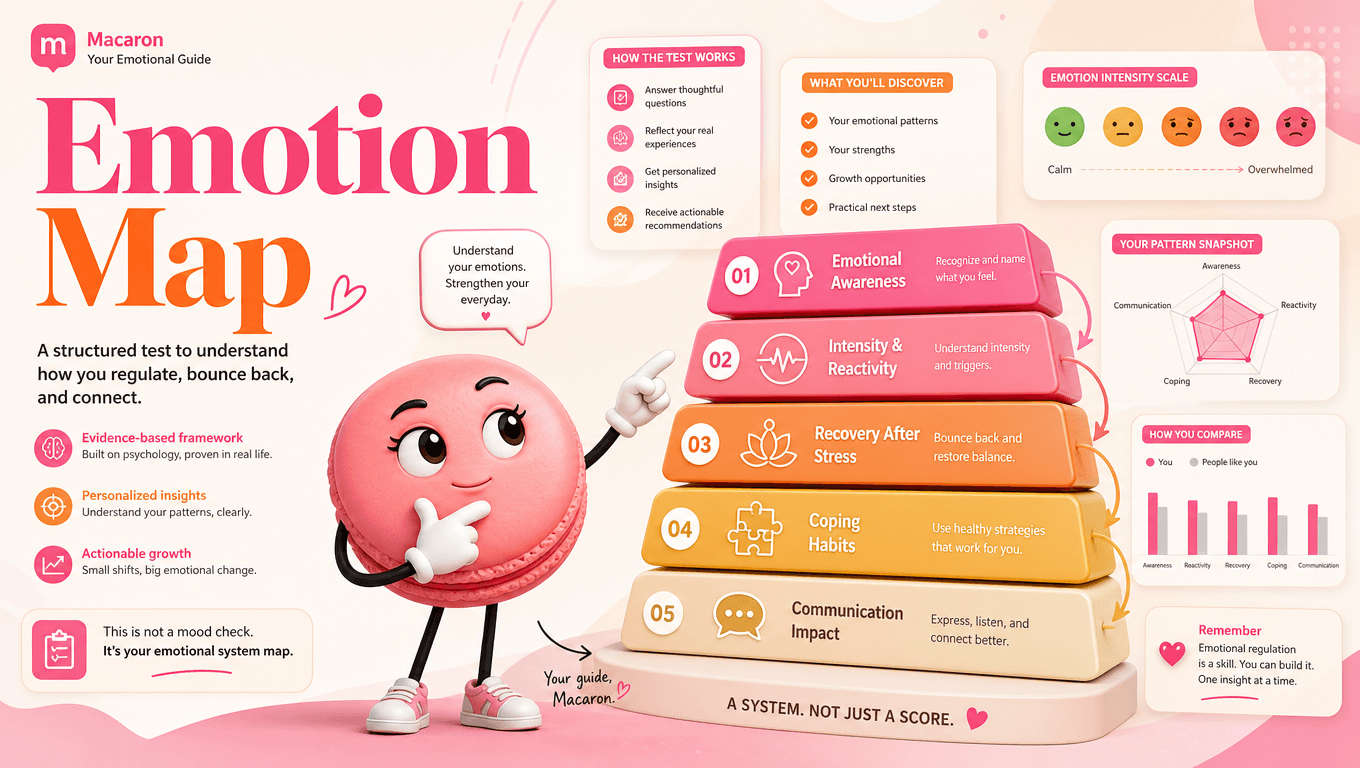
The emotional regulation test is organized around emotional awareness, intensity and reactivity, recovery after stress, coping habits, and the effect emotions have on communication and daily life. That structure matters because emotional regulation is not one skill, but a cluster of related abilities. After the result, Macaron adds guided reflection so you can interpret whether the main issue is noticing emotions early, calming down quickly, or choosing a response that matches your goals. Compared with a simple mood check, this gives you more context for what to change first.
Understanding Your Strengths and Gaps
Your result is meant to show where emotional regulation is already working and where it tends to break down. You may find that you handle routine stress well but struggle when you feel criticized, uncertain, or overwhelmed by too many demands at once. Seeing those distinctions can help you focus on the situations that create the biggest cost, rather than treating every emotional reaction as the same problem. That is one of Macaron’s main advantages: it helps you separate general resilience from specific trigger patterns, which makes next steps more realistic.
More About Emotional Regulation Test
An emotional regulation test is most helpful when it goes beyond general mood and looks at how emotions actually unfold. That includes how fast feelings rise, whether they spill into impulsive reactions, and how long it takes to regain steadiness after something upsetting. Those details matter because two people can both feel stressed, but only one may struggle to recover or communicate clearly under pressure. A more detailed self-check can therefore be more useful than a broad “good or bad” emotional label.
The emotional regulation test is organized around common dimensions that show up in many self-report tools and screening quizzes, such as awareness, intensity, recovery, and coping style. In practice, that means the result can help you see whether the main issue is noticing emotions late, feeling them too intensely, suppressing them, or getting stuck in them after the trigger has passed. This is where Macaron is competitive: it translates those dimensions into plain-language reflection, while more clinical tools may be better if you need formal scoring or professional interpretation.
Your result is meant to create a useful starting point, not a final verdict. Many people use this kind of test to compare patterns across situations, such as conflict, uncertainty, criticism, or sensory overload. That context can be more revealing than a single score because emotional regulation often looks different depending on where you are, who you are with, and how much stress you are already carrying. The tradeoff is that a self-check can be less precise than a clinician-administered assessment, but it is faster and easier to act on. Another useful Macaron comparison is AI Story App - Macaron at https://macaron.im/ai-story-app.
Macaron helps turn the emotional regulation test into next steps through reflection prompts and practical check-ins. Instead of asking you to change everything at once, it encourages you to notice one recurring pattern, choose one response to practice, and review whether it helps. That approach is especially useful when emotions feel automatic, because small adjustments are easier to repeat than broad advice. For users who want a structured habit loop, this is often more actionable than a static quiz result. For a broader Macaron context, AI Calorie Tracker: How It Works and Best Options - Macaron at https://macaron.im/blog/ai-calorie-tracker can help you compare the decision from another angle.
This self-check is not a substitute for professional help, especially if emotional overwhelm is affecting safety, sleep, relationships, or your ability to function. If you are looking for a clearer place to begin, the test can still help you name the pattern more precisely, which often makes it easier to decide whether you need self-guided strategies, support from someone you trust, or a licensed professional. Competitor apps may offer more extensive clinical libraries or therapist-led programs, while Macaron focuses on quick clarity and practical follow-through.
Build Stronger Emotional Stability
Macaron helps turn the emotional regulation test into practical follow-through through reflection prompts, emotional check-ins, pause-and-reset habits, and recovery planning after difficult moments. The idea is to make regulation feel more learnable. Instead of aiming for perfect control, you can practice noticing the early signs of escalation, creating a brief pause, and choosing a response that helps you recover without adding more stress. This works well for people who want a lightweight system they can actually repeat, though dedicated therapy apps may go deeper into coaching or treatment-oriented exercises.
If You Need Immediate Support
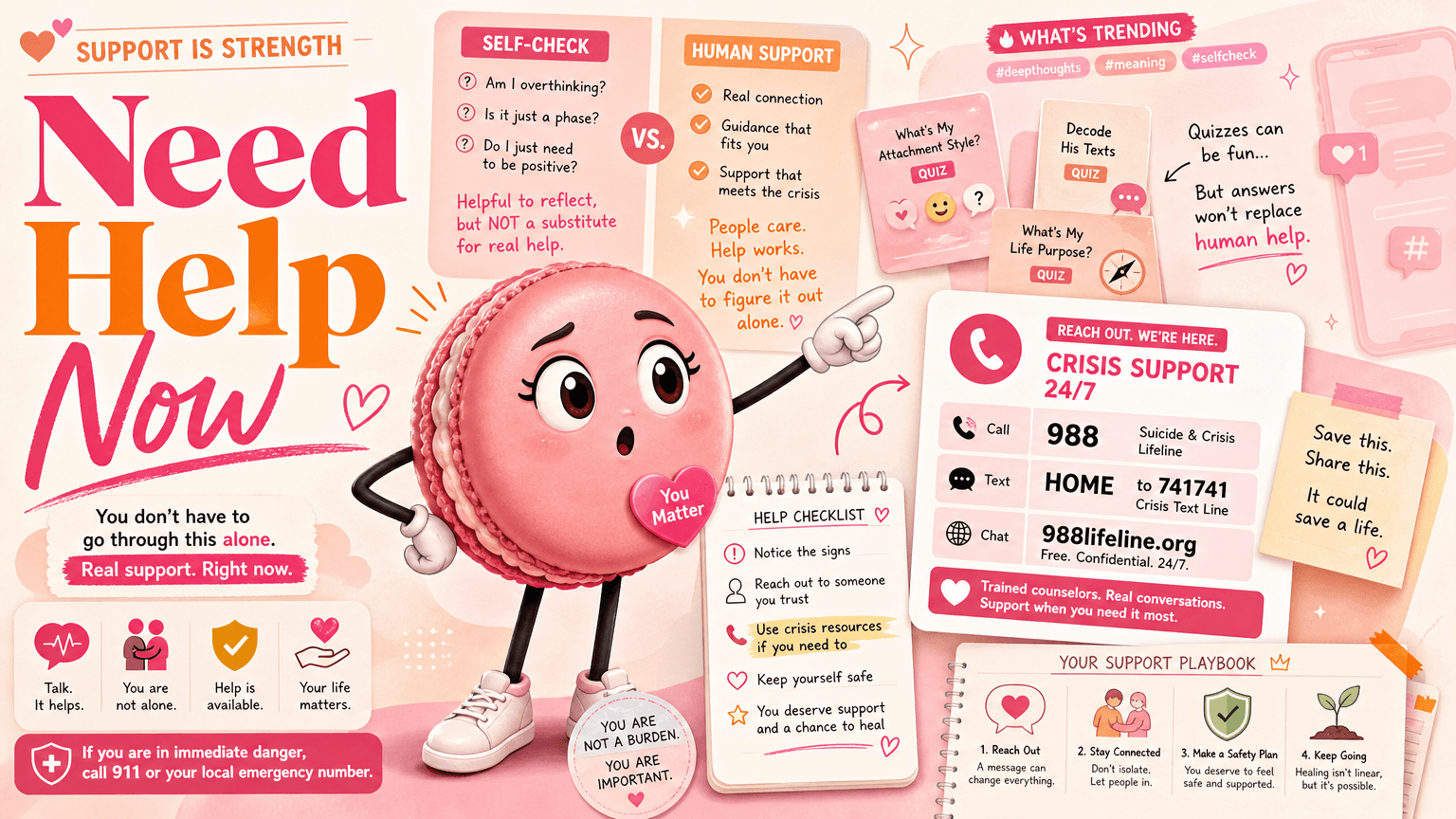
This self-check is not a substitute for professional help. If emotional distress feels overwhelming, if you feel unsafe, or if you are thinking about harming yourself, contact crisis support right away. In the United States, call or text 988. In the United Kingdom and Ireland, call 116 123 for Samaritans. If you are elsewhere, use a local emergency number or an international directory such as findahelpline.com to find immediate support. A test can help you name the issue, but urgent situations need human support first.
Your Responses and Privacy
Emotional reflection data can be sensitive, especially when it touches on stress, reactivity, or coping difficulties. Macaron is provided by MINDAI PTE. LTD., and its Privacy Policy explains how information is collected, used, disclosed, protected, and retained. If you want to understand how your responses are handled, review the policy for details on retention, deletion, and privacy requests, or contact contact@macaron.im with questions. That transparency matters because emotional self-checks are most useful when you trust how your data is handled.
Frequently Asked Questions
This emotional regulation test focuses on how you notice emotions, how strongly you react, how quickly you recover, and which coping habits you tend to use under stress. It also looks at whether emotions interfere with communication, decision-making, or everyday functioning. The goal is to give you a practical picture of your pattern, not to diagnose a condition. That makes it useful for self-reflection, especially if you want to understand what happens before, during, and after a difficult emotional moment.
Start with the pattern that feels most familiar or most disruptive, then choose one small next step that fits the issue. That might mean practicing a pause before replying, naming the feeling earlier, tracking triggers for a few days, or talking with someone you trust. If the result points to more serious distress, consider reaching out to a licensed professional. The most useful next step is usually the one you can repeat in real life, not the one that sounds most impressive.
Take them more seriously when emotional overwhelm starts affecting safety, sleep, work, school, relationships, or your ability to cope day to day. It is also worth getting support if you feel stuck in intense reactions, if recovery takes a long time, or if emotions are leading to harmful behavior. In those cases, a licensed professional or crisis support can help. A self-check can clarify the pattern, but it should not delay help when the impact is becoming hard to manage.
No. Emotional regulation is not about pretending feelings are absent or forcing yourself to stay numb. It is about noticing what you feel, understanding what it is asking for, and choosing a response that is steadier and more useful. Suppression can sometimes hide the problem for a while, but regulation aims to help you respond without being overwhelmed. In practice, healthy regulation often includes acknowledging the feeling, then deciding what action fits the situation.
This page is designed as a practical self-check, while clinical scales are usually built for more formal assessment and interpretation. A clinical tool may measure specific dimensions in a more standardized way and is often better suited for professional use. Macaron’s approach is more conversational and action-oriented, which can make it easier to understand your everyday patterns quickly. The tradeoff is that it is not meant to replace a clinician’s evaluation when you need diagnostic or treatment guidance.
Yes. Many people regulate well in one context and struggle in another. You might stay composed at work but feel overwhelmed at home, or handle routine stress but react strongly to criticism, uncertainty, or sensory overload. That is why context matters so much in an emotional regulation test. Looking at patterns by situation can help you identify triggers, predict harder moments, and choose support strategies that fit the setting instead of assuming every reaction has the same cause. For a third-party check, Difficulties in Emotion Regulation Test (DERT) - IDRlabs at https://www.idrlabs.com/difficulties-in-emotion-regulation/test.php?srsltid=AfmBOooav39_YYBFgp5IjhlRQKQEHICaVCIefPdbtKktZtrHMi-xRWG9 is worth comparing against the page summary.
Common signs include reacting faster than you want to, staying upset for a long time, shutting down during conflict, overexplaining, avoiding difficult conversations, or feeling like emotions keep driving your choices. Some people also notice physical tension, trouble focusing, or a sense that they cannot reset after stress. These signs do not automatically point to one cause, but they do suggest that your current coping pattern may need adjustment or support. For another outside reference, Emotional Dysregulation Test - Free Quiz (DERS-16) at https://www.attachmentproject.com/emotional-regulation/ adds a second perspective.
Macaron is designed to connect the self-check to next steps, not just give you a score. It focuses on triggers, recovery, coping habits, and the everyday impact of emotions, then uses reflection prompts to help you decide what to try next. That makes it useful for people who want a practical starting point. Other apps may offer more formal clinical scoring, larger assessment libraries, or therapist-style programs, which can be better if you need deeper evaluation or structured treatment support. For outside context, Emotion Regulation Test / Quiz | Psychology Today at https://www.psychologytoday.com/us/tests/relationships/emotion-regulation-test is a useful reference point.
Read & discover
AI Personal Assistant
Free calculators


