Emotional Test
An emotional test can be useful when your feelings are hard to label, seem unusually intense, or feel flattened in a way that is difficult to explain. Macaron turns that uncertainty into guided reflection so you can separate what is most immediate from what may be sitting underneath.
Emotional Test
This emotional test is a guided self-reflection for noticing what your feelings are like right now. It can help you separate intensity, clarity, overwhelm, and emotional flatness so you can choose a next step that fits your state.
This is a self-reflection tool, not a diagnosis or clinical assessment.
Please answer every question before viewing your result.
If your emotions feel overwhelming, unsafe, or hard to manage, reach out to a trusted person or a qualified professional. If you are thinking about harming yourself or someone else, seek immediate emergency support in your area right away.
What This Reflection Can Help You Notice
An emotional test is often searched by people who are not looking for a diagnosis, but for a clearer way to understand what they are feeling right now. That can include stress that shows up as irritability, sadness that feels muted, or a general sense of being off without knowing why. Macaron is designed for that kind of moment, when naming the feeling is harder than feeling it and you need a structured way to slow down and look more closely.
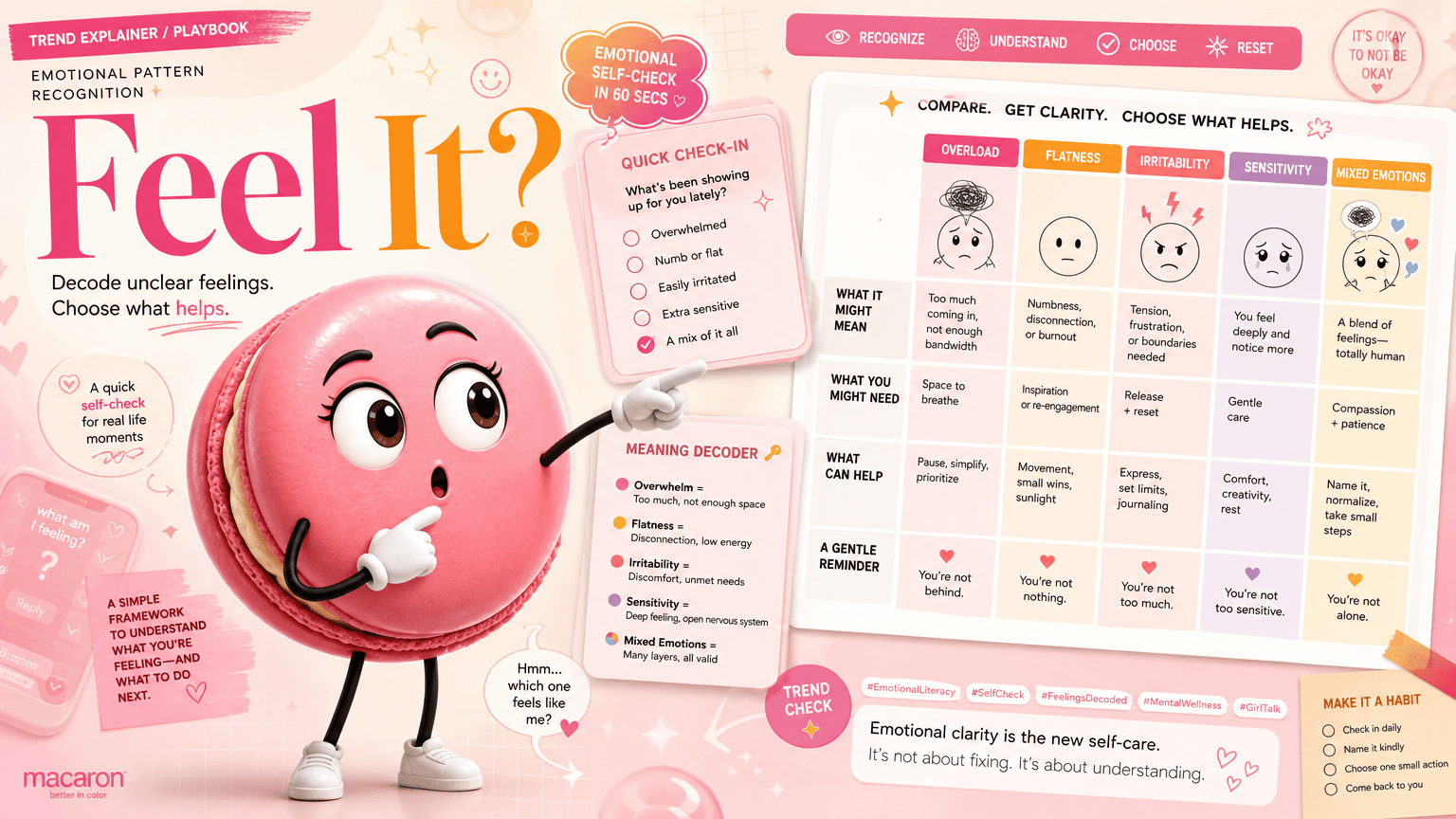
Rather than treating emotions as a single score, Macaron uses guided reflection to help you notice whether you are dealing with overload, emotional flatness, mixed feelings, or a reaction that has been building for a while. This matters because emotional experiences often overlap. Someone may feel tired, anxious, and sensitive at the same time, and a useful emotional test should help untangle those layers instead of forcing one label or oversimplifying what is actually happening.
The page is also careful about what this kind of test can and cannot do. It is not a clinical assessment, not a standardized psychological instrument, and not a substitute for professional care. That distinction is important because many people searching for an emotional test are actually trying to understand the difference between self-reflection, emotional intelligence quizzes, and formal evaluation, especially when they want insight without turning the experience into a diagnosis. For a related Macaron page, see How to Use AI as a Personal Assistant: 30 Prompts That Actually Work at https://macaron.im/blog/ai-personal-assistant-prompts.
common user discussions for emotional test often blend together emotional intelligence quizzes, mood checks, and broader self-awareness tools. Macaron fits the reflection use case: it helps you think through how strongly emotions are showing up, whether they are affecting daily functioning, and what patterns seem most prominent. The goal is not to rank your emotions or tell you who you are, but to make the experience easier to read and more useful in everyday life.
If your current state feels confusing, the most useful first step is often not to fix it immediately, but to identify it more accurately. A structured emotional test can create that pause. Once the feeling is clearer, it becomes easier to decide whether you need rest, grounding, a conversation, a change in routine, or professional support, and that clarity can make the next decision feel less overwhelming.
What This Reflection Can Help You Notice
Macaron helps you notice the kinds of emotional patterns people often mean when they search for an emotional test, including overload, flatness, irritability, sensitivity, and mixed emotions that are hard to separate. It can also surface the difference between feeling emotionally flooded and feeling disconnected, which are easy to confuse but often call for different responses. The point is to make the experience more readable, especially when you know something feels off but cannot yet put it into words. That can be especially useful if your emotions are changing quickly or showing up in ways that affect concentration, patience, or sleep.
How Macaron Structures This Reflection
Macaron organizes the reflection around how intense the feeling is, how clear or confusing it seems, how broad the emotional range feels, how much stress is involved, and whether daily functioning is being affected. That structure mirrors how people actually search for emotional test tools: they are often trying to understand not just what they feel, but how much it is spilling into the rest of life. This makes the result more practical and easier to act on, especially when you need a quick read on whether the state seems temporary, situational, or worth closer attention.
What Your Result Can Clarify
Your result is designed to clarify the dominant pattern without turning it into a verdict. It can help you see whether the main issue is overwhelm, emotional blunting, sensitivity, or a mix of several states, and whether the intensity seems manageable or worth paying closer attention to. It can also point toward the kind of next step that fits best, such as rest, reflection, grounding, or reaching out to someone you trust. That makes it more useful than a generic mood label because it connects insight to action.
More About Emotional Test
Macaron helps you reflect on patterns such as emotional overload, emotional numbness, irritability, sensitivity, or mixed feelings that seem to pull in different directions. These are common reasons people look for an emotional test in the first place. They may not want a label so much as a way to understand why their reactions feel bigger, smaller, or less predictable than usual, especially when the shift is affecting relationships, work, or how they handle pressure.
The reflection is structured around current intensity, clarity versus confusion, emotional range, stress load, and how much the feeling state is affecting everyday life. That structure matters because many emotional test searches are really about function, not theory. People want to know whether what they are experiencing is manageable, escalating, or starting to interfere with work, relationships, sleep, or decision-making, and a good reflection tool should make those tradeoffs easier to see.
Your result is meant to support awareness rather than self-judgment. It can help you notice which feeling is most dominant, whether several emotions are overlapping, and whether the pattern looks temporary or more persistent. This is especially helpful when a person can sense that something is wrong but cannot yet tell whether it is sadness, anxiety, burnout, frustration, or emotional exhaustion, which are often similar in the moment but lead to different next steps. Another useful Macaron comparison is Novel Reader Online - Macaron at https://macaron.im/novel-reader-online.
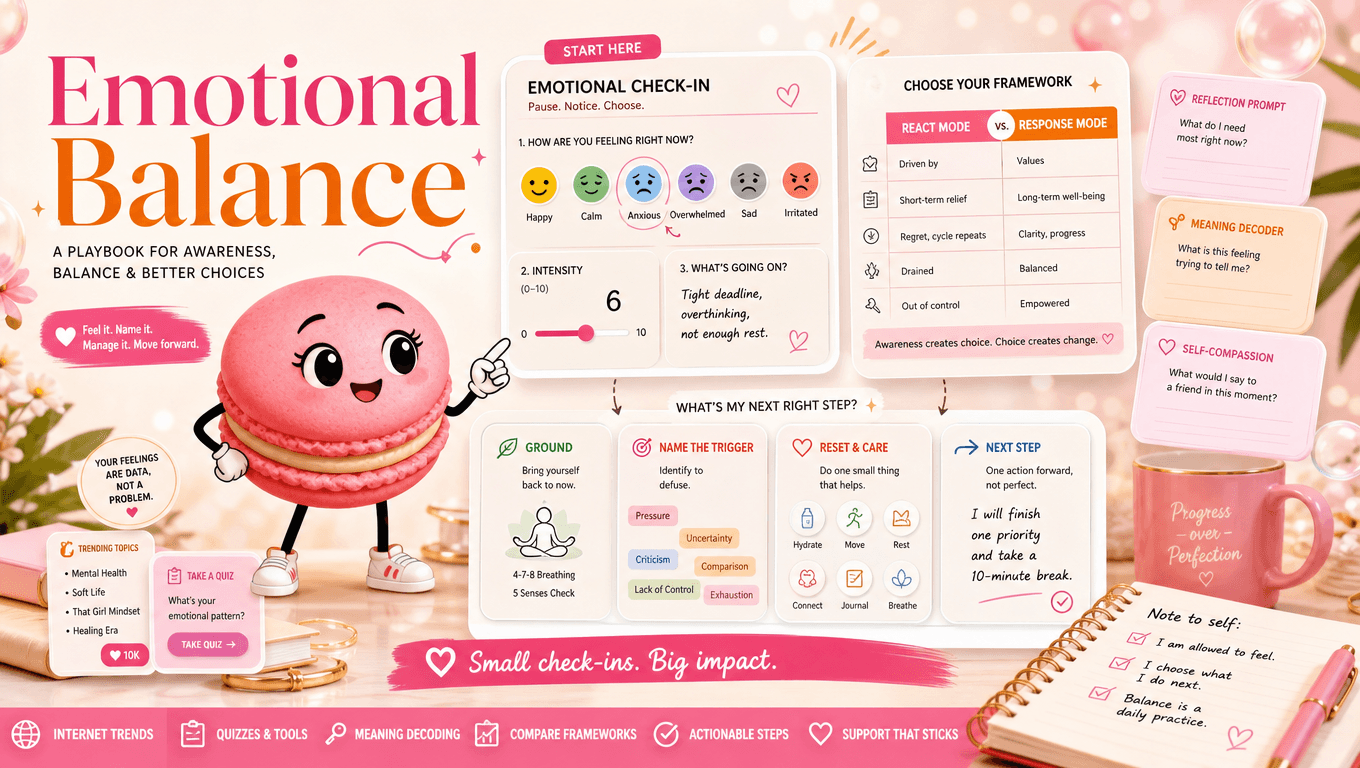
Macaron also turns insight into next steps by pairing reflection with grounding ideas, emotional check-ins, and prompts that help you identify triggers or pressure points. That practical layer is important because many emotional intelligence quizzes stop at description. A useful emotional test should help you decide what to do next, even if the next step is simply resting, slowing down, setting a boundary, or asking for support from someone who knows you well. For a broader Macaron context, Best Meal Planning Apps in 2026 - Macaron at https://macaron.im/blog/best-meal-planning-apps can help you compare the decision from another angle.
If your emotions have become harder to read, easier to ignore, or more difficult to carry, this page gives you a structured place to begin. It is built for people who want a careful, non-clinical way to make sense of what they are feeling before deciding whether they need a deeper conversation, a change in routine, or immediate help. The tradeoff is that this kind of reflection is less formal than a clinician-led assessment, but it is faster, more accessible, and often easier to use in the moment.
Create Better Emotional Balance
Macaron turns the emotional test into something actionable by pairing it with reflection prompts, short emotional check-ins, grounding ideas, and help naming possible triggers. That is useful because emotional awareness alone does not always change how a person feels in the moment. The aim here is to make the next step clearer, whether that means calming the nervous system, reducing pressure, or deciding that outside support would be more helpful. Compared with many EQ quizzes, Macaron is more oriented toward immediate self-management, though it does not replace therapy or a formal mental health evaluation.
If You Need Immediate Support
This emotional test is for reflection, not crisis care. If your distress feels overwhelming, if you do not feel safe, or if you are thinking about harming yourself, the right next step is immediate support from a crisis line, emergency service, or trusted person nearby. The page includes helplines because emotional confusion can sometimes sit alongside urgent risk, and it is important not to wait for a self-check when safety is the concern. A self-guided tool can help with awareness, but crisis situations require direct human support right away.
Your Responses and Privacy
Emotional reflection can involve sensitive information about mood, stress, relationships, and mental state, so privacy matters. Macaron is provided by MINDAI PTE. LTD., and the official privacy policy explains how data is handled. If you are deciding whether to use an emotional test online, it is reasonable to check how your responses are stored, what they are used for, and how to contact the provider with privacy questions. That privacy check is one area where a dedicated app can be more transparent than many free quiz sites, though clinician-administered assessments may still offer stronger procedural safeguards.
Frequently Asked Questions
This emotional test focuses on the practical signs people usually want to understand first: how intense the feeling is, whether it is clear or hard to name, whether several emotions are overlapping, and whether the state is affecting daily life. It is closer to a guided emotional check-in than a clinical assessment, so the emphasis is on pattern recognition and self-understanding rather than diagnosis. That makes it useful when you want clarity quickly, but not when you need a formal evaluation.
Start with the part of the result that feels most accurate or most urgent, then choose one small next step that fits the pattern. If you seem overwhelmed, grounding or rest may help. If the feeling is unclear, more reflection may be useful. If the result suggests persistent distress or reduced functioning, consider talking with someone you trust or a licensed professional. The best next step is usually the one that matches both the intensity and the practical impact.
Seek professional help when the distress is persistent, getting worse, affecting sleep or daily functioning, or feeling unsafe to manage alone. It is also important to reach out if you are having thoughts of self-harm or feel unable to stay safe. An emotional test can help you notice the pattern, but it should not be used to delay care when the situation is serious. If you are unsure, it is safer to ask for help sooner rather than waiting for the feeling to pass.
This page offers AI-guided reflection for personal insight, while a formal emotional assessment is usually standardized, often clinician-led, and designed for diagnostic or evaluative purposes. Emotional intelligence quizzes and mood check-ins can help with awareness, but they do not replace a professional evaluation. The difference is mainly in purpose, method, and how the results should be used. Macaron is better for quick self-understanding; a clinician is better when you need diagnosis, treatment planning, or documentation.
Not exactly. Emotional intelligence tests usually focus on skills such as recognizing emotions, regulating reactions, reading other people, and managing relationships under pressure. This emotional test is more about your current state: whether you feel overwhelmed, flat, confused, sensitive, or emotionally overloaded right now. There is some overlap, but the goal is different. EQ tests measure a broader ability pattern, while this page helps you make sense of what your emotions are signaling today.
Yes. Emotional numbness, flatness, or feeling disconnected can be just as important to notice as anxiety or sadness. A good emotional test should help you identify whether the issue is intensity, absence of feeling, or a mix of both. That distinction matters because numbness can point to stress, burnout, exhaustion, or emotional overload. Macaron is designed to make that state easier to name so you can decide whether rest, support, or a deeper conversation makes sense. For a third-party check, Test Your Emotional Intelligence | Free EQ Quiz From IHHP at https://ihhp.com/free-eq-quiz/ is worth comparing against the page summary.
Your answers may include sensitive information, so it is sensible to review the privacy policy before using any emotional test. Macaron is provided by MINDAI PTE. LTD., and the official policy explains how data is handled and how to contact the provider with privacy questions. If privacy is your main concern, compare how different tools store responses, whether they use them for product improvement, and whether you can control what is saved. That level of review is especially important for emotional or mental health-related reflections. For another outside reference, Emotional Intelligence Quiz - Greater Good Science Center at https://greatergood.berkeley.edu/quizzes/ei_quiz/take_quiz adds a second perspective.
That is one of the main reasons people use an emotional test. You do not need perfect language to begin; you only need enough awareness to notice whether the feeling is intense, confusing, heavy, flat, or mixed. Macaron is designed to help translate that vague experience into something more readable through guided reflection. If the result still feels unclear, that itself is useful information, because confusion can be part of the emotional pattern you are trying to understand. For outside context, Emotional Intelligence Test / Quiz - Psychology Today at https://www.psychologytoday.com/us/tests/personality/emotional-intelligence-test is a useful reference point.
Read & discover
AI Personal Assistant
Free calculators


