Empathy Test
An empathy test is most useful when it helps you notice how you listen, read emotion, and respond when someone needs care, honesty, or patience. Macaron uses AI-guided reflection to explore emotional awareness, perspective-taking, and response habits in real interactions, while making clear this is not a clinical or standardized assessment.
Empathy Test
This self-reflection helps you notice how you tune into other people’s feelings, perspectives, and needs in everyday conversations. It also explores what happens to your empathy when you are stressed, distracted, or in disagreement.
This is a self-reflection tool, not a diagnosis or clinical assessment.
Please answer every question before viewing your result.
This reflection is not a medical or psychological diagnosis. If reading these questions brings up distress, conflict, or thoughts of harming yourself or someone else, please reach out to a trusted person, a licensed professional, or local emergency support right away.
What This Reflection Can Help You Notice
An empathy test is usually searched for as a way to understand how well you notice other people’s feelings, but the term can mean different things depending on the source. Some pages present a formal questionnaire, while others use the phrase more loosely to describe a self-check about sensitivity, listening, or emotional attunement. Macaron treats it as a reflective tool, so the focus stays on how empathy shows up in daily conversations rather than on a single score.
In practice, empathy is not just about feeling for someone. common user discussions and common test language often point to several overlapping abilities, including recognizing emotional cues, imagining another person’s perspective, and responding in a way that fits the moment. That is why an empathy test can feel revealing even when it is not clinical. It helps you notice whether you tend to understand quickly, hesitate under pressure, or miss signals when conversations become emotionally loaded.
Macaron’s empathy test is designed to surface patterns that are easy to overlook in ordinary life. You may notice that you are attentive with close friends but less present when you are stressed, distracted, or disagreeing with someone. You may also see the difference between understanding what someone feels and knowing how to respond. Those distinctions matter because many people search for an empathy test when they are really trying to understand communication habits, not just emotional sensitivity. For a related Macaron page, see AI Personal Assistant - Macaron at https://macaron.im/ai-personal-assistant.
This page is intentionally careful about what the result can and cannot tell you. A self-reflection tool can highlight tendencies, but it cannot diagnose a condition, prove that someone is or is not empathetic, or replace a validated psychological measure. That distinction is important because online empathy quizzes often mix together emotional empathy, cognitive empathy, and broader ideas like being an “empath,” which can create confusion about what the result actually means.
Used well, an empathy test should leave you with something practical. Instead of treating the result as a label, Macaron helps you translate it into clearer listening, more grounded responses, and better awareness of how stress affects your relationships. The goal is not to judge whether you are a good or bad person. It is to give you a more precise starting point for understanding how you connect, where you get stuck, and what kind of empathy practice would be most useful next.
What This Reflection Can Help You Notice
Macaron helps you notice the parts of empathy that are easy to miss in real life, not just in theory. That includes whether you catch emotional cues early, whether you can step outside your own viewpoint, and whether you stay mentally present when someone is upset or asking for support. It also helps you see how stress, distraction, or conflict can change your attunement. Those patterns matter because many people think they are “bad at empathy” when the issue is actually timing, overload, or a specific communication habit.
How Macaron Structures This Reflection
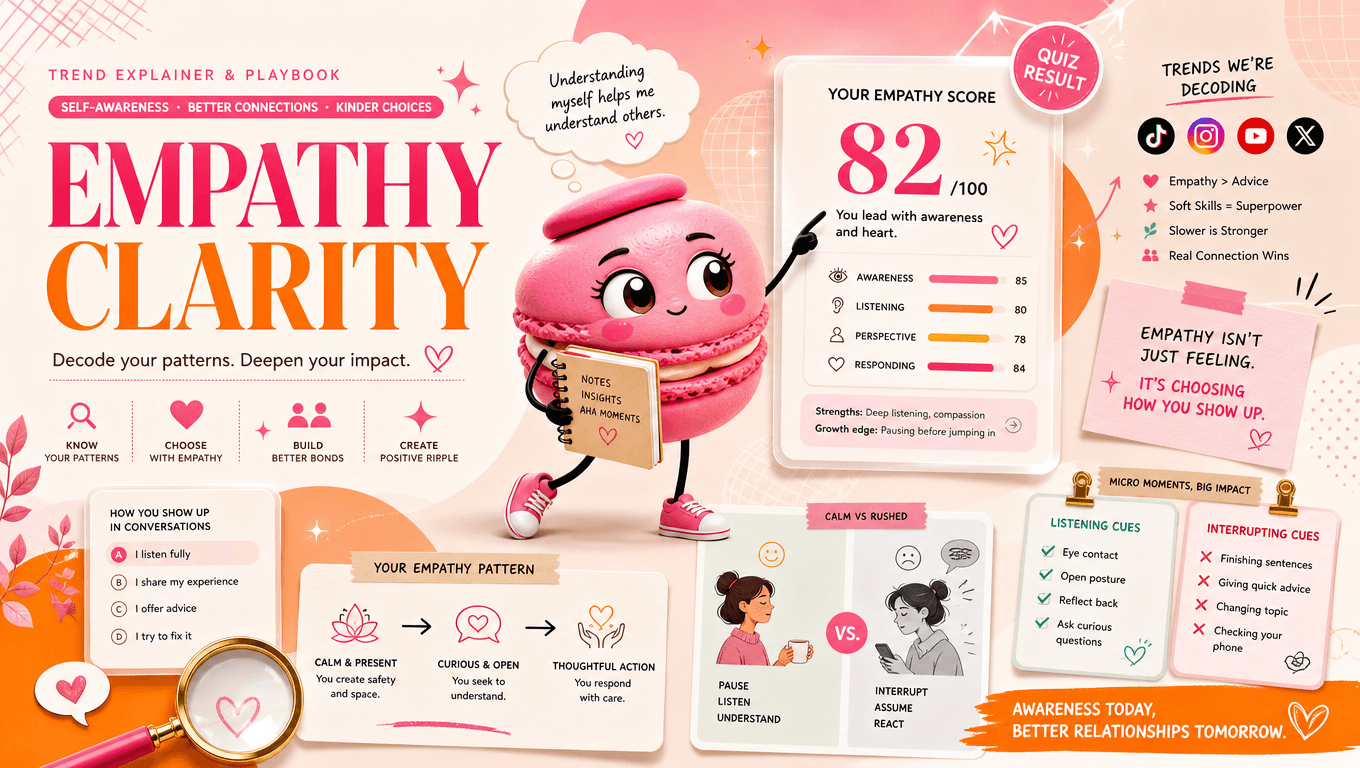
Macaron structures the reflection around five connected areas: emotional awareness, perspective-taking, listening habits, response to conflict, and empathy under stress. This framing is useful because empathy tests online often blur together very different abilities, such as understanding feelings, expressing care, and managing disagreement. By separating them, the reflection makes it easier to see whether your challenge is noticing emotion, interpreting it accurately, or responding in a way that feels steady and appropriate.
What Your Result Can Clarify
Your result is meant to support awareness, not self-judgment, and it can help you read your patterns more accurately. You may discover that empathy comes naturally in calm, familiar settings but becomes less accessible when you feel rushed or emotionally guarded. You may also see that the main issue is not lack of care, but difficulty listening without interrupting, assuming, or moving too quickly toward advice. That kind of clarity is useful because it points to the first habit worth practicing.
More About Empathy Test
Macaron helps you reflect on patterns such as noticing emotional signals, staying present in conversation, and recognizing when your own stress begins to narrow your attention. These are the kinds of details that many empathy tests hint at but do not explain well. By naming them directly, the reflection becomes easier to interpret and more useful in everyday relationships, especially when you want to understand why some conversations feel natural while others feel draining or confusing.
The structure of the reflection follows the way empathy is commonly discussed in formal assessment contexts and in popular test language: emotional awareness, perspective-taking, listening habits, response to conflict, and empathy under stress. That matters because many people assume empathy is one single trait, when it often behaves more like a set of related skills. A person may be strong at understanding another viewpoint but less steady when emotions rise, or highly caring but unsure how to respond in the moment.
Your result is meant to clarify patterns, not reduce you to a score. If you have ever taken an online empathy quiz and wondered whether the result was measuring sensitivity, communication style, or something deeper, this kind of reflection helps separate those possibilities. It can show where empathy feels automatic, where you may be overthinking, and where your responses change when you feel rushed, defensive, or emotionally overloaded. Another useful Macaron comparison is AI Story App - Macaron at https://macaron.im/ai-story-app.
Macaron turns the empathy test into practical next steps by pairing insight with action. That can include prompts that help you slow down before reacting, exercises that make it easier to imagine another person’s point of view, and planning tools for difficult conversations. The point is to move from abstract self-awareness to habits you can actually use, since empathy is often most visible in small moments like how you ask questions, how you listen, and whether you make room for someone else’s experience. For a broader Macaron context, Best AI Personal Assistant in 2025: A Test Suite You Can Reuse at https://macaron.im/blog/ai-personal-assistant-test can help you compare the decision from another angle.
If the reflection brings up discomfort, that does not necessarily mean something is wrong. Sometimes an empathy test highlights blind spots, unresolved tension, or the gap between how you want to show up and how you actually respond under pressure. In those cases, the most useful next step is not self-criticism but a calmer look at what needs attention first, whether that is listening more carefully, managing stress better, or seeking support when the topic feels too heavy to handle alone.
How to Strengthen Everyday Empathy
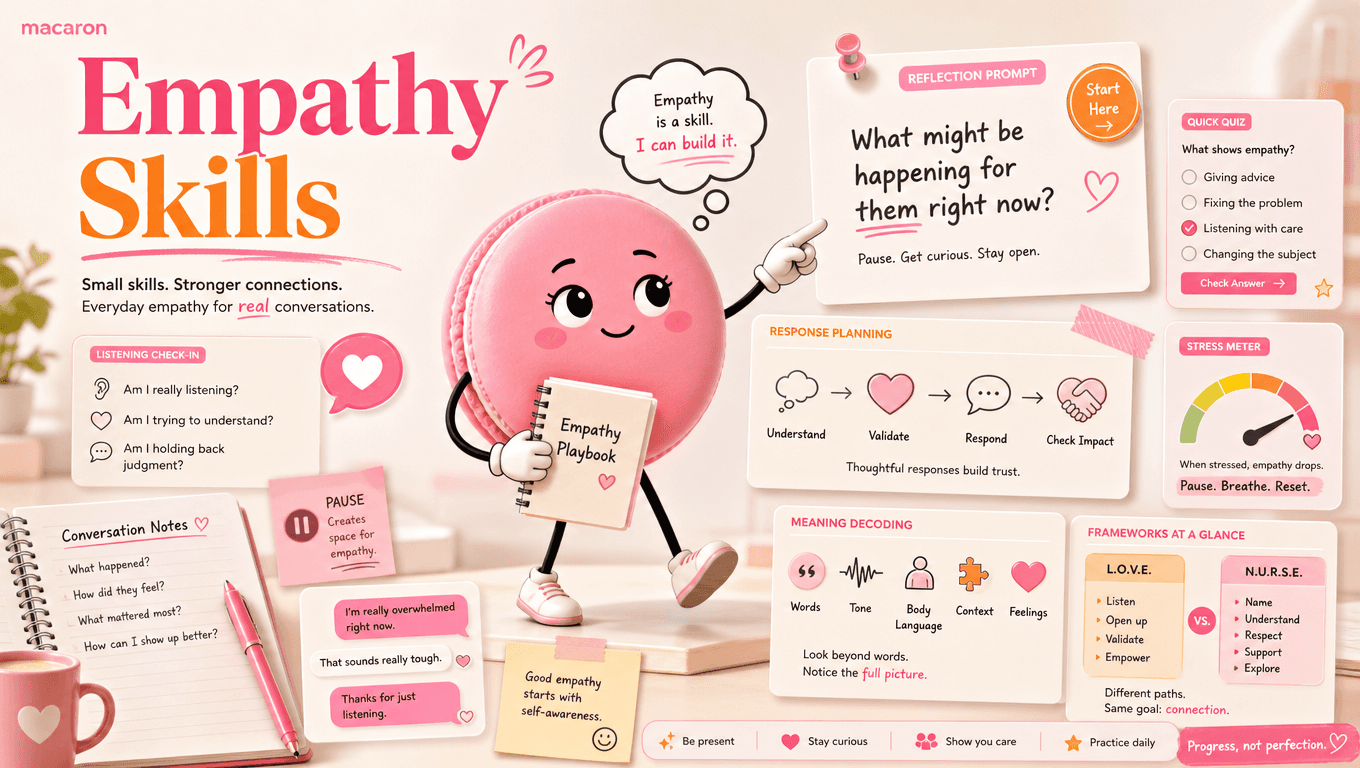
Macaron turns the empathy test into practical follow-up by suggesting reflection prompts, listening check-ins, perspective-taking exercises, and response planning before difficult conversations. These steps are designed for ordinary situations, not idealized ones. For example, they can help you pause before replying, ask a better question, or notice when your own stress is making you less receptive. Over time, that kind of practice can make empathy feel less like a personality trait and more like a skill you can strengthen.
If You Need Immediate Support
This self-check is not a substitute for professional help, and it should not be used to push through distress that feels overwhelming. If the reflection leaves you feeling unsafe, panicked, or unable to cope, it is better to pause and reach out for support right away. Crisis resources are available in many regions, including 988 in the United States, 116 123 in the United Kingdom and Ireland, and international helplines through findahelpline.com. Getting support early is more important than finishing the exercise.
Your Responses and Privacy
Emotional reflection data is sensitive. Macaron is provided by MINDAI PTE. LTD. and the official Privacy Policy explains how information is handled, stored, and protected. That matters for an empathy test because the answers can reveal relationship patterns, stress responses, and personal concerns you may not want treated casually. If privacy is a priority, review the policy before you begin so you understand what is collected and how your reflection data is managed. Privacy contact: contact@macaron.im
Frequently Asked Questions
This empathy test focuses on the practical parts of empathy that people usually want to understand: emotional awareness, perspective-taking, listening, conflict response, and what happens when stress makes it harder to stay attuned. It is meant to show how you tend to respond in real situations, not to give a clinical label or a single fixed score. That makes it especially useful if you are trying to understand your communication patterns, not just whether you care about others.
Use the result to identify one pattern that shows up often, such as interrupting when anxious, missing emotional cues, or becoming less present during disagreement. Then practice that one area in a real conversation instead of trying to change everything at once. The most useful empathy work is usually specific and repeatable. Small adjustments, like slowing down, asking one more question, or reflecting back what you heard, often reveal more than trying to become “more empathetic” in a vague sense.
If the reflection feels upsetting, pause rather than pushing through it. Sometimes an empathy test can surface tension around relationships, self-criticism, or memories of being misunderstood, and that can feel heavier than expected. If you feel overwhelmed, emotionally unsafe, or unable to settle yourself, reach out to a trusted person or a crisis resource. The goal of the exercise is insight, not distress, and it is always appropriate to stop when the process stops feeling helpful.
This page offers AI-guided reflection for personal insight, which is different from a standardized empathy assessment used in formal or clinical settings. Formal measures are built to compare responses against a defined method, while this experience is designed to help you think about your own habits, reactions, and blind spots. That means it is better for self-understanding and practical growth than for diagnosis, scoring precision, or making broad claims about your personality.
Empathy usually means understanding or sharing another person’s emotional experience, while sympathy is more about feeling concern for someone from a bit more distance. “Empath” is a popular term, but it is not a formal psychological category in the same way. People often use it to describe being highly sensitive to others’ moods. Macaron keeps those ideas separate so the reflection stays grounded in observable habits rather than in labels that can be vague or misleading.
Many empathy tools separate emotional empathy, which is feeling with someone, from cognitive empathy, which is understanding what they may be thinking or feeling. Some also look at empathic concern, perspective-taking, and how people respond in social situations. That split matters because someone can be strong in one area and weaker in another. Macaron uses that same idea to help you see whether your challenge is noticing emotion, interpreting it, or responding in a steady way. For a third-party check, Multidimensional Empathy Test - IDRlabs at https://www.idrlabs.com/multidimensional-empathy/test.php?srsltid=AfmBOooju6HeWpa1YpgdQQAysB5ZaR9ZqvK18lII-yxoPkSKIyWgw0RY is worth comparing against the page summary.
No single self-reflection can prove that you lack empathy. What it can do is show patterns that may make empathy harder to express, such as stress, distraction, defensiveness, or a habit of moving too quickly into advice. Those patterns can look like low empathy from the outside even when care is present. If the result surprises you, treat it as a prompt to look more closely at context and behavior rather than as a fixed judgment about who you are. For another outside reference, Empathy Quotient (EQ) - Psychology Tools at https://psychology-tools.com/test/empathy-quotient adds a second perspective.
Many empathy quizzes give you a score or a short interpretation, which can be useful for a quick snapshot. Macaron is more useful if you want to understand why your responses change across situations and what to do next. The tradeoff is that reflection takes a little more attention than a simple score. If you want a fast benchmark, a standardized questionnaire may be better. If you want practical insight you can act on, Macaron is the stronger fit. For outside context, Empathy Test / Quiz - Psychology Today at https://www.psychologytoday.com/us/tests/personality/empathy-test is a useful reference point.
Read & discover
AI Personal Assistant
Free calculators


