ENFJ Compatibility
ENFJ compatibility is easiest to understand when you look at reciprocity, emotional clarity, and whether both people are willing to show up consistently. Macaron helps you read the patterns behind attraction, conflict, and sustainable connection.
ENFJ Compatibility
This self-reflection module helps you notice how ENFJ compatibility shows up in real behavior, not just first impressions. It focuses on reciprocity, emotional clarity, and whether connection feels steady enough to support both closeness and independence.
This is a self-reflection tool, not a diagnosis or a scientific compatibility test.
Please answer every question before viewing your result.
This module is for reflection only and cannot determine whether a relationship is healthy or whether two people are truly compatible. If a relationship involves fear, control, pressure, or repeated hurt, consider reaching out to a trusted person or a qualified professional for support.
ENFJ in Relationships: The Giver’s Guide
ENFJ compatibility is often discussed as if it were only about “best matches,” but the more useful question is whether the relationship feels emotionally responsive, steady, and mutual over time. ENFJs are often drawn to warmth, sincerity, and people who communicate openly, yet chemistry alone does not show whether a bond can handle stress, boundaries, or uneven effort. Compatibility becomes clearer when you look at behavior, not just attraction.
Many ENFJ compatibility guides point to loyalty, emotional intelligence, shared values, and a partner who can match the ENFJ’s care without turning the relationship into one-sided labor. That pattern matters because ENFJs often invest early and deeply, which can make them feel connected quickly but also vulnerable to imbalance. A strong match is not simply someone who admires them; it is someone who can give, receive, and repair in a balanced way.
Macaron frames ENFJ compatibility as a relationship pattern rather than a fixed label. Instead of asking only who ENFJs are supposed to date, it helps you examine how needs are expressed, how quickly attachment builds, and whether the connection supports both closeness and independence. That is especially useful when a relationship feels intense but unclear, because intensity can mask whether the bond is actually sustainable. For a related Macaron page, see AI Personal Assistant - Macaron at https://macaron.im/ai-personal-assistant.
Many ENFJs are comfortable supporting others, encouraging growth, and keeping emotional harmony, but those strengths can hide a mismatch if the other person is less expressive, less reliable, or less willing to engage in difficult conversations. The risk is that the ENFJ keeps compensating, hoping care will eventually become mutual. Compatibility becomes easier to judge when you can separate genuine reciprocity from the habit of over-functioning for the relationship.
Use this page as a grounded guide for reading ENFJ compatibility in romance, friendship, and long-term partnership. The goal is not to find a perfect type pairing or a universal answer. It is to understand what helps a bond feel reciprocal, what creates strain, and what kind of communication makes closeness sustainable. That practical lens is often more useful than a static compatibility chart.
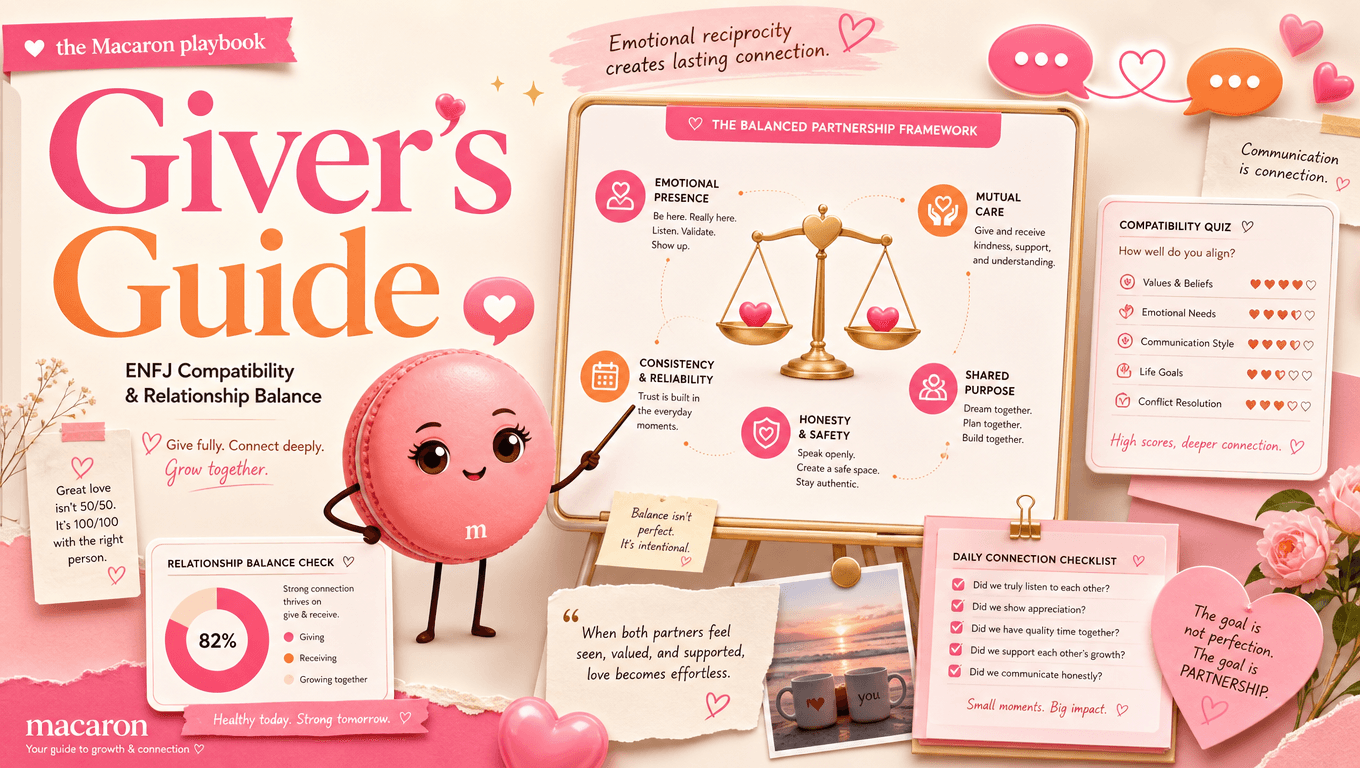
ENFJ in Relationships: The Giver’s Guide
ENFJ compatibility is often shaped by how much emotional presence, responsiveness, and mutual care a relationship can hold. ENFJs usually want more than surface-level affection. They tend to look for consistency, shared purpose, and the sense that both people are actively investing in the bond. That can make them deeply devoted partners and friends, but it can also make imbalance feel especially sharp when effort, reassurance, or honesty is missing. The relationship may look warm from the outside while still feeling uneven on the inside. Many ENFJs care deeply about: - emotional reciprocity - shared effort - meaningful communication - steady affection - growth that happens together Those priorities often create strong connection, but they also mean the relationship can start to feel draining if one person becomes the default giver. When the other side is avoidant, passive, or unclear, the ENFJ may keep trying to restore harmony long after the relationship has stopped feeling mutual. That is the tradeoff: their empathy builds closeness quickly, but it can also delay recognition of mismatch.
How Macaron’s ENFJ Compatibility Insight Supports Reflection
Macaron uses ENFJ compatibility as a relationship lens built around patterns that are easy to miss when you are focused only on attraction or type labels. It helps you ask who is initiating repair, who is carrying the emotional weight, and whether the relationship actually makes room for both people’s needs. That matters because ENFJs often notice what others feel before they clearly name what they need themselves, which can make their own needs easier to overlook. Key points include: - who carries the emotional weight - how clearly needs are expressed - whether care is mutual - how conflict affects closeness - whether the relationship supports long-term growth This makes the insight more useful than a type label alone because it turns compatibility into something you can observe in real behavior, not just in theory. Compared with apps that stop at a match score, Macaron is better for reflection and pattern-spotting, though a dedicated therapist or relationship coach may still be better for deeper conflict work.
More About ENFJ Compatibility
ENFJ compatibility is often shaped by how much emotional presence a relationship can hold without one person carrying all the weight. In practice, that means looking at whether affection is returned, whether plans are followed through, and whether both people feel safe being honest when something is off. A relationship can look harmonious on the surface while still leaving the ENFJ doing most of the emotional work, which is why behavior matters more than labels.
Many compatibility guides for ENFJs emphasize feeling types such as INFP, INFJ, and ENFP, but the useful takeaway is not just the type list. The deeper pattern is that ENFJs often do best with people who can respond to their warmth with sincerity, not just admiration. Shared values, emotional literacy, and a willingness to talk through tension matter as much as initial attraction, especially once the relationship moves beyond the early stage.
There is also a common confusion around whether two ENFJs are automatically a strong match. Same-type relationships can feel deeply understood because both people recognize the same emotional rhythms and priorities, but they can also amplify blind spots if neither person wants to slow down, set boundaries, or challenge the other. Compatibility depends on how the pair handles those pressure points, not just on similarity or shared enthusiasm. Another useful Macaron comparison is How Macaron AI Tackles the Problem with Traditional Task Lists at https://macaron.im/blog/macaron-ai-daily-planning-guide.
Strain often appears when the ENFJ is the one initiating repair, checking in, and protecting the relationship from conflict while the other person stays passive or vague. That imbalance can create resentment even when the connection still feels meaningful. Macaron helps you notice those patterns early, before care turns into obligation or emotional exhaustion. That is especially useful for ENFJs, who may keep giving long after the relationship has stopped feeling reciprocal. For a broader Macaron context, AI Story App - Macaron at https://macaron.im/ai-story-app can help you compare the decision from another angle.
The most useful ENFJ compatibility insight is not a promise of a perfect partner. It is a clearer way to read whether a bond has mutual effort, emotional honesty, and enough room for both people to be supported. That makes the guidance relevant for dating, friendship, and any relationship where closeness needs to be both warm and sustainable. It also clarifies the tradeoff: Macaron helps with pattern recognition, while some competitor apps may still be better if you want a quick type-to-type summary.
Which Relationship Dynamics Help ENFJs Feel Seen and Which Ones Create Strain
Some relationships feel steady because care flows both ways, even if the two people express it differently. Others become draining when one person keeps giving, smoothing things over, and anticipating needs while the other stays emotionally distant or inconsistent. For ENFJs, that difference matters because they often read reciprocity as a sign of safety, not just affection. When reciprocity is missing, they may still stay engaged because the bond feels meaningful. Macaron helps you reflect on: - what makes care feel mutual - where resentment starts building - how much reassurance or clarity matters - when support turns one-sided - what helps closeness stay healthy This kind of reflection is useful when a relationship feels good in moments but unstable across time. It helps separate genuine compatibility from the temporary comfort of being needed. Compared with broad compatibility charts, Macaron is better at surfacing the practical signs of imbalance, though a direct conversation with the other person is still the best test of whether the relationship can change.
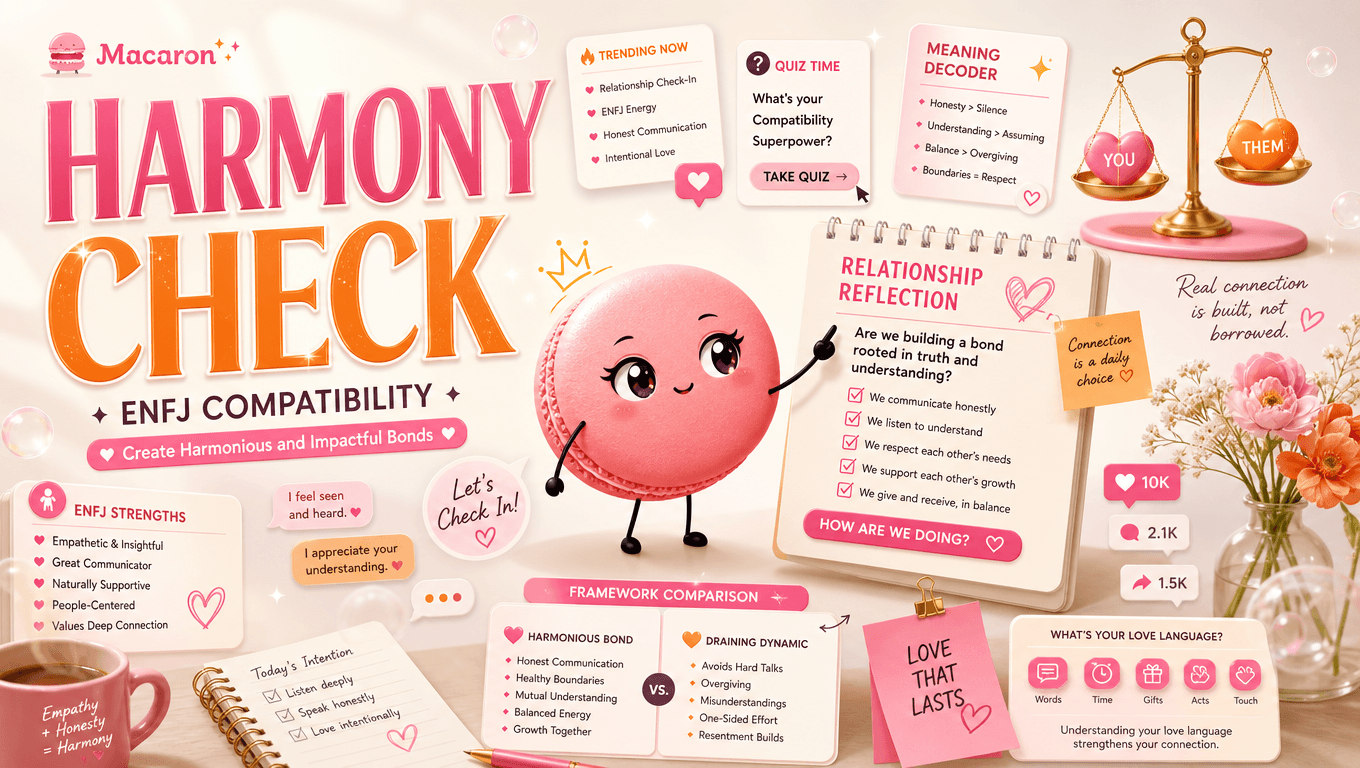
Create Harmonious and Impactful Bonds
Macaron turns ENFJ compatibility into practical support through prompts and check-ins that focus on the parts of relationships people often avoid naming directly. Instead of treating harmony as the goal at any cost, it helps you notice whether harmony is being maintained through mutual understanding or through silence, overgiving, and conflict avoidance. That distinction is especially important for ENFJs, who may work hard to preserve closeness even when their own needs are getting minimized. Key points include: - relationship reflection prompts - care-and-boundary check-ins - communication resets - conflict preparation - clarity around emotional reciprocity The result is a more grounded way to build connection, one that supports warmth without ignoring the tradeoffs that come with emotional intensity. Macaron is especially useful for people who want to understand patterns over time, while more traditional relationship advice can still be better for step-by-step conflict resolution scripts.
Frequently Asked Questions
ENFJ compatibility is usually strongest when emotional reciprocity, trust, and communication are present in everyday behavior, not just in big moments. ENFJs often want to feel that care is mutual, that effort is consistent, and that both people are willing to talk honestly when something feels off. Shared values matter too, but the real test is whether the relationship stays warm and balanced once stress, disagreement, or routine sets in.
ENFJs can stay invested in one-sided relationships because they are often good at seeing potential, reading emotional needs, and trying to keep the peace. They may give the other person more chances than they would give themselves, especially if the connection still feels meaningful in some moments. The challenge is that this can delay the point where they admit the relationship is not meeting them halfway.
Yes. ENFJ compatibility is useful in friendship because the same patterns show up there too, especially around reliability, emotional labor, and reciprocity. An ENFJ may feel close quickly to a friend who is open and encouraging, but the relationship can become frustrating if one person always initiates, supports, or checks in. Looking at compatibility can help clarify whether the friendship is genuinely mutual.
Macaron goes beyond a type-based summary by helping you examine how the relationship actually functions. Instead of only telling you which types are said to pair well with ENFJs, it guides you to notice patterns like emotional imbalance, conflict style, and whether care is being returned in practice. That makes the insight more useful for real decisions about dating, friendship, and long-term commitment.
Those types are often mentioned because they tend to share emotional depth, openness, or a preference for meaningful connection. That can make the relationship feel natural, especially early on. But type alone does not guarantee compatibility. An ENFJ can have a strong relationship with many types if the other person is reliable, emotionally honest, and willing to participate in repair. The better question is whether the dynamic is mutual and sustainable.
Yes, two ENFJs can work well together because they often understand each other’s emotional language, values, and desire for support. The risk is that both people may avoid conflict, overextend themselves, or assume the other person already knows what they need. If both partners are willing to set boundaries and speak plainly, the relationship can be deeply affirming. Without that, the same sensitivity that creates closeness can also create blind spots. For a third-party check, ENFJ Compatibility Chart: Best Match (Relationships, Love) | Boo at https://boo.world/enfj-personality/enfj-compatibility-chart is worth comparing against the page summary.
Common signs include one person always initiating conversations, planning, repairing conflict, or checking in emotionally. The ENFJ may also notice they are doing most of the reassurance work while their own needs stay vague or unaddressed. Another sign is feeling responsible for keeping the relationship calm at all times. When that pattern lasts, care can start to feel like obligation instead of connection. For another outside reference, ENFJ Compatibility: Best, Worst, Average, And One-Sided Matches at https://brainmanager.io/blog/social/enfj-compatibility adds a second perspective.
A good partner for an ENFJ is usually someone who is emotionally available, dependable, and willing to communicate directly. They do not have to be highly expressive in the same way, but they should be consistent and willing to participate in repair when something goes wrong. ENFJs often do well with people who appreciate their warmth without expecting them to carry the entire emotional load. Reliability matters as much as chemistry. For outside context, ENFJ Personality - Romantic Relationships - 16Personalities at https://www.16personalities.com/enfj-relationships-dating is a useful reference point.
Read & discover
AI Personal Assistant
Free calculators


