ENFP Compatibility
ENFP compatibility often looks effortless at first because ENFPs tend to bring warmth, curiosity, and emotional momentum into connection. The harder question is what happens when the relationship needs consistency, conflict repair, and follow-through, not just chemistry.
ENFP Compatibility
This self-reflection module helps you look at ENFP compatibility through everyday relationship patterns, not just first impressions. It focuses on what keeps connection exciting, steady, and emotionally safe over time.
This is a self-reflection tool, not a diagnosis or a scientific compatibility test.
Please answer every question before viewing your result.
This module is for reflection and conversation, not for diagnosing personality or predicting relationship outcomes. If a relationship feels unsafe, controlling, or emotionally harmful, prioritize support from trusted people or a qualified professional.
Why ENFP Compatibility Breaks Down When Energy Outruns Stability
ENFP compatibility is often treated like a simple match chart, but the real question is more practical: what kind of relationship lets an ENFP feel inspired without becoming emotionally drained? Many ENFPs are drawn to partners who are open, curious, affectionate, and willing to explore ideas and experiences together. That same intensity can become difficult if the bond lacks structure, reliability, or a shared way of handling everyday responsibility.
At the beginning, ENFP relationships can feel unusually easy because enthusiasm, conversation, and shared possibility arrive quickly. What tends to matter later is whether both people can keep showing up when life becomes repetitive, stressful, or emotionally complicated. Compatibility is less about whether the connection feels vivid in the moment and more about whether that vividness can survive ordinary pressure without turning into confusion or burnout.
Search patterns around ENFP compatibility repeatedly point to emotional openness, trust, spontaneity, and shared values. They also show that many people want to know which types are most likely to work long term, especially when the relationship involves different communication styles or different levels of introversion and extroversion. That makes this topic partly about personality fit and partly about whether two people can maintain the relationship when novelty fades. For a related Macaron page, see Macaron App Download (iOS & Android): Official, Safe, and Fast Install at https://macaron.im/blog/macaron-app-download.
Macaron helps you read ENFP compatibility as a pattern, not a label. Instead of treating one type pairing as automatically good or bad, it helps you notice where attraction is mutual, where expectations differ, and whether the relationship has enough steadiness to support the ENFP need for growth, freedom, and emotional honesty. That is more useful than a static compatibility ranking when you are trying to understand a real person.
That matters because ENFP compatibility is often misunderstood as a search for the most exciting partner, when the deeper issue is balance. The best fit is usually the one that can hold both movement and dependability, so the relationship feels alive without becoming chaotic or one-sided. In practice, that means looking for emotional responsiveness, follow-through, and enough room for individuality on both sides.
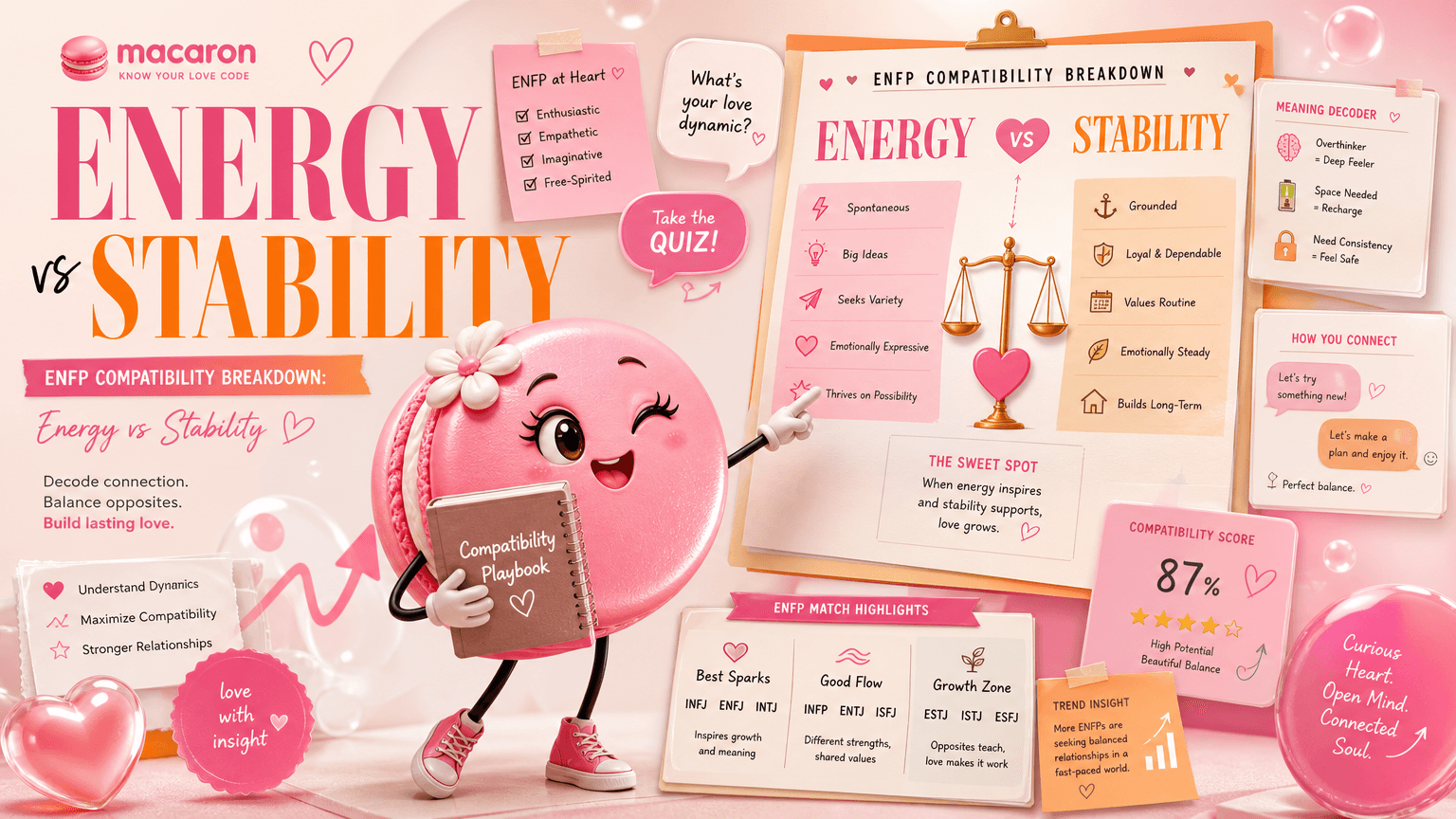
Why ENFP Compatibility Breaks Down When Energy Outruns Stability
ENFP compatibility can feel intense because many ENFPs want a relationship that is emotionally alive, mentally stimulating, and full of possibility. That creates a strong pull toward partners who are expressive, curious, and willing to engage deeply. The problem is that high energy alone does not guarantee a stable bond. When one person brings excitement but not consistency, the relationship can start to feel unpredictable, even if the chemistry is real. The healthiest version of ENFP compatibility usually includes trust, emotional openness, room for spontaneity, and enough steadiness to make the connection feel safe instead of scattered.
How Macaron Helps ENFPs See Spark, Follow-Through, and Emotional Consistency
Macaron helps you separate the early rush of attraction from the deeper signs of compatibility. That matters because ENFPs can quickly sense possibility, but it is not always easy to tell whether the other person is equally invested or simply matching the energy in the moment. Macaron encourages you to look at whether the spark is mutual, whether promises turn into action, how conflict changes the tone of the relationship, and whether novelty is strengthening the bond or distracting from unresolved issues. This makes ENFP compatibility more useful after the first wave of excitement has passed.
More About ENFP Compatibility
ENFP compatibility is often discussed in terms of ideal pairings, but the more useful question is how a relationship behaves under pressure. Many ENFPs are energized by partners who are imaginative, emotionally responsive, and open to change, yet they can lose interest quickly if the connection feels rigid, dismissive, or emotionally flat. The strongest matches usually make room for both freedom and follow-through, which is why long-term fit depends on more than shared interests or a strong first impression.
Macaron uses ENFP compatibility to move beyond type stereotypes and into real relationship signals. That includes whether communication feels easy in both directions, whether affection is consistent, and whether disagreements lead to repair or to withdrawal. This is especially helpful when a relationship feels promising on paper but confusing in practice, because the app focuses on patterns you can actually observe instead of relying on broad assumptions about personality types.
A lot of ENFP compatibility content focuses on which types are supposedly best, such as INFJ, INTJ, INFP, ENTP, or other intuitive pairings. Those patterns can be a useful starting point, but they do not replace the lived reality of shared values, emotional safety, and the ability to handle conflict without shutting down the connection. Macaron keeps the type conversation, but it adds the practical layer that many compatibility charts leave out. Another useful Macaron comparison is When Nano Banana Meets Macaron: Next‑Level AI Image Editing ... at https://macaron.im/blog/macaron-ai-essential-personal-assistant-features.
Macaron also helps clarify a common confusion: strong chemistry is not the same as long-term fit. ENFPs often respond strongly to novelty, playfulness, and emotional intensity, which can make a relationship feel more compatible than it really is. Looking at consistency, follow-through, and burnout risk gives a more grounded view of whether the bond can last. That tradeoff matters because the most exciting dynamic is not always the most sustainable one. For a broader Macaron context, Catalysing Macaron's Capabilities with Claude & DeepSeek Updates at https://macaron.im/blog/macaron-claude-deepseek-integration can help you compare the decision from another angle.
The goal is not to reduce ENFP compatibility to a score. It is to help you understand what kind of partner dynamic supports your energy, what kind of mismatch keeps repeating, and how to protect the parts of the relationship that make it feel both meaningful and sustainable. Macaron is most useful for people who want a clearer read on real behavior, not just a flattering label or a simplistic match result.
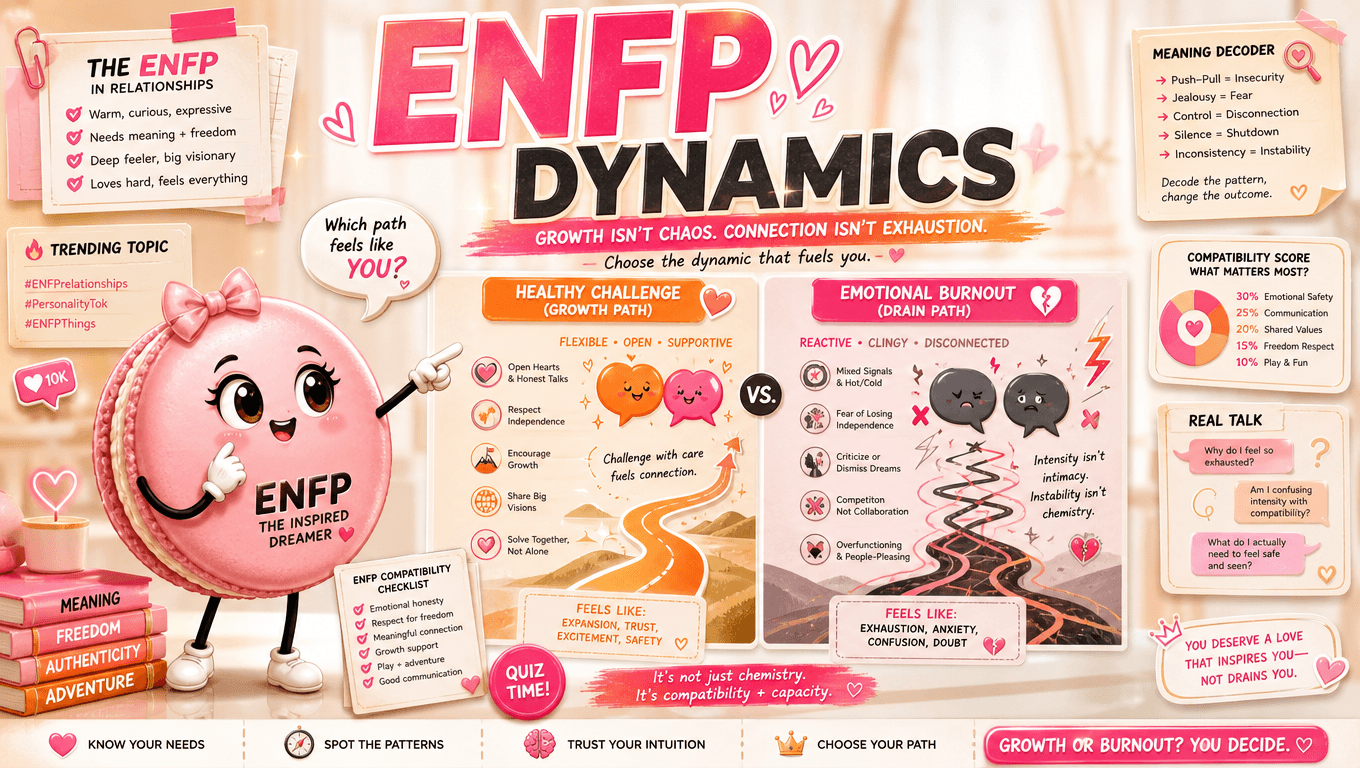
Which Relationship Dynamics Stretch ENFPs in Good Ways and Which Ones Burn Them Out
Some relationship dynamics help ENFPs thrive because they combine warmth, flexibility, and emotional depth. Others create strain when the pace is mismatched, the communication feels closed off, or one partner is inconsistent about what they want. Macaron helps you notice the difference between healthy challenge and emotional exhaustion. It can show you when a relationship is expanding your perspective, when it is making you overfunction, and when instability is being mistaken for chemistry. That distinction is especially important for ENFPs, who often value growth but do not do well in relationships that constantly drain their energy. It also helps you see when a partner’s steadiness is grounding versus when it is simply limiting.
Keep ENFP Chemistry Alive Without Losing Security
Macaron turns ENFP compatibility into practical relationship support instead of abstract theory. The tools are designed to help you check in on what is working, where communication is slipping, and whether both people still feel emotionally understood. That can include reflection prompts that surface hidden expectations, communication check-ins that reduce misunderstandings, emotional clarity tools that make feelings easier to name, and conflict resets that help repair tension before it hardens. The point is to protect both sides of the relationship: the spark that keeps ENFPs engaged and the steadiness that keeps the connection dependable. Compared with broader personality apps, the tradeoff is that Macaron is more relationship-specific and less focused on generic type education.
Frequently Asked Questions
The biggest factors are usually emotional openness, trust, consistency, and shared values. ENFPs often connect quickly with people who are curious, encouraging, and willing to communicate honestly, but long-term fit depends on whether the relationship also feels reliable. If the bond has excitement but no follow-through, it may feel strong at first and still become unstable over time. A good match usually makes room for both freedom and accountability.
Use it to look at patterns rather than moments. Ask whether the relationship still feels safe, whether communication stays clear during stress, and whether both people keep showing up in practical ways. The early spark can reveal attraction, but the later stage reveals whether the connection can handle routine, conflict, and emotional disappointment without falling apart. That is where real compatibility becomes visible.
Yes. ENFPs often respond strongly to novelty, emotional intensity, and playful energy, so a relationship can feel deeply compatible before the harder issues appear. Chemistry may cover up differences in values, pace, or reliability for a while. A better test of fit is whether the relationship still works when excitement is replaced by ordinary life and real responsibility. If the bond only works in high-energy moments, the fit may be weaker than it seems.
Macaron helps you move from attraction to interpretation. Instead of only asking who feels exciting, it helps you notice how the relationship behaves across communication, conflict, and consistency. That gives ENFP compatibility a more grounded meaning, especially if you are trying to decide whether a connection is just energizing or actually sustainable. It is useful when you want a clearer read on behavior, not just a personality label.
Either can work. ENFPs often enjoy partners who are open, responsive, and willing to explore ideas, regardless of whether they are introverted or extroverted. Introverts can bring calm, depth, and balance, while extroverts can match energy and social momentum. The more important question is whether both people respect each other’s pace and communication style. A mismatch in energy is manageable; a mismatch in expectations is harder.
They can, especially if both people value creativity, emotional honesty, and independence. Two ENFPs often understand each other’s need for novelty and encouragement, which can make the relationship feel lively and affirming. The challenge is that both partners may prefer inspiration over structure, so practical follow-through can become the weak point. If neither person wants to anchor the relationship, the connection may feel exciting but unstable. For a third-party check, ENFP Relationships, Love, & Compatibility - Personality Junkie at https://personalityjunkie.com/enfp-relationships-love-compatibility/ is worth comparing against the page summary.
People often mention INFJ, INTJ, INFP, ENTP, and sometimes other intuitive types because these pairings can create strong conversation, shared curiosity, or complementary perspectives. Those ideas can be helpful as a starting point, but they are not guarantees. Shared values, emotional safety, and conflict style matter more than a type label alone. A theoretically strong match can still struggle if the day-to-day relationship feels inconsistent or emotionally unsafe. For another outside reference, ENFP Personality - Romantic Relationships - 16Personalities at https://www.16personalities.com/enfp-relationships-dating adds a second perspective.
The biggest tradeoff is usually between excitement and stability. ENFPs often want a relationship that feels alive, expressive, and emotionally rich, but those qualities can become overwhelming if they are not balanced by reliability and clear communication. A partner who is steady but emotionally closed may feel dull, while a partner who is thrilling but inconsistent may feel exhausting. The best fit usually offers both warmth and follow-through. For outside context, ENFP Relationships & Compatibility With Other Personality Types at https://www.truity.com/blog/personality-type/enfp/relationships is a useful reference point.
Read & discover
AI Personal Assistant
Free calculators


