ENFP Love Language
ENFP love language is best read as a flexible lens, not a rulebook. It can help you understand why warmth, verbal reassurance, quality time, physical affection, and emotional openness often matter so much in ENFP relationships.
ENFP Love Language
This short self-reflection module helps you notice which kinds of affection tend to feel most meaningful in ENFP-style relationships. Use it as a practical lens for understanding patterns, not as a fixed label or a test of your worth.
This is a self-reflection tool, not a diagnosis or clinical assessment.
Please answer every question before viewing your result.
This module is for reflection and conversation, not for diagnosing relationship problems or personality traits. If a relationship feels unsafe, controlling, or emotionally harmful, consider reaching out to a trusted person or a qualified professional for support.
What ENFP Love Language Can Help You Notice
ENFP love language is most useful when you treat it as a way to notice patterns, not as a fixed personality verdict. Discussions around the topic often circle a few recurring themes, especially words of affirmation, quality time, physical touch, and spontaneous gestures. That makes the phrase less about one official answer and more about how affection is experienced in real relationships, where context matters as much as type.
For many people exploring this keyword, the real question is not only how ENFPs express love, but what makes love feel believable to them. ENFP-leaning affection is often described as enthusiastic, emotionally open, and highly responsive, with a strong preference for connection that feels alive rather than routine. That can include deep conversation, encouragement, playful energy, and small signs that someone is paying attention.
The search intent behind ENFP love language also includes confusion about consistency. Some relationships feel exciting early on because the emotional energy is high, but later become harder when follow-through, steadiness, or reciprocity is missing. This page helps you separate chemistry from sustainability so you can notice whether the connection is simply vivid or actually dependable over time. For a related Macaron page, see Best Meal Planning Apps in 2026 - Macaron at https://macaron.im/blog/best-meal-planning-apps.
Another useful angle is that love language is not always the same as love style. An ENFP may enjoy verbal affirmation and quality time, but still value touch, thoughtful gifts, or acts of service depending on the relationship and context. The point is to look at what lands, what gets missed, and what kind of effort makes the bond feel mutual instead of one-sided or performative.
Macaron is designed to support that kind of reflection. It helps you map affection patterns, notice where reassurance matters, and think through why freedom can feel supportive in one relationship and destabilizing in another. The goal is not to label people, but to make emotional patterns easier to read, compare, and discuss with more clarity.
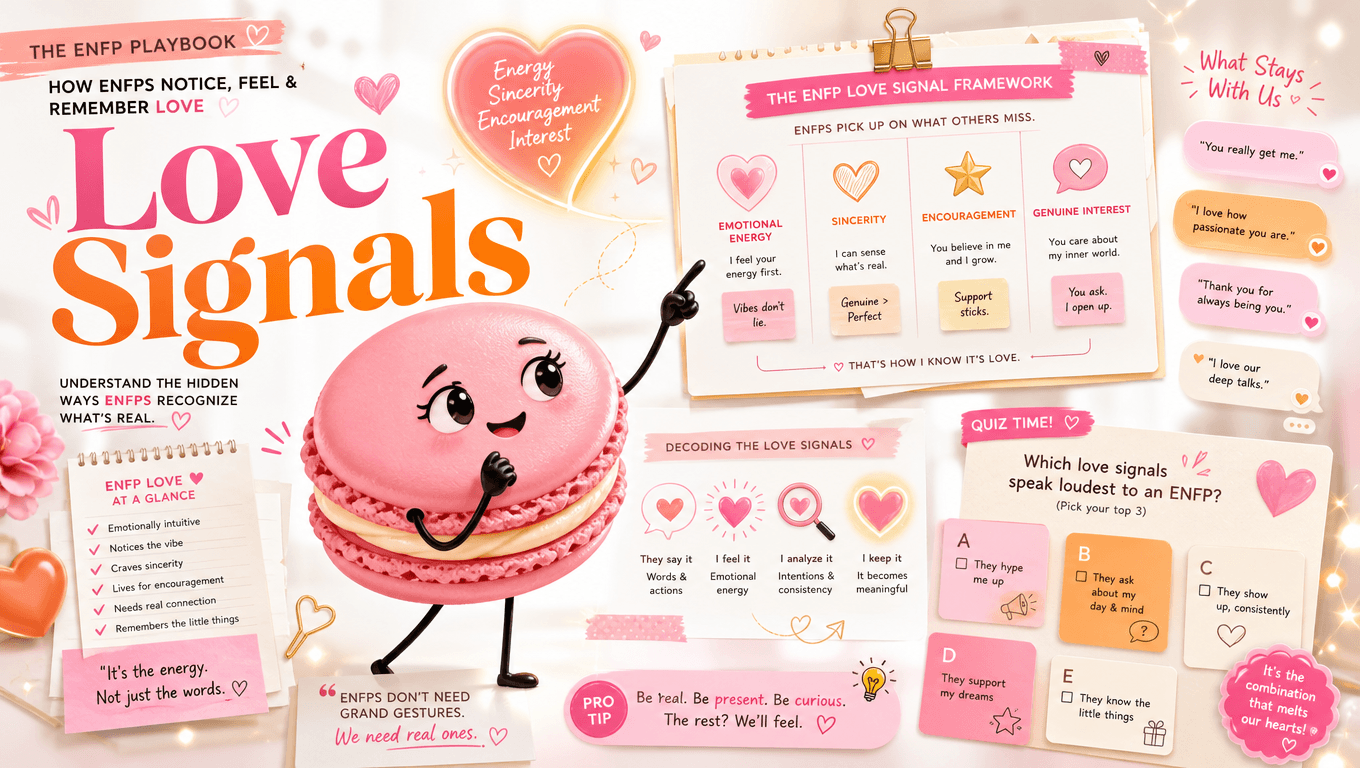
What ENFP Love Language Can Help You Notice
People who identify with ENFP themes often seem to notice love through emotional energy, sincerity, and active engagement rather than through formal declarations alone. In practice, that can mean they respond strongly to encouragement, thoughtful attention, and signs that a partner is genuinely interested in their inner world. Macaron helps you look for these patterns without forcing them into a single label. It can also clarify why some gestures feel deeply meaningful while others, even if well intentioned, feel flat, generic, or impersonal.
How Affection Can Land Differently
The same gesture can feel comforting in one relationship and confusing in another, which is why this keyword often draws people trying to understand mixed signals. ENFP-leaning people may experience affection differently depending on trust, timing, and how emotionally available the other person is. A lot of confusion comes from assuming enthusiasm alone equals closeness. Macaron helps you examine whether responsiveness, freedom, reassurance, and consistency are all present, or whether one of those pieces is missing and changing the meaning of the connection.
More About ENFP Love Language
People searching for ENFP love language usually want more than a list of traits. They want a practical way to interpret affection, especially when someone seems expressive one day and hard to read the next. This page focuses on the patterns that show up most often in personality-based relationship guides and community discussions, while staying careful about overgeneralizing from type alone or treating one preference as universal.
A common pattern is that ENFP-leaning people often respond strongly to words that feel sincere, specific, and emotionally warm. Generic praise may not land as well as comments that show real attention, such as noticing effort, naming qualities, or expressing appreciation in a personal way. That is why affirmation often appears near the top of ENFP love language discussions, especially when the words feel earned rather than automatic.
Quality time is another recurring theme, but it usually means more than simply being in the same room. The stronger interpretation is shared attention, curiosity, and emotional presence. Many people use the keyword because they want to know why an ENFP may feel disconnected even when a partner is physically nearby but mentally unavailable. In that sense, quality time is less about duration and more about mutual focus. Another useful Macaron comparison is AI Meal Planner Free: Best Free Options That Are Actually Useful at https://macaron.im/blog/ai-meal-planner-free.
Physical touch and spontaneous affection also come up often, though not in a one-size-fits-all way. Some ENFPs value hugs, closeness, and casual touch as reassurance, while others prefer touch only after trust is established. The useful insight is that affection can be both energizing and sensitive, so timing, comfort, and consent matter as much as the gesture itself. That is a tradeoff: spontaneity can feel exciting, but only when it respects boundaries. For a broader Macaron context, Best AI Personal Assistant in 2025: A Test Suite You Can Reuse at https://macaron.im/blog/ai-personal-assistant-test can help you compare the decision from another angle.
Macaron turns these ideas into something you can actually use in conversation and reflection. Instead of assuming one love language explains everything, it helps you compare emotional needs, notice where excitement fades, and identify the kinds of reassurance that keep a relationship feeling mutual, steady, and alive. That makes it especially useful for people who want clarity without flattening the complexity of the relationship.
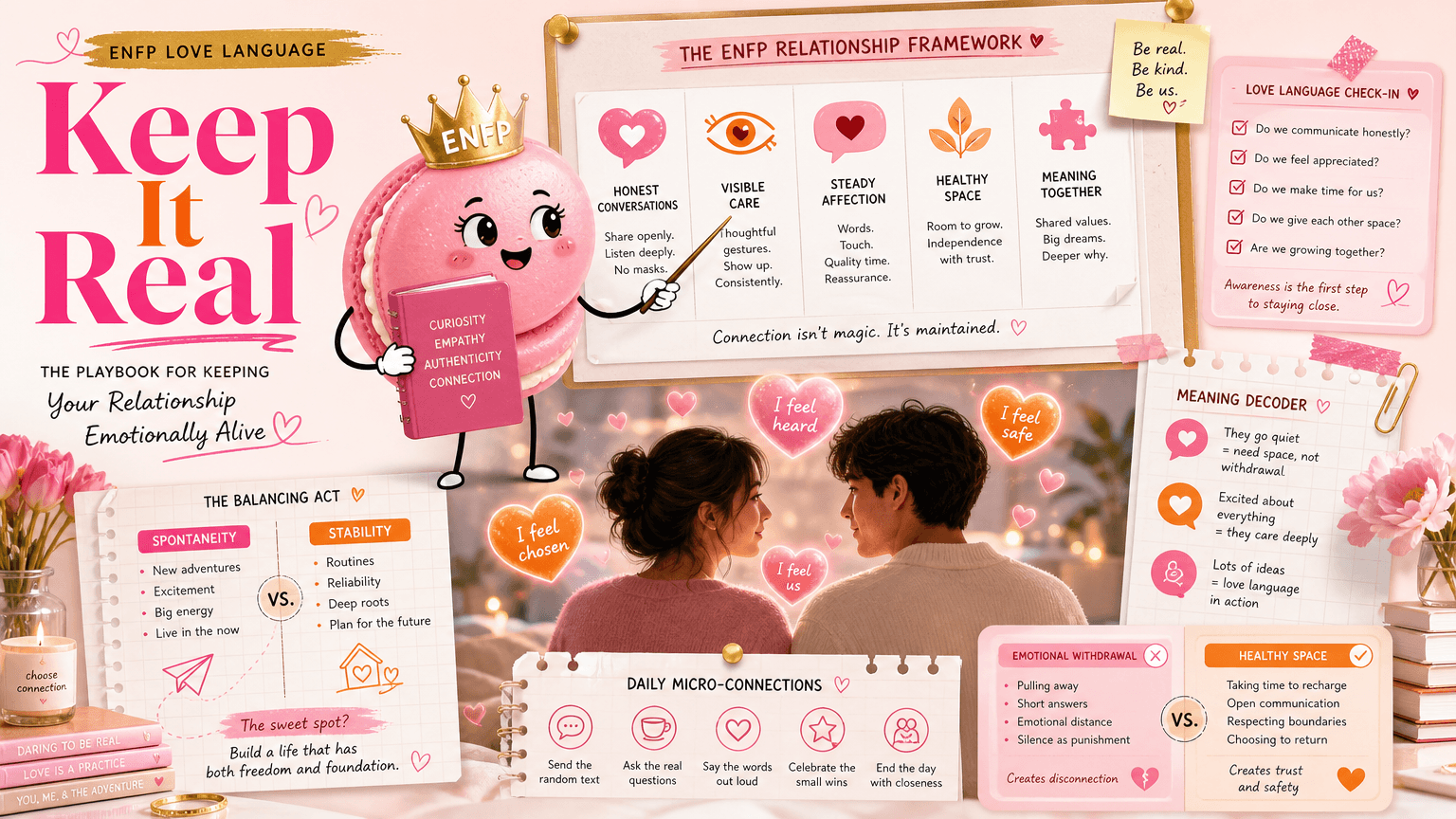
Keeping the Relationship Emotionally Alive
Many ENFP love language searches are really about how to keep a relationship from feeling stale, distant, or performative. Emotional aliveness often depends on more than novelty. It can require honest conversation, visible care, and enough steadiness that excitement does not collapse into uncertainty. Macaron helps you think through what keeps affection feeling real over time, when spontaneity becomes unstable, and how to tell the difference between healthy space and emotional withdrawal. That is useful for people who enjoy intensity but still need reliability.
Support More Connected Relationships
This section is about turning insight into action. If someone resonates with ENFP patterns, support often works best when it combines warmth with clarity, not pressure with guesswork. That may mean checking in about reassurance, naming what kind of attention feels meaningful, or noticing when a relationship needs more follow-through. Macaron helps you organize those observations so conversations become more specific and less reactive, especially when one person wants freedom and the other wants more consistency. The tradeoff is that specificity can feel less romantic than intuition, but it usually prevents avoidable misunderstandings.
Frequently Asked Questions
ENFP love language can help you reflect on how affection is expressed, what kind of attention feels emotionally real, and which behaviors create a sense of closeness. It is especially useful for noticing whether warmth, responsiveness, reassurance, or shared time matters most in a given relationship. Because people do not fit neatly into one pattern, the value is in identifying what consistently lands well and what tends to leave the connection feeling underfed or misunderstood.
That pattern often appears when early chemistry is strong but the relationship has not yet proven its steadiness. A connection can feel exciting because of openness, novelty, and emotional intensity, then become complicated if reciprocity, follow-through, or clear reassurance is weak. For people exploring ENFP love language, the key question is whether the relationship can sustain emotional energy once the first rush settles. Macaron helps you look at that transition more clearly.
No. While the keyword is often used in dating and romance, the same patterns can show up in close friendships, family relationships, and other emotionally important bonds. An ENFP-leaning person may still want affirmation, quality time, or playful connection outside romance. The difference is that the meaning of those gestures changes with the relationship context, so it helps to read them as part of a broader pattern of emotional connection rather than a romantic-only script.
Macaron helps by making the pattern easier to see instead of leaving you stuck in the feeling of inconsistency. You can use it to track when affection shows up, what kind of reassurance is missing, and whether the relationship is offering enough follow-through to match the emotional intensity. That can reduce second-guessing and make it easier to talk about needs in concrete terms, especially when the connection feels meaningful but unstable.
No. ENFP is a useful lens, but it does not override personal history, attachment style, culture, or the specific relationship. Some ENFPs strongly prefer words of affirmation, while others care more about touch, gifts, or acts of service. The better question is which gestures feel most reassuring in practice. Macaron is helpful here because it focuses on observed patterns instead of assuming a type label explains everything.
The main tradeoff is that type-based language can make patterns easier to name, but it can also tempt people to oversimplify. That is useful when you need a starting point for reflection, but risky if you use it as a substitute for direct communication. Competitor personality articles can be good for broad framing, while Macaron is better when you want to compare real interactions, track what actually happens, and turn vague impressions into clearer relationship notes. For a third-party check, What is the love language of a female ENFP? - Quora at https://www.quora.com/What-is-the-love-language-of-a-female-ENFP is worth comparing against the page summary.
That combination is common enough to be worth taking seriously. Many people who resonate with ENFP themes want emotional depth without feeling boxed in, so they may seek closeness while also protecting autonomy. The practical move is to talk about reassurance, time together, and personal space as separate needs rather than treating them as opposites. Macaron can help you sort those needs out so the conversation stays specific instead of turning into a debate about commitment. For another outside reference, Decoding the Love Languages of an ENFP - Boo at https://boo.world/enfp-personality/enfp-love-languages adds a second perspective.
If you want a formal love-language quiz, a personality test, or a broad article about MBTI theory, those tools may be enough. Macaron is stronger when you want to connect the idea to your own relationship patterns, compare repeated behaviors, and reflect on what is changing over time. In other words, it is better for practical sense-making than for one-time categorization. That makes it useful for ongoing reflection, but not a replacement for direct conversation. For outside context, Personality Type and Love Language: Campaigners (ENFPs) at https://www.16personalities.com/articles/personality-type-and-love-language-campaigners-enfps is a useful reference point.
Read & discover
AI Personal Assistant
Free calculators


