ENTJ Compatibility
ENTJ compatibility is easiest to read when you look beyond surface chemistry and ask whether two people can handle directness, shared goals, and emotional honesty. Macaron helps you examine the patterns that make an ENTJ relationship feel collaborative, not just efficient.
ENTJ Compatibility
This self-reflection module helps you think about ENTJ compatibility through communication, trust, pace, and shared goals. It is designed to clarify relationship patterns, not to label you or predict a perfect match.
This is a self-reflection tool, not a diagnosis or a scientific assessment of relationship fitness.
Please answer every question before viewing your result.
This module is for reflection and conversation starters only. If a relationship feels controlling, unsafe, or emotionally overwhelming, consider reaching out to a trusted person or qualified professional for support.
ENTJ in Relationships: Leadership, Vision, and Growth
ENTJ compatibility is often discussed as a question of who matches an ENTJ best, but the more useful answer is usually about how a relationship handles pace, honesty, and responsibility. ENTJs tend to look for partners who can keep up with their drive without turning the connection into a competition. That means compatibility is less about labels alone and more about whether both people can communicate clearly, respect each other’s competence, and stay aligned when decisions get serious.
In many relationship guides, ENTJs are described as strategic, goal-oriented, and direct, which helps explain why they often prefer relationships with structure and follow-through. That can create a strong foundation when the other person values independence and growth too. It can also create friction if one person expects emotional cues to be implied while the ENTJ is waiting for them to be stated plainly. Macaron helps surface those mismatches before they harden into resentment.
A common confusion around ENTJ compatibility is the difference between attraction and long-term fit. A relationship may feel exciting because both people are ambitious or intellectually sharp, but that does not always mean the bond can handle stress, conflict, or emotional vulnerability. Compatibility becomes more meaningful when you ask whether both people can recover after disagreement, share power without constant negotiation, and make room for feelings without losing momentum. For a related Macaron page, see AI Story App - Macaron at https://macaron.im/ai-story-app.
Search interest around ENTJ compatibility also tends to focus on specific type pairings, especially combinations that balance structure with spontaneity or logic with emotional depth. Those pairings can be helpful starting points, but they are not the whole story. Real relationships are shaped by maturity, communication habits, and how each person responds under pressure. Macaron keeps the focus on those practical patterns so the insight stays useful in everyday life, not just in type theory.
If you are trying to understand an ENTJ relationship more clearly, the key question is whether both people can build something that feels strong, honest, and sustainable. That includes ambition, but it also includes trust, repair, and the ability to say what is actually happening instead of hoping the other person will guess. Macaron is designed to make those dynamics easier to notice and easier to talk about.
ENTJ in Relationships: Leadership, Vision, and Growth
ENTJ compatibility often grows in relationships where both people can move with purpose, speak plainly, and respect each other’s capacity to lead. ENTJs are frequently comfortable taking initiative, setting direction, and solving problems quickly, which can make them feel dependable and ambitious as partners. The tradeoff is that this same strength can leave little room for unspoken feelings or slower emotional processing. Compatibility improves when the relationship supports both progress and emotional candor, not just efficiency.
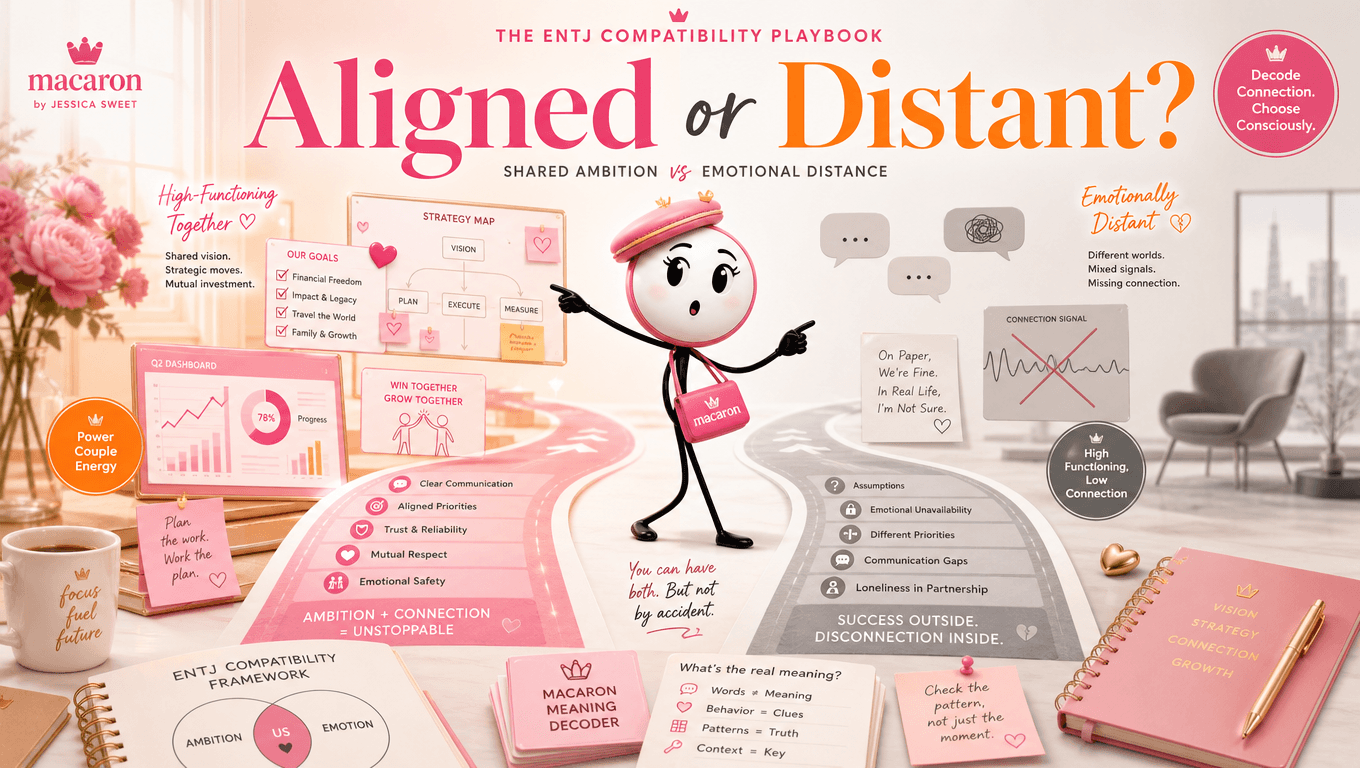
How ENTJs Can Tell the Difference Between Shared Ambition and Emotional Distance
Macaron uses ENTJ compatibility to help you tell whether a relationship is genuinely aligned or simply high-functioning on the surface. Shared ambition can look impressive, but it does not always mean both people feel seen, safe, or equally invested. This section helps you examine whether directness is opening the relationship up or shutting feelings down, whether responsibility is shared fairly, and whether growth is mutual. It is especially useful when the connection feels productive but emotionally hard to read.
More About ENTJ Compatibility
ENTJ compatibility is often strongest when both people can handle direct communication without reading it as criticism. ENTJs usually prefer conversations that move toward a decision, a plan, or a clear next step, so ambiguity can feel draining. At the same time, directness only works well when it is paired with respect. Macaron helps you look at whether honesty in the relationship is creating clarity, or whether it is starting to feel blunt, rushed, or emotionally thin.
Another recurring pattern in ENTJ compatibility discussions is the importance of competence and follow-through. Many ENTJs are drawn to partners who are capable, self-directed, and serious about their own goals. That does not mean the relationship has to look formal or businesslike, but it does mean reliability matters. Macaron helps you test whether the connection is built on mutual respect and shared effort, or whether one person is carrying the planning, pressure, and emotional labor alone.
ENTJ compatibility can also be misunderstood when ambition is treated as the same thing as intimacy. Two people may admire each other’s drive, yet still struggle to share softer needs, fears, or disappointment. That gap matters because relationships usually break down in the places where people assume the other person already knows what they need. Macaron helps you notice where a relationship is productive on the outside but under-communicated on the inside. Another useful Macaron comparison is Calorie Tracker — Monitor every bite to shape your health | Macaron at https://macaron.im/playbook/calorie-tracker-68957e011bbc6bcd9f80555e.
Many people searching ENTJ compatibility want to know which dynamics support the type and which ones slow it down. The answer usually depends on whether the relationship can balance leadership with collaboration. When one person’s pace dominates, or when control replaces cooperation, the connection can become efficient but emotionally narrow. Macaron gives you a way to examine those tradeoffs without oversimplifying the relationship into a best match chart. For a broader Macaron context, AI Calorie Tracker - Macaron at https://macaron.im/ai-calorie-tracker can help you compare the decision from another angle.
The practical value of ENTJ compatibility is not just identifying a type pairing, but understanding what makes the relationship workable over time. That includes conflict style, emotional responsiveness, shared standards, and whether both people can keep growing without pulling in opposite directions. Macaron turns those questions into a clearer relationship check-in so you can see where the connection is strong, where it needs adjustment, and where expectations may need to be renegotiated.
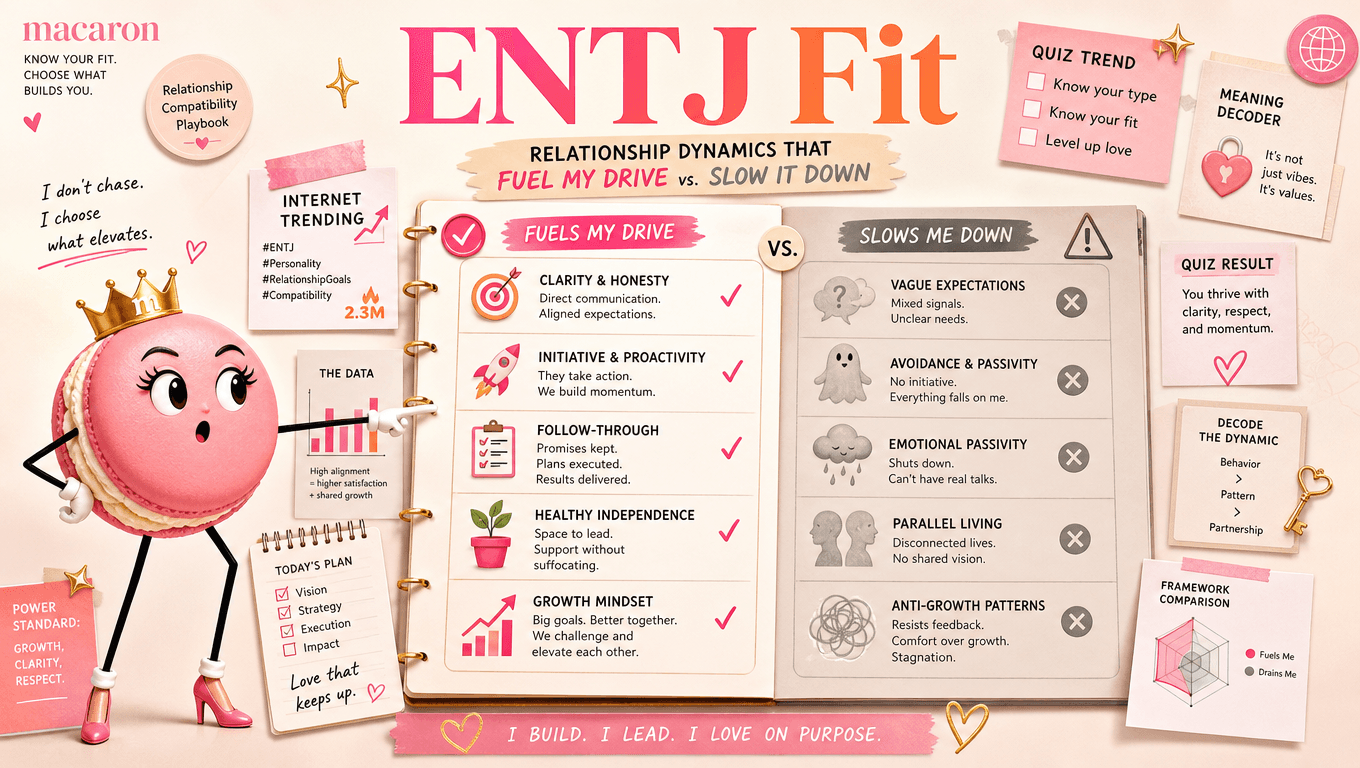
Which Relationship Dynamics Support ENTJ Drive and Which Ones Slow It Down
Some relationship patterns fit ENTJ energy well because they reward clarity, initiative, and follow-through. Others create friction by relying on avoidance, vague expectations, or emotional passivity. This section helps you look at the difference between healthy independence and disconnected parallel living. It also highlights a common ENTJ tension: when strong standards help the relationship improve, and when they start to feel controlling or one-sided. The goal is to identify which dynamics support momentum and which ones quietly drain it.
Create Powerful Partnerships
Macaron turns ENTJ compatibility into something you can actually use in a relationship, not just a personality label you read once and forget. The tools here are meant to support clearer conversations about standards, reciprocity, conflict, and long-term fit. That matters because ENTJ relationships often work best when expectations are explicit and both people know what success looks like. Instead of guessing at chemistry, you can use guided reflection to see whether the partnership is becoming stronger, more balanced, and more sustainable over time.
Frequently Asked Questions
ENTJ compatibility is shaped most by whether both people can communicate clearly, keep commitments, and handle disagreement without avoiding the real issue. Trust matters because ENTJs often want to know where they stand and what the plan is. Emotional honesty matters too, since a relationship can look strong on paper while still feeling distant if important needs stay unspoken. Shared direction helps, but only when it is paired with mutual respect and enough flexibility to adapt.
ENTJs often struggle when a relationship depends on hints, silence, or vague reassurance instead of direct conversation. If feelings are implied rather than stated, they may not know what needs attention until frustration has already built up. That can make the relationship feel inefficient or confusing, even when both people care. The issue is usually not a lack of interest, but a mismatch in communication style. Clear, timely honesty tends to work better than hoping tension will resolve itself.
Yes. ENTJ compatibility is useful anywhere leadership, accountability, and communication shape the relationship, including work partnerships, friendships, and collaborative projects. In those settings, it can help you understand who prefers structure, who needs autonomy, and how conflict is likely to unfold. The same patterns that matter in romance, such as follow-through, respect, and clarity, often matter just as much in non-romantic relationships. That makes the concept practical beyond dating.
Macaron helps you look at whether high standards are supporting the relationship or creating pressure that makes closeness harder. For ENTJs, expectations often come from a desire for growth, reliability, and shared effort, but those expectations can feel heavy if they are not discussed openly. The guided reflection makes it easier to separate healthy accountability from emotional distance. That can help you decide what needs to be clarified, softened, or renegotiated.
ENTJs are often compared with types like INTP, INTJ, ENFP, and INFJ because those pairings can balance structure, logic, spontaneity, or emotional depth in different ways. That said, type pairings are only a starting point. A strong match still depends on maturity, communication habits, and how each person handles pressure. Macaron is useful here because it focuses on the actual relationship pattern instead of assuming a type chart can predict everything.
Two ENTJs can be highly compatible if they respect each other’s ambition, share decision-making, and avoid turning every disagreement into a contest. The upside is strong momentum, clear expectations, and a shared preference for action. The downside is that both people may default to control, efficiency, or problem-solving before slowing down enough to address feelings. That tradeoff can work well for some couples, but it usually requires deliberate effort around softness, patience, and repair. For a third-party check, ENTJ Compatibility Chart: Best Match (Relationships, Love) | Boo at https://boo.world/entj-personality/entj-compatibility-chart is worth comparing against the page summary.
The biggest tradeoff is that the same traits that make ENTJs effective partners, such as decisiveness, standards, and forward motion, can also make emotional pacing harder. A relationship may run smoothly on logistics while still missing warmth, vulnerability, or room for uncertainty. That does not mean ENTJs are bad partners; it means they often need a relationship structure that makes emotional check-ins as normal as planning. Macaron helps make that tradeoff visible. For another outside reference, ENTJ Personality - Romantic Relationships - 16Personalities at https://www.16personalities.com/entj-relationships-dating adds a second perspective.
If you want a simple type ranking or a quick personality summary, other apps may feel faster because they stay at a more general level. Macaron is better when you want to examine how a relationship actually works in practice, including communication, expectations, and emotional friction. The tradeoff is that this takes a little more reflection. That extra effort is useful for people who want something more actionable than a label, especially in real relationships. For outside context, ENTJ Relationships & Compatibility With Other Personality Types at https://www.truity.com/blog/personality-type/entj/relationships is a useful reference point.
Read & discover
AI Personal Assistant
Free calculators


